

Key Takeaways
- A previous bad experience with Amazon PPC management is not a reason to stop advertising, it is a reason to find a better partner with a clearer brief.
- Most failed agency relationships share the same patterns: campaigns launched and left, no keyword evolution, no reporting that explains anything, and Amazon PPC managed in isolation from listings and inventory.
- A real Amazon advertising partner connects campaign decisions to listing performance, inventory signals, and organic rank not just to the campaign dashboard.
- The difference between a service provider and a genuine partner shows up in three places: how they report, how they structure campaigns, and whether they own the outcomes.
- Amazon Ads Verified Partner status is a baseline credibility signal not a performance guarantee. What matters more is account-specific evidence: case studies, trial tasks, and the first 30 days.
- The right Amazon PPC management relationship starts with a diagnosis, not a proposal.
If you have been burned by an Amazon advertising partner before, you already know the specific frustration. Campaigns went live. Spend went out. Then came the silence, monthly reports full of impressions and not much else, an ACoS that refused to improve, and the slow realization that the agency had moved on to the next client while yours was running on autopilot.
You are not alone. This is one of the most common experiences among growing Amazon brands, and it is exactly why finding the right Amazon advertising partner, not just any partner, is a decision that deserves more rigour the second time around.
This guide is for sellers who know Amazon PPC management works when it is done correctly and want to make sure the next relationship is a fundamentally different one.
Why Your Last Amazon Advertising Partner Did Not Deliver
Most sellers who have been burned by an Amazon PPC agency do not find out immediately. The first month looks fine – campaigns are live, spend is moving, reports arrive. The problem reveals itself slowly: ACoS that never improves, keywords that never evolve, and reporting that describes numbers without explaining them. By the time it is obvious something is wrong, months of the budget have already gone.
What “Set It and Forget It” Amazon PPC Management Actually Costs You
While many sellers focus on reducing Amazon PPC management costs, the larger expense is often poor campaign oversight. A low-cost service that neglects keyword expansion, bid management, and reporting can ultimately cost far more in wasted ad spend than a higher-quality partner.
The most common failure mode in Amazon PPC management is not dramatic incompetence. It is quite neglected, campaigns that launched correctly and then never evolved.
Here is what that typically looks like in the data:
High ACoS, flat sales:
Spend is going out. Revenue is not growing proportionally. The agency reports on the numbers but does not explain the cause, and does not change the structure that is producing them.
No keyword evolution:
The same keywords that were in the campaigns at launch are still there six months later. No search term mining. No exact match migration from converting queries. No new keyword discovery. The campaign is exactly where it started.
Auto-only or over-broad structures:
Campaigns built on automatic targeting or broad match with no segmentation between discovery and conversion traffic. Every click, relevant or not, competes for the same budget with no mechanism to separate what works from what wastes. This is also the root cause behind why Amazon PPC clicks stay high, but sales remain low.
No inventory or catalog awareness:
Ads running on out-of-stock ASINs. Budget allocated to products that are not retail-ready, low review counts, weak main images, and price points above the category average. Amazon PPC management that ignores the listing and inventory context it points to will always produce below-potential results regardless of how competitive the bids are.
Reporting that describes, not explains:
A spreadsheet or dashboard that shows ACoS, clicks, and spend, but does not tell you why ACoS changed, what was done about it, or what happens next. Reporting that generates no decisions is not management. It is record-keeping.
The Patterns That Show Up in Every Underperforming Agency Relationship
Beyond the data, there are relationship patterns that signal misalignment before the numbers deteriorate:
- You feel like you know less about your own account at month three than you did at month one.
- You are the one flagging performance problems rather than hearing about them from the agency.
- Questions about campaign structure or keyword strategy produce vague answers or are deflected.
- The agency’s success metric is spend management, not margin improvement.
- You have never spoken to the person who actually manages your campaigns, only to an account manager who relays information.
If any of these are familiar, what you experienced was a service provider relationship dressed up as a partnership. The distinction matters, and it determines everything about what you should look for next.
What a Real Amazon Advertising Partner Actually Does
The term “Amazon advertising partner” gets used loosely. Agencies, freelancers, consultants, and software tools all describe themselves as partners. What separates a real Amazon advertising partner from a vendor is not the label – it is what they are responsible for and how they approach that responsibility.
Consistent Amazon PPC Management Results Over Time, Not One-Off Wins
Any Amazon PPC management agency can produce a good month. A budget spike during Prime Day, an aggressive bid on a high-volume keyword, a fortunate competitor going out of stock, these can all produce a good-looking result that is not repeatable.
What a real partner produces is different in kind: controlled ACoS within margin goals across months that include ordinary weeks as well as peaks, TACoS trending down as ad-supported sales velocity builds organic rank, and keyword coverage that expands systematically rather than remaining static.
The difference between managed Amazon PPC that compounds and Amazon PPC management that plateaus is whether the week-to-week work is building something cumulative, a cleaner campaign structure, a growing negative keyword library, an expanding exact match portfolio of proven converting queries, or simply maintaining the setup from month one.
Using Data From Your Entire Account: Not Just Campaigns
Amazon PPC campaign management that only looks at the campaign dashboard is working with incomplete information. Real Amazon PPC management expertise connects campaign data to:
Inventory signals:
A campaign should slow spend on an ASIN approaching stockout and ramp on an ASIN returning to full stock. An Amazon PPC manager who does not know your inventory position is spending your budget on traffic that cannot convert into a sale.
Listing performance data:
Low CTR on a keyword with strong search volume is both a campaign signal and a listing creative signal. Deep impressions with low CVR are both an Amazon PPC advertising management issue and a listing quality issue. An Amazon PPC management expert who cannot see listing data will apply the wrong fix, adjusting a bid on a problem caused by a weak main image.
Search Query Performance Reports:
Real customer search behaviour, which queries generate impressions, clicks, and purchases for your products, is the most reliable source of keyword expansion data available. Amazon PPC management companies that ignore SQP in favour of external tools alone are missing the most accurate signal available.
Category-level benchmarks:
ACoS of 28% is good in some categories and concerning in others. Amazon PPC management services that cannot contextualize performance against category benchmarks cannot tell you whether you are winning or losing relative to the competitive landscape.
Campaign Structure That Reflects Strategy, Not Convenience
When campaigns are structured correctly, the data becomes easier to analyze, making Amazon PPC optimization more efficient and impactful.
A real Amazon advertising partner builds a campaign structure with clear intent:
- Branded traffic is separated from non-branded traffic, so defensive and offensive campaigns do not compete for the same budget.
- Match type segmentation: broad match for discovery, phrase for mid-funnel, exact match for proven converters in separate campaigns, so each can be evaluated and bid on independently.
- Consistent negative keyword strategy pre-populated before launch and actively maintained through weekly Search Term Report review.
- Ongoing harvest cycles convert search terms promoted from auto and broad campaigns to exact match manual campaigns on a defined cadence.
This is what the best Amazon PPC management looks like in structural terms. It is not complicated to describe. It is consistently absent in the underperforming agency relationships described in Section 1.
Advanced Use of Amazon’s Advertising Tools
Amazon’s advertising platform updates regularly. The gap between Amazon PPC management agencies that stay current and those that do not shows up in results, particularly for brands operating in competitive categories where marginal optimization advantages compound over time.
The tools that distinguish advanced Amazon PPC management experts from average operators:
- Amazon Marketing Stream bidding adjustment capability that allows intraday bid changes based on conversion rate patterns at specific hours.
- Search Term Impression Share competitive visibility data that shows what share of impressions your ads capture for a given query, and where competitors are outspending you.
- Budget rules automate scaling for high-performing campaigns during proven conversion windows.
- Sponsored Display and DSP integration retarget audiences who have viewed products but not converted, and reach new-to-brand audiences through off-Amazon placements.
Proficiency in these tools is not a bonus, it is the baseline expectation for managed Amazon PPC at a professional level in 2026.
How Amazon PPC Connects to Listings, Inventory, and Organic Rank
This is the dimension of Amazon PPC management that separates a full service Amazon agency from a campaign management service.
Amazon PPC does not operate independently of the listing it points to, the inventory behind it, or the organic rank it either builds or erodes. When these are managed as a connected system:
- Listing creative decisions are informed by campaign CTR data, a keyword generating high impressions, but low CTR signals a listing appearance problem, not a bid problem.
- Campaign pacing is informed by inventory depth, so budget is never spent on out-of-stock ASINs.
- Bid investment is calibrated to organic rank signals. TACoS trending down confirms that paid advertising is generating the sales velocity that builds organic position, not substituting for it.
Amazon PPC management services that operate in isolation from listing optimization and inventory will always hit a ceiling that campaign changes alone cannot break through. The most cost-effective Amazon PPC management is the kind where advertising and account health compound each other, where each layer makes the other more efficient.
How to Tell the Difference Before You Commit
The burned seller’s central anxiety is not “what should I look for?” It is “how do I know whether this agency will actually deliver before I hand over my budget again?” This section answers that question with specific, testable signals.
Questions That Reveal Whether an Agency Is a Real Partner or a Service Provider
These questions are not designed to test technical knowledge. They are designed to reveal how an agency thinks about your account, whether they see it as a performance system or a task list.
Walk me through how you would handle a keyword that is generating spend but not converting:
A service provider answers: “We would lower the bid or pause the keyword.” A real partner answers: “First, we would check whether the intent behind that query genuinely matches your product, because the fix for an irrelevant keyword is negation, not a bid reduction. Then we would check the listing CVR for that keyword to determine whether it is converting traffic poorly or attracting the wrong traffic. The diagnosis determines the action.”
How do you connect Amazon PPC management to inventory and listing decisions:
A service provider answers: “We focus on the campaigns listing and inventory are separate.” A real partner answers with a specific mechanism: how they monitor inventory signals, what happens to campaign pacing when stock runs low, and how CTR and CVR data from campaigns inform listing creative decisions.
What does your Search Term Report review process look like:
A service provider answers: “We review it monthly.” A real partner describes a weekly cadence with specific thresholds: spend levels that trigger negation, conversion counts that trigger exact match promotion, and pattern mining for new keyword candidates.
How do you report, and what does a report actually contain:
A service provider sends a dashboard or spreadsheet. A real partner sends a weekly update that explains what changed, why it changed, what was done about it, and what the next week’s focus is. The test: could you give this report to your finance lead and have them understand what is happening in the account? If not, it is record-keeping, not management.
What an Amazon Ads Verified Partner Status Actually Means
Several agencies in the Amazon PPC management space describe themselves as Amazon Ads Verified Partners or Certified Amazon Advertising Partners. It is worth understanding what this signal represents – and what it does not.
What verified partner status confirms:
- The agency has met Amazon’s minimum requirements for training and certification.
- Account managers have passed Amazon Advertising accreditation assessments.
- The agency has managed a minimum qualifying ad spend volume across client accounts.
What verified partner status does not confirm:
- Performance quality – there is no performance threshold for maintaining partner status.
- Category expertise – certification is general, not category-specific.
- Whether senior or junior staff manage the day-to-day.
- Whether the agency’s approach is strategy-led or execution-led.
Use verified partner status as a baseline credibility filter, which confirms the agency is operating legitimately within Amazon’s ecosystem. Use the questions above to determine whether they are worth hiring.
Red Flags That Should End the Conversation Immediately
These signals indicate structural problems that are unlikely to be resolved through a better onboarding process or clearer communication:
They cannot explain their bidding logic:
If an Amazon PPC management expert cannot describe specifically how they set starting bids, not “we use Amazon’s suggested range,” but “we calculate maximum profitable CPC from Profit Per Unit multiplied by estimated conversion rate,” they are guessing.
No direct access to the person managing your account:
If your primary contact is an account manager who relays information between you and the actual Amazon PPC manager, you have no visibility into decisions being made about your spend. This is the agency structure most associated with the set-it-and-forget-it pattern described in Section 1.
They talk about ACoS, but never TACoS:
An agency that only reports ACoS has a campaign-level view of your business, not a business-level view. TACoS connects Amazon PPC to organic rank, the metric that tells you whether your advertising investment is building brand equity or creating paid traffic dependency. Amazon PPC management experts who do not track TACoS are optimizing the wrong signal.
Guaranteed ACoS outcomes:
No one controls Amazon’s auction. Any agency that promises a specific ACoS outcome is either misrepresenting their capability or defining “guarantee” in a way that protects them, not you.
They cannot show category-specific case studies:
Amazon PPC management for supplements requires different tactics than for home goods, electronics, or apparel. An agency without documented results in your category is learning on your account.
How to Know If an Amazon PPC Agency Is Right for You
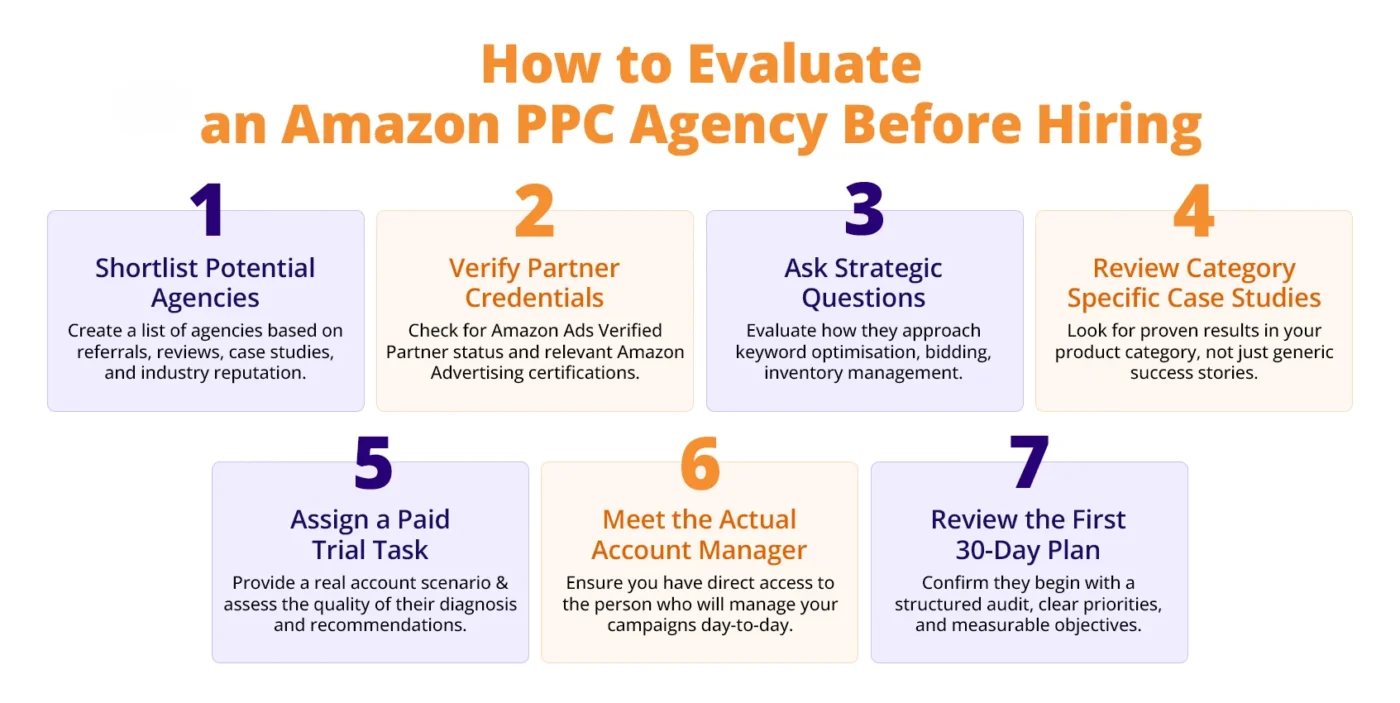
This is the question sellers ask most directly: not “what should I look for” but “how do I actually verify it before committing?” The answer is a structured evaluation process that generates real evidence rather than relying on promises.
The Trial Period Framework: How to Test Before You Commit
A paid trial task is the highest-signal evaluation available before a long-term Amazon PPC management engagement. Any Amazon PPC management expert worth hiring will accept a compensated scope of work before a full retainer begins. Any agency that refuses or resists should be removed from consideration.
What a useful trial task looks like:
Present the agency with a real scenario from your account, anonymized if necessary. For example: “Here is a campaign structure and 30 days of Search Term Report data. Walk us through what you would change first, why, and in what sequence.”
A real partner responds with:
- A specific diagnosis (what the data shows is wrong).
- A prioritized action sequence (what to fix first and why the order matters).
- A clear explanation of the expected outcome and how it would be measured.
- Questions about your margin structure and business goals that contextualize their recommendations.
A service provider responds with:
- Generic recommendations that could apply to any account.
- A list of things they would “look into” rather than specific changes.
- No questions about margin or business context.
Pay for the trial task. An hour of a senior Amazon PPC manager’s time is worth compensating, and the quality of the work tells you more about day-to-day management than any proposal document.
What the First 30 Days Should Look Like With a Real Partner
If the trial task passes and you begin a managed Amazon PPC relationship, the first 30 days are diagnostic, not optimization.
A real Amazon advertising partner spends the first month:
Weeks 1–2 – Full account audit:
Campaign structure review (match type separation, ASIN isolation, naming conventions), Search Term Report analysis across the last 60–90 days (wasted spend identification, exact match gaps, negative keyword coverage), bid levels versus break-even ACoS per product, TACoS trend analysis, and listing-to-campaign connection diagnosis (CTR and CVR by keyword).
The audit should produce a prioritized findings document, ranked by financial impact, with specific actions and estimated timelines. Not a generic “areas for improvement” summary.
Weeks 3–4 – Priority fixes only:
The highest-impact structural changes: obvious wasted spend negated, duplicate campaign targeting consolidated, and campaigns paused on out-of-stock ASINs. The initial structural rebuild begins, match type separation, ASIN isolation, and bid alignment to margin.
What should not happen in the first 30 days: mass bid changes based on insufficient data, claims of dramatic ACoS improvement before the campaign structure is clean, or silence.
If an Amazon PPC management agency cannot produce a structured audit with prioritized findings in the first two weeks, find a different one.
The Difference Between Amazon PPC Outsourcing and a Real Partnership
Many sellers evaluating Amazon PPC outsourcing are asking the wrong question. The question is not “should I outsource Amazon PPC?”, it is “am I outsourcing to a service provider or building a partnership?”
Amazon PPC outsourcing to a service provider:
- You hand over the campaigns and receive monthly reports.
- The agency optimizes within the campaign layer only.
- Performance plateaus because the listing and inventory layers are never addressed.
- You have no visibility into decisions being made about your spend.
- When performance declines, you hear about it in the next report.
Amazon PPC management as a genuine partnership:
- The agency knows your margin structure, your inventory position, and your catalog goals.
- Amazon PPC decisions are connected to listing performance and organic rank signals.
- Weekly reporting tells you what changed, why, and what happens next.
- You have direct access to the person managing your account.
- Problems are flagged proactively, not discovered reactively.
The transition from outsourcing to partnership is not primarily about the agency’s technical capability, it is about the relationship structure. Senior strategist involvement, direct communication, and accountability for outcomes (not just execution) are the structural requirements. These should be agreed explicitly before the engagement begins, not assumed.
At AMZDUDES, Amazon PPC management is not a standalone service. As a full service Amazon agency, we connect your Amazon ads, listing creative, inventory forecasting, and customer insights so that your advertising actually drives profit rather than just generating campaign activity. The difference this makes in practice: when a keyword shows declining CVR, the fix might be in the listing, not the bid, and a team that can see both layers applies the right fix.
See our Amazon PPC case studies and discover what this approach delivers in practice.
Frequently Asked Questions
What is Amazon PPC management?
Amazon PPC management is the ongoing process of creating, optimizing, and refining Amazon sponsored advertising campaigns, Sponsored Products, Sponsored Brands, and Sponsored Display, to improve advertising efficiency and drive profitable revenue growth. Professional Amazon PPC management goes beyond campaign setup to include weekly Search Term Report review, margin-based bid optimization, inventory-aware campaign pacing, and reporting that explains what changed and why.
How do I find an Amazon advertising partner I can trust after a bad experience?
Start with specific, testable questions rather than proposals and promises. Ask how they handle a keyword that spends without converting, and the answer reveals whether they diagnose problems or just react to them. Request a paid trial task before any long-term commitment. Require direct access to the person who will actually manage your account. And confirm they track TACoS alongside ACoS, agencies that only report ACoS have a campaign-level view, not a business-level view.
What is an Amazon Ads Verified Partner, and does it matter?
Amazon Ads Verified Partner status confirms that an agency has met Amazon’s minimum training, certification, and spend volume requirements. It is a baseline credibility filter, it tells you the agency is operating legitimately within Amazon’s ecosystem. It does not confirm performance quality, category expertise, or the seniority of those who manage day-to-day. Use it as a minimum threshold, not as a selection criterion.
What is the difference between Amazon PPC outsourcing and a real partnership?
Outsourcing delivers campaign execution, bids are managed, reports are generated, and the account runs. A real partnership delivers connected management: Amazon PPC decisions informed by listing performance, inventory signals, and organic rank data. The practical difference: an outsourced agency adjusts bids when ACoS rises. A real partner diagnoses whether the cause is keyword relevance, listing conversion, or bid misalignment, and fixes the right thing.
How do I know if an Amazon PPC agency is right for me?
Three tests before committing. First: ask them to walk through a specific account scenario, how they would handle a keyword that is spending without converting. The quality of the diagnosis reveals how they think. Second: assign a paid trial task based on real account data. Third: confirm who actually manages your account day-to-day and what direct communication access you will have. If the agency resists any of these, it tells you something important before you have spent anything.
What should the first 30 days with an Amazon PPC management agency look like?
The first 30 days should be diagnosis, not optimization. A professional Amazon PPC management agency should deliver a full account audit in weeks one and two, covering campaign structure, Search Term Report history, bid levels versus break-even ACoS, TACoS trend, and listing-to-campaign CVR analysis. Weeks three and four should address the highest-impact structural problems identified in the audit. Any agency that jumps straight to bid changes without a structured audit first is skipping the diagnostic layer.
What are the red flags when evaluating Amazon PPC management companies?
Inability to explain bidding logic specifically. No direct access to the account manager. Reporting ACoS without TACoS. Guaranteed ACoS outcomes. Reluctance to provide category-specific case studies. Monthly-only reporting on accounts spending above $10,000/month. Strategies that are entirely tool-dependent without human strategic judgment. Any agency that meets three or more of these criteria is likely to reproduce the experience that brought you here.
Is affordable Amazon PPC management worth considering?
Affordable Amazon PPC management services can work for brands with straightforward catalogs and stable campaigns that need efficient execution rather than strategic direction. The risk is that low-cost services are typically volume-based, with more accounts per manager, less time per account, slower optimization cadence. The question is not “can I find cheap Amazon PPC management?” but “does my account complexity require strategic direction or execution efficiency?” If campaigns need rebuilding, if listing quality is a bottleneck, or if multiple ASINs need a lifecycle-stage strategy, affordable Amazon PPC management services will typically produce affordable results.
What does Amazon PPC management cost?
Amazon PPC management costs vary by model and scope. For a full breakdown of pricing tiers, models, and how to evaluate whether the investment is justified for your specific account, see our complete Amazon PPC agency pricing guide.