
Key Takeaways
- Large Amazon PPC agencies manage too many accounts per person, which means your account gets optimised when someone gets around to it, not when it needs it.
- Expert-led small teams outperform larger setups because fewer accounts per manager means faster execution, deeper strategy, and zero internal queues between a problem and its fix.
- Professional Amazon PPC management is not just campaign creation; it is weekly keyword management, margin-based bid optimisation, inventory-aware pacing, and ads connected to listings and SEO.
- Set-it-and-forget-it or autopilot management is the single most expensive form of PPC neglect. The losses are invisible until the account falls too far behind to recover without significant spending.
- The right management partner treats your account like a performance engine: diagnosing before changing, integrating advertising with listing and customer data, and reporting what changed and why, not just what the numbers are.
If you have worked with a large Amazon PPC agency before, you already know what the experience often looks like. A monthly report with a lot of numbers and not many answers. And somewhere in the middle, campaigns running on autopilot, bids unchanged for weeks, negative keywords never reviewed, and an ACoS that stubbornly refuses to move in the right direction.
You are not wrong to want something different. The preference for a small, highly skilled team over a large agency is not just a preference for personalisation; it is a recognition that volume management and expert management are structurally different things. They produce structurally different outcomes.
This guide makes the case with specifics: why expert-led small teams outperform at scale, what professional Amazon PPC management actually covers, how to recognise when your current setup is the problem, and what this model looks like in practice.
Why Expert-Led Teams Outperform Large Agencies on Amazon PPC
The assumption behind hiring a large agency is that more people means more capability. In Amazon PPC, this assumption breaks down quickly because the work that actually moves performance is not parallelisable across a large team. It requires a single expert who knows your account, your margin, your competitive landscape, and your inventory situation deeply enough to make good decisions in real time.
When that expertise is diluted across 30, 40, or 50 accounts per manager, the depth disappears. What remains is process: templates applied, reports generated, and tickets resolved in turn.
The Structural Reason Fewer Accounts Per Manager Produces Better Results
Amazon’s auction system does not wait for quarterly reviews. CPCs shift daily. Competitor bids change overnight. A keyword that was profitable last week may be burning budget this week because a new seller entered the category and drove up CPC by 40%. An ASIN that sold out yesterday is still running ads today because no one checked.
In a high-volume agency, the question is not whether your account manager is capable; it is whether they have the time and attention to catch these shifts before they compound into expensive problems.
When a manager handles fewer accounts, the maths change entirely:
| Account Load | Weekly Review Depth | Response to Performance Shift | Optimisation Frequency |
| 30–50 accounts/manager | Surface-level | Days to weeks | Monthly at best |
| 8–12 accounts/manager | Keyword and ASIN-level | Same day or next | Weekly without exception |
The difference is not effort. It is structured. A manager with 8 accounts has the cognitive space to know each one deeply. A manager with 40 accounts is triaging, not optimising.
What Gets Lost When PPC Is Managed at Volume
The things that get cut first when a manager is stretched across too many accounts are precisely the things that compound performance over time:
Weekly Search Term Report review:
This is the highest-leverage ongoing action in Amazon PPC mining, converting terms for exact-match promotion, eliminating wasted spend, and expanding the keyword universe from live campaign data. At a high-volume agency, this gets done monthly, if at all. At an expert-led operation, it happens every week without exception.
ASIN-level diagnosis:
When a specific product is dragging account-level ACoS above target, identifying it requires pulling and interpreting the Advertised Product Report at the ASIN level, then cross-referencing with listing quality, review count, price position, and inventory. This takes 20–30 minutes per problem ASIN. At volume, it does not get done until ACoS has been elevated for weeks.
Margin-aware bid decisions:
Setting the right bid requires knowing the product’s profit per unit, the current conversion rate, and the maximum profitable CPC that the margin can sustain. At volume, bids are typically adjusted algorithmically or against category averages, not against the specific economics of each product. The result is bids that look reasonable and produce predictably mediocre ACoS.
Integration across the account:
Your PPC performance is not determined by your campaigns alone. It is determined by what your listing delivers to the traffic your campaigns drive. A campaign pointing to a listing with a weak main image will underperform regardless of how precise the keyword targeting is. A manager stretched across 40 accounts does not have time to flag listing issues that are suppressing PPC performance. A manager with 8 accounts does.
Precision Over Scale: How This Changes What Your Account Actually Receives
The shift from volume management to expert management is not just about attention. It is about a fundamentally different relationship between the manager and the account.
At volume: your account is a set of campaigns to be maintained within acceptable KPI ranges.
At expert scale: your account is a performance system where advertising, listing quality, keyword strategy, and inventory signals are connected and managed as an integrated whole.
When your ads, listing creative, and customer insights are unified under a single management lens, the decisions improve across every layer. A keyword that converts well but consistently produces low CVR on the listing page is both an ad efficiency signal and a listing signal, and both need addressing. A manager who only sees the PPC side fixes the bid. A manager who sees both sides fixes the listing.
This is the structural advantage of expert-led management. Not that small teams work harder. That they can see the full picture.
What Expert Amazon PPC Management Actually Covers
Most sellers who have been let down by an Amazon PPC management service were let down not because the agency was incompetent, but because they were only managing part of what management should cover. Understanding the full scope of professional Amazon PPC management and where the gaps typically are is what allows you to evaluate whether a service is genuinely managing your account or just maintaining it.
Campaign Architecture Built for Your Margin and Goals, Not a Template
Professional management starts with understanding your business before building anything. Break-even ACoS calculated from your actual margin, not a category average, is the reference point for every bid decision. Target ACoS is set below break-even to generate actual profit, not just cover costs. Campaigns are structured by goal (launch, scale, retain), by match type (separate campaigns for Exact, Phrase, Broad), and by ASIN, so performance data is clean and actionable rather than blended and misleading.
A generic template applied across a catalogue treats a $12-profit product the same as a $35-profit product. Expert management treats them differently because their economics require different bids, different ACoS targets, and different optimisation priorities.
Search Term and Keyword Management Done Weekly, Not Monthly
The Search Term Report is the highest-leverage tool in Amazon PPC. Every week, it reveals which actual shopper queries triggered your ads, which ones converted, which ones wasted spend, and which new converting terms are emerging that deserve promotion to exact match manual campaigns. Understanding which Amazon PPC metrics to prioritise from this report is what separates reactive management from strategic management.
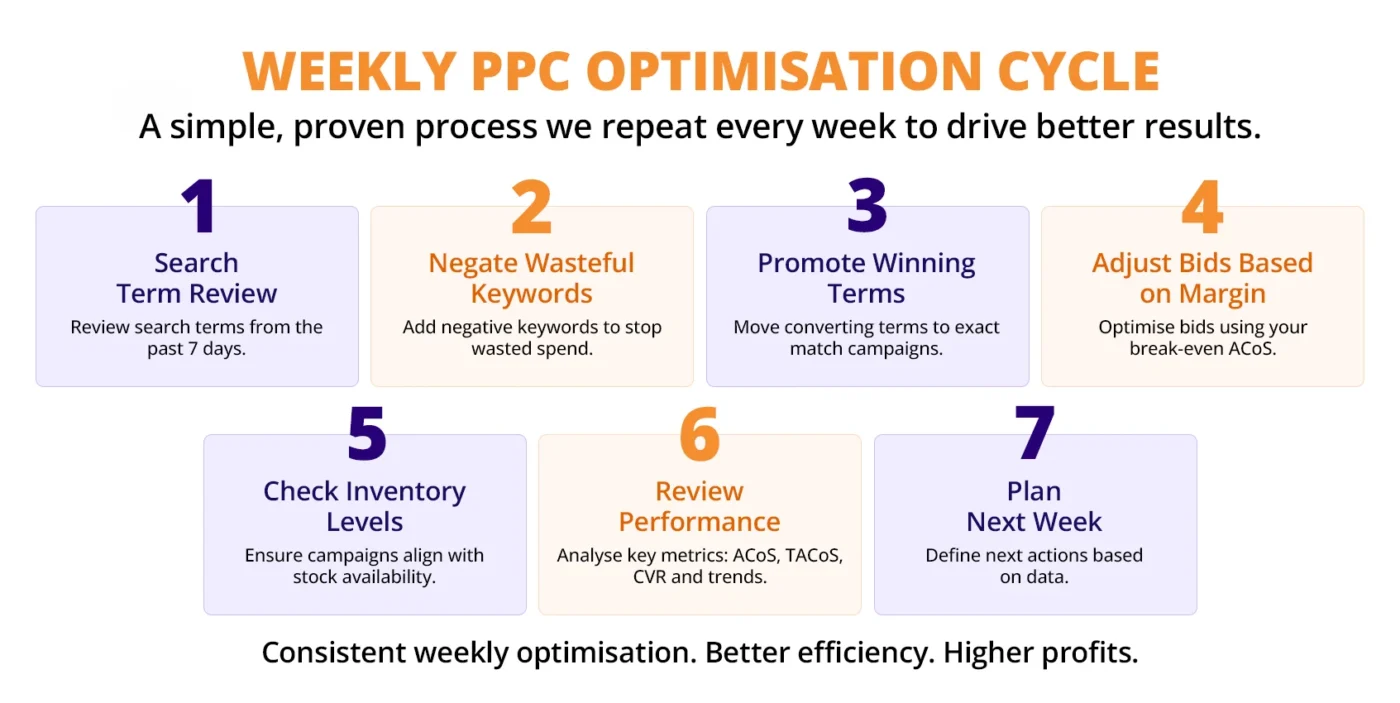
Expert management means this report is pulled, analysed, and acted on every seven days:
- Any search term with $15 or more in spend and zero conversions: negated at the campaign level immediately
- Any search term with 3 or more conversions below break-even ACoS: promoted to an exact match manual campaign with a margin-based bid
- Patterns in converting terms mined for modifier-based keyword expansion
At a monthly cadence, three to four weeks of avoidable waste accumulate before anyone sees it. At a weekly cadence, it is caught before it compounds.
Bid Management From Your Break-Even Number, Not Amazon’s Suggestions
Effective Amazon bid management starts with profitability thresholds, not Amazon’s suggested bid ranges or category-wide averages. Amazon’s suggested bid range reflects what other sellers are currently paying, not what your margin can profitably sustain. Expert bid management calculates the maximum profitable CPC first:
Max Profitable CPC = Profit Per Unit × Conversion Rate
Every keyword bid is evaluated against this number. Keywords below 50% of break-even ACoS get bid increases to capture more volume. Keywords above break-even for 30 or more days get bid reductions. Amazon’s suggested range is a market signal, not a target.
Placement multipliers are set only after Placement Report data confirms that a specific placement (Top of Search, Product Pages) converts at or below the target ACoS for this specific product. Never before.
Inventory-Aware Campaign Pacing: Never Spending on Out-of-Stock ASINs
One of the most expensive and entirely avoidable forms of PPC waste is running campaigns on products that are out of stock or approaching a stockout. Every click on an out-of-stock listing is a wasted dollar the shopper lands, cannot buy, and leaves. The ranking signals built with that spend are simultaneously degrading because sales velocity has stopped.
Expert management monitors inventory levels across the catalogue and reduces bids proactively on ASINs with fewer than 30 days of stock remaining at current velocity. When stock runs out, campaigns are paused immediately, not when someone notices the next day.
This alone can eliminate 5–15% of total ad spend waste in accounts with active inventory fluctuations.
Ads, Listings, and SEO Working as One System, Not in Silos
A PPC campaign is not a standalone instrument. It is the amplifier for what your listing delivers. If the listing does not convert the traffic the campaign drives, the campaign has a structural ceiling on its performance, and no amount of bid optimisation breaks through it.
Expert management flags listing-level issues that are suppressing PPC performance:
- The main image that does not generate a click-through at thumbnail size in search results is identifiable through abnormally low CTR on a relevant keyword
- Price point above category average without visible differentiation identifiable through moderate CTR but below-category CVR
- Review count below 15 or rating below 4.0 is identifiable through consistently poor CVR across all keywords, regardless of bid level
- Title missing primary purchase intent keyword in the first 60 characters, identifiable through low impression share on high-intent terms
When advertising, listing creative, and customer insights are unified under the same management lens, these connections are visible and actionable. When PPC and listing management operate in silos, the problem is diagnosed as a bid issue and never fixed at its source.
Reporting That Tells You What Changed, Why, and What Is Next
The difference between a performance report and a data report is interpretation. A data report tells you the numbers. A performance report tells you what the numbers mean, what changed since last week, why it changed, and what is happening next.
Expert management delivers weekly performance reports with:
- What campaigns were changed and why
- What keywords were added, negated, or promoted and the data that drove the decision
- What the ACoS and TACoS trends are, and whether it is moving in the right direction
- What is the next week’s focus based on this week’s data
Monthly summary reports exist for Amazon PPC trend analysis, long-term performance tracking, and strategic direction. But the weekly report is where active management is documented and where you can verify that your account is being worked on, not just watched.
AMZDUDES, a Full Service Amazon Agency, manages PPC as part of one connected growth system where your ads, listing creative, and customer insights work together to improve performance and profitability. We structure campaigns around your real margins, manage keywords and bids weekly, monitor inventory to reduce wasted spend, and optimise based on both advertising data and listing conversion performance. Because when PPC and listing optimisation operate separately, problems get treated as bid issues instead of being fixed at the source. To maintain this level of precision, we intentionally cap account loads so every brand receives consistent weekly attention.
Signs Your Current Amazon PPC Management Needs to Change
The most insidious form of poor PPC management is not obvious failure, it is quiet stagnation. ACoS is not dramatically high. Revenue is not collapsing. But the account has plateaued, optimisations are not happening, and the gap between where performance is and where it should be grows silently every week.
What Our Audits Find in Accounts That Have Underperformed for Months
A professional Amazon PPC audit typically reveals structural inefficiencies long before performance decline becomes obvious in account-level metrics.
When we audit accounts that have been under management by an agency, a freelancer, or an internal team for six months or more without meaningful improvement, the same patterns appear repeatedly:
| Audit Finding | What It Means | Account Impact |
| Broad match overuse across all campaigns | No match type separation, discovery and conversion mixed | High ACoS from irrelevant traffic blended with converting traffic |
| No negative keywords or outdated negative lists | Irrelevant search terms consume the budget daily | 15–30% of total spend is going to queries with zero purchase intent |
| Duplicate ASIN targeting across campaigns | Same ASIN in multiple campaigns bidding against each other | Inflated effective CPC through internal competition |
| No dayparting or time-of-day awareness | Budget spending at an equal rate 24 hours a day | Budget is depleting during low-conversion hours, leaving peak hours underfunded |
| Campaigns running on out-of-stock ASINs | No inventory monitoring connected to campaign management | Continue spending on listings that shoppers cannot buy from |
| Bids unchanged for 30, 60, or 90+ days | Set-and-forget management, no responsive optimisation | Performance locked at initial setup levels regardless of how market conditions change |
| No exact match manual campaigns built from auto data | Converting search terms never promoted from auto to exact | Best-performing queries managed at auto bid levels without precision control |
If three or more of these are present in your account, the account has not been actively managed. It has been maintained.
The Autopilot Problem: What Set-It-and-Forget-It Management Actually Costs You
Autopilot management is the most common and the most expensive form of PPC neglect, specifically because it is invisible. The campaigns are running. The dashboard shows numbers. The monthly report arrives. Everything looks like management is happening.
But nothing is changing. Bids set in January are still running in July. The search term report has not been reviewed in weeks. Negative keywords from the launch phase are the only ones in the account. A competitor entered your main keyword category in March and drove CPC up 35%, and no one noticed because no one was watching.
What autopilot management costs in practice:
Wasted spend that compounds:
An irrelevant search term consuming $15/week is $780/year. An account with ten such terms loses $7,800 annually on spend that returns nothing, and that number grows as ad budgets scale.
Missed conversion opportunities:
A converting search term that has appeared in the Search Term Report for three months but was never promoted to exact match has been delivering conversions at auto campaign bid levels rather than at the optimised exact match bid level you could have been paying. The revenue was there. The precision was not.
Competitive displacement:
While your campaigns ran on autopilot, competitors adjusted their bids, refined their keyword targets, and improved their listings. The gap compounds every week. After six months of autopilot management, rebuilding a competitive position requires more spend and more time than continuous active management would have cost.
Organic rank erosion:
If your campaigns were generating ranking signals for important keywords, but no one was reviewing TACoS to confirm that paid advertising was supporting organic rank rather than substituting for it, you may have lost organic positions while maintaining acceptable-looking ACoS numbers.
The autopilot signal to look for:
Pull your Search Term Report for the last 60 days. Sort by spend descending. If the top 20 terms contain multiple obviously irrelevant queries with significant spend and zero conversions, and those terms have been there for more than 14 days, your campaigns are on autopilot. Active management catches these within a week.
The Real Cost Beyond Wasted Ad Spend
The waste visible in a monthly report, dollars spent on irrelevant clicks, is only the most obvious cost of poor management. The less visible costs are often larger:
Organic rank lost while campaigns underperformed:
Advertising that generates sales velocity supports organic ranking. Advertising that generates clicks without conversions does not. Months of below-target CVR from campaigns not optimised for intent mean months of weaker organic rank signals, which affect organic revenue long after the campaigns are fixed.
Competitive intelligence never gathered:
The Search Term Report, Placement Report, and Advertised Product Report are not just optimisation tools. They are intelligence sources revealing which queries your competitors are capturing, which placements convert in your category, and which of your ASINs are underperforming relative to their potential. Unreviewed reports are unactioned intelligence.
Launch momentum was lost and never recovered:
For new products, the first 60–90 days of advertising determine the organic ranking trajectory. Autopilot management during a launch where ACoS acceptance was appropriate but conversion data was never mined, means the ranking foundation is built on auto campaign inefficiency rather than exact match precision.
When Automated Tools and DIY Stop Being Enough
Automated PPC tools are useful for executing a strategy you already have. They are not a substitute for the strategy itself. A rule-based bid management tool that adjusts bids based on ACoS targets executes faster than a human for routine adjustments. But it cannot:
- Diagnose why a keyword is above break-even ACoS and determine whether the cause is keyword relevance, listing conversion, or bid level.
- Identify that an ASIN’s poor performance is driven by a listing quality issue rather than a campaign structure problem.
- Recognise that a competitor has entered a keyword category and that the appropriate response is a bid increase rather than the algorithm’s standard ACoS-triggered bid reduction.
- Connect campaign data to inventory signals to prevent spending on out-of-stock listings.
DIY management stops being enough when the account complexity, including the number of ASINs, number of campaigns, and number of match type layers, exceeds the time available to manage it well. At that point, the choice is not between expert management and doing it yourself. It is between expert management and autopilot.
Who This Model Is Built For
Expert-led Amazon PPC management is not the right fit for every brand at every stage. Understanding where this model delivers the most value and where a different approach might be more appropriate is how you know whether to pursue it.
Multi-ASIN Brands That Need Precision at Scale
If you are managing 10 or more active ASINs across multiple categories, the combinatorial complexity of Amazon PPC grows faster than most in-house or tool-based approaches can handle. Each ASIN has its own margin, its own competitive landscape, its own keyword universe, and its own listing quality profile. Managing them with the same strategy and the same bid framework produces mediocre results across all of them.
Expert management at this scale means each ASIN is treated with the same depth it would receive as a standalone product because the manager knows the account well enough to apply ASIN-specific strategy without losing the cross-ASIN view of budget allocation and competitive positioning.
The AMZDUDES model caps account loads specifically so that multi-ASIN brands receive weekly ASIN-level attention rather than account-level averages.
Amazon PPC Management for Small Brands With Lean Teams
Small brands with lean internal teams face a specific problem: the person managing PPC is also managing listings, customer service, inventory, and five other operational functions. PPC optimisation gets the attention left over after everything else, which is rarely enough for the weekly cadence that precision management requires. For many growing sellers, affordable Amazon PPC management becomes the practical way to maintain weekly optimisation quality without expanding the internal team.
What small brands specifically need from a managed service:
- Weekly Search Term Report management that catches waste before it compounds.
- Inventory-aware campaign pacing that prevents spending on out-of-stock items without requiring manual monitoring.
- Bid management that references their specific margin, not a category average that may be loss-making at their price point.
- Reporting that is readable by a non-specialist, what changed, why it changed, and what to expect next week.
What small brands do not need: a dashboard with 47 metrics and a monthly PDF that requires a data analyst to interpret.
AMZDUDES’ pricing is structured around what each brand actually needs, not a fixed package applied regardless of catalogue size or complexity. For small brands, that means expert management without the overhead of services that are not relevant to your stage.
Sellers Who Have Outgrown Generic Agency Management
Generic agency management, where your account is one of 40 managed by a generalist, works at a certain scale and fails above it. The failure is typically gradual rather than sudden: results plateau, optimisation frequency decreases as the account grows more complex, and the manager’s familiarity with your account’s specifics diminishes as their portfolio grows.
The signal that you have outgrown this model: you know more about your own account’s problems than your agency does. When you flag an issue with a high ACoS on a specific ASIN, a competitor entering a key keyword, an inventory situation that should pause certain campaigns, and the response is delayed or generic, the model has failed.
Expert-led management for sellers at this stage is not about switching from one generic agency to another. It is about switching from volume management to precision management with a team that has the account depth and the access speed to match the pace at which your business actually operates.
What Personalised Expert Management Looks Like in Practice
The difference between reading about expert management and experiencing it is the tangible difference in how your account is handled day-to-day. This section describes what that difference looks like in practical terms.
24/7 Accessibility: No Tickets, No Queues, Direct Access
On Amazon, performance shifts do not wait for business hours. An ASIN stocks out at 11 pm. A Lightning Deal fails to drive the expected conversion rate, and budgets need reallocation before the window closes. A competitor runs an aggressive promotion, and your impression share drops overnight.
In a high-volume agency, these situations generate support tickets reviewed in turn during business hours and resolved days after the opportunity or problem was identified.
Expert-led management with direct access means these situations are handled when they happen. The person you reach is the person who manages your account, not a support team member reading your account for the first time. Direct access to Amazon PPC management experts ready to act when your business needs it is not a feature offered alongside the management service. It is how the management service works.
The First 30 Days: Diagnosis Before Any Campaign Changes
The first month of expert management is not optimisation. It is a diagnosis.
Week 1–2 Account audit:
Full review of campaign architecture, match type structure, negative keyword coverage, bid levels versus margin-based maximums, Search Term Report history, Placement Report performance, and Advertised Product Report ASIN-level ACoS. Every gap, inefficiency, and structural problem is documented before anything is changed.
The reason: making bid changes before understanding the account structure produces unreliable results. A bid reduction that looks like an improvement may actually be cutting spend on a keyword that was supporting organic rank. A negative keyword added without understanding why that term was triggering may eliminate a genuinely relevant query.
Diagnose first. Change second.
Week 3–4 Priority fixes:
Based on the audit, the highest-impact changes are made first: obvious wasted spend is negated, duplicate campaigns are consolidated, and out-of-stock ASIN campaigns are paused. The initial campaign restructure, match type separation, ASIN isolation, and bid alignment to margin begin.
The account does not look dramatically different at the end of 30 days. The data does. Clean structure produces clean data, and clean data makes the optimisation decisions in months two and three significantly more reliable.
The First 90 Days: What Compounding Precision Looks Like
Days 31–60 The keyword harvest cycle begins:
With a clean structure in place, the Search Term Report weekly review starts producing its first exact match promotions. Converting queries that were buried in auto and broad campaigns are isolated in exact match manual campaigns with margin-based bids. Negative keyword lists grow and become increasingly accurate. TACoS is tracked weekly alongside ACoS, confirming that ACoS improvements are building business health, not just suppressing a dashboard metric.
Days 61–90 The compound effect:
By this point, the account’s performance data is clean, trustworthy, and actionable. The exact match campaign is populated with validated converting queries at precise bids. Wasted spending has been systematically eliminated. Placement multipliers have been calibrated from real placement-level conversion data. The manager knows the account’s margin profile, its competitive landscape, and its seasonal patterns well enough to make strategic decisions in real time.
TACoS trending down while revenue trending up is the confirmation signal that the system is working. ACoS improving while TACoS rises is the warning signal that would only be caught by a manager watching both metrics simultaneously, which is what expert management ensures.
Real Results: What This Approach Delivers Across Categories
These are documented outcomes from AMZDUDES-managed accounts, not projections or averages:
1: Explicit Essentials Bath & Body Monthly revenue from $11,885 to $131,329 in 90 days. New-to-Brand customer rate above 96%. The foundation was fixing a compliance issue that had blocked advertising, then building a full-funnel PPC structure on converted listing ads and listing working together from day one.
2: Health & Household ACoS reduced from approximately 165% to approximately 61% while tripling monthly revenue. This account came from a situation where in-house management had reached its capability ceiling; the team knew something was wrong, but could not diagnose the structural cause.
3: DTC to Amazon Expansion $438K in revenue and 8,900+ New-to-Brand customers through a structured launch strategy that connected PPC directly to listing optimisation and catalogue architecture. The brand had been selling DTC and had no Amazon PPC history to start from.
4: Sports Nutrition Brand 7,157 New-to-Brand customers and $324K+ in first-time sales within 10 months. PPC strategy integrated with Subscribe & Save enrollment ads driving acquisition, Subscribe & Save driving retention. The result was compounding revenue from a single customer acquisition investment.
5: Food & Beverage Brand 65% year-over-year revenue growth and 8,853 New-to-Brand customers. Growth driven through Amazon PPC campaign management connected to listing creative and bundle strategy, not through increased ad spend alone.
The pattern across these accounts: the results come from integration. Ads connected to listings. PPC connected to inventory. Campaign data connected to creative decisions. This is what expert management with direct access and low account-to-manager ratios makes possible. It is not achievable at volume.
Ready to see what Expert Management does for your account?
Most accounts we audit haven’t been actively managed. They’ve been maintained, bids set months ago, search term reports unreviewed, and campaigns running on products that are out of stock. The waste is invisible until someone actually looks.
AMZDUDES, a Full Service Amazon Agency, reviews and optimises your account every week, not just to maintain campaigns, but to actively improve profitability and competitive performance. We unify your Amazon ads, listing creative, and customer insights into one connected system, so decisions are based on how shoppers actually search, click, and convert. The result is advertising focused on real profit and long-term growth, not vanity metrics.
Our Amazon PPC Services are structured around what your brand specifically needs: your margin, your catalog, and your stage of growth. No fixed packages. No autopilot.
The starting point is a free account review, no commitment, no pitch deck. Just an honest look at what your account is doing, what it should be doing, and what the gap is worth.
Frequently Asked Questions
What is Amazon PPC management?
Amazon PPC management is the ongoing process of creating, optimising, and refining Amazon sponsored advertising campaigns, including Sponsored Products, Sponsored Brands, and Sponsored Display, to improve advertising efficiency and drive profitable revenue growth. Professional management goes beyond campaign creation to include weekly keyword management, margin-based bid optimisation, inventory-aware pacing, and integration with listing quality and customer insights.
What does Amazon PPC management include?
At a professional level: campaign architecture built around your margin and goals, weekly Search Term Report management (negatives and exact match promotion), bid adjustments based on your break-even ACoS, inventory-aware campaign pacing, placement report analysis, Advertised Product Report ASIN-level diagnosis, and weekly performance reporting with interpretation. The distinction between professional management and autopilot management is that professional management is actively changing based on data, not just running campaigns and generating reports.
Why do small expert teams outperform large agencies on Amazon PPC?
Fewer accounts per manager means each account receives weekly keyword-level attention, faster response to performance shifts, and deeper familiarity with the specific margin and competitive dynamics of each product. Large agencies optimise for volume, which means your account gets attention when the manager’s schedule allows, not when your account needs it. The structural advantage of a small expert team is not effort. It is the depth of account knowledge that is only possible when a manager is not spread across 30 or 40 accounts simultaneously.
What is autopilot Amazon PPC management, and why is it a problem?
Autopilot management is campaigns that run without active weekly optimisation bids unchanged for months, Search Term Reports unreviewed, negative keywords never updated, and inventory signals ignored. The damage is invisible at first: ACoS looks acceptable because it has not changed, but performance has plateaued. Competitive position erodes quietly. Wasted spending compounds. Organic rank weakens. When autopilot management is eventually identified, the recovery cost in both spend and time typically exceeds what active management would have cost for the same period.
How much does Amazon PPC management cost?
Costs vary by scope and engagement structure. Amazon’s ad spend operates on a pay-per-click model, where you pay only when someone clicks your ad. Management fees for expert-led services range from retainer-based to performance-aligned structures, depending on catalogue complexity and goals. AMZDUDES structures engagements around what each brand actually needs rather than applying a fixed package regardless of account size. If pricing has been a reason you have not reached out, start with a conversation there is no commitment involved.
What is the difference between Amazon PPC management and Amazon PPC consulting?
Management is ongoing, the team actively runs your campaigns week to week, making real-time decisions and executing optimisations continuously. Consulting is typically project-based, such as an audit, a strategy document, or a one-time structural recommendation that your internal team then executes. Management requires more investment but produces compounding results because the optimisation cycle never stops. Consulting is valuable for brands that have capable internal operators but need strategic direction or a structural diagnosis before rebuilding.
Is Amazon PPC management right for small brands?
Yes, particularly for small brands with lean internal teams where the person responsible for PPC is also managing listings, inventory, customer service, and operations. Expert management removes the cognitive load of PPC optimisation from a team that cannot give it the weekly attention it requires, replacing it with a specialist who can. The key is finding a service whose engagement structure matches your catalogue size and goals, not a fixed package designed for enterprise accounts applied to a 10-ASIN brand.
What should I expect in the first 30 days of Amazon PPC management?
The first 30 days should be spent on diagnosis before change. A complete account audit covering campaign structure, keyword coverage, bid levels versus margin, Search Term Report history, and ASIN-level performance. Followed by priority fixes, obvious waste is negated, structural problems are identified, and campaigns are aligned to your margin data. The account will not look dramatically different in 30 days. The data will and clean data is the foundation that makes the next 60 days significantly more effective.
How do I know if my current Amazon PPC management is underperforming?
Pull your Search Term Report for the last 30 days. Sort by spend descending. If the top 20 search terms contain multiple obviously irrelevant queries with significant spend and zero conversions, and those terms have been there for more than 14 days, your campaigns are not being actively managed. Additional signals: bids unchanged for 60 or more days, no exact match manual campaigns built from auto campaign data, campaigns running on out-of-stock ASINs, and monthly reports that show numbers without explaining what changed or why.