

Key Takeaways
- Understand Amazon target audience: Amazon shoppers value convenience, competitive pricing, fast delivery, product variety, and trusted reviews before making a purchase.
- Types of audience segmentation: The four main segmentation types are demographic, geographic, behavioral, and psychographic segmentation.
- 4 effective ways to find target customers: Conduct market research and use Amazon tools and analytics to identify customer trends, buying behavior, and demand patterns.
- Build stronger customer profiles: Create buyer personas and use social media insights to better understand customer interests, pain points, and motivations.
- Refine your strategy regularly: Continuously review customer data, search trends, and competitor insights to improve targeting and long-term growth.
Many Amazon sellers struggle to grow because they are trying to sell to everyone. They invest in marketing but still fail to attract the right buyers. Attracting the right buyers is crucial, as without customers, you won’t have any sales even if you have a great product.
Understanding your target market is essential for an effective marketing strategy if you want to unlock massive growth on one of the world’s largest e-commerce platforms. Identifying who shops, what drives their decisions, and how to meet their needs can put you miles ahead of the competition as a seller.
This guide helps you understand Amazon target market, Amazon customer segmentation, how Amazon reaches its audience, and how you can find the right customers for your brand.
Who Is Amazon’s Target Audience?
Amazon’s vast reach means its customer base is incredibly broad, spanning nearly every demographic with over 310 million active users worldwide.
Amazon’s customer base is exceptionally diverse, encompassing individuals of all ages and geographic locations. Its largest customer segment falls within the 25–34 age group. The U.S. remains Amazon’s strongest market, with around 82% of users located there, representing more than 255 million customers.
The company’s e-commerce platform appeals to a wide range of consumers, from budget-conscious shoppers to those seeking premium goods.
Amazon’s target audience shares several common traits, such as a preference for convenience, low prices, and a wide product selection. These shoppers are digitally connected and frequently use smartphones, tablets, and laptops to make purchases efficiently. In fact, more than 57% of Amazon’s website traffic comes from mobile devices, highlighting the growing importance of mobile shopping behavior among consumers.
While Amazon attracts a broad audience overall, each product category serves a more specific type of customer. For example, parents shopping for baby products, fitness enthusiasts buying supplements, or homeowners looking for storage solutions all have different needs and buying behaviors. This is why sellers need to go beyond Amazon’s general audience and identify the exact customer segment most likely to buy their product.
Amazon Customer Demographics
Amazon’s audience is broad, but certain customer trends stand out across the platform. Understanding these patterns can help sellers make better decisions around pricing, messaging, product positioning, and advertising.
Age
Amazon’s strongest customer groups are adults between 25 and 44 years old. These shoppers are typically busy professionals, parents, and convenience-driven buyers who rely on Amazon for everyday purchases, home essentials, electronics, beauty products, and more. Younger shoppers, especially Gen Z, are also becoming more active on Amazon, particularly in categories like fashion, supplements, gadgets, and trending products.
Gender
Amazon attracts both male and female shoppers across nearly every category, although purchase behavior often varies by niche. For example, categories like electronics, tools, and gaming may skew more male, while beauty, baby products, and home organization often attract more female buyers.
Income
Amazon serves a wide range of income groups, but middle-income households remain one of the platform’s largest customer segments. Budget-conscious shoppers often prioritize affordability, discounts, and bundles, while higher-income customers may focus more on premium features, convenience, faster delivery, and trusted brands.
Prime Membership Behavior
Prime members are among Amazon’s most valuable customers because they shop more frequently, spend more per order, and are more likely to make repeat purchases. Fast shipping, convenience, exclusive deals, and subscription-based buying behavior often play a major role in their purchase decisions.
Mobile Shopping Behavior
A large percentage of Amazon customers browse and buy through mobile devices. This means sellers need mobile-friendly product images, short and scannable bullet points, strong first impressions, and pricing that is easy to compare quickly.
Amazon Target Market Segmentation
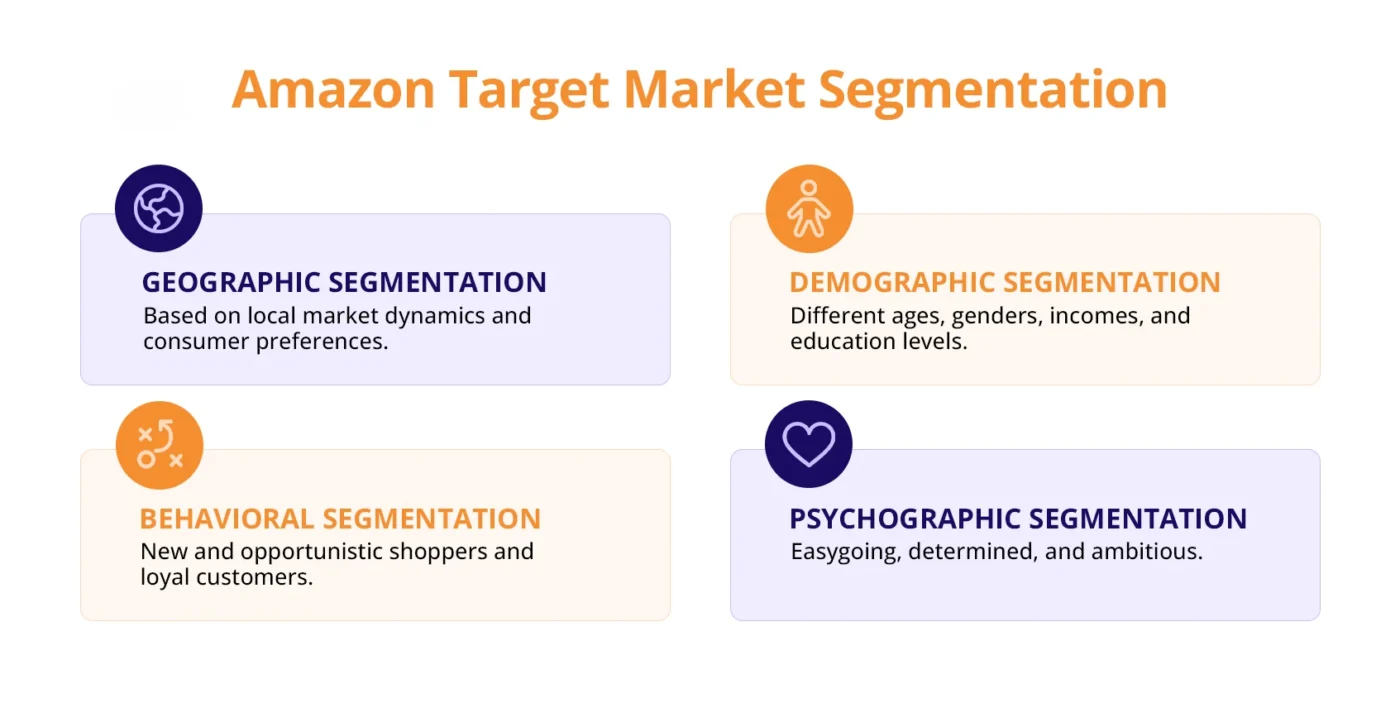
Market segmentation divides a broad audience into distinct groups based on shared characteristics. This enables sellers to target each group more effectively. Amazon employs this strategy through demographic, geographic, behavioral, and psychographic segmentation.
Amazon Demographic Segmentation
Amazon’s demographic segmentation focuses on categorizing customers based on age, gender, and income. By analyzing these demographic traits, sellers can customize their marketing strategies and product offerings to meet different groups’ unique preferences and needs.
Age: Dominant groups are 25-34 (28.81% of sales) and 35-44 (19.57%), with growing Gen Z engagement.
Gender: Over 57.1% of Amazon customers are male, and 42.9% are female.
Income: Middle-income households ($40K-$125K) form the largest segment (48%).
Amazon Geographic Segmentation
Geographic segmentation organizes audiences based on geographic characteristics, which allows companies to customize their marketing strategies to local preferences. This includes localized pricing strategies and promotional campaigns customized to specific regions’ needs.
For example, customers in colder regions may search for winter products, while urban shoppers may prioritize convenience and space-saving items. Understanding location-based demand can help sellers create more relevant listings, seasonal campaigns, and localized offers.
Amazon Behavioral Segmentation
Behavioral segmentation looks at how customers interact with products and make purchasing decisions. Some Amazon shoppers are loyal repeat buyers, while others are first-time customers who compare multiple options before purchasing. Customer behavior can also include shopping frequency, spending habits, response to discounts, brand loyalty, and purchase intent.
Amazon Psychographic Segmentation
Psychographic segmentation focuses on customer lifestyles, interests, values, attitudes, and motivations. Two customers with similar demographics may still make completely different buying decisions because of their personal preferences and beliefs. For example, one customer may prefer eco-friendly products, while another may prioritize luxury or convenience. Understanding psychographic traits helps sellers position their products more effectively and create messaging that resonates with the right audience.
How Amazon Reaches Its Audience
Amazon connects with its target market through various marketing strategies, including Amazon Advertising to promote products, and Amazon search engine optimization (SEO) to enhance visibility in search results. Key tactics include personalized email marketing, video marketing to influence purchase decisions, and regular web design updates to improve user experience.
Additionally, Amazon uses conversion rate optimization (CRO) to refine product listings and leverages user-generated content for social proof. The company relies on user data to personalize shopping experiences and provide relevant advertisements, employing channels like social media and digital ads to maintain strong audience engagement.
How to Find Target Audience for an Amazon Brand
Finding the right target markets is important if you want your marketing efforts to pay off. Here are some effective ways to find the right Amazon target audience for your brand.
1. Conduct Market Research
Understanding your target audience on Amazon starts with researching your niche and reviewing customer feedback. For example, if you sell home office chairs, reviews may reveal that customers care most about comfort and easy assembly. If you sell reusable water bottles, shoppers may focus more on durability, insulation, and leak-proof designs. These insights help you understand what matters most to your audience.
Once you identify these preferences, you can optimize your amazon product titles, descriptions, images, and A+ content to match customer expectations. Use search term reports, reviews, and conduct keyword research to understand how shoppers search for products and what influences their buying decisions. You can also gather additional insights through surveys or customer feedback to refine your messaging and position your product more effectively.
2. Use Amazon Tools & Analytics
Amazon’s Seller Central and Advertising Console provide detailed reports on sales, orders, and customer feedback, as well as insights into your advertising campaigns. Analyzing this data allows you to identify trends, such as rising demand from parents for educational toys or increased interest from pet owners searching for premium grooming products. You can use these insights and adjust your marketing strategy accordingly.
In addition to trend analysis, you can also track the performance of specific keywords and ad placements, which can be helpful in optimizing your campaign for better ROI. By identifying which strategies drive the most engagement and conversion, you can allocate your budget more effectively.
3. Build Buyer Personas
Buyer personas help you understand who your ideal customers are, what they care about, and why they buy. Instead of only looking at age or income, focus on customer motivations, pain points, and buying behavior. For example, an eco-conscious shopper may care about sustainable materials and ethical sourcing, while a busy parent may value convenience, safety, and time-saving features.
Creating a few clear buyer personas makes it easier to personalize your listings, ads, and messaging to different customer groups. This can help improve engagement, conversions, and customer loyalty. However, avoid creating personas based only on assumptions or outdated information. Your personas should be built using real data from reviews, as customer reviews drive growth on Amazon. You can also rely on search terms, competitor analysis, and customer behavior.
4. Leverage Social Media Platforms
Social media can help you reach your target audience, build brand awareness, and drive more traffic to your Amazon listings. Creating content such as product demonstrations, customer testimonials, tutorials, or behind-the-scenes posts can help capture attention and keep your brand visible. For example, a beauty brand may share skincare routines, while a kitchen brand may post quick recipe videos using its products.
You can also use paid social media ads like Facebook to reach new customers and retarget people who have already shown interest in your products. Partnering with influencers or complementary brands can further expand your reach and build trust with potential buyers. This can help bring in more qualified traffic and improve overall conversions on Amazon.
Amazon Target Market Examples by Category
Different product categories attract different types of shoppers. Understanding these patterns can help sellers build more targeted campaigns and stronger customer profiles.
- Supplements: Health-conscious adults between 30 and 55 who care about wellness, fitness, immunity, or recovery.
- Pet Products: Millennial pet owners looking for convenience, premium ingredients, or specialized pet care solutions.
- Baby Products: Parents who prioritize safety, ease of use, durability, and time-saving features.
- Home Organization: Homeowners, renters, and families who want to maximize storage and reduce clutter.
- Fitness Products: Active consumers focused on performance, recovery, convenience, and long-term health goals.
- Beauty Products: Customers looking for trusted ingredients, premium experiences, clean beauty, or anti-aging benefits.
- Office Supplies: Remote workers, students, and small businesses seeking affordability, productivity, and convenience.
Conclusion
Understanding and identifying your target audience on Amazon is a critical aspect of achieving success on the platform. You can take your business even further by effectively targeting your ideal audience. With the insights, you can find the high-converting customers and stay competitive in the ever-growing seller market.
If you need expert assistance to fine-tune your Amazon target market, you can reach out to us. AMZDUDES, as a full service marketing agency, provides exceptional Amazon account management services, handling everything from audience targeting to managing PPC campaigns that drive long-term growth. Get a free consultation to get in touch with our experts.
Frequently Asked Questions
What is an Amazon target market strategy?
An Amazon target market strategy is the process of identifying the specific group of customers most likely to buy your products. It involves understanding customer demographics, interests, shopping behavior, pain points, and purchase intent so you can create more relevant listings, ads, and offers.
Why is target audience research important for Amazon sellers?
Target audience research helps Amazon sellers understand who their ideal customers are and what influences their buying decisions. This allows brands to improve listing content, reduce wasted ad spend, increase conversions, and create more effective PPC campaigns.
How do I find my target audience on Amazon?
You can find your target audience on Amazon by reviewing Amazon Brand Analytics, studying customer reviews, analyzing search term reports, researching competitors, and building customer personas. These methods help you identify which audience segments are most interested in your products.
What are the main types of Amazon market segmentation?
The four main types of Amazon market segmentation are geographic segmentation, demographic segmentation, behavioral segmentation, and psychographic segmentation. These categories help sellers better understand different customer groups and create more targeted marketing strategies.
How does Amazon Brand Analytics help identify target customers?
Amazon Brand Analytics provides data on top search terms, customer buying behavior, product trends, and audience interests. Sellers can use this information to understand which products customers are searching for and what drives their purchase decisions.