Key Takeaways
- Full-service Amazon management covers six operational areas: PPC and advertising, listing optimization, catalog operations, brand protection, inventory coordination, and reporting. PPC-only management is not full-service regardless of how it is marketed.
- The first 30 days should be entirely diagnostic. A professional agency completes a comprehensive account audit and delivers a prioritized 90-day roadmap before making structural changes to campaigns or listings.
- Quick wins like wasted spend reduction and suppressed listing fixes typically appear within weeks 2 to 4. Structural improvements, including organic rank movement and conversion rate gains, appear by day 60. Compounding results where TACoS declines and organic sales grow proportionally appear by day 90.
- Agencies promising dramatic results in the first week are typically only adjusting bids, which is the smallest lever in full-service management. The structural and operational work that produces lasting improvement takes the full 90-day window to execute and stabilize.
The first 90 days of a full-service Amazon account management engagement set the trajectory for everything that follows. This window determines whether a brand builds the structural foundation that compounds into sustainable growth or simply gets its bids adjusted while the real operational issues go unaddressed.
For DTC brands expanding to Amazon or established sellers switching agencies, understanding what should actually happen during these 90 days is essential. It separates professional management from basic campaign babysitting and gives you a concrete framework to evaluate whether your agency partner is delivering real value or running the clock.
This guide walks through the complete 90-day process: what full-service management actually includes, what happens in each 30-day phase, and what measurable results you should see at each checkpoint.
What Full Service Amazon Management Actually Includes
The Difference Between PPC-Only and Full-Service Management
Most agencies that call themselves full-service are actually PPC management agencies with a few additional deliverables. True full-service Amazon management covers every operational function that affects your brand’s Amazon performance, not just the advertising campaigns.
The distinction matters because PPC efficiency has a ceiling. If your listings do not convert the traffic your campaigns generate, no bid adjustment improves ACoS. If your catalog has suppressed ASINs silently losing revenue, no keyword strategy recovers that loss. If your brand has unauthorized sellers damaging your reviews and undercutting your price, no campaign structure protects your margin. Full-service management addresses all of these simultaneously because they are all connected.
The Six Operational Areas Covered
A genuine full-service Amazon account management engagement covers:
PPC and advertising management. Campaign architecture, Amazon PPC keyword research, keyword strategy, bid management, Search Term Report review, placement optimization, and expansion across Sponsored Products, Sponsored Brands, Sponsored Display, and DSP as appropriate.
Listing optimization and creative. Titles, bullets, backend keywords, main images, gallery images, A+ Content, and Brand Store, all optimized for both search visibility and conversion rate.
Catalog and account operations. Suppressed listing monitoring and resolution, variation management, browse node optimization, Amazon Account Health Rating tracking, and Seller Central case management.
Brand protection. Brand Registry maintenance, unauthorized seller monitoring, counterfeit detection, and Buy Box monitoring.
Inventory coordination. Sales forecasting, reorder point recommendations, FBA inbound planning, and storage fee prevention, coordinated with advertising to prevent stockouts that collapse organic ranking.
Reporting and analytics. TACoS, ACoS, margin, New-to-Brand rate, organic rank tracking, and strategic narrative that explains what changed, why, and what comes next.
If your agency engagement does not explicitly cover all six areas, you are receiving partial management, regardless of the label.
Why the First 90 Days Set the Trajectory for Everything After
Amazon’s algorithm rewards consistency and momentum. The structural decisions made in the first 90 days of an engagement- which keywords to prioritize, how campaigns are architected, which listings receive optimization attention first, which catalog issues get resolved- determine the trajectory of organic ranking, advertising efficiency, and revenue growth for the next 6 to 12 months.
An agency that spends the first 30 days properly auditing before acting, then executes structural fixes in days 30 to 60, then optimizes against real data in days 60 to 90, builds a foundation that compounds. An agency that starts adjusting bids on day one without understanding the underlying issues produces temporary improvements that do not hold.
Days 1 to 30: Audit, Baseline, and Foundation
The first month should be entirely diagnostic. A professional agency completing a rushed audit or skipping it entirely to start “showing results quickly” is making decisions based on assumptions rather than data. This produces changes that may look good in the first week but create problems in weeks 4 through 8 when the assumptions turn out to be wrong.
Comprehensive Account Audit
The audit examines every operational area systematically:
PPC audit. Campaign structure review including match type separation, ASIN isolation, naming conventions, and placement modifier calibration. Search Term Report analysis covering the last 60 to 90 days to identify wasted spend, exact match gaps, and negative keyword coverage. Bid strategy evaluation against actual placement-level performance data.
Listing audit. Click-through rate analysis by keyword to identify listing appearance problems (main image, title, price). Conversion rate analysis by campaign to identify listing conversion problems (bullets, images, A+ Content, reviews, price). Competitor comparison against the top 5 listings for each priority keyword.
Catalog audit. Full inventory of suppressed, inactive, and stranded listings. Variation structure review for every parent-child relationship. Browse node and category verification. Backend search term completeness check across the catalog.
Brand health audit. Amazon Brand Registry status verification. Unauthorized seller check across all ASINs. Buy Box ownership analysis. Review health assessment including recent negative review patterns.
TACoS trend analysis. Is advertising building organic rank, or is it substituting for organic sales? This single metric reveals whether the account has been growing sustainably or simply spending more to maintain flat performance.
Baseline Metrics Documentation
Before any changes are made, the agency documents a complete baseline of current performance. This baseline is the only objective way to measure whether the engagement is producing results.
Baseline metrics should include: ACoS and TACoS at account and product-group level, conversion rate by ASIN, organic rank position for the top 10 to 20 priority keywords, wasted spend as a percentage of total ad spend, suppressed listing count, and Buy Box ownership percentage.
Without this documented baseline, evaluating the engagement at day 60 or day 90 becomes subjective rather than data-driven.
Brand Registry and Account Setup Verification
For DTC brands entering Amazon for the first time, the first 30 days also include verifying that foundational elements are correctly configured: Brand Registry enrollment and Brand Representative role assignment, Storefront setup, A+ Content eligibility confirmation, and advertising account structure.
For established sellers switching agencies, this phase includes verifying that existing Brand Registry protections are active, account permissions are correctly assigned, and no pending compliance issues exist that could affect the upcoming structural changes.
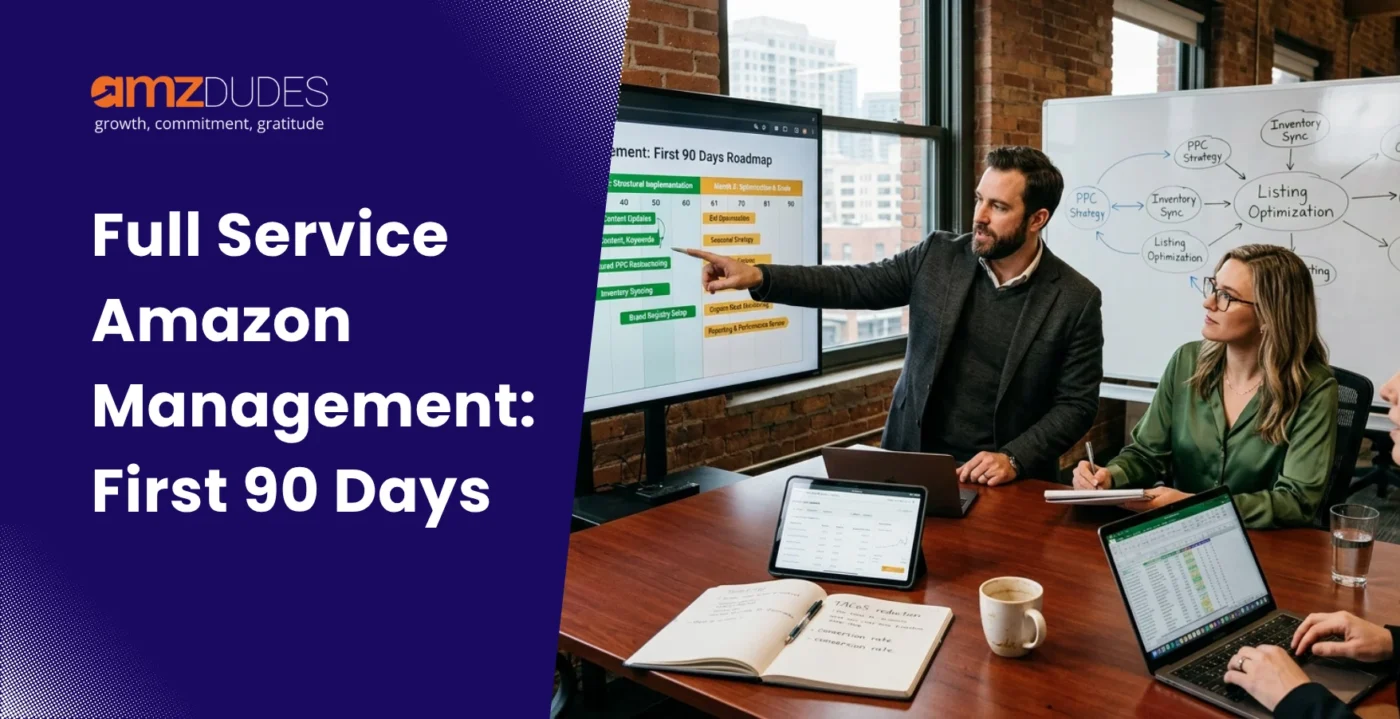
90-Day Roadmap Delivered Before Campaign Changes Begin
By the end of month 1, the agency should deliver a documented 90-day roadmap that includes: the specific findings from the audit, the prioritized list of structural changes planned for days 30 to 60, the optimization approach for days 60 to 90, and realistic performance targets for each 30-day checkpoint.
This roadmap is the accountability document for the entire engagement. It converts the audit findings into a specific action plan with measurable milestones. If your agency does not produce this document, you have no objective way to evaluate whether their subsequent work matches what they said they would do.
Days 30 to 60: Structural Fixes and Rebuild
Month 2 is the implementation phase. The structural changes identified in the audit are executed systematically, usually in order of impact: highest-impact fixes first, refinements second.
PPC Campaign Architecture Rebuild
Campaign structure is typically the highest-impact change. The rebuild includes:
Match type separation. Exact, phrase, broad, and auto campaigns are separated into their own campaigns with independent budgets. This prevents budget from flowing to low-converting broad terms when exact match keywords deserve more investment.
Intent-based tiering. Campaigns are organized into awareness, consideration, and conversion tiers. Each tier receives budget proportional to its role in the funnel rather than receiving equal allocation regardless of intent level.
Negative keyword foundation. The wasted spend identified in the audit is addressed immediately through comprehensive negative keyword lists at both campaign and ad group levels. This is often the single fastest return-on-investment action in the entire 90-day plan.
Budget reallocation. Spend is shifted from underperforming campaigns to proven performers based on audit data. The Amazon account management plan should document the rationale for every budget change so performance can be evaluated against the stated logic.
Listing Optimization and A+ Content Publication
Listings identified in the audit as underperforming on CTR or CVR receive focused optimization:
Title restructuring to include the primary keyword within the first 80 characters while maintaining readability. Titles should be written for shoppers first and Amazon’s index second.
Bullet point rewrite to address the top 3 to 5 purchase objections in the category rather than listing product specifications that buyers do not evaluate at the bullet-point stage.
Backend keyword audit and rebuild to ensure all available character space is used with genuine, non-duplicate keywords that expand indexing beyond what the visible content covers.
A+ Content publication with benefit-focused modules that answer specific buyer questions and advance the purchase decision. For DTC brands, Amazon A+ Content should maintain visual consistency with the brand’s website and packaging to reinforce recognition across channels.
Image gallery optimization including main image competitive assessment, lifestyle image additions, and infographic creation for products where visual feature communication improves conversion.
Catalog Cleanup
The catalog issues identified in the audit are resolved during this phase:
Suppressed listing reinstatement. Every suppressed or inactive listing is diagnosed, corrected, and resubmitted. Some of these listings may have been offline for weeks or months, representing significant silent revenue loss.
Variation restructuring. Broken parent-child relationships are repaired. Incorrectly merged variations are separated. Review consolidation is verified across all child ASINs.
Browse node and category corrections. Products assigned to incorrect browse nodes are moved to the correct categories, which improves filter-based discoverability.
Brand Protection Setup
For Amazon account management for brands with registered trademarks, brand protection is configured during this phase:
Brand Registry protections activated including automated IP violation detection and reporting.
Unauthorized seller monitoring established with a defined process for identifying and addressing unauthorized third-party sellers.
Buy Box monitoring configured to alert when Buy Box ownership drops below acceptable thresholds, which can indicate unauthorized seller activity or pricing issues.
Inventory Coordination Handoff
If inventory coordination is within the engagement scope, month 2 establishes the communication and forecasting process:
Sales velocity data shared with the brand’s supply chain team to inform reorder timing and quantity decisions.
Advertising-inventory alignment established so the agency does not increase spend on ASINs approaching stockout, and does not reduce spend on ASINs with excess inventory that needs velocity.
FBA inbound planning coordinated to ensure inventory arrives ahead of demand rather than arriving after advertising has already generated orders the brand cannot fulfill.
Days 60 to 90: Optimization, Testing, and Stabilization
Month 3 is where the structural work from month 2 begins producing visible compounding results. The focus shifts from building to refining.
Weekly Search Term Report Discipline Established
By day 60, the weekly Search Term Report review cadence should be fully operational. This is the most important ongoing habit in Amazon advertising management and the one most directly responsible for sustained efficiency improvement.
Each weekly review identifies: non-converting search terms for negative keyword addition (typically any term with 20+ clicks and zero conversions), converting search terms from auto or broad campaigns for promotion to dedicated exact match campaigns, and emerging keyword opportunities that the initial strategy did not target.
This discipline is what produces continuous ACoS improvement month over month rather than a one-time fix that gradually degrades.
Placement Modifiers and Dayparting Refinement
With 30 to 45 days of performance data at the new campaign structure, placement-level and time-of-day patterns become clear enough to optimize against.
Placement modifiers are applied based on actual conversion rate differentials between Top of Search, Product Page, and Rest of Search. If Top of Search converts at 14 percent and Product Page converts at 5 percent, a modifier concentrating spend on Top of Search improves overall efficiency without changing keyword targets.
Dayparting adjustments concentrate bids during peak conversion windows and reduce them during low-performance hours. With 30 days of hourly data under the new structure, these patterns are statistically reliable enough to act on.
Creative Testing and A/B Experiments Launched
With the baseline listing optimizations from month 2 now generating conversion data, month 3 is the right time to begin testing:
Manage Your Experiments (A/B tests) on main images, titles, bullet points, and A+ Content for ASINs with sufficient traffic to produce statistically significant results within 4 to 8 weeks.
Sponsored Brands Video creative testing with different hooks, product demonstrations, and messaging approaches.
A+ Content module sequencing tests to determine which module order produces the highest scroll depth and conversion rate.
Full Reporting Cadence in Place
By day 60 to 70, the full reporting cadence should be operational. For most engagements, this means:
Weekly reports covering campaign performance, Search Term Report actions taken, budget changes, and any operational issues addressed.
Monthly reports covering TACoS trend, ACoS by campaign tier, organic rank movement on priority keywords, conversion rate changes, and strategic recommendations for the coming month.
Quarterly business reviews (starting at day 90) covering the full picture: baseline-to-current performance comparison, roadmap progress against the original 90-day plan, and strategic planning for the next quarter.
What Results to Expect by Day 90
Setting realistic expectations for each checkpoint prevents the frustration that comes from expecting month-3 results at day 14.
Quick Wins Visible by Week 2 to 4
The fastest-impact changes produce visible results within the first month, often during the audit phase itself:
Wasted ad spend identified and cut. Negative keyword additions from the audit typically reduce wasted spend by 10 to 25 percent within the first 2 to 3 weeks.
Suppressed listings reinstated. Listings that were silently offline begin generating revenue again immediately upon reinstatement.
Obvious listing errors corrected. Title keyword gaps, missing backend search terms, and pricing anomalies flagged during the audit are fixed quickly.
These quick wins often produce enough immediate improvement to demonstrate the value of the engagement before the larger structural work has even been completed.
Structural Improvements Visible by Day 60
The campaign rebuild and listing optimization from month 2 produce measurable changes by the end of month 2:
ACoS begins improving as the new campaign architecture concentrates budget on higher-converting keywords and match types.
Conversion rate improves on optimized listings as updated titles, bullets, images, and A+ Content begin accumulating conversion data.
Catalog revenue recovers as previously suppressed or misclassified listings begin contributing again.
Expect some fluctuation during this phase. Amazon’s algorithm needs time to adjust to structural changes, and interim performance may dip temporarily before stabilizing at a better level. An experienced agency communicates this pattern clearly rather than overpromising smooth, linear improvement.
Compounding Results Visible by Day 90
By day 90, the compounding effects of structural fixes, ongoing optimization, and weekly Search Term Report discipline should produce:
TACoS trending downward as organic sales grow proportionally faster than ad spend. This is the clearest signal that the engagement is building durable value rather than simply spending more efficiently.
Organic rank improving on priority keywords. The combined effect of better conversion rate, increased sales velocity, and focused keyword targeting should produce measurable organic rank gains on the 10 to 20 keywords identified as priorities during the audit.
Conversion rate holding above pre-engagement baseline across optimized ASINs, confirming that listing improvements are translating into real buyer behavior changes.
A clear baseline-to-current comparison documented in the day-90 report showing exactly where every metric stood at engagement start versus where it stands now.
If these results are not visible by day 90, the agency should be able to explain specifically why, backed by data, and present a revised plan for the next quarter. If they cannot, that is a meaningful signal about the engagement’s trajectory.
Conclusion
The first 90 days of a full-service Amazon management engagement follow a specific, structured sequence: diagnose before acting, build before optimizing, and let the compound effects of structural improvements produce the results that bid adjustments alone cannot deliver. Agencies that rush past the audit to show quick wins, or skip the structural rebuild to focus only on bids, produce temporary improvements that do not hold.
The 90-day framework in this guide gives you a concrete standard to evaluate any agency against. By day 30, you should have a documented audit and roadmap. By day 60, structural changes should be implemented across campaigns, listings, and catalog. By day 90, compounding results should be visible in TACoS, organic rank, and conversion rate. If your agency is not meeting these checkpoints, the framework tells you exactly where the gap is and what questions to ask.
If you want a partner who executes this 90-day framework with senior-led accountability, integrated PPC, listing, and catalog work, and reporting tied to the metrics that actually measure growth, AMZDUDES, a full service Amazon agency, can help. Our Amazon account management for brands is built around the structured 90-day engagement process covered in this guide, with clear milestones and documented accountability at every checkpoint.
Frequently Asked Questions
What does full service Amazon management include?
Full service amazon management covers six operational areas: PPC and advertising management (Sponsored Products, Brands, Display, DSP), listing optimization and creative (titles, bullets, images, A+ Content, Brand Store), catalog and account operations (suppressed listings, variations, browse nodes, account health), brand protection (unauthorized sellers, counterfeit monitoring, Buy Box tracking), inventory coordination (forecasting, reorder recommendations, FBA planning), and reporting (TACoS, ACoS, margin, NTB, organic rank). If your engagement does not explicitly cover all six, it is partial management regardless of the label.
Why should the first 30 days be audit-only?
Making structural changes to campaigns or listings without first understanding the current state and the specific causes of underperformance produces changes based on assumptions rather than data. The audit identifies the actual problems, their relative priority, and the specific fixes needed. Agencies that skip the audit and immediately start adjusting bids are addressing symptoms rather than causes, which produces temporary improvements that do not hold.
How long does it take to see results from full-service management?
Quick wins (wasted spend reduction, suppressed listing fixes) typically appear within weeks 2 to 4. Structural improvements (ACoS improvement, conversion rate gains) appear by day 60. Compounding results (TACoS decline, organic rank improvement) appear by day 90. Full flywheel effects, where organic rank, paid efficiency, and content conversion compound together, appear at the 90 to 120 day mark. Agencies promising dramatic results in the first week are typically only adjusting bids.
What should a 90-day roadmap include?
A professional Amazon account management plan delivered at day 30 should include: comprehensive audit findings across PPC, listings, catalog, and brand health. Documented baseline metrics for every KPI that will be measured. A prioritized list of structural changes planned for days 30 to 60 with specific deliverables and timelines. The optimization approach for days 60 to 90. Realistic performance targets for each 30-day checkpoint. This document becomes the accountability framework for the entire engagement.
What metrics should I expect in reporting?
Beyond standard ACoS, a full-service agency should report on: TACoS to confirm advertising is building organic growth, conversion rate by ASIN with testing results, organic rank movement for priority keywords, wasted spend recovered through negative keywords, New-to-Brand percentage from advertising, and a strategic narrative explaining what changed, why, and what comes next. Reports that show only clicks, impressions, and ACoS are not sufficient for a full-service engagement.
Is full-service management appropriate for DTC brands new to Amazon?
Yes, and it is often more important for DTC brands than for Amazon-native sellers. DTC brands bring strong products and brand equity but typically lack Amazon-specific operational expertise. A full-service Amazon account management engagement protects brand equity during the Amazon expansion by handling listing optimization, Brand Registry setup, pricing parity with DTC channels, and advertising strategy while the brand’s internal team focuses on product development and DTC operations. The first 90 days for a DTC brand also include account setup and Brand Registry configuration, which Amazon-native sellers already have in place.
What if results are not visible by day 90?
If the compounding results described in Section 5 are not visible by day 90, your agency should be able to explain specifically why with data. Common legitimate reasons include: the category is exceptionally competitive and organic rank movement takes longer, listing creative testing has not yet reached statistical significance, or inventory issues prevented the full advertising plan from executing. The key is whether the explanation is specific, data-backed, and accompanied by a revised plan. If the explanation is vague or the agency cannot articulate what went wrong and what changes they will make, that is a signal worth acting on.