Key Takeaways
- Amazon-exclusive expertise: hire consultants who specialize solely in Amazon PPC and understand its ad system, data, and category dynamics.
- Beyond ACoS: choose experts who optimize TACoS, ROI, CVR, and organic rank for sustainable profitability, not just a lower ACoS number.
- Strategic, data-backed execution: look for structured keyword research, precise targeting, and well-organized campaigns.
- Clarity and credibility: trust consultants who provide transparent reporting and proven case studies.
- Sustainable growth vision: partner with experts who build long-term, data-driven roadmaps that integrate SEO, DSP, and AMC.
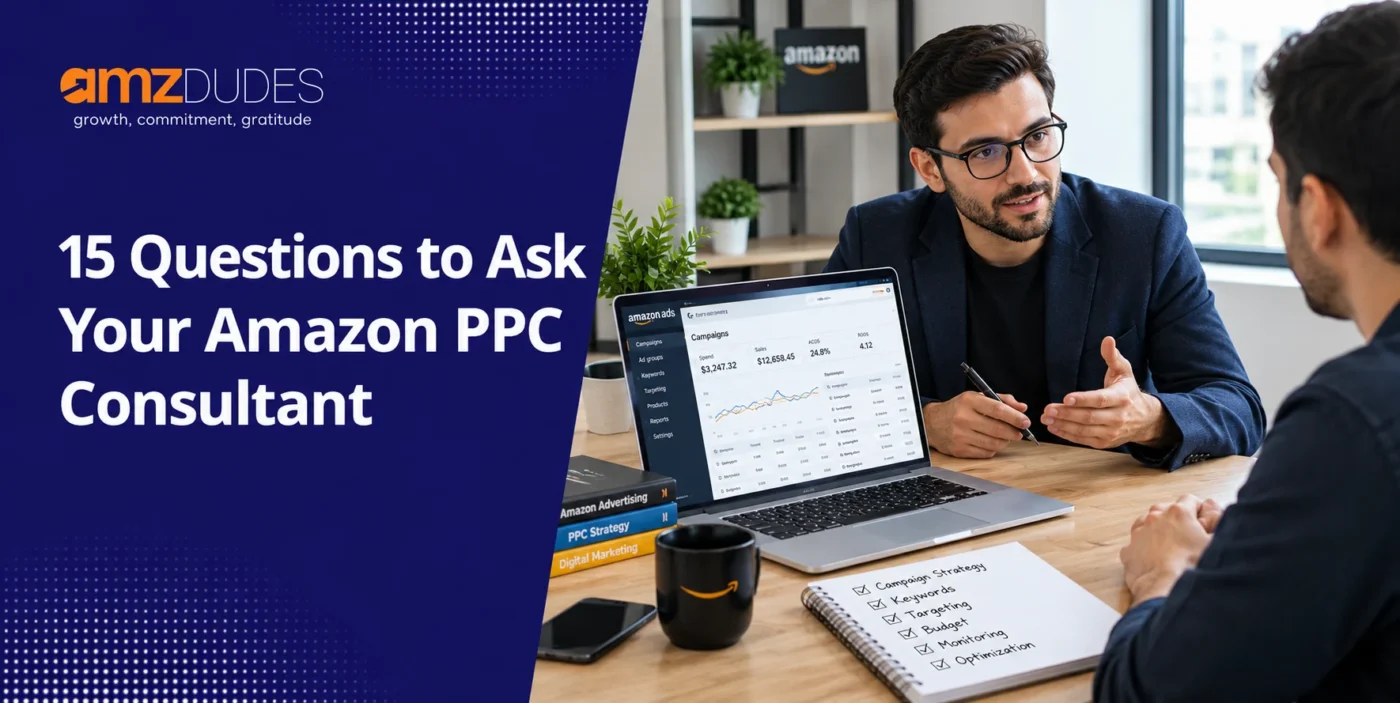
Hiring an Amazon PPC consultant is one of the highest-leverage decisions your brand will make. One wrong hire can drain your ad budget and stall your revenue, while the right one can lift it for months. The line between a right and a wrong hire is thin, and the fastest way to tell them apart is to ask the right questions before you sign.
So this guide walks you through 15 essential questions to ask an Amazon PPC consultant before hiring. These are not regular interview questions.
Treat the full set of Amazon PPC consultant questions below as hiring criteria, each one designed to reveal the real capability and strategic thinking behind the pitch, so you can judge who will actually grow your account.
1. What is your experience with Amazon PPC?
Your first question to an Amazon PPC consultant should be about their experience with Amazon PPC specifically, then narrowed to your product niche. Amazon ads are not like Google or Facebook ads that a full-stack marketer can handle. Amazon has its own rules, updates, data models, and winning strategies, so anyone joining you as an Amazon PPC expert must know the platform’s updates, Amazon PPC campaign structuring methods, and the practices that actually grow an Amazon business. That is also why the line between a right and a wrong Amazon PPC consultant hire comes down to verifiable experience, not a polished pitch.
A strong candidate can tell you how many years they have focused on Amazon PPC, the types of accounts they have handled (wholesale, private label, agency), the niches they know, and the monthly ad spend they have managed. If it looks like they just switched to Amazon ads with no portfolio of successful case studies, treat it as a red flag and keep looking.
How an expert should answer:
“I have managed Amazon PPC campaigns for over five years, focused solely on Amazon advertising. My portfolio spans home and kitchen, beauty, and supplements, where I have helped brands scale from $10K to $1.2M+ in monthly revenue. I build structured, data-driven campaigns across Sponsored Products, Sponsored Brands, and Sponsored Display.”
A good consultant does not just name KPIs like ROAS, ACoS, and TACoS. They show how they moved them. For example: “Over the past year I managed more than $5 million in ad spend across private label and wholesale accounts, with a 28% reduction in ACoS, a 15% improvement in TACoS, and a 42% increase in total sales.” If you want a deeper refresher on what ROAS, ACoS, and TACoS actually measure, review them before the interview so you can press on specifics.
2. How do you lower ACoS without affecting profitability?
Your next question should be about their strategy for lowering ACoS without hurting profitability. Many inexperienced consultants focus only on cutting bids, which reduces spend but also kills ranking momentum and sales. A true expert balances ACoS, TACoS, and ROI to make ad spend more efficient. Here is what an experienced consultant should do:
- Start with break-even ACoS: They review your break-even ACoS to find campaigns that are overspending. High-ACoS campaigns get optimized or paused, while strong performers stay active to hold ranking and traffic.
- Rebuild and organize campaigns: If your account structure or naming convention is messy, fix it first. A clean setup makes Amazon PPC optimization smoother and the data easier to read.
- Use negative targeting smartly: They add negative keywords in Auto, Broad, and Phrase campaigns to stop wasting money on irrelevant clicks that never convert.
- Adjust bids from real CPC data: Instead of cutting bids at random, they check your average CPC. For example, if your bid is $1.20 but your average CPC is only $0.90, they might lower it toward $0.70 to bring performance closer to target without losing visibility.
- Push budget to what works: They shift budget to the best-performing keywords and ASINs to keep sales steady and scale the campaigns that are already profitable.
- Monitor TACoS and ROI continuously: They do not just watch ACoS. They make sure your TACoS improves, and your ROI increases over time, meaning more sales from both ads and organic traffic.
Red flag answer: “We just lower bids or pause high-ACoS campaigns until the numbers look better.” This can reduce spend temporarily, but it often kills ranking momentum, drops sales, and hurts overall profitability.
3. What is your approach to keyword research?
Keyword research sets the direction of your entire PPC strategy. Without a structured process, you target irrelevant traffic and waste spend. A professional follows a disciplined, data-backed Amazon PPC strategy rather than chasing random high-volume terms. A skilled consultant uses:
- Amazon Search Term Reports and Search Query Performance Reports to find high-converting keywords and real customer intent.
- Tools like Helium 10 Cerebro or DataDive for reverse-ASIN research to see which keywords competitors are winning sales on.
- Filters for search volume, competition, and conversion potential to shortlist only the most relevant, profitable terms.
- Segmentation by intent (ranking, discovery, branded, defensive) to structure campaigns that cover every stage of the funnel.
They should also explain how they promote converting keywords into exact match campaigns while pausing or excluding low performers to keep spend efficient and data clean.
Red flag answer: “We target high-volume keywords because they bring more traffic.”
This shows a lack of strategy and intent awareness. High traffic without conversions only drains your budget.
What to look for: a consultant who focuses on relevance, intent, and profitability, so every keyword drives ranked, converting, sustainable sales.
4. How do you define success beyond ACoS?
ACoS tells you a lot about PPC performance, but it is not the only metric that should be optimized, monitored, and reported. When you hire an Amazon PPC expert, choose someone who values the full set of performance metrics:
- TACoS (Total ACoS): shows how ad spend affects total sales. A falling TACoS with steady or higher sales means your ads are fueling organic growth.
- ROI: measures overall profitability from ad spend, not just cost control.
- NTB (New-to-Brand) sales: how many first-time customers your ads bring in.
- CVR (conversion rate): how well your listings convert ad traffic into purchases.
- CTR (click-through rate): ad engagement and keyword relevance.
- Organic rank: how paid campaigns lift organic visibility over time.
Red flag answer: “We only focus on ACoS.” A professional always connects ACoS with TACoS, ROI, and organic rank to measure real success. Your brand needs a consultant who understands how PPC drives organic growth and builds a long-term, sustainable strategy, not just short-term ad sales.
5. Can you share a successful case study or client results?
Do not rely on wordy talk when you hire an Amazon PPC expert. Ask the consultant to share case studies, reports, and success stories. A genuine expert shows their portfolio confidently to prove credibility and performance. If someone deflects with “I can’t share results or case studies due to confidentiality,” treat it as a red flag. There are always ways to show anonymized before-and-after data without breaching a client’s privacy.
6. How do you balance Sponsored Products, Brands, and Display?
Ask how they balance Sponsored Products, Sponsored Brands, and Sponsored Display. Each ad type serves a specific purpose and contributes differently to visibility, conversions, and brand growth. The three main ad types on Amazon are:
- Sponsored Products: the backbone of any PPC strategy. They capture high-intent shoppers and drive direct sales through keyword-level targeting.
- Sponsored Brands: build awareness, strengthen recall, and promote your range. A good consultant uses them to grow branded search and cross-sell.
- Sponsored Display: used for retargeting, product defense, and audience expansion, keeping you visible after the shopper leaves the search page.
An expert knows how to allocate budget across these, so your strategy covers both acquisition and retention. If someone relies only on Sponsored Products and ignores the other two, they do not understand the full-funnel potential of Amazon advertising.
7. How do you structure Amazon PPC campaigns?
Proper structuring is one of the most critical parts of Amazon PPC management. Without a clear setup, optimization gets messy, tracking becomes confusing, and results turn inconsistent. A strong consultant emphasizes organization and naming conventions so performance is always easy to read. Here is what they should do:
- Create or refine brand-defense campaigns to protect branded keywords and ASINs from competitor targeting.
- Prioritize single-keyword campaigns for top-performing terms to improve ranking and control budget precisely.
- Use clear, consistent campaign names to separate auto, manual, and research campaigns for easier reporting.
- Build dedicated competitor-targeting campaigns to monitor spend, analyze performance, and capture market share from competitor listings.
- Keep research campaigns active to test new keywords and discover profitable opportunities.
Red flag answer: “We just put all keywords in one campaign.” This shows a lack of strategy and makes it impossible to track or optimize accurately.
8. How often do you optimize campaigns?
Amazon PPC is not a set-and-forget channel. Optimal performance requires continuous optimization. Ideally, optimization happens once or twice a week, with daily performance tracking. A strong cadence sounds like:
- Daily: monitor and adjust high-spending campaigns to catch issues early, watching how each day’s budget is spent and adjusting accordingly.
- Weekly: review performance and find scaling opportunities. Adjust bids, placements, and negatives based on data trends, and shift budget toward keywords and campaigns delivering stronger ROI.
- Monthly: run a full account audit to assess profitability and growth, launch campaigns for top or seasonal keywords, refine targeting, and update the plan for the month ahead.
Red flag answer: “We optimize monthly.”
What to look for: a consultant who watches performance closely and makes proactive decisions rather than waiting.
9. What is your framework for product launches and seasonality?
Ask how they handle product launches and seasonality. A successful launch needs a mix of smart aggression and control, and a professional plans ahead rather than reacting after the data arrives. An effective framework includes:
- Exact match campaigns to drive early sales velocity and keyword ranking.
- Listing optimization before launch to ensure strong conversion potential.
- Review-building tactics aligned with PPC exposure for faster trust and clicks.
- Budget pacing to manage CPC spikes during high-demand periods.
- Seasonal planning done a quarter ahead, with budgets and creatives pre-tested.
Red flag answer: “We’ll react once the data comes in.” This reflects poor planning and missed opportunities during the most critical phases.
What to look for: a consultant who emphasizes predictive planning, early testing, and structured seasonal workflows.
10. How do you use negative keywords to reduce wasted spend?
Ask how they use negative keywords, since this is key to stopping wasted spend and improving efficiency. A professional has a clear process to remove irrelevant clicks and protect profitable search terms:
- Run weekly search term checks to find poor or irrelevant queries.
- Add negative keywords based on CTR and conversion data.
- Use shared negative lists to avoid duplicate targeting across campaigns.
- Monitor keyword overlap so multiple campaigns do not bid on the same term.
Red flag answer: “We don’t use negatives much.” This signals poor optimization and a lack of control.
What to look for: a consultant with a clear system for exclusions who regularly removes wasted traffic to improve results.
11. How do you scale campaigns responsibly?
Ask how they scale. Scaling is not just raising budgets; it is growing reach while keeping performance stable, and a professional expands only when the data supports it:
- Watch key signals such as improving CTR, stable CVR, and enough margin room before increasing spend.
- Check inventory levels so stock can handle higher demand without losing rank.
- Increase budgets gradually rather than doubling spend overnight.
- Expand reach smartly using lookalike ASIN targeting, product bundling, or category-based DSP retargeting.
Red flag answer: “We double the budget on what’s working.” This shows a lack of data-driven planning and can quickly hurt profitability.
What to look for: an expert who scales through measured steps, clear data signals, and margin-focused decisions for consistent, sustainable growth.
12. How do you integrate PPC with organic SEO?
Ask how they align PPC and SEO, because both work hand in hand on Amazon. When a shopper clicks your ad, it is your listing that decides whether they buy. A good consultant uses PPC to create momentum and SEO to keep that growth steady. They run ads on keywords that actually convert, then use the ad data to improve titles, bullets, and backend keywords. They replace weak keywords with stronger, high-intent ones, so every click helps your listing rank better and sell more. Work with consultants who connect PPC and SEO to build real, long-term growth, not just quick wins.
13. How do you report performance to clients?
Top-notch performance means little if the consultant cannot report it clearly. When you hire an expert, ask about their reporting cadence and how they will keep you informed about wins, challenges, and setbacks. Look for someone who:
- Provides detailed reports with a monthly breakdown of organic and PPC sales.
- Explains clearly what actions were taken and what comes next based on the outcomes.
- Uses graphs, charts, and professional dashboards instead of long paragraphs, so you can see reporting cadence and results at a glance.
14. How do you use advanced tools or Amazon Marketing Cloud (AMC)?
Ask how they use advanced tools like Amazon Marketing Cloud (AMC). AMC gives a complete picture of customer behavior, far beyond standard ad reports. A skilled consultant uses AMC to:
- Track the full customer journey, not just last-click conversions.
- Run custom queries to understand how shoppers move from awareness to purchase.
- Build precise audience segments for retargeting and upper-funnel campaigns.
- Measure incrementality to see which campaigns actually drive new sales, not just repeat ones.
This level of data insight separates advanced partners from average ones. AMC reveals which touchpoints influence buying decisions so every ad dollar works smarter.
15. What is your long-term vision for my brand’s growth?
Ask about their long-term growth plan. A real expert does not just report ACoS; they show you where your brand is headed and how they will get it there. A strong consultant should:
- Set a 6 to 12 month roadmap with clear growth goals and forecasted results.
- Plan cash flow and budget pacing to support scaling without hurting profitability.
- Outline expansion steps, including when to move into DSP, video ads, or international marketplaces.
- Define clear milestone phases, where each step builds on the last and turns short-term wins into long-term brand strength.
Red flag answer: “We’ll just keep doing what works.” This shows no plan for scale or sustainability.
What to look for: a consultant who builds a data-backed growth roadmap, tracks progress, and takes proactive steps to scale your brand month after month.
Final Thoughts
Choosing an Amazon PPC consultant is one of the most important growth decisions your brand will make. You are not just hiring someone to run ads; you are trusting them to shape your visibility, profitability, and long-term position on Amazon. The right partner turns data into direction and strategy into sales momentum, and the 15 questions above are how you find them before you sign.
At AMZDUDES, a full-service Amazon agency, we do not believe in one-size-fits-all campaigns. Every strategy is built around your brand’s stage, goals, and market potential, combining advanced analytics, creative testing, and Amazon-specific expertise to deliver results that keep improving over time. You can see what that looks like across brands in our case studies.
If your goal is sustainable growth, predictable returns, and complete clarity in your ad performance, then see how we turn advertising into a competitive advantage.
Frequently Asked Questions (FAQs)
What questions should I ask an Amazon PPC consultant before hiring?
Start with their Amazon-specific experience, how they lower ACoS without hurting profitability, their keyword research process, how they define success beyond ACoS, and whether they can share real case studies. From there, ask about campaign structure, optimization cadence, negative keyword process, scaling approach, PPC and SEO integration, reporting, use of AMC, and their long-term roadmap. The 15 questions in this guide cover each of these in order.
What is the most important question to ask an Amazon PPC consultant?
“Can you share a case study with real before-and-after numbers?” is the single most revealing question. Any consultant who has managed Amazon PPC profitably has documented results, including ACoS and TACoS movement, revenue growth, and timeframe. If they cannot produce them, that is the clearest signal to keep looking.
How do I know if an Amazon PPC consultant is actually good?
A strong consultant specializes in Amazon rather than running it alongside Google and Facebook ads, optimizes TACoS and ROI rather than only ACoS, structures campaigns cleanly, uses negative keywords systematically, connects PPC to organic rank, and reports weekly with clear next steps. Vague answers, guaranteed ACoS numbers, and monthly-only reporting at meaningful spend are red flags.
What is the difference between an Amazon PPC consultant and an agency?
A consultant usually advises and audits on a project or retainer basis, diagnosing problems and setting direction while your team or another operator runs campaigns day to day. An agency builds and owns the strategy and executes it, often integrating PPC with listing creative and customer data. Choose a consultant for strategic guidance and an agency for full management.
How many questions should I ask before hiring an Amazon PPC consultant?
There is no fixed number, but the 15 questions here are designed to work as a complete screening framework covering experience, strategy, execution, reporting, and vision. Even asking the top five, experience, ACoS strategy, keyword research, success metrics, and case studies- will quickly separate a capable expert from a convincing pitch.