
Key Takeaways
- Hiring the wrong Amazon PPC expert is more expensive than not hiring one. A bad hire inflates ACoS, wastes ad budget, and sets campaigns back months.
- Three distinct roles exist: Amazon PPC Specialist (tactical execution), PPC Manager (strategy and oversight), and PPC Consultant (audit and advisory). Each suits a different brand stage and budget.
- The freelancer vs agency decision comes down to one question: Do you need someone to execute a strategy you already have, or someone to build and own the strategy entirely? Freelancers execute. Agencies strategise, integrate, and scale.
- The seven evaluation criteria that separate real expertise from a convincing pitch: ACoS and TACoS track record, keyword isolation competency, campaign structure clarity, Search Term Report fluency, audience segmentation capability, margin awareness, and proof of revenue growth.
- The highest-risk hiring mistake is not asking for case studies. Any expert worth hiring has documented results with real numbers. If they cannot produce them, keep looking.
- Amazon PPC agencies operate entirely remotely; location is irrelevant. The right partner in Austin manages accounts as effectively as one around the corner.
Hiring the wrong person to manage your Amazon PPC campaigns is one of the most expensive mistakes a brand can make. It is more damaging than not hiring anyone at all because a bad hire actively wastes your ad budget, produces misleading data, and may require months of cleanup before performance recovers.
The average CPC on Amazon has climbed to $1.04 in 2026, with competitive categories exceeding $1.50. At these rates, campaigns managed by someone who understands the platform’s auction mechanics, margin-based bidding, and keyword structure produce meaningfully different outcomes than campaigns managed by someone who simply knows how to create a campaign in Campaign Manager.
This guide gives you the complete framework: how to determine what type of hire you actually need, what to look for when evaluating candidates, where to find real talent, what to pay, and how to structure the hiring process so you do not get burned.
What Type of Amazon PPC Expert Do You Actually Need?
The term “Amazon PPC expert” covers a wide range of roles with significantly different responsibilities, costs, and appropriate use cases. Hiring a specialist when you need a manager or a freelancer when an agency would serve you better wastes money in both directions.
Amazon PPC Specialist, Manager, and Consultant: What Each Role Does
Amazon PPC Specialist A PPC specialist handles the tactical execution of campaigns, creating ad groups, managing keyword bids, pulling and acting on Search Term Reports, adding negatives, and monitoring daily performance. They operate within a strategy someone else defines.
Best for: Brands with an internal marketing lead who owns strategy but needs a dedicated operator to execute campaigns. Monthly ad spend is typically under $15,000.
Signs you need a specialist, not a manager: You know what you want campaigns to achieve and can define success metrics clearly. You need execution capacity, not strategic direction.
Amazon PPC Manager: Amazon PPC managers own a strategy, define campaign architecture, set goals, interpret performance data at the account level, and report to ownership or leadership. They direct execution (which may be handled by a specialist or team) and make higher-level decisions about budget allocation, match type strategy, and funnel structure.
Best for: Growing brands without internal PPC leadership. Monthly ad spend $15,000–$50,000. Brands launching new ASINs regularly or managing a catalog of 20+ products.
Signs you need a manager, not a specialist: You are not sure what your campaigns should look like. You need someone who can tell you what to do, not just do what you tell them.
Amazon PPC Consultant: Amazon ppc consultants provide audit, advisory, and strategy services typically on a project or retainer basis rather than ongoing campaign management. They diagnose problems, build frameworks, and advise on direction. They do not operate campaigns day-to-day.
Best for: Brands that have in-house operators but want an experienced outside perspective. Brands whose internal team manages campaigns but whose performance has plateaued. Monthly ad spend at any level, but consultation is most valuable above $10,000.
Signs you need a consultant, not a manager: You have people who can execute but lack the strategic clarity to know what to execute. You want an audit before a structural rebuild.
| Role | Key Responsibility | Best Suited For | Typical Monthly Cost |
| PPC Specialist | Campaign execution, bid management, keyword ops | Brands with <$15k ad spend have an internal strategy | $500–$1,500 |
| PPC Manager | Strategy ownership, campaign architecture, reporting | Mid-sized or scaling brands, $15k–$50k ad spend | $1,500–$4,000 |
| PPC Consultant | Audits, advisory, strategic direction | Brands with operators who need strategic guidance | $100–$250/hr |
| Full Agency | End-to-end strategy + execution + reporting | Multi-ASIN brands, $15k+ ad spend, need full team | $1,500–$7,000/month |
Freelancer vs Agency vs In-House: Which Is Right for Your Situation?
This is the most consequential structural decision in Amazon PPC hiring. It determines not just cost but also the capability ceiling, how sophisticated your campaigns can become, and how quickly problems get resolved.
When a freelancer is the right choice:
- You have a clearly defined strategy and need someone to execute it, not build it
- Your catalog is focused, and your campaigns are relatively stable
- You have internal bandwidth to oversee their work and catch gaps
- You need flexibility, freelancers can be scoped down or paused more easily
- Your advertising can be managed in isolation from listing creative and customer data
When an agency is the right choice:
- You need a strategy owned, not just executed by someone who builds the architecture, not just runs it
- Your catalog is growing, and campaigns need to be connected to listing quality and creative performance
- You want your advertising, listing creative, and customer insights working as a unified system rather than in silos
- You need team depth, backup coverage, specialised capability in DSP, AMC, and audience targeting
- You are scaling and need a partner who has seen your problem in other accounts before yours
The deeper reason agencies outperform freelancers at scale: A freelancer manages your ads. A full-service agency unifies your ads, listing creative, and customer insights into a single performance system. This distinction matters because Amazon advertising does not work in isolation. A Sponsored Products campaign pointing to a listing with a weak main image, a low review count, or a price above the category average will always underperform, regardless of how technically correct the keyword targeting is.
The brands that scale profitably on Amazon are not the ones with the most optimised bids. They are the ones whose advertising, listing quality, and creative work go together. That integration connecting what the ad says to what the listing delivers to what the customer data reveals is what a capable full-service agency provides that a PPC-only freelancer structurally cannot.
When in-house is the right choice:
- Your monthly ad spend and account complexity have grown to a point where a dedicated internal hire is more cost-effective than an agency retainer
- Brand strategy and PPC strategy need to be integrated with daily operations at a depth that requires someone embedded in the business
- You have the infrastructure to recruit, onboard, manage, and retain specialist talent over time
The common mistake: Brands hire a freelancer when they need an agency because the freelancer is cheaper. Their campaigns grow in complexity, the freelancer reaches their bandwidth ceiling, performance plateaus, and the brand eventually hires an agency, anyway, having wasted 6–12 months and accumulated structural problems the agency then needs to fix.
The right question is not “what is the cheapest option?” It is “what level of capability does my account complexity actually require?”
Should You Outsource Amazon PPC or Build an Internal Team?
For many growing brands, outsourcing Amazon PPC advertising is more cost-effective at the beginning. Building an internal team only makes financial sense when:
- Your account complexity and monthly ad spend have grown to a point where a dedicated in-house manager is more cost-effective than a retained agency
- Your account requires daily brand-level coordination that an external partner cannot replicate at the depth you need
- You have the infrastructure to recruit, manage, retain, and backfill specialist talent
For brands below this threshold, the institutional knowledge an experienced agency brings, managing hundreds of accounts across categories and competitive landscapes, typically outperforms what an equivalent-cost in-house hire can deliver. An in-house hire learns your account. An agency has already seen your problem in someone else’s account.
There is also a structural difference in what each option can access. An in-house hire manages your PPC. A full service Amazon agency connects your PPC to your listing performance, your creative assets, and your customer insight data, because the team managing your campaigns can see what your creative team is doing and what your analytics are showing. That connected view is difficult to replicate with a single in-house employee working in isolation from listing and creative decisions.
This is why many scaling brands eventually ask which one is better, an Amazon PPC agency or in-house manager, because the decision affects not just campaign execution, but how connected your advertising, creative, and growth strategy becomes over time.
What to Look For When You Hire an Amazon PPC Expert
Credentials and years of experience are poor proxies for capability. Amazon’s advertising platform changes regularly; the tactics that worked in 2022 are not the same ones that work in 2026. The right evaluation criteria focus on demonstrated outcomes, not claimed expertise.
The Seven Criteria That Separate Real Expertise From a Good Pitch
1. Proven ACoS and TACoS track record:
Any Amazon PPC expert worth hiring can show you documented examples of ACoS reduction and TACoS management, not just ACoS in isolation. ACoS measures paid ad efficiency. TACoS measures total ad dependency. An expert who only tracks ACoS and lets TACoS rise is creating the appearance of optimisation while eroding organic rank.
Ask specifically: “Can you show me an account where you reduced ACoS while maintaining or improving TACoS over 90 days?”
2. Keyword isolation and exact-match extraction competency:
The ability to identify converting search terms from auto campaigns and exact-match manual campaigns, isolate them from broad match noise, and assign the right bid based on margin is the technical foundation of profitable Amazon PPC. An expert who cannot explain this process in specific terms is operating by feel rather than by system.
Ask specifically: “Walk me through how you move a keyword from auto campaign discovery to exact match manual campaign. What data do you use and at what threshold?”
3. Campaign structure clarity:
Ask any candidate to describe the campaign architecture they would build for a brand spending $20,000/month on ads across 30 ASINs. The answer reveals immediately whether they think structurally separate match types in separate campaigns, ASIN isolation, dedicated defensive and offensive campaigns, or whether they create all-in-one campaigns that blend data and make diagnosis impossible.
Red flag: “I would create Sponsored Products, Sponsored Brands, and Sponsored Display campaigns.” This is a campaign-type list, not a structural answer.
Strong answer: “I would start with one auto campaign per ASIN segmented into four ad groups, migrate proven converting search terms to exact match manual campaigns after 14 days, build separate phrase match discovery campaigns, and isolate branded keywords in a dedicated defensive campaign. Budget allocation would start at 40% exact match, 25% phrase, 20% auto, 15% ASIN targeting.”
4. Search Term Report fluency:
Search Term Reports remain one of the most important tools in Amazon PPC optimization because they reveal which customer queries are actually generating profitable conversions. An expert who cannot describe a specific weekly workflow for pulling it, actioning negatives, migrating winners, and tracking keyword expansion is not operating at a professional level. Ask them to walk through their Search Term Report process, the specific columns they sort by, the thresholds they use for negation, and how they document what they find.
5. Audience segmentation and real-time bidding awareness:
Amazon’s 2025 advertising console updates introduced granular audience segmentation and real-time bidding adjustments. A current expert understands how to segment audiences by purchase behaviour, browsing history, and demographic signals, and how to apply bidding adjustments that reflect conversion likelihood across different audience segments. If a candidate’s knowledge stops at keyword match types and has no awareness of audience-level targeting, they are behind the current platform.
6. Margin awareness and business context:
The best Amazon PPC hires think like business partners, not campaign operators. They understand that an ACoS of 35% might be profitable for one product and loss-making for another because profitability depends on margin, not on the ACoS number itself. They calculate break-even ACoS before setting any bid. They understand TACoS as a business health signal, not just an advertising metric.
Ask: “How do you determine the right ACoS target for a product before you begin managing its campaigns?” A strong answer begins with the margin profit per unit, Amazon fees, and COGS, and derives the target from there.
7. Proof of revenue growth, not just efficiency improvement:
ACoS optimisation that shrinks revenue is not a success. The goal of Amazon PPC management is profitable revenue growth, not a lower ACoS number achieved by cutting spend until the account barely advertises. Ask specifically for case studies showing both ACoS improvement AND revenue growth. When these move together, the strategy is working. When ACoS improves while revenue flattens or declines, the strategy is sacrificing growth for efficiency.
A related question worth asking: how does the expert connect advertising decisions to listing quality and creative performance? The best Amazon PPC partners understand that an ad is only as strong as the listing it points to, that CTR is determined by the main image before it is determined by the keyword, and that CVR is determined by the listing before it is determined by the bid. An expert who treats PPC as a closed system, disconnected from listing creative and customer insight data, will hit a performance ceiling that better keyword management cannot break through.
What an Amazon PPC Specialist Job Description Should Actually Require in 2026
If you are hiring a specialist role (in-house or freelance), these are the genuine requirements, not the generic job board language:
Technical requirements:
- Proficiency in Amazon’s Advertising Console, Campaign Manager, and Bulk Operations
- Ability to pull, interpret, and action all advertising report types (Search Term, Keyword, Placement, Advertised Product)
- Demonstrated experience with exact-match isolation from auto campaigns
- Familiarity with Search Query Performance reports and Brand Analytics (Brand Registry)
- Understanding of dynamic bidding types and when each is appropriate
- Experience with negative keyword management at campaign and ad group levels
Strategic requirements:
- Ability to calculate break-even ACoS and max profitable CPC from unit economics
- Understanding of TACoS as a business health metric alongside ACoS
- Experience in structuring campaigns by match type, ASIN, and intent
- Familiarity with funnel-stage campaign mapping (awareness, consideration, conversion)
Communication requirements:
- Weekly performance reporting with interpretation, not just data delivery
- Clear explanation of what changed, why it changed, and what the next action is
- Ability to flag problems proactively before they become expensive
Red Flags That Tell You to Walk Away Before You Sign
They cannot produce case studies with real numbers:
Any expert who has managed Amazon PPC campaigns profitably has documented results. If they offer testimonials but no performance data, ACoS reduction percentage, revenue growth, or New-to-Brand rate improvement, they either do not have results worth showing or are concealing poor performance. Walk away.
They guarantee specific ACoS outcomes:
ACoS is determined by an auction. No one controls auction outcomes; they can only influence them through bid management, keyword strategy, and listing quality. Any guarantee of a specific ACoS number is a fabrication designed to close the sale. It is not a professional commitment.
Their fee structure incentivises higher spend, not better returns:
Some agencies charge a percentage of your ad spend, meaning their revenue grows automatically as your budget grows, regardless of whether performance improves. At $30,000/month in ad spend and a 15% fee, they earn $4,500/month simply by keeping your budget high. There is no inherent incentive to make spending more efficient.
If you encounter this pricing model, you require clear performance guardrails, a TACoS cap, an ACoS target, or a revenue floor below which the fee is reduced. Alternatively, ask directly: Is your fee tied to your expertise and the work involved, or to the size of my budget? The answer tells you whose interest the pricing model serves.
They cannot explain their reporting cadence:
“We send monthly reports” is not an adequate answer for an account spending $20,000/month on ads. At that spend level, meaningful data accumulates in days, not months. A professional management partner reports weekly with specific metrics, specific changes made, and specific next actions, not a monthly PDF summary.
They talk only about ACoS, never TACoS:
TACoS is what separates a campaign manager from a business partner. An expert who only references ACoS in their pitch has a campaign-level view, not a business-level view. The brands that scale profitably track both.
Their “strategy” is entirely tool-dependent:
Helium 10, Scale Insights, and similar tools are excellent for automating execution. They are not a substitute for strategic judgment. An expert whose entire approach is “I use Helium 10 Adtomic to manage bids” is telling you they automate execution but have not described the strategy that execution serves.
The seven criteria mentioned above reveal a simple truth:
The results you get from Amazon PPC depend on how much visibility your partner has into the full business. A PPC-only specialist can optimise campaigns, but they cannot fix weak listings, low CTR images, or missed customer insights that affect performance.
That is why a full service Amazon Agency outperforms PPC-only setups. When ads, listing creative, and customer data work together, every optimisation compounds instead of working in silos. Our Amazon PPC Services are connected to your listing quality and customer insights, so campaign data improves your creative, and customer behavior sharpens your targeting.
Where to Find Professional Amazon PPC Experts Online
This section covers where real talent lives, not the generic.
Vetted Platforms and Communities That Surface Real Talent
LinkedIn for targeted outreach:
LinkedIn is the most reliable channel for finding Amazon PPC specialists and managers with verifiable work history. Use specific search filters: “Amazon PPC” + “Sponsored Products” + location (if you prefer US-based). Review their posting history. Professionals who publish content about Amazon advertising typically know what they are talking about. Direct message is more effective than applying to job posts.
MarketerHire and Toptal for vetted freelancers:
These platforms pre-vet candidates before they appear on the platform. MarketerHire specialises in performance marketers and has an Amazon advertising vertical. Toptal screens for the top 3% of applicants. Both cost more than standard freelance platforms; their value is in reducing your vetting burden, not in lower rates.
Boutique Amazon agencies for full service management:
Boutique agencies specialising exclusively in Amazon (rather than general digital marketing agencies that offer Amazon as one of many services) typically produce better Amazon-specific results. They hire specialists whose careers are built on Amazon expertise, not generalists learning Amazon alongside Google Ads and Facebook campaigns.
The most capable of these agencies do not just run ads. They connect your advertising performance to your listing creative, your customer insight data, and your organic ranking signals, so the work compounds rather than operates in silos. When your PPC team can see your listing data and your creative team can see your campaign data, the decisions they make are fundamentally different from what a PPC-only manager can produce working in isolation.
AMZDUDES is a full service Amazon advertising agency, not a general digital agency with an Amazon offering. Our team unifies PPC strategy, listing creative, and customer insights for brands spending $10,000–$500,000/month on Amazon advertising. Our case studies show what this integrated approach produces in practice across Health & Household, Beauty & Personal Care, Food & Beverage, Sports Nutrition, and DTC-to-Amazon expansion.
Specialist job boards, such as RemoteOK, We Work Remotely, Contra:
For hiring freelance Amazon PPC talent specifically, attract remote-first professionals. Search specifically for “Amazon PPC” or “Amazon advertising” rather than general PPC; the skills are not transferable from Google Ads without significant platform-specific learning.
PPC hiring partners and specialist recruiters:
For in-house roles above $75,000/year, specialist recruiters with e-commerce and Amazon advertising networks can significantly reduce time-to-hire. They maintain relationships with passive candidate professionals who are not actively job-searching but would move for the right opportunity. This channel is worth the recruiter fee for senior roles.
Where the Best Amazon PPC Talent Actually Is in 2026
The community consensus confirmed across Amazon seller forums, Reddit’s r/AmazonFBA, and specialist Slack groups is that the best Amazon PPC talent has largely moved away from generalist freelance marketplaces. The reasons:
- Top performers do not need to compete on price on commodity platforms
- They are fully booked through referrals, agency employment, or long-term client relationships
- The best work reaches them through referrals from other Amazon sellers, agency partnerships, or direct LinkedIn outreach
The most reliable sourcing channels for high-quality Amazon PPC talent:
- Referrals from other Amazon brand owners ask in seller communities (Amazon Seller Forums, Helium 10 Facebook Group, Seller Roundtable) who they use and trust
- LinkedIn direct outreach to professionals with visible Amazon PPC content
- Agency partnerships where you get a team, not an individual, with built-in backup
- Vetted platforms (MarketerHire, Toptal), where quality screening has already been done
A note on location: Amazon PPC agencies and experts work entirely remotely; campaigns are managed through Campaign Manager regardless of where the manager sits. There is no operational reason to restrict your search to local providers. An Amazon PPC agency based in Austin manages US marketplace campaigns as effectively as one around the corner. Restrict your search by expertise and results, not geography.
How Much Does It Cost to Hire an Amazon PPC Expert?
Understanding Amazon PPC agency pricing is important before comparing freelancers, consultants, and full service agencies, because pricing structures vary significantly based on scope, account complexity, and level of strategic involvement.
Here are the current 2026 ranges for the US market.
Cost by Hire Type
| Hire Type | Monthly Cost | Best For | Notes |
| Freelance Specialist (global) | $500–$1,500/month | Brands that have a strategy and need execution capacity | Variable quality vetting is your responsibility |
| Freelance Manager (US, vetted) | $1,500–$3,500/month | Brands that need strategy direction and execution | Senior specialists command the higher end |
| PPC-Only Agency | $1,500–$4,000/month | Brands wanting expert PPC management without a full-service scope | Focused on advertising, only listing and creative are separate |
| Full-Service Amazon Agency | $2,000–$7,000/month | Brands that want PPC, listing, creative, and insights unified | Compounds faster than PPC-only because all levers connect |
| In-House PPC Manager | $65,000–$95,000/year | Brands at scale where embedded expertise justifies the overhead | Plus benefits, tools, recruiting, and backfill cost |
| Strategic Consultant | $100–$250/hour | Audits, launch planning, and advisory services before committing to management | Project-based, not ongoing |
Fully-loaded in-house cost:
A mid-level in-house Amazon PPC manager at $75,000/year costs approximately $90,000–$102,000 annually when benefits, payroll taxes, tools, and recruiting amortisation are included, $7,500–$8,500/month. At this cost level, the in-house hire needs to deliver meaningfully more value than an agency retainer at a comparable investment, which is a high bar given the institutional knowledge an experienced agency brings from managing accounts across categories and competitive landscapes.
How Amazon PPC Management Fee Structures Work
Flat monthly retainer:
A fixed fee regardless of ad spend. Predictable costs, stable budgeting, and no automatic fee inflation as your budget grows. This model aligns the agency’s incentive with delivering value, not with the size of your spend. Common for brands with stable monthly budgets who want cost certainty and a partner focused on performance, not scale.
Performance-based / revenue share:
A base fee plus a percentage of incremental revenue growth above an agreed baseline. The most aligned model for brands focused on growth. Requires a clear definition of what counts as agency-attributable growth and a clean measurement framework to avoid disputes. Less common but increasingly preferred by brands that want their partner’s compensation to reflect outcomes.
Hybrid (base + performance):
A base retainer covering management costs plus a performance component tied to revenue growth or ACoS improvement targets. Attempts to balance stable management economics with outcome alignment.
Percentage of ad spend:
Some agencies charge a percentage of your total monthly ad spend, typically 10–20%. The inherent risk: the agency’s revenue grows as your budget grows, regardless of whether performance improves. If you encounter this model, ask directly: What performance targets come with it? A percentage-of-spend model without performance guardrails serves the agency’s interest more than yours.
The question to ask any agency:
“Is your fee tied to your expertise and the work you deliver, or to the size of my budget?” The answer reveals the underlying incentive structure, which determines whether your interests and theirs are aligned.
AMZDUDES, a full service Amazon Agency, does not operate on a fixed pricing model. Engagements are structured around what each brand actually needs, not a standard package applied regardless of catalog size, goal, or complexity. Whether you are a brand just beginning to scale or one managing significant monthly ad spend, the starting point is a conversation about your specific situation.
How to Know If the Cost Is Justified by Your Ad Spend
A simple justification framework:
Is the management fee less than the value improvement the expert delivers?
If your campaigns are currently running at 45% ACoS and your break-even ACoS is 30%, you are losing money on every ad-driven sale. A professional who reduces ACoS to 25% on a $20,000/month spend account saves approximately $4,000/month in wasted spend, significantly more than a $2,500/month management fee.
The break-even test: estimate your current wasted spend (spend above your break-even ACoS threshold). If the management fee is less than the estimated waste you are currently generating, the fee is economically justified before accounting for any revenue improvement.
How to Structure the Hiring Process So You Do Not Get Burned
The brands that make consistently good PPC hires do not rely on interviews and intuition. They use a structured process that produces evidence of capability before any commitment is made.
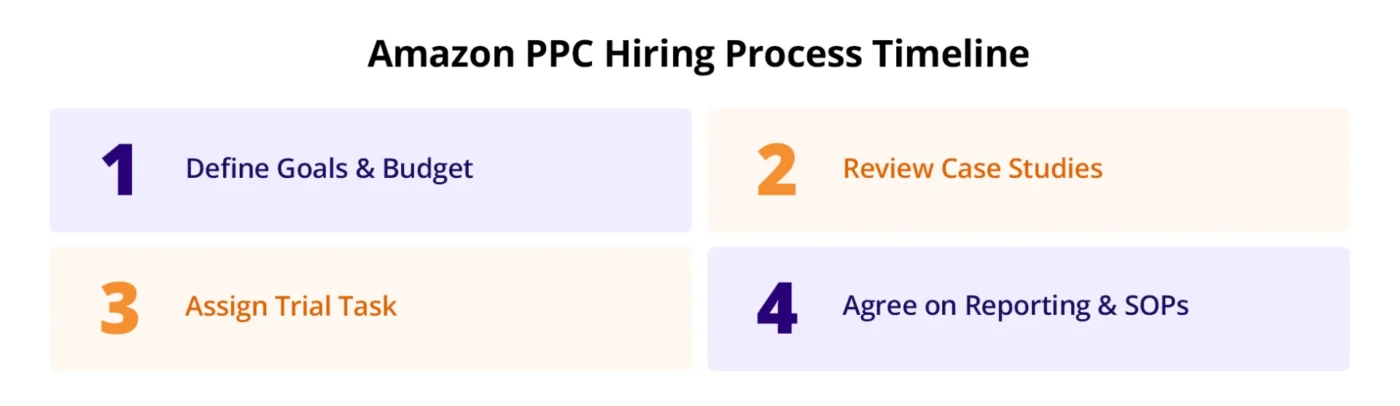
Step 1: Define What You Need Before Outreach Begins
Before reaching out to any candidate or agency, document:
- Your current situation: Monthly ad spend, current ACoS, TACoS trend, ASIN count
- Your goal: Launch new products, reduce ACoS, scale existing campaigns, or all three
- Your internal capacity: Do you have someone to provide brand context and approve strategy, or do you need the hire to own everything?
- Your budget: Maximum monthly management fee you can sustain regardless of results
This clarity prevents the most common hiring failure: briefing a candidate incompletely, then evaluating them on expectations you never communicated.
One of the smartest things you can do before signing any contract is prepare a list of questions to ask before hiring an Amazon PPC agency, especially around reporting, campaign ownership, fee structure, and case-study transparency.
Step 2: Request Case Studies What to Look For and What to Ignore
What a strong case study contains:
- The situation before engagement started (ACoS, TACoS, ad spend level, problem being solved)
- The specific actions taken (not “we optimised campaigns” but “we segmented auto campaigns into four ad groups by targeting type, built exact match manual campaigns from Search Term Report winners after 14 days, and implemented a weekly negative keyword review”)
- The results with actual numbers (ACoS from X% to Y%, revenue from $A to $B, New-to-Brand rate, TACoS trend)
- The timeframe (how long these results took to achieve)
What to ignore:
- Results with no before-and-after context (telling you ACoS is 22% means nothing without knowing where it started)
- Results with no timeframe
- Revenue growth without a margin context (growing revenue at negative margins is not a success)
- Generic testimonials without specific performance data
AMZDUDES case study examples you can review:
- Explicit Essentials scaled from $11,885 to $131,329 in 90 days with 96%+ New-to-Brand customers through structured PPC and catalog optimisation
- Health & Household reduced ACoS from ~165% to ~61% while 3× monthly revenue, moving beyond the limits of in-house PPC management
- DTC to Amazon Expansion drove $438K in revenue and 8,900+ New-to-Brand customers through structured Amazon PPC and catalog strategy
- Sports Nutrition Brand 7,157 New-to-Brand customers and $324K+ in first-time sales within 10 months using PPC and Subscribe & Save strategy
- Food & Beverage Brand 65% YoY revenue growth and 8,853 New-to-Brand customers through Amazon PPC, bundles, and Subscribe & Save
When evaluating any agency or expert, request case studies from a category similar to yours. The challenges in supplements differ from those in home goods. Category-specific experience matters.
Step 3: Assign a Trial Task That Tests Strategic Thinking
The trial task is the most reliable hiring signal available. It reveals how a candidate actually thinks, not how they present in an interview.
For agencies: Ask for a strategic response to a fictional (or your actual, anonymised) account scenario: “This account is spending $18,000/month on Sponsored Products with a 52% ACoS. The break-even ACoS is 35%. What would your first 30 days look like?”
A strong response includes: a diagnostic framework (what data they would pull first and why), a prioritised action sequence (what they would fix in what order), and an honest assessment of what is and is not under their control.
A weak response: “We would optimise bids, refine keywords, and improve your ACoS.” This is a generic claim with no specific process.
For individual specialists: Assign a paid task reviewing a Search Term Report and providing specific recommendations, or auditing a Campaign Manager screenshot for structural issues. Pay them for this task. Anyone qualified enough to hire is qualified enough to be paid for their time.
Step 4: Agree on Reporting Cadence and SOPs Before You Sign
Before committing to any engagement, confirm in writing:
Reporting frequency and content: What reports are delivered, at what cadence, and what do they include? Weekly performance updates with campaign-level ACoS, TACoS, and spend versus budget should be the minimum. Monthly strategic reviews covering trend analysis and forward-looking recommendations should be separate from weekly operational reports.
Communication channels and response time: How are day-to-day questions handled? What is the expected response time? Who is the primary contact, and who covers when they are unavailable?
Access and account control: You retain admin access to your Amazon Advertising Console at all times. The expert or agency should be an Editor, not the sole Admin. You should be able to see everything they are doing, download any report, and make changes if needed.
Scope definition: What is explicitly included in the management fee, and what costs extra? DSP management, Amazon Marketing Cloud analytics, creative production, and A+ content. If these are not in scope, know that before signing.
Performance review terms: Define at what point performance is reviewed formally and what happens if targets are consistently missed. A well-structured engagement includes a 60-day performance review with agreed metrics and a clear process for addressing underperformance.
Before you hire, speak with someone who has seen this problem before
Every account we take on has a version of the same story: campaigns that technically work but do not grow the business the way they should. The targeting is reasonable. The structure is functional. But performance has plateaued, because the ads are disconnected from the listing creative they point to, and disconnected from the customer data that should be shaping them.
That disconnection is the problem most PPC hires cannot fix. Not because they lack skill, but because they lack visibility.
As a Full Service Amazon Agency, AMZDUDES unifies your Amazon advertising, listing creative, and customer insights into a single performance system, so your ad spend drives profit, not just traffic. Our Amazon PPC Services are built around your brand’s specific situation, your catalog size, your spend level, your competitive landscape, and your margin reality. No fixed packages. No generic playbooks. Just a strategy built around what your account actually needs.
If you have been managing campaigns and wondering why the results have stopped moving, or if you are preparing to hire and want an honest assessment of what your account actually needs, start with a conversation. There is no pitch, no commitment, and no fee for the first call.
Frequently Asked Questions
What is an Amazon PPC specialist?
An Amazon PPC specialist is a professional who manages the tactical execution of Amazon Sponsored Ads campaigns, creating and structuring campaigns, managing keyword bids, pulling and actioning Search Term Reports, adding negative keywords, and monitoring daily performance. They work within a strategy defined by a manager or client. Best suited for brands that have a clear strategy in place and need execution capacity, not strategic direction.
What does an Amazon PPC specialist’s job description typically include?
Core requirements include proficiency in Amazon Campaign Manager and Bulk Operations, experience with keyword research and match type management, ability to interpret Search Term and Keyword reports, negative keyword management, bid optimisation using ACoS data, and weekly performance reporting. Senior roles add TACoS tracking, campaign architecture design, and audience segmentation capability.
Should I hire an Amazon PPC agency or a freelancer?
The core question is: do you need someone to execute a strategy you already have, or someone to build and own the strategy entirely? Freelancers execute well within a defined brief. Agencies build the strategy, connect it to your listing creative and customer data, and own the results. If your campaigns need strategic direction, creative integration, or team-level capability, an agency is the right choice regardless of spend level.
How much does it cost to hire an Amazon PPC expert?
Freelance specialists: $500–$1,500/month. Freelance managers (US, senior): $1,500–$3,500/month. PPC-only agencies: $1,500–$4,000/month. Full-service Amazon agencies: $2,000–$7,000/month. In-house PPC manager: $65,000–$95,000/year fully loaded. Strategic consultants: $100–$250/hour. The management fee is justified when it is less than the wasted ad spend that the expert eliminates.
What fee structures do Amazon PPC agencies use?
The most common models are flat monthly retainers, performance-based fees tied to revenue growth or ACoS targets, and hybrid arrangements combining a base fee with performance incentives. Some agencies use percentage-of-spend models. Ask any agency how their fee is structured and whether it is tied to the size of your budget or to the results they deliver. The answer tells you whose interest the model serves.
How can an Amazon PPC expert improve my campaigns?
A qualified Amazon PPC expert improves campaigns by: eliminating keyword waste through systematic Search Term Report negation, migrating converting search terms from auto to exact match manual campaigns, setting bids from margin data rather than Amazon’s suggested ranges, optimising placement multipliers from actual placement-level ACoS data, separating match types and ASINs into clean campaign structures that produce readable data, and tracking TACoS to ensure ACoS improvements are building business health rather than eroding organic rank.
What are the red flags when hiring an Amazon PPC specialist?
Key red flags: inability to produce case studies with real numbers, guaranteed ACoS outcomes (no one can guarantee auction results), fee structures that incentivise higher spend without performance guardrails, monthly-only reporting at high ad spend levels, no mention of TACoS in their evaluation framework, and strategies that are entirely tool-dependent with no underlying strategic logic.
Does the location of an Amazon PPC agency or expert matter?
No. Amazon PPC management happens entirely through Campaign Manager remotely, regardless of where the expert sits. An agency in Austin, New York, or anywhere else manages US marketplace campaigns identically. Restrict your evaluation to expertise and results, not geography.
What is the difference between ACoS and TACoS, and why should my Amazon PPC hire know both?
ACoS (Advertising Cost of Sales) measures ad spend against ad-attributed revenue only. TACoS (Total ACoS) measures ad spend against total revenue, including organic sales. An expert who only tracks ACoS can produce a lower ACoS number by cutting spend on campaigns that are supporting organic rank, making the account look more efficient while actually reducing total revenue. A professional who tracks both confirms that ACoS improvements are building business health, not just improving a dashboard metric.
How do I evaluate Amazon PPC agency results in a case study?
Look for: before-and-after ACoS and TACoS numbers with a clear timeframe, revenue growth alongside efficiency improvement, New-to-Brand customer acquisition rates, and category-specific experience. Ignore: results without a before context, testimonials without performance data, and revenue growth without a margin context. Always ask for a case study from a category similar to yours.
How long does it take to see results after hiring an Amazon PPC expert?
Negative keyword management shows impact within 7–14 days. Meaningful ACoS improvement from keyword restructuring typically takes 4–8 weeks. Full campaign maturity, where bid decisions are based on reliable historical data and TACoS is trending correctly, takes 60–90 days. Any expert promising transformative results in the first 2 weeks is either extraordinarily lucky or misrepresenting what is possible.