
Key Takeaways
- An Amazon PPC expert does significantly more than adjust bids they diagnose campaign structure, build keyword architecture, connect advertising to listing and inventory performance, and optimize toward margin, not just ACoS.
- Expert Amazon PPC management moves the metrics that matter most conversion rate, TACoS trend, and new-to-brand customer rate, not just ACoS in isolation.
- The characteristics that define a real Amazon PPC specialist are specific and testable before hiring, ask about their Search Term Report workflow, how they calculate bid ceilings, and whether they track TACoS.
- The step-by-step process expert Amazon PPC management follows begins with diagnosis, not changing accounts that skip the audit phase, and jumping to bid adjustments rarely produces lasting improvement.
- Most brands need an Amazon PPC expert when account complexity, catalog size, competitive pressure, or spend level, outpaces what basic management or tools can handle reliably.
Amazon PPC management looks straightforward from the outside. Create campaigns. Target keywords. Adjust bids. Review performance. Repeat.
In practice, the gap between that description and what expert Amazon PPC management actually involves is wide enough to explain most of the underperformance brands’ experience when their campaigns are run by someone without genuine expertise, or by no one in particular.
An Amazon PPC expert is not simply someone who knows how to create a Sponsored Products campaign in Campaign Manager. They are someone who understands the full system that determines whether Amazon advertising produces compounding profit or manageable-looking waste, the auction mechanics, the campaign architecture decisions, the keyword funnel structure, the connection between advertising and listing quality, the margin-based bid framework, and the weekly optimisation process that keeps all of it improving rather than decaying.
This guide explains what Amazon PPC experts actually do, what distinguishes real expertise from basic management, what to look for when hiring, and the step-by-step process expert management follows.
What an Amazon PPC Expert Actually Does
The most useful way to understand what an Amazon PPC expert does is to compare it to what non-expert management looks like, because the difference is not obvious from the outside, and it does not always show up immediately in the numbers.
Expert Management vs Basic Campaign Management: The Real Difference
Basic Amazon PPC management is reactive and tactical. Bids are adjusted when ACoS is high. Keywords are added when impressions are low. The Search Term Report is reviewed occasionally. Reports show what happened. The campaign structure from launch is largely the same six months later.
Expert Amazon PPC management is diagnostic and structural. Before any bid is changed, the expert asks why the ACoS is high, is it a keyword relevance problem, a listing conversion problem, a bid misalignment problem, or a campaign structure problem? Each cause requires a different fix, and applying the wrong fix to the right symptom is one of the most common and expensive errors in Amazon advertising.
The practical difference:
| Basic Management | Expert Management |
| Lowers bid when ACoS is high | Diagnose the cause of high ACoS first |
| Reviews Search Term Report monthly | Reviews and actions Search Term Report weekly |
| Sets bids from Amazon’s suggested range | Calculates the maximum profitable CPC from the margin data |
| Reports what happened | Explains what happened, why, and what changes next |
| Adds keywords from the tool estimates | Mine’s converting queries from live campaign data |
| Manages campaigns in isolation | Connects campaigns to listing, inventory, and rank signals |
This shift from reporting to diagnosis is the foundation of real Amazon PPC optimization, and it changes which metrics you track, which bids you touch, and what you fix first.
The Specific Responsibilities of an Amazon PPC Management Expert
An Amazon PPC management expert is responsible for:
Keyword strategy and campaign architecture:
Designing the campaign structure from first principles, which match types serve which purposes, how budget is allocated between discovery and conversion campaigns, how ASINs are isolated to preserve data clarity, and how the keyword universe is grown systematically from live campaign data rather than static research.
Margin-based bid management:
Setting and adjusting bids based on the break-even ACoS calculated from each product’s actual unit economics, not benchmarks or suggested ranges. Every bid decision references the maximum profitable CPC: Profit Per Unit × Conversion Rate.
Search term management:
Weekly Search Term Report review, negating irrelevant queries before they accumulate significant waste, promoting converting queries to exact match manual campaigns, and mining patterns for keyword expansion. This single weekly action produces more ACoS improvement than any other optimisation activity in most accounts.
Listing-to-campaign diagnosis:
Identifying when poor Amazon PPC performance is caused by listing quality issues rather than campaign issues. Low CTR on a relevant keyword signals a listing appearance problem – weak main image, uncompetitive price, or poor title, not a bid problem. An expert who sees both the campaign data and the listing data applies the right fix.
Inventory-aware campaign pacing:
Monitoring inventory depth and adjusting campaign spend to avoid wasting budget on out-of-stock ASINs. Every click on an out-of-stock listing is pure waste – and the ranking signals built with that spend are simultaneously eroding.
TACoS monitoring:
Tracking Total Advertising Cost of Sales (total ad spend ÷ total revenue, including organic) to confirm that ACoS improvements are building business health rather than eroding organic rank. An Amazon PPC expert who only tracks ACoS is optimising the wrong signal.
Strategic reporting:
Delivering weekly reports that explain what changed, why it changed, and what the next period’s focus is, not monthly spreadsheets of numbers that require the client to interpret.
What Amazon PPC Specialists, Consultants, and Managers Each Handle
The terms Amazon PPC expert, Amazon PPC specialist, Amazon PPC consultant, and Amazon PPC manager are often used interchangeably, but they represent different role types with different scopes of responsibility.
Amazon PPC Specialist:
Handles tactical execution, campaign creation, keyword additions, bid adjustments, Search Term Report review, and negative keyword management. Works within a strategy defined by someone else. Best suited for brands that have a strategic direction but need execution capacity.
Amazon PPC Manager:
Owns strategy, sets goals, defines campaign architecture, and reports at the account level. Directs execution and makes higher-level decisions about budget allocation, match type strategy, and funnel structure. Best suited for growing brands without internal Amazon PPC leadership.
Amazon PPC Consultant:
Provides audit, advisory, and strategic direction, typically on a project or retainer basis without managing day-to-day execution. Diagnoses structural problems and designs the framework for internal teams or specialists to execute. Best suited for brands that have operators but need strategic clarity.
Amazon PPC Agency / Expert Team:
Covers the full scope, strategy, execution, creative alignment, reporting, and integration with listing and inventory management. Best suited for brands that want a partner who owns outcomes across the full Amazon advertising system.
Why Expert Amazon PPC Management Delivers Better Results
Expert Amazon PPC management does not just produce lower ACoS numbers. It produces a different kind of account, one where decisions are connected to outcomes, where the keyword universe grows over time, and where advertising compounds into organic visibility rather than creating dependency on paid traffic.
How Expert-Led Campaigns Outperform Self-Managed or Tool-Only Setups
The performance gap between expert-managed Amazon PPC and self-managed or tool-only setups shows up most clearly in three areas:
Keyword coverage that compounds:
A self-managed account typically has roughly the same keywords at month six as at launch, because no systematic process exists for mining the Search Term Report and promoting proven converting queries to exact match campaigns. An expert-managed account grows its library of validated buyer queries every week, producing progressively better targeting precision and lower average CPC on converting terms.
Budget allocation that reflects business goals:
A tool-only setup allocates budget based on recent performance signals, whatever was converted last week gets more spend. An expert-managed account allocates budget based on product role: core ASINs receive protected budgets for visibility stability, expansion ASINs receive controlled growth budgets, and support ASINs operate under efficiency caps. The result is more predictable total catalog performance and better protection of high-margin products during competitive periods.
ACoS improvements that hold:
Self-managed accounts frequently produce short-term ACoS improvements from budget cuts that simultaneously erode organic rank. TACoS rises even as ACoS falls. An expert-managed account monitors both metrics simultaneously and confirms that ACoS improvements reflect genuine efficiency gains rather than organic position sacrificed for a better-looking dashboard. This is the difference between Amazon PPC performance and reporting that drives decisions versus reporting that just documents what happened.
The Amazon PPC Average Conversion Rate, and Why Expert Management Moves It
Amazon’s average conversion rate for sponsored ads runs approximately 10–14% across categories. The range is wide, supplements and consumables often convert above 15%, while new product launches with limited reviews may convert below 5%.
Expert Amazon PPC management improves conversion rate through two levers that basic management rarely addresses:
Keyword intent alignment:
When discovery traffic (broad match, auto campaigns) and conversion traffic (exact match, proven buyer queries) share campaigns and budgets, the blended conversion rate looks lower than the account’s actual conversion potential. Separating these into distinct campaign structures reveals the true conversion rate of high-intent exact match traffic, often 2–3× the blended rate, and allows budget to be concentrated where conversion is strongest.
Listing quality feedback loop:
An Amazon PPC expert reads CTR and CVR data at the keyword level as a diagnostic signal for the listing, not just for the campaign. A keyword with 0.5% CTR when the category average is 1.2% is a listing appearance signal, main image, title, or price positioning is failing to generate a click. A keyword with strong CTR but below-8% CVR is a listing conversion signal, the detail page is not closing shoppers who were interested enough to click. Acting on these signals, by improving the listing rather than just adjusting the bid, is how expert management improves conversion rates that basic management leaves unchanged.
ACoS, TACoS, and the Metrics an Amazon PPC Expert Optimises Toward
ACoS (Advertising Cost of Sales) = Ad Spend ÷ Ad Revenue × 100. It measures how efficiently campaigns convert spend into ad-attributed revenue. Useful at the campaign level. Incomplete as a business health signal.
TACoS (Total Advertising Cost of Sales) = Total Ad Spend ÷ Total Revenue (organic + paid) × 100. It measures how advertising spend relates to the full business, including organic sales that advertising supports through ranking signals.
An Amazon PPC expert tracks both simultaneously and interprets them together:
| ACoS Trend | TACoS Trend | What It Means |
| Declining | Declining or stable | Advertising is working, efficiency improving, and organic growing |
| Declining | Rising | Organic rank eroding, ACoS improvement is cosmetic |
| Stable | Declining | Organic growing faster than paid dependency, very positive |
| Rising | Rising | Account needs a structural diagnosis |
| Rising | Stable or declining | Growth mode, acceptable if intentional (launch phase) |
Break-even ACoS is the foundational metric for every bid decision: (Profit Per Unit ÷ Sale Price) × 100. An Amazon PPC expert sets the target ACoS 5–10 points below break-even and evaluates every campaign decision against this number, not against industry averages or competitor benchmarks.
What to Look For When Hiring an Amazon PPC Expert
Hiring for Amazon PPC is a high-stakes decision, and one most sellers underestimate until after a poor hire has already cost them months of compounding inefficiency. A capable expert compounds results over time. An incapable one produces the same kind of managed-looking waste that comes from no expert at all, with an added management fee.
The evaluation criteria below are specific and testable. Use them in every expert hiring conversation.
The Skills and Characteristics That Define a Real Amazon PPC Expert
Analytical precision:
The ability to read campaign data at the keyword level, not just the campaign level, and distinguish between different causes of the same symptom. High ACoS can mean bid misalignment, keyword irrelevance, listing conversion failure, or campaign structure contamination. A real expert identifies which.
Margin awareness:
Understanding that every bid decision has a profitability implication specific to the product’s unit economics, not a general category average. The best Amazon PPC experts calculate break-even ACoS and maximum profitable CPC before setting a single bid, and revisit these calculations whenever COGS or fees change.
Structural thinking:
The ability to design campaign architecture, match type separation, ASIN isolation, budget allocation by product role, negative keyword layering across campaign types, that produces clean, readable data. An expert who cannot describe the campaign structure they would build for your account before touching Campaign Manager is not thinking structurally.
Listing and inventory integration:
Understanding that Amazon PPC performance is determined partly by what campaigns do and partly by what the listing and inventory deliver to the traffic campaigns drive. A real Amazon PPC expert flags listing quality issues that are suppressing campaign performance, and knows the difference between a campaign problem and a listing problem.
Communication clarity:
The ability to explain what changed, why it changed, and what the outcome was in language that the brand owner can evaluate and act on. Reporting that requires the client to interpret data is not expert communication. Expert communication tells the client what the data means.
TACoS fluency:
An Amazon PPC expert who only discusses ACoS does not have a full business-level view. TACoS is the metric that connects advertising to organic rank, the most important long-term signal in Amazon PPC management. Any expert who cannot explain TACoS and how they track it is not operating at a professional level.
Questions to Ask Before You Hire an Amazon PPC Specialist
Walk me through how you handle a keyword that is generating spend but not converting?
This question reveals diagnostic depth. A real expert explains how they identify the cause before prescribing the fix, checking search term relevance, listing CVR, campaign structure, and bid level. A basic manager says, “We would lower the bid or pause it.”
How do you calculate bids specifically? What formula do you use?
The correct answer: Maximum Profitable CPC = Profit Per Unit × Conversion Rate. Any answer that references Amazon’s suggested bid range as the primary input is a red flag.
What does your Search Term Report review process look like? What cadence, what thresholds, and what actions?
The correct answer: weekly review, negation at $15+ spend, and zero conversions, exact match promotion at 3+ conversions below break-even ACoS, negative exact added to source campaigns to prevent internal competition.
Do you track TACoS, and what does a healthy TACoS trend look like for a brand at our stage?
The correct answer names a specific TACoS target for the brand’s growth stage and explains what falling ACoS with rising TACoS means. An expert who does not track TACoS is managing campaigns, not the account.
Can you show me a case study from a brand in a similar category?
Category experience matters significantly. Amazon PPC for supplements requires different tactics than for home goods, apparel, or electronics. An expert with no documented results in a relevant category is learning on your account.
Red Flags That Tell You to Keep Looking
Guaranteed ACoS outcomes:
No one controls Amazon’s auction. A guarantee of a specific ACoS number protects the agency, not the client.
No direct access to the person managing the account:
The set-it-and-forget-it pattern that produces most Amazon PPC underperformance is structurally enabled when the client’s contact is an account manager, not the expert actually making decisions about their campaigns.
Monthly reporting only:
At meaningful ad spend levels ($10,000+/month), a monthly report means 30 days of avoidable waste can accumulate before anything is addressed. Expert Amazon PPC management includes a weekly Search Term Report review and weekly performance communication as a baseline.
No mention of TACoS:
ACoS-only reporting has a campaign-level view. Expert management has a business-level view. If TACoS never comes up, keep looking.
Cannot produce category-specific case studies:
Claimed expertise without documented results is an assertion, not evidence.
The Step-by-Step Process Expert Amazon PPC Management Follows
This is the section the blog title promises, the actual step-by-step process. Expert Amazon PPC management is not a single action or a monthly adjustment cycle. It is a structured, repeatable system that begins with diagnosis and compounds performance over time.
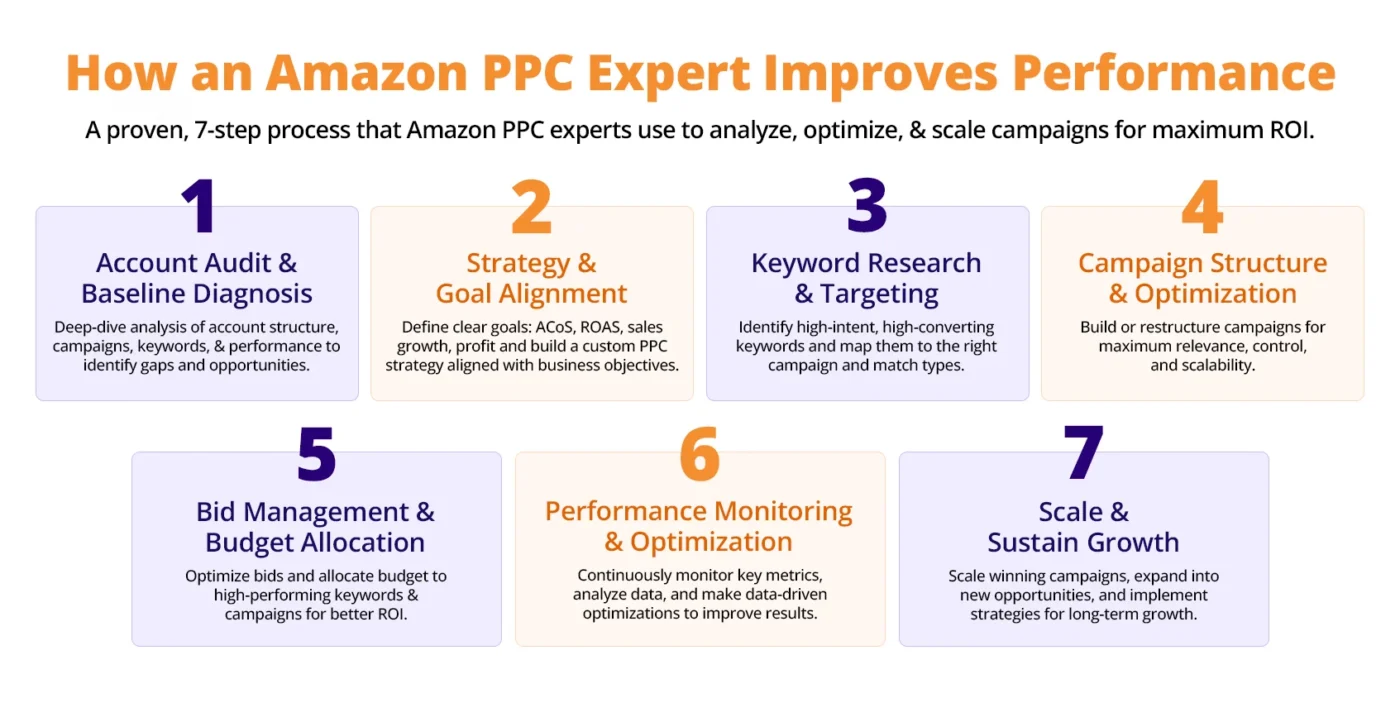
Step 1: Account Audit and Baseline Diagnosis
Before any campaign is created or any bid is changed, an Amazon PPC expert begins with a complete account audit. This is non-negotiable, changes made without understanding the account’s current state produce unpredictable results and often create new problems while addressing visible ones.
The audit covers:
Campaign structure review:
Are match types separated into distinct campaigns? Are ASINs isolated so their performance data is readable? Do campaign names follow a consistent convention that makes optimisation faster?
Search Term Report analysis (last 60–90 days):
What wasted spending has accumulated on irrelevant queries? Which search terms have converted consistently but have never been promoted to exact match campaigns? What patterns in converting terms reveal keyword expansion opportunities?
Bid levels vs break-even ACoS:
Is the current average CPC on each campaign above or below the maximum profitable CPC for the products being advertised? Are bids from the original setup still in place without adjustment?
TACoS trend:
Is advertising spend supporting organic rank growth or substituting for it? Has TACoS improved, held stable, or deteriorated over the last 90 days?
Listing-to-campaign diagnosis:
Are CTR levels on relevant keywords signalling a listing appearance problem? Is CVR data pointing to listing conversion issues that no bid change can fix?
Output of Step 1: A prioritised findings document ranked by financial impact. Not a generic “areas for improvement” summary, a specific list of what is wrong, why it is wrong, and what the fix sequence looks like.
Step 2: Campaign Architecture and Keyword Strategy
With the audit complete, the expert designs or redesigns the campaign architecture from first principles.
Campaign structure decisions:
Match type separation:
Broad match campaigns for discovery (finding new converting search terms at conservative bids), phrase match campaigns for mid-funnel intent capture, and exact match campaigns for proven converting queries at margin-based bids. Each in separate campaigns with separate budgets and separate optimisation logic.
ASIN isolation:
Each product is in its own campaign structure, where possible, so that a high-performing ASIN does not have its budget diluted by a weaker ASIN in the same campaign, and so that performance data is attributable at the product level.
Product role budget allocation:
Core ASINs (primary revenue drivers) receive protected budgets. Expansion ASINs (growth candidates) receive controlled budgets with defined ACoS tolerance during the learning phase. Support ASINs receive capped efficiency budgets.
Keyword strategy:
Seed keywords:
From Search Query Performance data, Brand Analytics, competitor reverse-engineering (Cerebro), and Amazon autocomplete, evaluated against purchase intent, listing relevance, and margin-supportable CPC.
Keyword funnel mapping:
Entry terms (broad, high-volume, lower intent) in discovery campaigns. Mid-intent terms in phrase match campaigns. High-intent long-tail terms and proven converting queries in exact match campaigns. Each layer is evaluated by different metrics and optimised toward different goals.
Step 3: Bid Management and Match Type Optimisation
With a clean campaign structure in place, bid management becomes precise rather than approximate, because each campaign type has a distinct role and a distinct bid framework.
The bid adjustment schedule:
- New campaigns: review after 14 days minimum, not before.
- Established campaigns: review monthly against 30-day performance data.
- Emergency adjustments (obvious waste above $50 in spend, zero conversions): within 7 days.
The bid adjustment framework:
| Keyword Performance (30-day) | Action | Increment |
| ACoS below 50% of break-even | Increase bid | +10–15% |
| ACoS 50–80% of break-even | Hold, monitor 2 more weeks | – |
| ACoS 80–100% of break-even | Small reduction | –10–15% |
| ACoS above break-even for 30+ days | Reduce bid | –20–30% |
| ACoS above 2× break-even for 30+ days | Reduce significantly or pause | –40–50% |
Bidding strategy selection by campaign stage:
- New campaigns (0–30 days): Dynamic Down Only. Amazon lowers bids in low-conversion scenarios. Protects the budget during data collection.
- Established campaigns (30–90 days) with conversion history: Dynamic Up and Down on proven keywords. Amazon can raise bids in high-conversion windows.
- Proven exact match keywords with reliable CVR: Fixed. Cost certainty where the conversion relationship is confirmed.
Placement multipliers: Only applied after Placement Report data confirms that a specific placement (Top of Search, Product Pages) converts at or below the target ACoS for this specific product. Never applied as a default or assumption.
Step 4: Search Term Report Analysis and Keyword Expansion
This is the highest-leverage ongoing action in expert Amazon PPC management and the one most commonly under-executed in non-expert setups.
The weekly Search Term Report workflow:
Negation (immediate waste elimination):
Pull the Search Term Report for the last 7 days. Sort by spend descending. Any search term with $15 or more in spend and zero conversions: add as a negative phrase at the campaign level immediately. Any obviously irrelevant term (wrong category, research intent, competitor brand name not being targeted): negative regardless of spend level.
Exact match promotion (winner isolation):
Any search term with 3 or more conversions and ACoS below break-even: create as an exact match keyword in a dedicated manual campaign at a bid calculated from the max profitable CPC formula. Add a negative exact in the source auto or broad match campaign to prevent internal competition on the same query.
Pattern mining (keyword expansion):
Look for patterns in converting search terms, modifiers (size, material, use case), attribute combinations, and long-tail structures. Generate new exact match candidates from these patterns and add to an exact match testing queue. This is how a professionally managed account’s keyword library grows from 50 converting terms to 200 over 6 months.
The compounding effect:
Week one of this process produces a modest ACoS improvement from negation. Month three produces a significantly more efficient account, because converting terms are concentrated in exact match campaigns, wasted spend is systematically eliminated, and the keyword library reflects what actual buyers use to find and purchase the product.
Step 5: Creative and Listing Alignment
Expert Amazon PPC management does not operate in isolation from what the listing delivers to the traffic the campaigns drive. This connection is where a full service Amazon agency produces structurally better results than a PPC-only management service because the same team that manages campaigns can see the listing data and flag the issues that are suppressing campaign performance.
How experts identify listing issues from campaign data:
Low CTR on a relevant keyword (below 0.3%):
The ad is appearing, but shoppers are not clicking. This is a listing appearance signal that the main image, title, or price is not compelling enough to generate a click in a crowded search result. The fix is in the listing, not the bid.
Strong CTR with below-8% CVR:
Shoppers are clicking but not buying. This is a listing conversion signal that the detail page is not closing the sale. Variables: review count and rating, price vs competitors, bullet point copy, A+ Content quality, and product images.
Consistent high ACoS across all keywords for a specific ASIN:
When ACoS is elevated across all keywords for one product, not selectively for specific terms, the problem is usually the listing rather than the campaign structure. A listing that converts at 5% will produce above-break-even ACoS regardless of how precisely the keywords are managed.
Creative decisions in expert management:
Sponsored Brands headlines are written to reflect the same purchase intent language as the Sponsored Products keywords, creating a consistent signal across the search results page. Sponsored Brands Video is produced for silent viewing with on-screen text, showing the product in the first 3 seconds, and targeting proven exact match keywords rather than experimental ones. A/B testing of main images, using real CTR data from campaigns to validate creative decisions, is part of the ongoing optimisation cycle.
Step 6: Reporting, TACoS Tracking, and Ongoing Optimisation
The final step in the expert Amazon PPC management process is what makes the previous five steps compound rather than plateau.
Weekly reporting framework:
A professional Amazon PPC expert delivers a weekly update that covers:
- What changed in the account this week (specific campaigns, keywords, bids, structures)
- Why it changed (the data signal that triggered the decision)
- What was the result relative to the target ACoS and TACoS trend
- What the next week’s focus is, specific actions planned, not a list of things being monitored
The monthly account review:
Every 30 days, a structured review covers: keyword-level ACoS versus break-even across all campaigns, Placement Report analysis for placement multiplier calibration, Advertised Product Report for ASIN-level diagnosis, TACoS trend over the full month, and budget allocation review, whether the distribution between core, expansion, and support ASINs still reflects current business priorities.
The quarterly strategic review:
Every 90 days: campaign architecture audit (keyword cannibalization, match type drift, ASIN isolation integrity), competitive landscape review (where competitors have gained or lost impression share), and product lifecycle review (whether ASIN classifications have changed, has an expansion product established organic rank, and graduated to core treatment?).
The compounding outcome:
An account managed through this six-step process for 90 days typically shows: 15–25% reduction in wasted spend from systematic negation, a growing library of exact match converting queries producing progressively lower average CPC, TACoS trending down as advertising-supported sales velocity builds organic rank, and reporting that the brand owner can use to make operational decisions, not just review as a performance record.
When You Need an Amazon PPC Expert and When You Do Not
Expert Amazon PPC management is not necessary at every stage of every business. Understanding when the investment is justified and when basic management is sufficient helps brands make the timing decision correctly rather than over-investing too early or under-investing too late.
Signs Your Account Has Outgrown Basic Management
The keyword list has not grown since launch:
If the same keywords that were in manual campaigns at month one are still the only keywords at month six, Search Term Report mining is not happening. Basic management can execute on an existing keyword list. Expert management grows it.
ACoS is high, but the cause is unclear:
When you know ACoS is above target but cannot identify whether it is a bid problem, a keyword relevance problem, a listing conversion problem, or a campaign structure problem, the account needs expert diagnosis, not more bid changes.
Spending more has not produced proportionally more revenue:
A brand that increases Amazon PPC budget by 50% and sees revenue increase 10% has hit the efficiency ceiling of its current campaign architecture. Spending more on a broken structure produces more waste, not more sales.
TACoS is rising despite stable or improving ACoS:
The most expensive version of this pattern: campaigns are being “optimised” in a way that is eroding organic rank. Expert management catches this. Basic management typically does not track TACoS at all.
Campaign management is taking more time than the account’s complexity warrants:
If an internal team is spending 10+ hours per week on Amazon PPC management for a 20-ASIN account and performance is still inconsistent, the time is being spent on execution rather than strategy. Expert management produces better outcomes in less client-side time.
Amazon PPC Management for Growing Brands and Large Catalogs
Amazon PPC management for growing brands has a specific inflection point, the moment when account complexity outpaces the capacity of whoever is currently managing it. This typically happens at:
- 15–20+ active ASINs with different margin profiles and lifecycle stages.
- $15,000+/month in monthly ad spend, where structural inefficiencies compound into significant absolute dollar waste.
- Entry into new Amazon categories or marketplaces where competitive dynamics are unfamiliar.
- Launch of new products into an existing account where the new ASINs need isolation from the established campaign structure.
At each of these inflection points, expert Amazon PPC management produces disproportionate returns because the structural decisions that need to be made are beyond what reactive campaign management can handle without creating new problems.
When to Hire an Amazon PPC Management Agency
An Amazon PPC management agency becomes the right choice when execution alone is no longer the constraint, when the account needs strategic direction, structural rebuilding, and a team that connects Amazon PPC to the full picture of listing performance, inventory, and customer data.
Specifically, the moment for an agency is when:
- Account complexity, catalog size, spend level, and competitive pressure have outpaced what any single person can manage without making structural trade-offs.
- Amazon PPC decisions need to be connected to listing creative, inventory forecasting, and customer insights because the performance ceiling of any campaign is determined by what the listing delivers to the traffic it drives.
- You need consistent weekly optimisation, not periodic check-ins, because at meaningful spend levels, a week of unreviewed Search Term Report data is a week of avoidable waste accumulating.
- The reporting you receive describes numbers but does not explain what they mean or what changes next.
The best Amazon PPC management agencies operate as an extension of the brand, not a vendor who manages campaigns in isolation. A full service Amazon agency that unifies your Amazon PPC, listing creative, inventory forecasting, and customer insights gives your advertising a structural advantage that Amazon PPC management services operating in isolation cannot produce because every campaign decision is informed by what the listing is doing, what inventory signals are showing, and what customer data reveals about buyer behaviour.
What Expert Amazon PPC Management Looks Like in Practice
The brands below came in with the same problems most growing sellers share, high ACoS with no clear cause, keyword coverage that had not moved since launch, and reporting that documented performance without explaining it. What changed was not the budget. It was the structure behind how Amazon PPC was managed.
- Explicit Essentials from $11,885 to $131,329 in monthly revenue in 90 days, with 96%+ New-to-Brand customers
- Health & Household ACoS reduced from ~165% to ~61% while tripling monthly revenue
- DTC to Amazon Expansion $438K in revenue and 8,900+ New-to-Brand customers through structured Amazon PPC and catalog strategy
- Sports Nutrition Brand7,157 New-to-Brand customers and $324K+ in first-time sales within 10 months
These results share a common structure: Amazon PPC managed as part of a system that connects advertising to listing quality, inventory, and customer insights, not as a standalone campaign activity.
If your current Amazon PPC management is producing campaigns that run but do not compound, ACoS that improves temporarily and reverts, keywords that stay static, reporting that shows numbers but does not drive decisions, the gap is almost always structural, not tactical.
Need More Than Campaign Management? Get a Custom Amazon PPC Strategy
If you’ve made it this far, you’ve probably realized that profitable Amazon PPC is not about adjusting bids more often. It’s about building a system where campaign structure, keyword strategy, listing conversion, and customer behavior all work together to drive profitable growth.
That’s exactly how we approach Amazon advertising at AMZDUDES, a full service Amazon agency. Our team combines Amazon advertising, listing creative, conversion optimization, and customer insights into a single growth strategy. That means every advertising decision is informed by what shoppers are responding to, how your listings are converting, and where the biggest profit opportunities exist across your catalog.
Whether you’re dealing with rising ACoS, stagnant keyword growth, or an account that has outgrown basic management, our Amazon PPC services are designed to identify the structural issues limiting performance and build a strategy around your products, margins, and growth goals.
At AMZDUDES, we combine Amazon advertising, listing creative, and customer insights into one unified strategy so your ad spend drives measurable business growth, not just campaign activity. Contact us for a custom Amazon PPC strategy and discover what’s holding your account back from profitable scale.
Frequently Asked Questions
What does an Amazon PPC expert service actually include?
Weekly Search Term Report analysis, margin-based bid management from your actual unit economics, inventory-aware campaign pacing, TACoS tracking alongside ACoS, and reporting that explains what changed and why. If a service cannot describe each of these specifically, it is managing campaigns, not your account.
What conversion rate should I expect from Amazon PPC?
Blended account averages of 10–14% are misleading. Discovery traffic converts at 3–6%. High-intent exact match traffic on proven converting queries typically converts at 15–25%. An expert-managed account separates these, so the budget concentrates where conversion is strongest, not blended across both.
What does Amazon PPC management cost?
Freelance specialists run $500–$2,500/month. Senior experts and boutique agencies run $2,500–$5,000/month. Full-service Amazon agencies run $2,000–$7,000/month depending on catalog size and scope. The right question is not what it costs but whether the management fee is less than the wasted spend it eliminates. For a full breakdown, see our Amazon PPC agency pricing guide.
How do I find the best Amazon PPC management agency for my brand?
Ask three things before anything else: how they calculate bids (the answer should reference your margin, not Amazon’s suggested range), what their Search Term Report cadence is (weekly is the minimum), and whether they track TACoS. Category-specific case studies with real numbers are non-negotiable. An agency that cannot produce them is asking you to take their word for it.
What is the difference between running Amazon PPC and having it managed?
Running campaigns means ads are live and spend is going out. Having your account managed means someone is diagnosing why performance is where it is, growing your keyword coverage weekly from live data, connecting bid decisions to your margin, and flagging listing issues that campaign changes alone cannot fix. Most brands have the first. Far fewer have the second.
Why is my Amazon PPC optimised but ACoS still not improving?
Usually, because the constraint is not in the campaigns. Low CVR driven by weak listing images, below-average review count, or pricing above category norms will produce above-target ACoS regardless of how precisely the keywords are managed. No bid change fixes a conversion problem caused by the listing. An expert who sees both campaign data and listing performance data can identify where the real problem is.
When do I need an Amazon PPC consultant vs a full management service?
A consultant is right when you have capable internal operators but need strategic clarity, an audit, a structural diagnosis, and a framework to execute against. Full management is right when you need both strategy and execution owned by the same team. If your team can run campaigns but does not know what architecture to build or which metrics to track, you need management, not advice.
How much does it cost to hire an Amazon PPC expert?
Amazon PPC expert costs vary significantly by seniority and scope. Freelance specialists typically range from $500–$2,500/month depending on experience. Senior Amazon PPC management experts command $2,500–$4,500/month. Full-service Amazon PPC management agencies charge $2,000–$7,000/month depending on catalog complexity and service scope. For a complete breakdown of pricing models and tiers, see the Amazon PPC agency pricing guide.
What is the average Amazon PPC conversion rate?
The average conversion rate for Amazon sponsored ads runs approximately 10–14% across categories. Categories with higher purchase intent (consumables, replenishment products) and established reviews often convert at 15–20%. New product launches with limited reviews may convert at 3–7%. Expert Amazon PPC management improves conversion rate by isolating high-intent exact match traffic from lower-intent discovery traffic – which typically reveals a conversion rate 2–3× higher on proven converting terms than the blended account average suggests.
How do I know if an Amazon PPC expert is right for my account?
Five signals that indicate the need for expert management: your keyword list has not grown since launch; ACoS is high, but you cannot diagnose why; spending more has not produced proportionally more revenue; TACoS is rising despite stable ACoS; or campaign management is consuming significant internal time without consistent results. If two or more of these are present, expert management is likely to produce faster improvement than continued internal optimisation.
What is the difference between an Amazon PPC consultant and an Amazon PPC manager?
A consultant provides audit, advisory, and strategic direction, typically project-based, without day-to-day execution. A manager owns strategy and execution on an ongoing basis. If you have capable internal operators who need strategic direction, a consultant adds value. If you need someone to own the outcomes, build and run the campaigns, review the Search Term Report, and deliver weekly performance reporting, a manager or managed service is the appropriate scope.
How to become an Amazon PPC expert?
Becoming an Amazon PPC expert requires hands-on account management experience across multiple categories, deep familiarity with Amazon’s auction mechanics and ad formats, and proficiency in the full analytics stack, Campaign Manager, Advertising Reports, Search Query Performance, and Brand Analytics. Amazon Ads certification (available through the Amazon Advertising Learning Console at learningconsole.amazonadvertising.com) provides a structuamazon ppc management expertsred learning path and formal accreditation. Genuine expertise develops through managing accounts at scale and building the diagnostic instinct to distinguish between different causes of the same campaign symptoms.