
Key Takeaways
- ACoS tells you how much you spend to generate revenue, while ROAS tells you how much revenue each advertising dollar produces. But the metric that actually determines profitability is your breakeven ACoS.
- The right Amazon ads agency reduces ACoS by fixing account structure, eliminating wasted spend, improving conversion rates, and shifting budget toward proven high-converting search terms and ASINs.
- Increasing ROAS is about generating more revenue from the same spend through higher-intent targeting, full-funnel advertising, smarter retargeting, and focusing budget on incremental sales.
- The right ACoS and ROAS targets depend entirely on your business stage. Launch campaigns prioritize ranking and data collection, while mature products focus on profitability and efficient scaling.
- Most Amazon PPC inefficiencies come from poor campaign segmentation, weak listings, premature optimization decisions, and scaling ad spend before the account is structurally ready.
How can an Amazon ads agency reduce your ACoS and increase your ROAS?
In 2026, with average CPC up $1.12–$1.35 and average ACoS at 29–32%, most sellers are watching their margins decrease while ad spend increases. An Amazon ads agency fixes what you cannot see. After managing over $2 million in ad spend across 50+ brands, we have outlined the exact interventions that can reduce ACoS on Amazon and increase ROAS.
In this blog, you will get a detailed overview of the campaign structures, keyword strategies, bid management tactics, and listing optimizations that a professional Amazon ad agency implements to reduce ACoS and increase ROAS, along with benchmarks by business stage and the most common mistakes to avoid.
Understanding Amazon Ads ACoS and ROAS
Before knowing how to reduce ACoS on Amazon and how to increase ROAS, you need to understand what these metrics actually are, what they measure, how they relate to each other, and what “good” actually looks like for your specific business.
What Is Amazon Ads ACoS?
Amazon Ads ACoS (Advertising Cost of Sale) measures how much you spend on Amazon advertising compared to the revenue your ads generate. It is one of the most important Amazon PPC metrics for evaluating campaign profitability and ad efficiency.
Amazon ACoS Formula
ACoS=(Ad Revenue/ Ad Spend) ×100
For example, if you spend $200 on Amazon PPC ads and generate $800 in ad sales, your Amazon ACoS is 25%. This means you spend 25 cents in advertising for every $1 generated through ads.
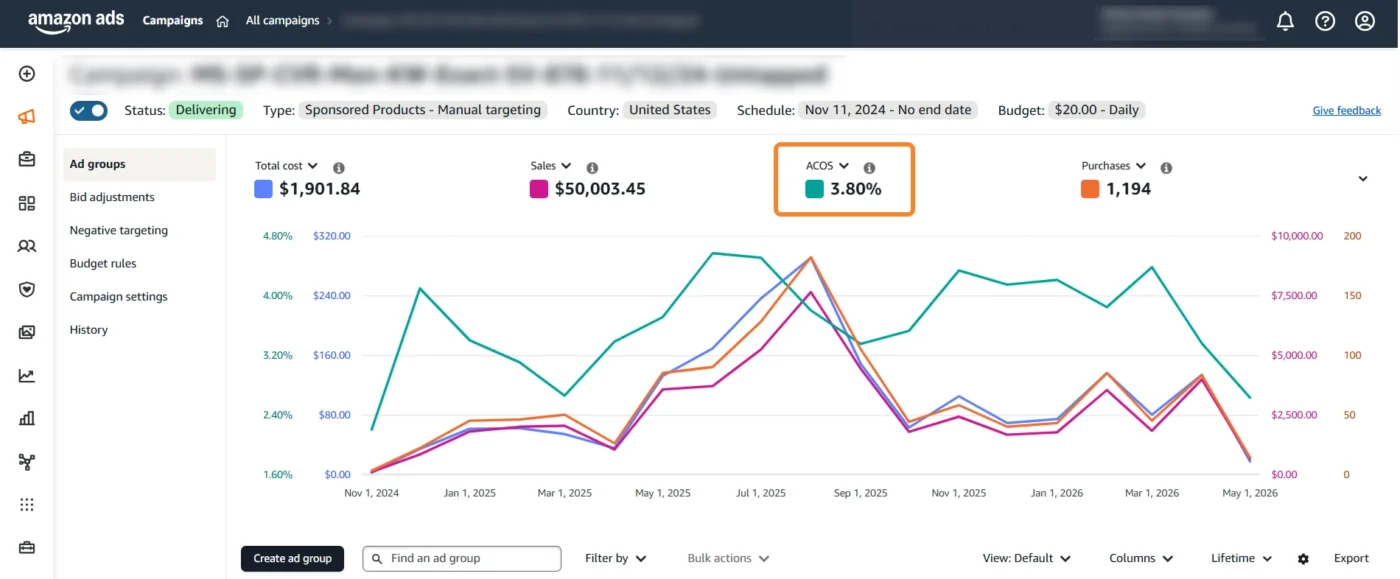
In 2026, the average Amazon ACoS across most categories ranges from 29% to 32%. For most established brands, a healthy ACoS typically falls between 20% and 30%, depending on margins and category competition.
The most important number, however, is your breakeven ACoS, the point where your ads stop being profitable.
Breakeven ACoS=(Sale Price − All Non-Ad Costs/ Sale Price)×100
If your product has a 35% profit margin before advertising, your breakeven ACoS is 35%. Any ACoS below that means your ads are profitable. Anything above it means your advertising is eroding margins.
What Is Amazon Ads ROAS?
ROAS (Return on Ad Spend) measures how much revenue you earn for every dollar spent on Amazon advertising. It is one of the most important Amazon PPC metrics for evaluating campaign profitability and ad efficiency.
Amazon ROAS Formula
ROAS=Ad Spend/ Ad Revenue
If you spend $200 on Amazon ads and generate $800 in sales, your ROAS is 4. This means you earn $4 in revenue for every $1 spent on advertising.
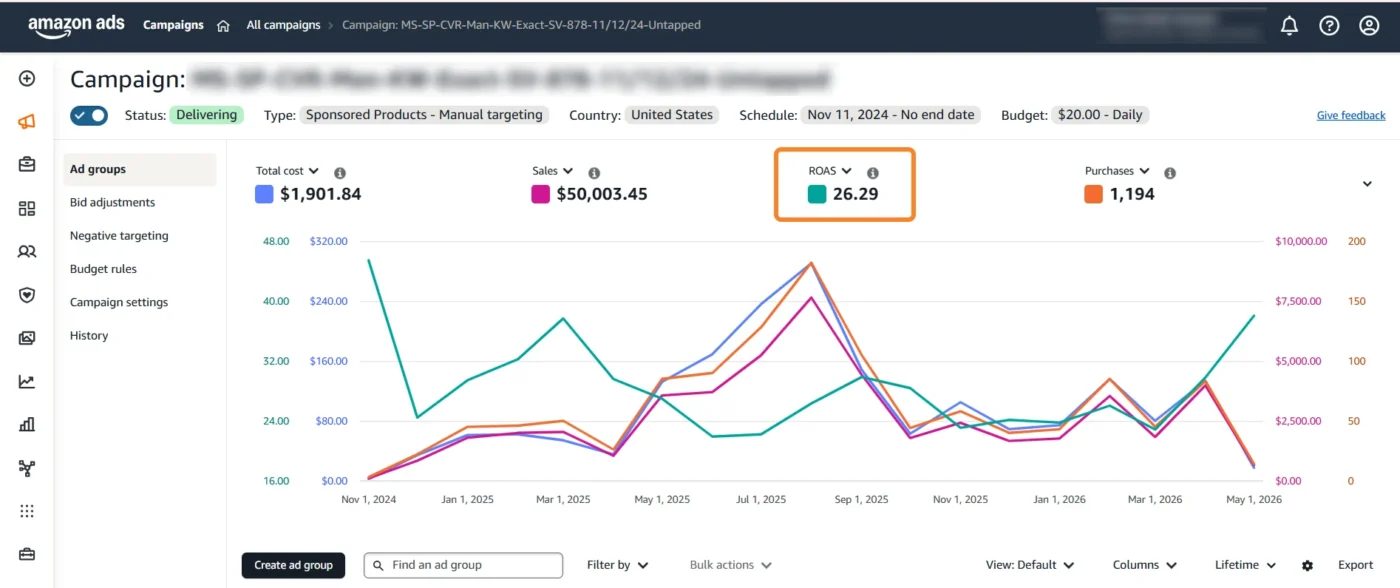
However, if you are wondering what a good ROAS is for Amazon advertising, it varies by category, margin structure, and goal. As a general benchmark:
- Below 3x ROAS: Likely unprofitable for most product categories
- 3x–5x ROAS: Solid performance for mid-margin products
- 5x–8x ROAS: Strong performance; indicates efficient targeting and good conversion
- 8x+ ROAS: Exceptional; often seen in low-competition niches or highly optimized mature campaigns
Your minimum ROAS can be calculated as:
Min. ROAS = Sale Price ÷ Total Costs (production + Amazon fees + shipping)
For a product selling at $40 with $20 in total costs, your minimum ROAS is 2. Anything below that means ads are reducing your margins.
ACoS vs ROAS: What’s the Key Difference?
ACoS and ROAS measure the same relationship from opposite directions. ACoS shows advertising cost relative to revenue, while ROAS shows revenue generated relative to advertising spend. The table below will help you understand the relationship between these two key metrics for Amazon advertising:
| ACoS | ROAS |
| 50% | 2x |
| 33% | 3x |
| 25% | 4x |
| 20% | 5x |
| 10% | 10x |
Any Amazon ad agency that knows how to reduce ACoS on Amazon and how to increase ROAS usually tracks ACoS at the campaign level for day-to-day optimization decisions and ROAS at the account or product level for strategic budget allocation and profitability reporting.
How an Amazon Ads Agency Reduces ACoS on Amazon
Below is the exact multi-layer framework professional Amazon ads agencies use to reduce ACoS for clients, often by 30–50% within 90 days.
1. ASIN Prioritization: Advertise the Right Products First
This is the most effective and most ignored strategy in Amazon advertising, and it is where experienced agencies always start. Research consistently shows that approximately 40% of Amazon PPC results depend on which ASINs you advertise, not how you bid or structure campaigns. Advertising a slow-moving, low-converting product will definitely result in high ACoS, no matter how efficiently you’ve built the campaign.
What Amazon ads agencies do:
- Identify the hero ASINs, which are the products with strong organic conversion rates, good reviews (typically 4.0+ stars with 50+ reviews), and competitive pricing
- Concentrate initial ad spend on these high-converting products, they will produce the lowest ACoS and highest ROAS
- Deprioritize or pause advertising on slow movers until listing quality is improved
- Implement inventory-aware bidding rules: when stock drops below 15 days, reduce bids by 30–50% to protect margins and prevent advertising products that are about to go out of stock
2. Campaign Architecture That Agencies Use
The single most impactful structural change an Amazon ads agency makes is building a proper Amazon PPC campaign structure. Most under-performing accounts have everything dumped into one or two campaigns. Agencies build a deliberate six-layer structure. This is the campaign structure we, as a well-experienced Amazon Ads agency, generally propose:
| Campaign Type | Purpose |
| Auto (Discovery) | Let Amazon find converting search terms you haven’t thought of |
| Broad (Expansion) | Scale reach on proven seed keywords |
| Phrase (Intent) | Target mid-funnel buyers with defined search patterns |
| Exact (Conversion) | Maximize efficiency on proven, high-converting terms |
| Brand (Defense) | Protect your brand name from competitor ads |
| Competitor (Aggression) | Capture intent from shoppers looking at competitor products |
The optimization loop that agencies run continuously:
- Run auto campaigns to discover which search terms actually convert
- Once a search term generates 3+ conversions, move it to an exact match keyword in a manual campaign with a bid calibrated to your target ACoS
- Add that same term as a negative exact in the auto campaign to prevent both campaigns from bidding against each other
- Repeat weekly
Through this process, an expert Amazon ads agency turns your discovery spend into sales-driven spend, and you see a drop in ACoS over time.
Expert Insight:

Branded and non-branded keywords should never live in the same campaign. Brand searches naturally generate lower ACoS because shoppers already know your product and are closer to purchase. When blended together, branded performance masks inefficient generic keyword spend, making optimization decisions unreliable. Experienced Amazon ads agencies always separate them to maintain clean data and accurate profitability analysis.
3. Negative Keyword Management
Amazon negative keywords are one of the highest-ROI activities in Amazon PPC management, and they are routinely neglected by brands managing their own accounts.
Adding a search term as a negative keyword tells Amazon not to show your ad for that query. When you do it consistently, your ad spend does not get wasted for the clicks that do not convert, which is one of the core reasons behind high ACoS.
What agencies do:
- Conduct a weekly search term report review, identifying terms with high spend and zero or low conversions
- Add these as negative exact or negative phrase matches in the relevant campaigns
- Build a negative keyword list from day one, even before data accumulates, using common irrelevant modifiers
- Add converting keywords from auto campaigns as negative exact matches in those same auto campaigns to prevent competition between campaign tiers
Aggressive negative keyword management alone can reduce wasted spend by 15–25% due to which you see an immediate improvement in your ACoS without any major changes.
4. Smart Amazon Bid Management
Amazon bid management is not simply raising bids on winners and lowering them on the ASINS which are not performing well enough, though that is part of it. Professional bid management requires understanding match types, campaign goals, placement performance, and business context.
Bidding strategy by campaign goal:
- High-ACoS campaigns: Use “down only” dynamic bidding. This prevents Amazon from increasing your bids for placements that are less likely to convert, giving you cost control without sacrificing reach
- Mature, proven campaigns: Use “up and down” bidding to allow Amazon to compete for high-conversion placements at premium prices
- Brand defense campaigns: Use fixed bids with placement modifiers to ensure consistent positioning
Placement report optimization:
Amazon allows you to see performance broken down by placement: top of search, product pages, and rest of search. In most accounts, top-of-search placement converts at 2–4x the rate of product pages. Agencies review placement reports regularly and apply bid multipliers to shift budget toward the placements that actually generate sales.
The discipline of incremental bid changes:
Agencies make bid adjustments of 10–15% at a time, then monitor for 3–5 days before making the next change. Aggressive changes in the Amazon bids create data noise that makes it impossible to understand cause and effect.
One important thing that an Amazon ads agency gets really well is that position 1 is not always the most profitable placement. Position 2–3 often converts nearly as well at 40–50% lower CPCs. Agencies test lower positions systematically rather than defaulting to top-of-search at any cost.
5. Amazon Listing Optimization
This is the most powerful and most overlooked touchpoint to reduce ACoS on Amazon, and it is one that has nothing to do with campaign settings.
Here is the math: If your current listing converts at 5% and you improve it to 10%, your ACoS drops by approximately 50%, without touching a single bid, keyword, or campaign structure. The same ad spend now generates twice the revenue.
A 2% conversion rate improvement can drop ACoS by 3–5 points across your entire portfolio simultaneously. No other single optimization produces that kind of account-wide impact.
The Amazon listing optimization framework we’ve observed top Amazon ads agencies use:
- Main image: Biggest driver of click-through rate (CTR). If shoppers don’t click, nothing else matters. Test lifestyle imagery, packaging clarity, and competitive differentiation
- Price competitiveness: Being priced 10–15% above the category average dramatically suppresses conversion regardless of ad quality
- Review count and rating: Products with fewer than 15 reviews or below 3.8 stars convert poorly under paid traffic pressure. Address this before scaling ad spend
- Title and bullet points: Keyword-rich but benefit-led copy that answers the buyer’s key question: “Why this product over the others?”
- A+ Content: Premium visuals, comparison charts, and brand storytelling that build trust and reduce purchase hesitation
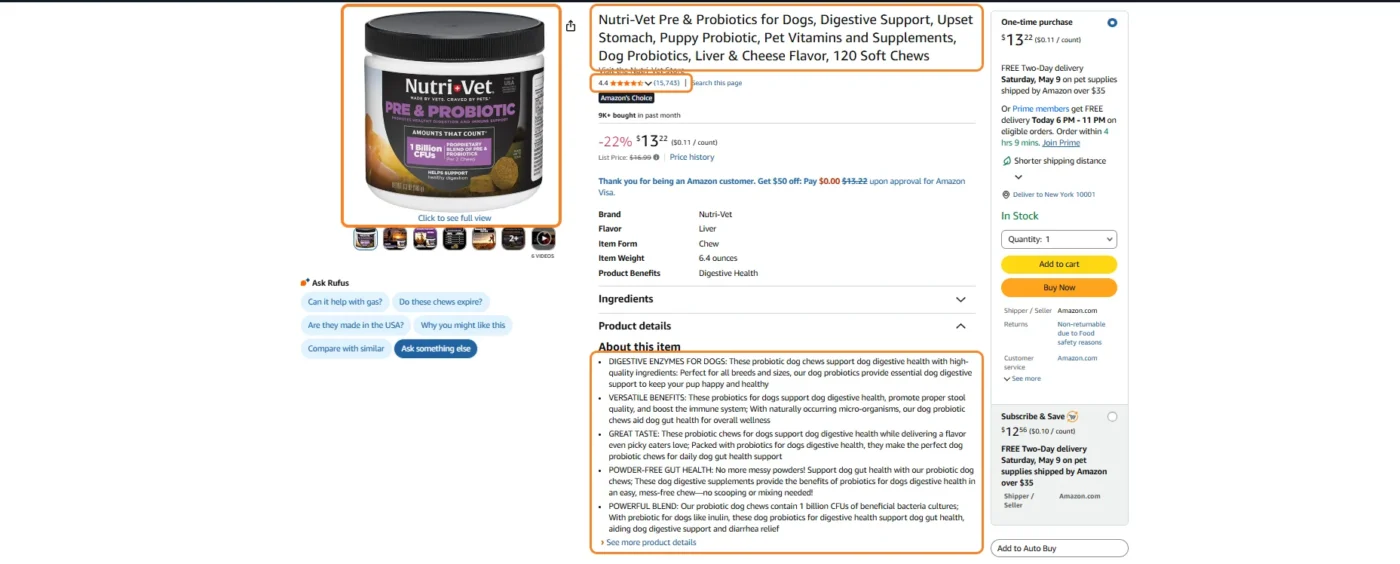
An Amazon ads agency that only manages your campaigns without addressing your listings is leaving the most powerful element that can reduce ACoS on Amazon untouched.
6. Dayparting and Budget Reallocation
Amazon does not offer dayparting in all ad types, so agencies use bid scheduling tools and manual budget rules. They focus spending during peak conversion hours and reduce spending when performance is low.
How a top Amazon ads agency implements this to reduce Amazon ads ACoS:
- Pull a performance breakdown by hour of day and day of week
- Identify windows where the conversion rate is significantly below the account average
- Reduce bids or pause campaigns during those windows
- Reallocate the saved budget to peak performance hours
This approach can reduce ACoS by 5–15% in accounts with clear performance patterns. For example, B2B products often see conversion drop sharply on weekends. Consumable products often show clear morning versus evening buying patterns. Not every account has a pattern worth acting on. Agencies run the analysis first, rather than applying dayparting to every account.
How Amazon Ads Agency Increases Amazon Ads ROAS
You need to understand that reducing ACoS and increasing ROAS are related but distinct goals. Reducing ACoS focuses on eliminating waste. Increasing ROAS focuses on generating more revenue from the same, or even greater, investment. Here is how an Amazon ads agency increases ROAS for your brand:
1. Targeting Intent, Not Just Keywords
The most common mistake brands make in their own campaigns is targeting keywords based on search volume rather than buyer intent. High-volume keywords attract broad audiences, many of whom have no intention of purchasing.
What does an Amazon ads agency do differently to increase ROAS
- Analyze search term reports to identify which queries are actually driving conversions, not just clicks
- Build campaign structure around proven buyer-intent terms: specific product names, use-case queries (“protein powder for weight loss”), and comparison terms (“X vs Y”)
- Use long-tail keywords strategically, they carry lower CPCs, attract higher-intent buyers, and improve conversion rates, all of which directly increase ROAS
Long-tail keywords are particularly powerful for ROAS optimization. A 3–5 word specific search query may drive 60% fewer impressions than a broad term but convert at 3–4x the rate, dramatically improving revenue per dollar spent.
2. Sponsored Brands and Sponsored Display for Full-Funnel ROAS Growth
Most brands over-index on Sponsored Products and under-utilize Sponsored Brands and Sponsored Display, which are the two ad types that, when used correctly, significantly increase ROAS by capturing demand at multiple stages of the purchase journey.
Sponsored Brands:
- Appear prominently at the top of Amazon search results and drive traffic to your Store or product catalog
- Best used for brand awareness, new product launches, and category-level visibility
- L’Oréal’s agency iCrossing allocated 40% of their budget to Sponsored Brands, targeting generic terms like “beard trimmer”, the resulting campaign significantly exceeded their 280% ROAS target
- Our Amazon ads agency typically recommends allocating 25–40% of the total ad budget to Sponsored Brands for established brands
Sponsored Display:
- Enables retargeting of shoppers who viewed your product but did not purchase
- Surgically re-engages the warmest possible audience, people who already know your product and have expressed intent
- Agencies segment retargeting audiences by behavior (viewed in last 7 days, viewed in last 30 days, cart abandonment) and bid accordingly, with recent viewers receiving higher bids
- The combination of auto-removed irrelevant audiences and precise retargeting dramatically improves ROAS for display spend
The full-funnel approach: Agencies build campaigns that guide shoppers through all stages: awareness (Sponsored Brands, DSP) → consideration (Sponsored Products, Sponsored Display) → conversion (Exact match Sponsored Products) → retention (Sponsored Display purchase remarketing).
Each layer of Amazon ads strengthens the next, which increases ROAS across the entire account.
3. Spending Where Ads Actually Create New Sales
A key but often ignored part of improving ROAS is understanding incrementality, meaning, did the ad actually cause the sale? The issue is that not every sale that gets credited to an ad really came from that ad. If someone was already going to buy your product anyway, running an ad just means you’re paying for a sale you would have gotten for free. That lowers your real ROAS.
What agencies look for:
- Products with high organic rank where paid ads are cannibalizing organic traffic
- Keywords where you already hold the top organic position, in these cases, bid down or pause Sponsored Products on those exact terms and redirect the budget to terms where you have a weak organic presence
- Campaign types generating clicks from existing customers who would repurchase anyway (especially in consumable categories)
By identifying and eliminating cannibalizing spend, agencies reallocate budgets to campaigns that generate genuinely new demand, improving ROAS without increasing total ad spend.
4. Cross-Channel Attribution to Increase ROAS
For brands driving external traffic to Amazon through Google, social media, influencer partnerships, or email, Amazon Attribution is a critical tool that agencies use to identify which off-platform channels are generating real Amazon conversions.
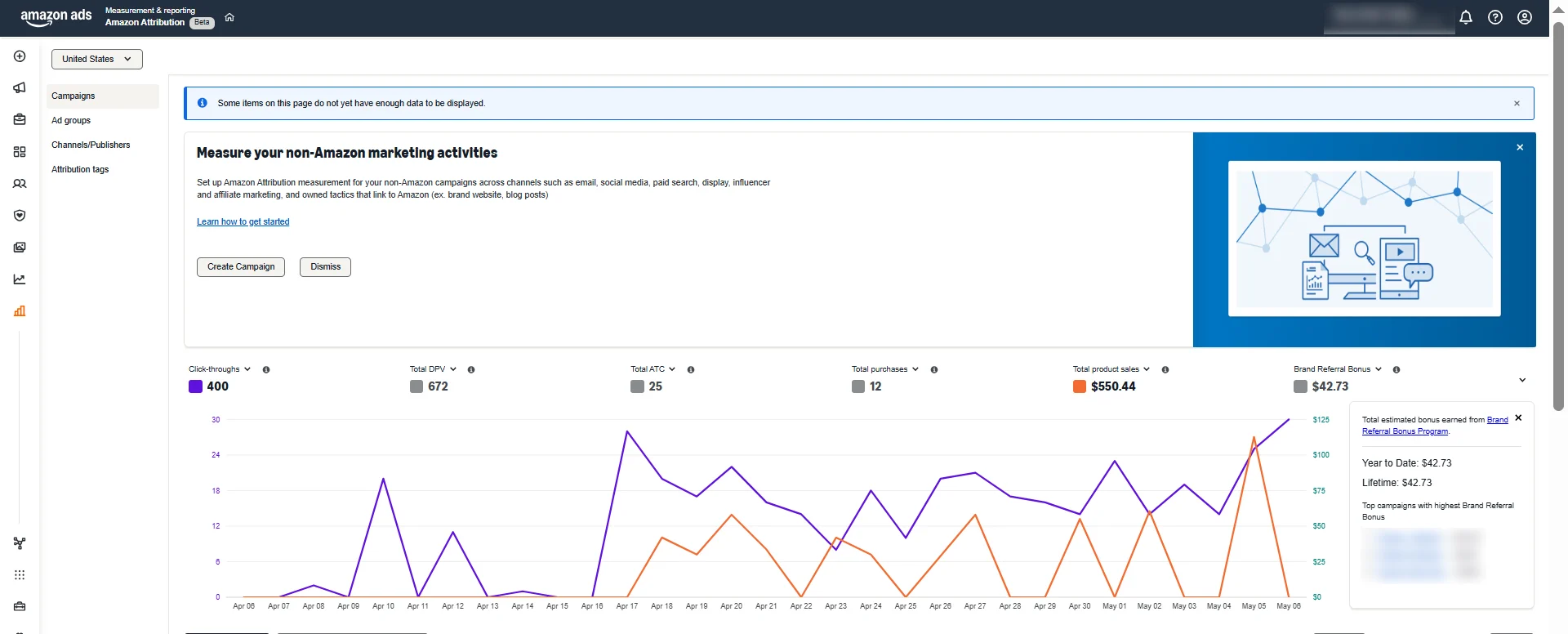
How it works: Amazon Attribution provides unique tracking tags for each external traffic source. Agencies deploy these tags across all non-Amazon campaigns, then analyze which publishers, platforms, and product categories are driving the most Amazon sales.
Real-world impact: MidWest Homes for Pets worked with agency Tinuiti using Amazon Attribution to track which external publishers drove the most sales. By identifying the best-performing channels and shifting budget accordingly, they increased their ROAS by 32%, without changing a single Amazon campaign setting.
For brands investing in influencer marketing, affiliate programs, or paid social, this kind of attribution analysis is essential to understanding total ROAS, not just on-platform efficiency.
What are ACoS and ROAS Benchmarks by Business Stage?
If you are looking for a defined figure to know the target Amazon ads ROAS or Amazon ads ACoS, know that it can never be fixed. The right number depends entirely on what stage your brand and product are in. Applying the wrong target to the wrong stage is one of the most common strategic errors agencies correct in new client accounts.
Launch Phase (First 60–90 Days on Amazon)
- Target ACoS: 30–50% (at or above breakeven)
- Target ROAS: 2x–3x
At launch, your primary shouldn’t be profitability, but it should be data collection and organic rank building. You need to gather enough conversion data for Amazon’s algorithm to understand what your product is and who buys it. You need reviews. You need keyword rank.
Accepting a higher ACoS during launch is a calculated investment, not a failure. Agencies set realistic expectations here and help brands understand that early high ACoS is building the organic foundation that will lower TACoS for years.
Growth Phase (Products with Established Rank and Reviews)
- Target ACoS: At or slightly below breakeven
- Target ROAS: 3x–5x
In the growth phase, you have enough data to know which keywords convert and which campaigns are driving real incremental sales. The focus shifts from discovery to efficiency, harvesting proven keywords into exact match campaigns, tightening bids, and eliminating wasted spend systematically.
Profit/Scale Phase (Established Products with Strong Organic Presence)
- Target ACoS: 15–25% (well below breakeven)
- Target ROAS: 5x–10x+
For mature, well-ranking products, the advertising goal shifts to profitability and incremental growth. Campaigns should be tightly structured around proven exact-match keywords with aggressive negative keyword coverage. TACoS should be declining as organic sales constitute an increasing share of total revenue.
Hero Products vs. Profit Products: A Critical Distinction
Not all products in your catalog should have the same ACoS target. The right Amazon ads agency segments products into:
- Hero products: high-volume catalog leaders where a higher ACoS is acceptable because every sale builds brand visibility, drives review velocity, and supports cross-sell opportunities
- Profit products: solid performers where the goal is efficiency; ACoS targets should be conservative and margins protected
A blended account ACoS target mismanages both categories. Hero products get under-invested. Profit products get overspent. Segmenting by product role is fundamental to intelligent budget allocation.
6 Common Mistakes That Hurt ACoS and ROAS
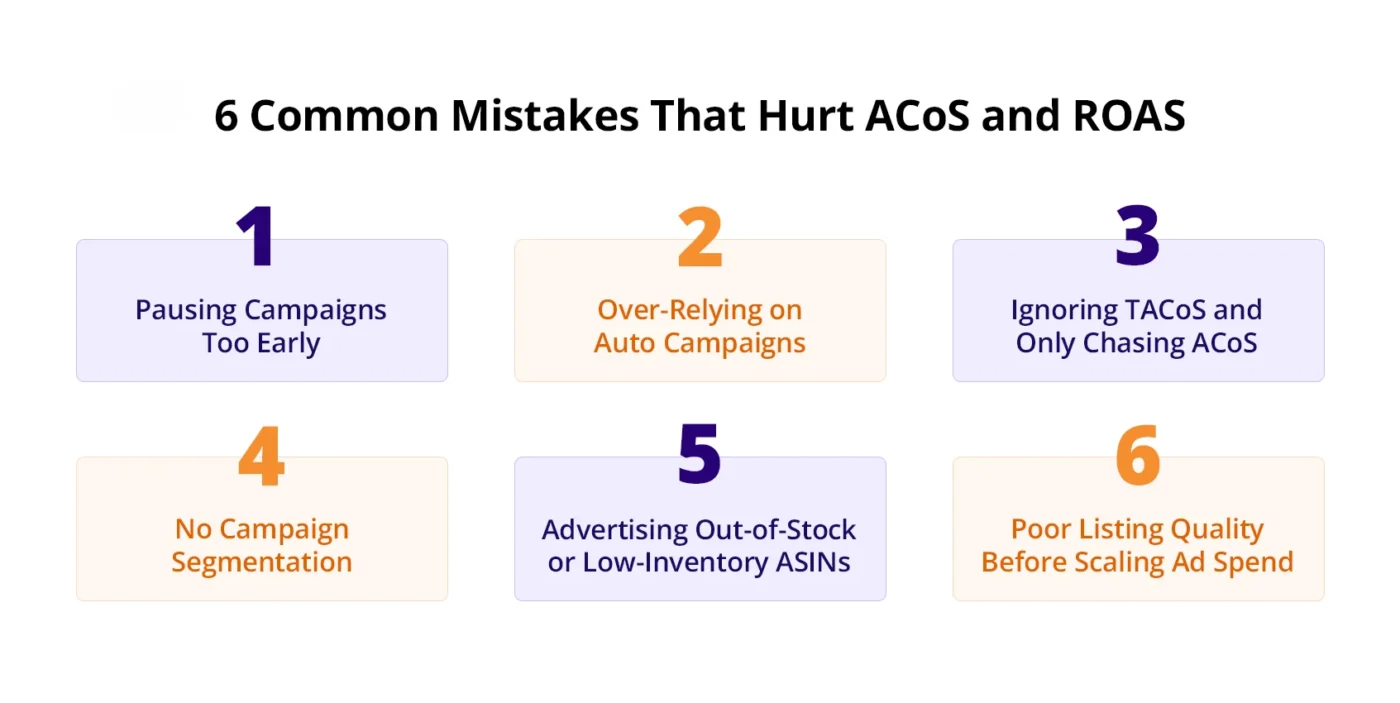
In auditing hundreds of Amazon ad accounts, professional agencies see the same mistakes repeatedly. Avoiding these is often as impactful as implementing positive changes.
1. Pausing Campaigns Too Early
Amazon’s advertising data has a reporting lag of 12–48 hours, depending on ad type. Sponsored Products use a 7-day click attribution window; Sponsored Brands use 14 days. If you pause a campaign after 5 days because it looks unprofitable, you may be pausing it before the majority of attributed conversions have even been recorded.
The rule: do not evaluate Sponsored Products performance until at least 8 days after launch; wait 15 days for Sponsored Brands. Give campaigns sufficient data before making structural decisions.
2. Over-Relying on Auto Campaigns
Auto campaigns are powerful discovery tools, but they are not optimization tools. They find new keywords, but they also generate significant irrelevant traffic. An account that runs primarily on auto targeting will perpetually have high ACoS because it is perpetually paying for unqualified clicks without the structure to capitalize on what it finds. Auto campaigns should feed into, but never replace, a manual campaign architecture.
3. Ignoring TACoS and Only Chasing ACoS
An account where ACoS is declining but TACoS is rising is an account where organic sales are falling as a proportion of total revenue. The ads are becoming less efficient and less supportive of organic growth simultaneously.
Agencies that only report ACoS to clients are missing this dimension entirely. Always track TACoS weekly alongside ACoS to ensure your advertising is building a sustainable business, not just a paid-traffic dependency.
4. No Campaign Segmentation
Mixing branded, generic, competitor, and auto campaigns produces a blended ACoS that is impossible to act on. You cannot tell which segments are profitable and which are draining the budget. Every optimization decision becomes a guess.
Proper segmentation, by keyword type, match type, product category, and business objective, is the foundation of accountable Amazon advertising.
5. Advertising Out-of-Stock or Low-Inventory ASINs
Advertising a product with fewer than 15 days of inventory remaining accelerates your stockout timeline and wastes ad spend on a product that is about to disappear from search results. When you restock, Amazon’s algorithm may take days or weeks to restore your previous organic ranking.
Agencies implement inventory threshold rules: bids are automatically reduced when stock drops below 15 days and paused when below 7 days.
6. Poor Listing Quality Before Scaling Ad Spend
Increasing the ad budget on a listing that converts at 3–4% is burning money. Before scaling spend, the listing must be retail-ready: strong main image, competitive price, sufficient positive reviews, clear title and bullets, and A+ Content. Agencies audit listing quality as the very first step, and refuse to scale spend until the conversion foundation is solid.
Conclusion
In 2026, if you want to reduce ACoS on Amazon and increase ROAS, know that it’s not just a one-step thing, but it’s a whole process. It requires the right ASINs, campaigns, keywords, bids, and listing quality, all reviewed continuously as the marketplace evolves. In 2026, with CPCs at record highs and competition intensifying, brands that hold ACoS steady and grow ROAS execute this system with precision. Most do it with professional agency support.
An Amazon ads agency delivers a structured account that makes waste visible and fixable, negative keyword management that eliminates 15–25% of wasted spend, listing optimization that multiplies every other improvement, a full-funnel strategy that builds organic rank, TACoS tracking that ensures ads build a sustainable business, and weekly execution that keeps pace with Amazon. Your account can almost certainly be improved.
The question is whether you have the bandwidth and system to do it. If not, the right Amazon ads agency is something that you need to onboard. An Amazon ads agency like AMZDUDES can help you reduce your ACoS, increase your ROAS, and scale profitably with their professional Amazon ads agency services.
Book a free consultation call now.
Frequently Asked Questions
1. What is a good ACoS for Amazon in 2026?
A good ACoS depends on your product’s profit margin. Your target ACoS should be at or below your breakeven ACoS, which equals your pre-advertising profit margin. The 2026 category average is approximately 29–32%, but this number is meaningless without the context of your specific margins.
2. What is the difference between ACoS and ROAS on Amazon?
ACoS and ROAS measure the same relationship from opposite directions. ACoS = (Ad Spend ÷ Ad Revenue) × 100 and shows what percentage of ad revenue goes to advertising. ROAS = Ad Revenue ÷ Ad Spend and shows how many dollars of revenue each advertising dollar generates. A 25% ACoS equals a 4x ROAS.
3. How can an Amazon ads agency reduce my ACoS?
A professional agency reduces ACoS through a multi-layer approach: restructuring campaign architecture, implementing aggressive negative keyword management, optimizing bids by placement and match type, prioritizing high-converting ASINs, and improving listing conversion rates. Most well-executed agency engagements produce 30–50% ACoS reduction within 90 days.
4. How long does it take to see results from Amazon PPC optimization?
Initial structural improvements (campaign architecture, negative keywords) often show results within 2–4 weeks. Listing-driven conversion improvements take 4–8 weeks. Organic rank improvements supported by advertising typically become measurable at 60–90 days. TACoS improvement is a 3–6 month metric.
5. What Amazon ads agency services should I look for?
Look for agencies offering: full campaign audit and restructuring, keyword research and ongoing harvesting, bid management with placement optimization, negative keyword management, listing optimization support, and transparent reporting that includes ACoS, ROAS, TACoS, and organic revenue trends. Amazon Ads Verified Partner status is a meaningful quality signal.
6. What is the relationship between ACoS and TACoS?
ACoS measures ad spend against ad-attributed revenue only. TACoS measures ad spend against total revenue, including organic sales. A brand with a 35% ACoS but 10% TACoS is using advertising to build organic rank effectively, the high ACoS is an investment in long-term efficiency. Agencies track both to evaluate true advertising health.