

What is Amazon 3PL, and How Does It Work?
As part of the e-commerce supply chain, Amazon has turned up third-party logistics services into one of its priorities. It adds up to the challenges of being an Amazon 3P seller, including inventory, fulfillment, and overall Amazon operations management. With good strategies, 3PL for Amazon providers manage these to ensure that sellers concentrate on growing their businesses.
When compared to Fulfillment by Amazon, which runs the entire processing under controls of Amazon, with 3PL, one can have an Amazon 3PL warehouse, order fulfillment, and shipping done for you while providing a better scope for flexibility and cost savings. Understanding Amazon SFP 3rd party logistics fulfillment pricing is essential when evaluating whether this model fits your business.
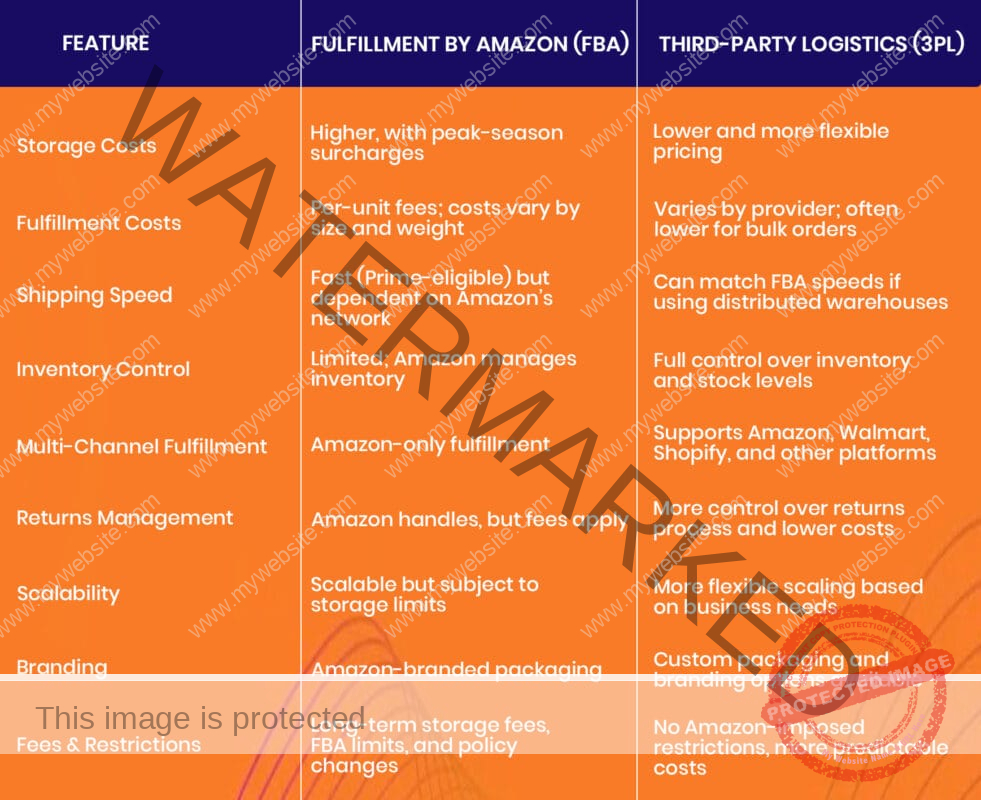
Pros of Using a 3PL Provider for Your Amazon Business
1. Lower Storage and Fulfillment Costs
In fact, in recent years, the FBA storage cost has been hiked, especially in peak seasons. A 3PL may help in saving costs through lower storage fees and different pricing schedules, which can be much more cost-effective with respect to inventory management. When comparing Amazon SFP 3rd party logistics warehouse cost vs. FBA, many sellers find significant savings.
With 3PL, one has access to a very wide distribution network; hence, they can store goods much closer to customers. This significantly reduces shipping costs and efforts while also improving delivery time, hence encouraging customer satisfaction and sales conversion rates.
To maximize cost savings, sellers should also implement smart repricing strategies that align with their fulfillment model, ensuring competitive pricing while maintaining healthy profit margins.

2. Multi-Channel Fulfillment
A key strength of the 3PL is that it is multi-channel; not limited to Amazon alone. If you are selling through Walmart, Shopify or eBay, you can acquire a third-party fulfillment Amazon provider to manage all your orders from just one inventory.
Therefore, management of the stock is simpler, and it helps towards the lessening of overselling risk, which is usually a common problem for companies operating several fulfillment channels through manual intervention.
To stay competitive across multiple platforms, sellers should optimize listings with Amazon SEO best practices that improve search visibility and drive organic traffic.
3. Greater Inventory Control
With FBA, there is stringent inventory control by Amazon, including long-term storage fees and removal orders. A 3PL for Amazon will give you full control over the way you manage your inventory, doing away with unnecessary additional charges and yet again stock-outs.
Most of the 3PL providers have real-time inventory tracking, and thus, you can easily check your stock levels and readjust according to your strategy.
4. Faster Shipping Options
Most Amazon 3rd party logistics providers maintain multiple warehouse sites spread across the U.S. As such, they can ship products faster for customers. Some even have made available 2-day shipping solutions that complement Amazon’s Seller Fulfilled Prime (SFP) program. This makes them ideal Amazon SFP 3rd-party logistics partners.
So far, as emphasized by Amazon, a 3PL that is capable of matching Prime speed delivery can serve as a huge competitive advantage.
Even without the Prime badge, sellers can drive traffic with the right Amazon advertising strategy, boosting conversions and offsetting the impact of longer delivery times.
5. Avoid FBA Restrictions and Delays
During peak seasons, Amazon typically implements storage restrictions that make sending in new stock very difficult for sellers. A 3PL provider gets past this restriction and, therefore, allows you to store and distribute your inventory without worrying about it.
FBA becomes quite unpredictable due to its frequently changing policies by Amazon, working with a 3PL provider would be much more flexible to comply with the necessary changes.
6. Better Customer Service and Returns Management
Handling returns through FBA can be expensive and inefficient. Many 3PL for Amazon FBA providers offer a smoother return process with better tracking, allowing you to maintain high customer satisfaction and strong Amazon product reviews.
They can also process returns more efficiently, reducing the likelihood of lost inventory or unnecessary fees. So, if you are doing 3PL Amazon FBA USA, you should consider getting in touch with a reliable 3P partner.
Cons of Using a 3PL Provider for Amazon Sales
1. Complex Setup Process
Switching from FBA to a 3PL requires time and effort. You’ll need to integrate the provider’s system with Amazon’s Seller Central, set up shipping automation, and establish clear communication for third-party fulfillment with Amazon.
The onboarding process may involve signing contracts, configuring software, and training your team to use the 3PL’s platform. This transition period can take weeks or even months, depending on the complexity of your business.
2. Higher Upfront Costs
While 3PL services often save money in the long run, they may have higher initial costs. You’ll need to pay for storage, pick-and-pack services, and shipping fees upfront, unlike FBA, where fees are deducted per sale. Understanding Amazon SFP 3rd party logistics provider cost structures helps you budget effectively.
However, these costs may be offset by lower long-term expenses, especially if your business scales efficiently with 3PL services.
3. Need for Strong Inventory Management
Since Amazon does not manage the fulfillment process, you must ensure your 3PL provider keeps accurate stock levels. If inventory data is not updated correctly, it can lead to stockouts or over-ordering.

4. Lack of Amazon Branding Benefits
Amazon’s FBA program offers benefits like the Prime badge, which boosts conversions. While Seller Fulfilled Prime (SFP) is an option, qualifying for it requires strict adherence to shipping performance metrics. Working with experienced Amazon 3PL services can help you meet these requirements.
Without the Prime badge, customers may prefer FBA sellers over your listings, potentially impacting sales. To counter this, ensure your 3PL provider offers fast and reliable shipping.
To offset the absence of the Prime badge, sellers must focus on alternative strategies like Amazon advertising to enhance visibility and conversion rates.
5. Risk of Poor Service from 3PL Providers
Not all 3PL providers offer the same level of service. A poorly managed provider can result in delayed shipments, lost inventory, and negative customer reviews. Researching and choosing a reliable 3PL partner is crucial.
Look for providers with strong reviews, a proven track record, and experience working with Amazon 3P sellers. Many high-revenue sellers outsource Amazon account management services to experienced teams or experts to avoid fulfillment and operational risks.
For Logistics Companies: How to Become a 3PL for Amazon
There is a growing demand for Amazon SFP 3rd-party logistics providers. If you run a warehouse or fulfillment business, here is how to position yourself for Amazon sellers.
Step 1: Understand Amazon SFP Requirements
To handle Amazon SFP 3rd party logistics fulfillment, your operation must meet Amazon’s performance metrics:
- On-Time Delivery: >99%
- Tracking Validation: 100% of orders must have valid tracking.
- Shipping Speed: Offer options that match Prime speeds.
Step 2: Optimize Your Warehouse Network
Sellers search for Amazon 3PL warehouse partners with strategic locations. A distributed network allows for faster, cheaper shipping. If you want to compete on Amazon SFP 3rd party logistics warehouse cost, you need to demonstrate density and efficiency.
Step 3: Integrate with Amazon Seller Central
Your software must seamlessly sync with Amazon. Sellers need real-time inventory updates and automated order routing. Highlighting your robust tech integration is key to attracting clients.
Step 4: Develop Transparent Pricing
Sellers constantly compare Amazon SFP 3rd party logistics provider cost, and Amazon SFP 3rd party logistics companies cost. Your pricing model should be clear and competitive. Break down costs for storage, pick & pack, and shipping to match what sellers expect from Amazon 3PL services.
Understanding Amazon 3PL & SFP Costs: A Pricing Breakdown
When evaluating Amazon SFP 3rd party logistics provider cost, it’s crucial to understand the different pricing models. Unlike FBA’s per-unit fee structure, 3PLs typically have a multi-part pricing model. Here’s what to look for:
1. Storage Fees (The “Warehouse Cost”)
This is what searchers mean by Amazon SFP 3rd party logistics warehouse cost.
- Pricing Model: Usually charged per pallet or per cubic foot per month.
- Typical Range: $15 – $40 per pallet/month, or $0.50 – $1.50 per cubic foot/month.
- Seller Tip: Ask about “idle storage” fees for inventory that doesn’t move.
2. Receiving & Put-Away
The cost to unload your truck, check in inventory, and put it on the shelf.
Pricing Model: Often a flat fee per pallet received or an hourly labor rate.
3. Pick & Pack Fees (The “Fulfillment Cost”)
The core of Amazon SFP 3rd party logistics fulfillment pricing.
- Pick Fee: A charge for each item retrieved from the shelf ($1 – $3 per unit).
- Pack Fee: A charge for materials and labor to box the item ($1 – $4 per order).
- Seller Tip: Costs can vary significantly based on item size.
4. Shipping (Pass-Through Costs)
You will pay for the shipping label, often at discounted commercial rates.
Pricing Model: The 3PL passes along its negotiated carrier rate, sometimes with a small markup.
5. Integration & Monthly Minimums
Some providers charge a small monthly fee for software integration. Many also have a monthly minimum spend (e.g., $500/month).
Top Types of Amazon 3PL Companies and Their Cost Structures
When researching Amazon SFP 3rd party logistics companies cost, you’ll generally encounter three tiers of providers:
When researching Amazon SFP 3rd party logistics companies cost, you’ll generally encounter three tiers of providers. Understanding these will help you match a provider to your business size and budget.
Tier 1: Enterprise 3PLs (e.g., ShipBob, Ryder, DHL)
Enterprise-level providers like ShipBob, Ryder, and DHL are best suited for large, established sellers with high order volumes. Their cost structure features competitive pick and pack rates due to economies of scale, though they may require higher storage minimums and offer less flexibility in contract negotiation. The key advantage of this tier is access to massive warehouse networks that enable fast, nationwide shipping capabilities.
Tier 2: Mid-Market 3PLs Specializing in Amazon (e.g., Deliverr, Red Stag Fulfillment)
Mid-market specialists such as Deliverr and Red Stag Fulfillment cater to growing sellers focused on Seller Fulfilled Prime and multi-channel operations. These providers offer transparent, often month-to-month pricing with technology specifically tailored for Amazon integration. Their deep connection with Amazon Seller Central and expertise in SFP performance metrics make them ideal partners for sellers looking to scale while maintaining the Prime badge.
Tier 3: Regional & Niche 3PL Warehouses
Regional and niche 3PL warehouses are perfect for small to medium sellers or those dealing with heavy, oversized, or specialized products. These providers typically offer the most negotiable warehouse costs and flexible arrangements. While they may have less sophisticated technology than enterprise options, they excel in providing personalized service and deep category expertise that larger providers cannot match.
How to Choose the Right 3PL for Your Amazon Business
There are a few important questions to ask if you are thinking of hiring a 3PL. Consider the following:
- Experience with Amazon sellers: The provider must fully understand Amazon’s fulfillment requirements.
- Warehouse locations: Their network should be maximally dispersed to allow very fast shipping of your orders.
- Integration with Amazon: Choose a provider that syncs with Amazon Seller Central.
- Scalability: Your 3PL should be able to grow along with your business.
- Pricing transparency: Watch out for hidden charges from storage to picking to packing.
Ask for a detailed breakdown of Amazon SFP 3rd party logistics fulfillment pricing.
Conclusion: 3PL- Is it an Option for Your Amazon Business in 2025?
3PL providers can help in cutting down fulfillment costs, getting new channels away from Amazon, and enhancing logistical flexibility on the one hand, and sometimes complicate starting up and putting things in place in terms of administration and finance on the other. If having more control over your fulfillment process and reducing dependence on FBA is one of your company’s goals, then moving toward a 3PL will become a major strategic opportunity.
For logistics providers, learning how to become a 3PL for Amazon opens up a growing market of sellers seeking reliable Amazon 3PL services with transparent Amazon SFP 3rd party logistics provider cost structures.
AMZDUDES offers multiple solutions to maximize sales and efficiency in Amazon operations for 3P sellers. Whether it be Amazon account management or wholesale strategies, we have customized solutions for you. Whether you need a guide to transition into a 3PL or optimize your Amazon fulfillment strategy, get in touch with AMZDUDES!
Book a free consultation call now.
Frequently Asked Questions
1. What is Amazon 3PL?
Amazon 3PL refers to third-party logistics providers that store inventory, process orders, and ship products for Amazon sellers outside the FBA network.
2. How do I become a 3PL for Amazon?
To become a 3PL for Amazon, you must meet Seller Fulfilled Prime performance targets, integrate with Amazon Seller Central, and offer competitive Amazon SFP 3rd party logistics pricing.
3. How much does Amazon SFP 3rd party logistics cost?
Amazon SFP 3rd party logistics provider cost typically includes storage fees ($15-$40 per pallet/month), pick and pack fees ($1-$4 per order), and shipping costs. Request an itemized quote.
4. Is 3PL cheaper than Amazon FBA?
In many cases, 3PL can reduce storage and fulfillment costs, particularly during peak seasons when FBA storage fees increase.
5. Can a 3PL handle orders from multiple sales channels?
Yes, most 3PL providers support multi-channel fulfillment, allowing sellers to manage orders from Amazon, Shopify, Walmart, and eBay using a single inventory system.
6. What are the best Amazon 3PL services?
The best provider depends on your needs. Enterprise options include ShipBob; mid-market specialists include Deliverr; regional warehouses offer personalized service.