
Key Takeaways
- Understanding the core differences is essential Amazon and Google are both search engines, but Amazon is built for purchasing products while Google is designed to help users find information and research solutions.
- Amazon SEO ranking factors Product rankings are influenced by conversion rate, sales velocity, customer reviews and ratings, keyword relevance, customer experience signals, and seller authority.
- Google SEO ranking factors: Rankings depend on content quality and E-E-A-T, backlink authority, user experience signals, mobile-first performance, technical site structure, and overall domain authority and trust.
- 6 key Amazon SEO vs Google SEO differences: The platforms differ in search intent, keyword usage, reliance on backlinks, focus on conversions vs engagement, algorithm priorities, and the type of content optimized.
- Choose the best option for your business: Google SEO helps build brand visibility and attract users in the research phase, while Amazon SEO captures high-intent shoppers ready to buy; using both together can expand reach and improve conversions.
If you are running a business online in 2026, understanding search engine optimization (SEO) is crucial for success. There are two dominant search engines overall; Amazon and Google. Both platforms are search engines, but one is built to help people buy, and the other is built to help people find information. That core difference between Amazon and Google SEO determines how you rank and convert.
In this comprehensive guide, we will explore the distinct differences of Amazon SEO vs Google SEO. This guide helps you understand what SEO is, the differences between optimizing for Amazon’s A10 algorithm and optimizing for Google’s web search. You will also learn which of both is the best option for your business with the insights provided.
What is SEO and Why it is Important
Forbes defines SEO as the process of optimizing content to rank organically on search engines, usually appearing right below the paid ads in search results. The importance of SEO lies in visibility. When your content appears higher in search results, it becomes easier for people to find you when they search for something related to what you offer.
Whether you are selling products, promoting services, or building an audience, SEO is one of the most reliable ways to reach high-intent users. The global SEO industry is projected to exceed $122.11 billion in market value by 2028, highlighting how strongly businesses depend on organic search to drive revenue and growth.
For businesses selling online, SEO offers several advantages:
- Increases organic traffic without paying for ads
- Improves brand visibility and credibility
- Attracts high-intent customers searching for specific products or information
- Creates long-term marketing value compared to paid campaigns
SEO is powerful as it brings intent driven traffic. These are not random clicks but are people actively searching for a product or information.
How Does Amazon SEO Work?
Amazon is a purchase focused search engine. It is the first and foremost a product‐search engine. Over half of U.S. shoppers begin product searches on Amazon (56%) so the platform ranking system prioritizes products that show higher sales. Amazon
The Amazon A10 algorithm is the brain of Amazon’s search engine that decides which products appear at the top of search results for a specific searched term on Amazon. Its main goal is to show shoppers the most relevant products that are likely to be purchased by shoppers.
To determine rankings, Amazon evaluates several factors and prioritizes listings that are more likely to generate sales.
Amazon SEO Factors
Amazon doesn’t officially disclose how its algorithm ranks products, but through industry analysis and seller data, several key factors are known to influence product rankings. These typically include:
- Conversion Rate: How often your listing turns clicks into purchases. The algorithm favors listings that consistently turn views into purchases.
- Sales Velocity: The revenue of your product over time. Consistent sales tells Amazon that your products perform well naturally which ultimately makes your position stronger on search results.
- Customer Reviews and Ratings: Both quality and helpful votes build trust. A10 Algorithm looks at both how many reviews you have and how recent and relevant they are.
- Keyword Relevance: How closely your listing matches the search query. The closer your keywords are to what people are searching for, the better chances of you appearing in results.
- Customer Experience Factors: Pricing, fulfillment speed, return rates, and inventory consistency help Amazon determine whether your product delivers a positive shopping experience for customers. Well optimized listings on Amazon that offer competitive pricing, reliable fulfillment, and consistent stock availability are more likely to rank higher.
- Seller Authority: Your account health history, feedback ratings, and fulfillment reliability signal trust and operational performance. Sellers who maintain a strong Amazon account health rating and positive customer feedback are more likely to gain better visibility in search results.
How Does Google SEO Work?
Google is a general information search engine with ~90% global search share where people usually search to find businesses, products, services, and just about anything online.Google SEO focuses on optimizing websites and content so they appear higher in Google search results when users search for information, products or anything else.
The Google algorithm is a set of systems that works together to decide which pages to show up for terms users search in Google search bar.
It evaluates multiple factors to provide the most helpful results for users.
Google SEO Factors
- Content Quality and Expertise: Google favors content written with (E-E-A-T) experience, expertise, authority, and trustworthiness.
- Backlink Profile: Backlinks are links from other websites pointing to your page. Links from credible websites signal credibility and authority to Google ultimately improving your ranking.
- act as endorsements and can improve your ranking.
- User Experience: Refers to how easily visitors can interact with your website. Factors like bounce rate, time on site, and how users interact with your page all influence SEO.
- Mobile-First Indexing: Your site must perform well on mobile devices since Google prioritizes mobile versions for ranking.
- Site Structure and Technical SEO: Clean URLs, proper indexing, and fast load speeds make it easier for Google to understand and rank your site.
- Domain Authority and Trust: Domain authority reflects the overall credibility of a website based on its age, quality of content, backlinks, and trust signals. Older domains with consistent quality and good reputations tend to rank higher.
Amazon Search vs Google Search Key Differences
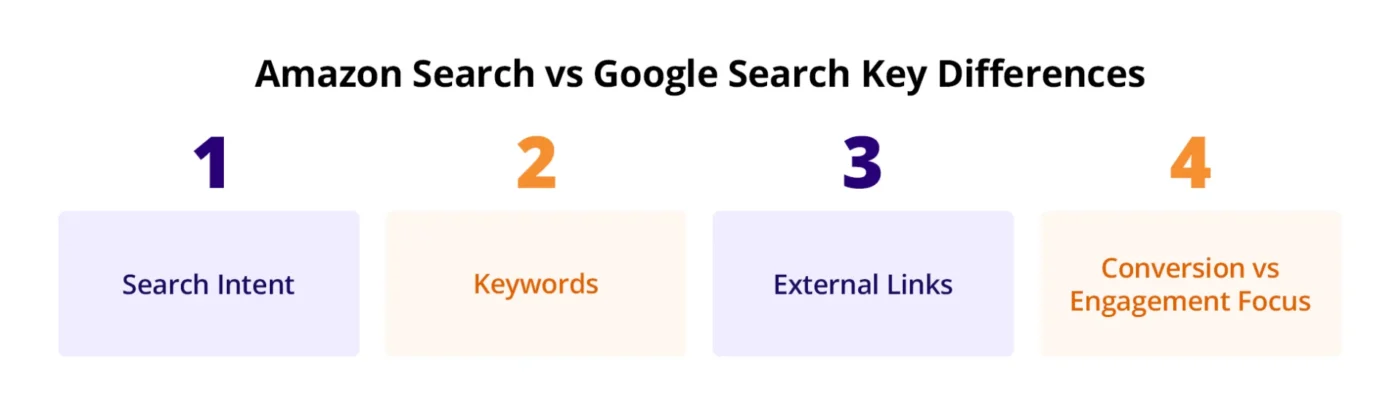
Although both platforms use search algorithms, Amazon SEO and Google SEO have notable differences. What works on Google to get traffic won’t necessarily help you rank on Amazon and vice versa. Understanding these differences helps sellers choose the right optimization option for their business.
1. Search Intent
Amazon is a buying platform. Most users search with buying intent so Amazon’s algorithm ranks products based on how likely they are to sell.
Google is more information focused as users search for information or solutions. Google’s algorithm is designed to show the most relevant and helpful content that best satisfies the user’s search query.
2. Keywords
On Amazon, keywords help algorithms understand which product should appear for a specific search query. Sellers place keywords in product titles, bullet points, backend search terms and product descriptions.
Google SEO uses keywords to determine the relevance of web content. Google also evaluates search intent, keyword context, and related terms to understand the overall topic of a page rather than relying only on exact keyword matches.
3. External Links
Google evaluates backlinks from other websites to measure authority and relevance. Pages that earn high quality backlinks from trusted sources are favored by Google algorithm.
Amazon’s ranking system doesn’t rely on backlinks. Instead it focuses on internal performance signals such as sales and high conversion metrics for ranking.
4. Conversion vs Engagement Focus
Amazon heavily prioritizes conversion rate and sales performance. Listings that consistently turn visitors into buyers tend to rank higher because the platform wants to show products that generate revenue.
Google focuses more on engagement signals, such as how long users stay on a page, whether they click other links, and whether they return to search results quickly.
5. Algorithm Priorities
Amazon’s algorithm prioritizes factors that increase the likelihood of a purchase. Factors like pricing, fulfillment method, and inventory levels directly influence rankings.
Google’s algorithm focuses on delivering the most useful information. It emphasizes expertise, authoritativeness, and trustworthiness, as well as mobile optimization and crawlability.
6. Content Optimization
On Amazon, content optimization focuses on product listings. Sellers improve rankings by optimizing titles, bullet points, images, A+ content, and backend keywords to increase both relevance and conversions.
Google SEO focuses on website content, such as blog posts, guides, landing pages, and product pages. Google evaluates depth, structure, and topic authority for ranking.
Amazon SEO vs Google SEO: What is the Best Option for Your Business?
Amazon SEO vs Google SEO can drastically affect how sellers reach potential buyers. Choosing between Amazon SEO vs Google SEO depends largely on your business model, and where your target customers begin their buying journey.
Google SEO is more effective for capturing customers earlier in the research stage. Google is great for leads that are just starting their search and trying to figure out what they need. If a customer becomes aware of the need for a product, they are likely to search on Google for products to get ideas. Businesses can use blogs, guides, and informational content to attract users before they decide where to buy.
Amazon SEO, on the other hand, is often the better option for audiences that are way forward in their buying journey and know what they want and are looking to find the right product. For 56% of people, Amazon is step one in the buying journey. Since Amazon users already have high purchase intent, optimized Amazon listings can quickly translate into sales.
Aside from your audience, your campaign intentions influence which SEO option is best for your business. If you are looking to promote your products, Amazon is the best option and if you are interested in promoting your services, Google SEO is better. Amazon SEO focuses only on products and getting leads to purchase products. Google enables you to market your business and sell your products.
Though both platforms have their specialities, there is no reason to strictly compare Amazon SEO vs Google SEO to settle for one option when you can use both of them together. Yes! Google SEO and Amazon SEO work together and it can be a great combination. With this, you can reach more leads by using Google SEO to boost your Amazon products which can help earn you more conversions.
You can create powerful campaigns by relying on both and combined, they can help your business grow. In many cases, the most effective strategy is not choosing one over other but combining both.
Conclusion
Understanding Amazon SEO vs Google SEO can save you time and a lot of frustration. Each platform has its own priorities, and both are essential for business growth. While choosing one you have to understand your audience journey and business priorities to select one. But it’s not necessary to be strict in selecting either option from Amazon SEO vs Google SEO as you can use both approaches to grow your business.
If you want to achieve sustainable growth on Amazon, working with an experienced Amazon SEO agency can make a significant difference.
Book a free consultation to get in touch with our Amazon SEO experts now!
Frequently Asked Questions
What is the main difference between Amazon SEO and Google SEO?
The main difference lies in search intent. Amazon SEO focuses on ranking products that are most likely to generate sales, while Google SEO prioritizes informative and authoritative content that best answers a user’s search query.
Does Amazon SEO use backlinks like Google?
No. Amazon’s algorithm does not rely on backlinks. Instead, it ranks listings based on internal marketplace signals such as conversion rate, sales velocity, reviews, pricing competitiveness, and fulfillment performance.
Which is better for ecommerce businesses: Amazon SEO or Google SEO?
It depends on the business model. Amazon SEO is more effective for capturing shoppers ready to purchase, while Google SEO helps attract potential customers earlier in the research phase.
Can businesses use Amazon SEO and Google SEO together?
Yes. Many brands use Google SEO to build awareness through blogs and guides while optimizing Amazon listings to rank higher and convert the demand into sales.
How does keyword optimization differ between Amazon and Google?
Amazon SEO relies heavily on exact keyword placement in titles, bullet points, and backend search terms, while Google SEO focuses on content relevance, topic depth, and relevant keyword usage across web content.