
Key Takeaways
- Amazon MCF lets sellers fulfill non-Amazon orders using inventory stored in Amazon warehouses.
- MCF and FBA serve different purposes. FBA is for Amazon orders, while MCF is for external channels.
- MCF works from a single inventory pool, with Amazon handling pick, pack, and shipping.
- MCF pricing includes fulfillment and storage fees, which are generally higher than standard FBA fees.
- Sellers can reduce MCF costs through inventory control, compact packaging, and preferred pricing discounts.
Amazon Multi-Channel Fulfillment, commonly known as Amazon MCF, is one of the newest offerings from Amazon to sellers. MCF (Multi-Channel Fulfillment) allows businesses to fulfill orders placed on multiple sales channels. It aims to simplify fulfillment by using a single pool of inventory stored in Amazon’s warehouses. This can help sellers with reduced logistics complexity while delivering orders quickly across different platforms.
In this guide, we’ll walk you through everything you need to know about Amazon Multi-Channel Fulfillment. We will cover everything from how it works to best practices and everything in between.
What is Amazon Multi-Channel Fulfillment?
Amazon Multi-Channel Fulfillment (MCF) is a service that allows sellers to use Amazon’s fulfillment network to ship orders that come from outside Amazon. With this service sellers that use multiple channels for selling their products can store their products on Amazon warehouses instead of managing separate warehouses for each sale channel. Amazon handles the picking, packing, and shipping of the orders coming from those sales channels.
For example, a seller using MCF service can store their product inventory at Amazon fulfillment centers and use it to fulfill orders from platforms like Shopify or eBay. When an order is placed outside Amazon, it is sent to Amazon Multi-Channel Fulfillment, and Amazon delivers the product directly to the customer.
Difference Between Fulfillment by Amazon (FBA) and Amazon Multi-Channel Fulfillment (MCF)?
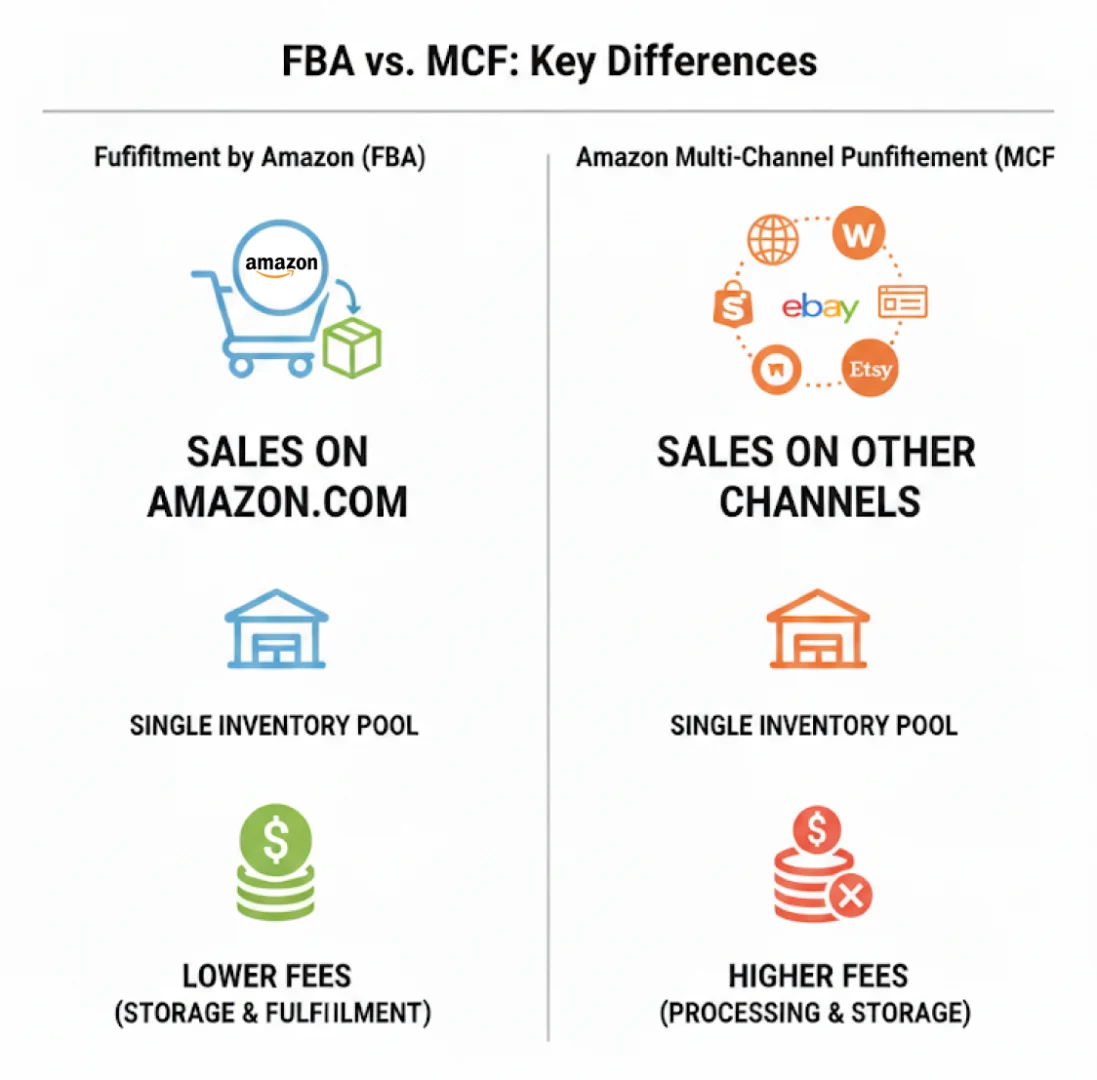
Amazon FBA and Amazon Multi-Channel Fulfillment are often perceived as similar but they are different. The primary difference between Amazon MCF and Amazon FBA is that MCF is for sales on non-Amazon channels, while FBA is for Amazon sales only.
Other than this difference, both services also differ on pricing. Fulfillment costs for MCF can be significantly high due to various fees associated with order processing and inventory management, which can impact overall profitability. On the other hand with FBA fulfillment the orders coming through the Amazon channel have relatively low fee for storage and fulfillment.
How Amazon Multi-Channel Fulfillment Works?
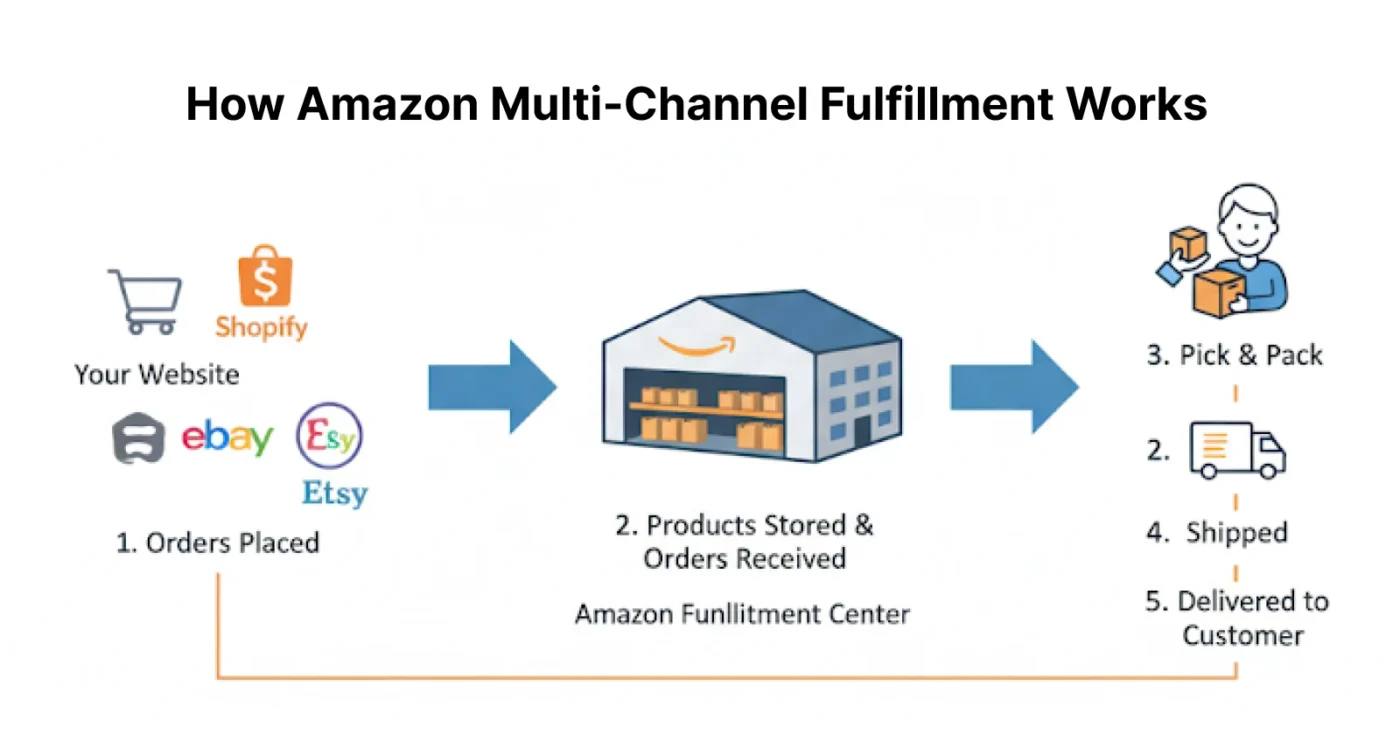
Amazon’s Multi-Channel Fulfillment works by fulfilling orders received through multiple channels from one pool of inventory that is stored in Amazon’s warehouses. When a customer places an order on your own website or another marketplace where your products are listed, the order details are sent to Amazon MCF. Amazon then jumps in and takes care of the whole process from packing to delivering the product to customers.
- Your products are stored in Amazon fulfillment centers.
- Amazon receives the orders in their warehouses.
- Amazon proceeds to pick, pack, and ship the order to the customer.
Amazon Multi-Channel Fulfillment Pricing
Amazon Multi Channel Fulfillment uses a fee based structure. Sellers are charged different fees when Amazon fulfills their multi-channel orders.
Here is the breakdown of Amazon Multi-Channel Fulfillment cost:
1. Fulfillment Fee
This is a per-unit fee for fulfilling MCF items. The fee varies depending on product size, weight, and units per order. For the current year, Amazon has announced that the fulfillment fee for 2026 will be increased by $0.30 per unit. Fulfillment fees include picking, packing, and shipping. Here is the latest fee structure for MCF orders shipped within the US.
| STANDARD 3 business-day delivery | ||||
| Size tier | 1-unit order | 2-unit order | 3-unit order | 4+ unit order |
| Small Standard: 4 oz or less | $7.34 | $4.98 | $4.10 | $3.64 |
| Small Standard: 4+ oz to 8 oz | $7.51 | $5.09 | $4.19 | $3.72 |
| Small Standard: 8+ to 12 oz | $8.17 | $5.68 | $4.72 | $4.23 |
| Small Standard: 12+ to 16 oz | $8.66 | $5.90 | $4.88 | $4.38 |
| Large Standard: 4 oz or less | $7.56 | $5.12 | $4.40 | $4.00 |
| Large Standard: 4+ oz to 8 oz | $7.72 | $5.23 | $4.49 | $4.08 |
| Large Standard: 8+ to 12 oz | $8.61 | $6.00 | $4.90 | $4.50 |
| Large Standard: 12+ to 16 oz | $8.93 | $6.26 | $5.15 | $4.70 |
| Large Standard: 1+ to 2 lb | $10.64 | $7.19 | $5.90 | $5.25 |
| Large Standard: 2+ to 3 lb | $11.75 | $8.13 | $6.79 | $5.95 |
| Large Standard: 3+ to 20 lb | $11.75 + $0.70/lb above 3 lb | $8.13 + $0.65/lb above 3 lb | $6.79 + $0.63/lb above 3 lb | $5.95 + $0.63/lb above 3 lb |
| Small Bulky: Up to 30 lb | $18.08 + $0.75/lb above 2 lb | $13.32 + $0.70/lb above 2 lb | $11.49 + $0.70/lb above 2 lb | $9.73 + $0.70/lb above 2 lb |
| Small Bulky: above 30lb | $39.13 + $0.75/lb above 30 lb | |||
| Large Bulky: Up to 30 lb | $18.43 + $0.77/lb above 2 lb | $13.58 + $0.71/lb above 2 lb | $11.72 + $0.71/lb above 2 lb | $9.92 + $0.71/lb above 2 lb |
| Large Bulky: above 30 lb | $39.89 + $0.77/lb above 30 lb | |||
| Extra-Large Up to 50 lb | $32.17 + $0.62/lb above first lb | |||
| Extra-Large 50+ to 70 lb | $62.64 + $1.01/lb above 51 lb | |||
| Extra-Large 70+ to 150 lb | $84.66 + $1.41/lb above 71 lb | |||
| Extra-Large 150+ lb | $253.97 + $1.69/lb above 151 lb | |||
| Expedited 2 business-day delivery | ||||
| Size tier | 1-unit order | 2-unit order | 3-unit order | 4+ unit order |
| Small Standard: 4 oz or less | $10.70 | $6.31 | $4.78 | $3.96 |
| Small Standard: 4+ oz to 8 oz | $10.83 | $6.55 | $5.03 | $4.43 |
| Small Standard: 8+ to 12 oz | $11.45 | $6.91 | $5.44 | $4.89 |
| Small Standard: 12+ to 16 oz | $13.12 | $7.50 | $6.00 | $5.10 |
| Large Standard: 4 oz or less | $10.88 | $6.31 | $4.96 | $4.30 |
| Large Standard: 4+ oz to 8 oz | $11.59 | $6.55 | $5.20 | $4.79 |
| Large Standard: 8+ to 12 oz | $11.81 | $6.91 | $5.55 | $5.22 |
| Large Standard: 12+ to 16 oz | $13.12 | $7.50 | $6.00 | $5.38 |
| Large Standard: 1+ to 2 lb | $13.45 | $7.96 | $6.42 | $5.91 |
| Large Standard: 2+ to 3 lb | $14.14 | $8.65 | $7.19 | $6.58 |
| Large Standard: 3+ to 20 lb | $14.14 + $0.69/lb above 3 lb | $8.65 + $0.69/lb above 3 lb | $7.19 + $0.67/lb above 3 lb | $6.58 + $0.67/lb above 3 lb |
| Small Bulky: Up to 30 lb | $19.75 + $0.75/lb above 2 lb | $14.35 + $0.70/lb above 2 lb | $13.53 + $0.70/lb above 2 lb | $13.14 + $0.70/lb above 2 lb |
| Small Bulky: above 30 lb | $40.80 + $0.75/lb above 30 lb | |||
| Large Bulky: Up to 30 lb | $20.13 + $0.77/lb above 2 lb | $14.63 + $0.71/lb above 2 lb | $13.80 + $0.71/lb above 2 lb | $13.40 + $0.71/lb above 2 lb |
| Large Bulky: above 30 lb | $41.59 + $0.77/lb above 30 lb | |||
| Extra-Large Up to 50 lb | $35.27 + $0.65/lb above first lb | |||
| Extra-Large 50+ to 70 lb | $67.73 + $1.01/lb above 51 lb | |||
| Extra-Large 70+ to 150 lb | $90.30 + $1.41/lb above 71 lb | |||
| Extra-Large 150+ lb | $299.11 + $1.66/lb above 151 lb | |||
Other than that Amazon has also introduced Preferred Pricing to eligible merchants, offering up to a 15% discount on MCF fulfillment fees and a $1 FBA fee credit for every MCF unit shipped for at least 6 months and up to one year.
Here is how preferred pricing works
| Duration | Eligibility | Benefits |
| 6 months | Meet any of the following criteria:Enrolled in the MCF NSI program with 100+ MCF units shipped on or after October 15, 2025Started using an MCF API integration on or after October 15, 2025An established FBA seller who in the past 12 weeks has:Shipped 5,800+ FBA units, ANDShipped fewer than 1,200 MCF units | 15% discount on MCF outbound fulfillment fees$1 FBA credit for every MCF unit shipped (capped at $50,000) |
| 12 months | Shipped between 1,200 and 23,000 MCF units in the past 12 weeks | Up to 15% discount on MCF outbound fulfillment fees, based on units shippedUp to $1 FBA credit for every MCF unit shippedBenefits apply to your first 100,000 MCF units or 12 months, whichever comes first |
2. Storage Fee
This fee is for inventory space in fulfillment centers. It is calculated from your daily average volume in cubic feet and unit size, that is ready to ship per Fulfilled by Amazon policies. Here is the breakdown of storage fees based on products.
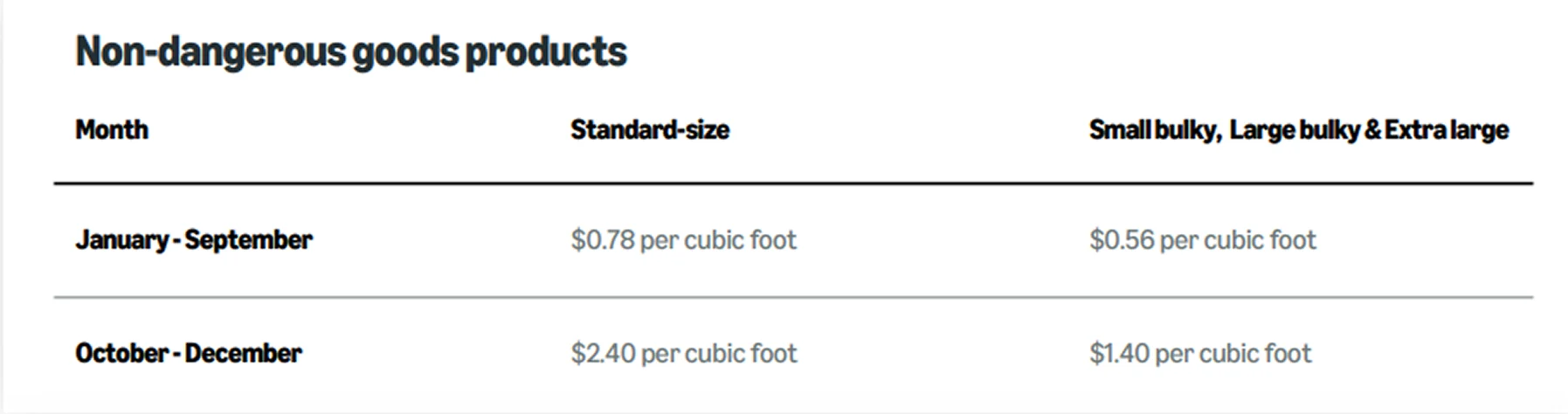
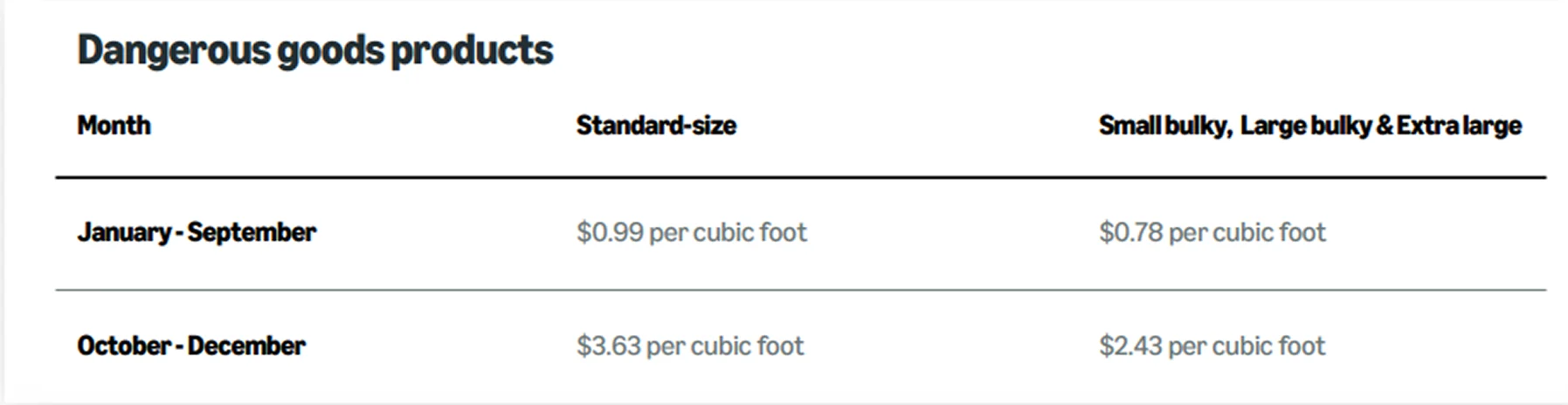
Amazon MCF merchants are required to pay a monthly inventory storage fee to keep their inventory in Amazon’s warehouses. This fee is calculated based on how much square footage your inventory takes up.
If your inventory remains in the warehouse for a long time, Amazon charges additional long-term storage fees. Storage fees also vary by season, as during peak seasons, Amazon increases the storage fee per cubic foot. As a seller, it’s important to consider these costs, as they can cut into your profits during the holiday period.
Benefits of Amazon Multi-Channel Fulfillment
Amazon Multi-Channel Fulfillment (MCF) offers several benefits to ecommerce businesses. MCF works well for online sellers who are just starting out or expanding to multiple channels with preference to keep things simple and easy.
Reliable Service: You can trust Amazon as it has a proven track record for accurate, damage free and timely delivery. Amazon MCF also offers real-time tracking, giving you and your customers visibility every step of the way.
Fast Shipping: Amazon has an extensive network of fulfillment centers and shipping carriers which makes it possible to deliver your product faster. You can choose between Standard (within 3 business days) and Expedited (within 2 business days).
Simple, Predictable Cost: Amazon MCF pricing is straightforward with transparent pricing for fulfillment and storage. Sellers can forecast expenses and manage pricing accordingly.
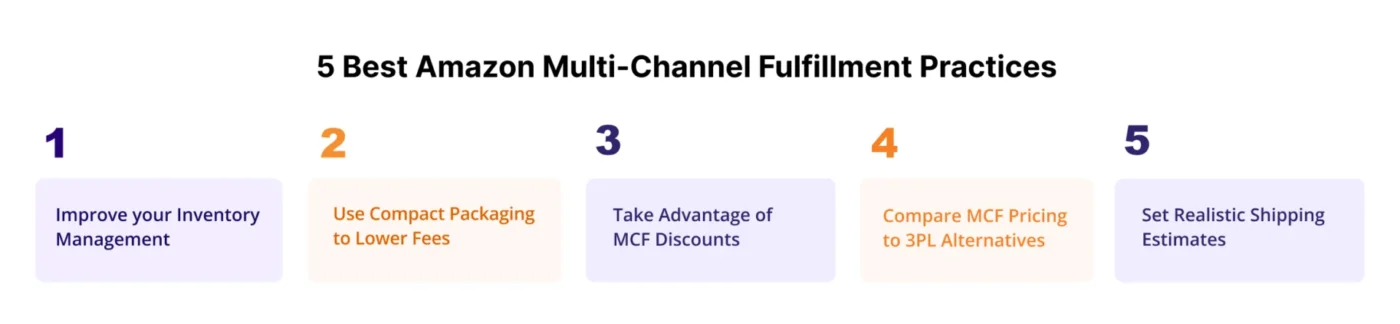
How to Use Amazon Multi-Channel Fulfillment: 5 Best Practices
Here are some best practices that can help sellers to be more efficient while maintaining a high level of customer satisfaction when using Amazon MCF.
1. Improve your Inventory Management
Effective inventory management is critical when using Amazon MCF as the stock is shared across multiple channels. Regular inventory monitoring is essential to avoid stockouts. With monitoring, you can identify the slow moving SKUs that incur additional charges as Amazon charges additional fee as long term storage fee. You can shift these slow-moving SKUs to other cheaper 3PL warehouses to avoid high storage costs.
For example, a seller with seasonal products, such as Christmas decoration items, can store excess inventory in a 3PL warehouse and transfer stock to Amazon only before high demand periods.
2. Use Compact Packaging to Lower Fees
Using more compact and lightweight packaging can help sellers reduce these fees as Amazon charges MCF fee based on dimensional weight. Optimizing your packaging can be an effective strategy to lower fees. For example, a seller shipping skincare products can replace oversized boxes with tight yet protective packaging. This will reduce empty space and overall package size.
3. Take Advantage of MCF Discounts
Amazon offers volume-based discounts, meaning higher order volumes can lead to lower fulfillment costs per unit. Sellers can take advantage of this by encouraging customers to buy in bundles instead of single items. For example, sellers who sell protein bars can create a 12-bar bundle at a discounted price which is likely to reduce per unit fulfillment cost.
4. Compare MCF Pricing to 3PL Alternatives
While Amazon MCF offers competitive fulfillment but with prices rising every year, it may not always be the most cost effective solution for every product. Sellers can compare Amazon MCF fees with quotes from third-party logistics (3PL) to find the best fit. For example, a seller shipping large home furniture items may look for 3PL offering freight shipping with low cost compared to Amazon.
5. Set Realistic Shipping Estimates
Since Amazon prioritizes FBA orders, MCF orders can sometimes ship slower, especially during peak seasons. Sellers should set realistic delivery timelines on platforms like Shopify or eBay to ensure client satisfaction. For example, instead of promising “2-day shipping” on a Shopify store, a seller can list “2–4 business days” to better match Amazon MCF delivery speeds.
Conclusion
Amazon Multi-Channel Fulfillment is a powerful solution for sellers who are looking for a simplified solution to sell across multiple platforms. By storing products in Amazon warehouses, sellers can count on Amazon to handle everything related to orders coming from outside Amazon.
While Amazon with reduced logistic complexity is a reliable option, it is important to set realistic expectations. You can follow the effective practices mentioned in the article to get the most from Amazon Multi Channel Fulfillment.
If you need expert guidance for that, you can book a free consultation call with us. AMZDUDES as an Amazon growth agency can help you optimize fulfillment ensuring cost control for maximum profitability.
If you’re looking to use Amazon Multi-Channel Fulfillment strategically and scale your business across channels, AMZDUDES can help you optimize fulfillment, control costs, and grow your brand efficiently on and beyond Amazon.
Frequently Asked Questions
What shipping options do Amazon Multi-Channel fulfillment offer?
Amazon Multi-Channel Fulfillment offers two shipping options: Standard shipping, which delivers orders in 3 business days, and Expedited shipping, which delivers orders in 2 business days.
Can I use MCF without selling on Amazon?
Yes, you can use Amazon Multi-Channel Fulfillment without selling on Amazon. You can store inventory in Amazon warehouses and use MCF to fulfill orders from your own website or other marketplaces.
Are there monthly storage fees?
Yes. You pay monthly storage fees for the space your inventory occupies. These fees fluctuate seasonally, typically increasing during the holiday peak season.
Are MCF fees higher than FBA fees?
Yes, MCF fees are generally higher than FBA fees because they are designed for non-Amazon orders.
Can I choose slower shipping to reduce MCF costs?
Yes, selecting Standard shipping instead of Expedited can help lower fulfillment fees.