

Key Takeaways
- Most Amazon sellers can recover 1–3% of their annual FBA revenue through Amazon reimbursement services when all major reimbursement claim categories are actively audited and managed.
- Amazon’s 60-day reimbursement claim window has made weekly Amazon reimbursement audits far more important, as delayed claims can permanently expire before sellers ever file them.
- Inbound shipment discrepancies, damaged inventory, customer return issues, FBA fee overcharges, and removal order losses are some of the highest-value Amazon reimbursement categories sellers frequently overlook.
- The quality of an Amazon reimbursement service depends heavily on claim coverage, follow-up discipline, escalation handling, and fee transparency, not just automation or brand recognition.
- Across four managed seller accounts, our Amazon reimbursement services recovered over $151,000 in one year through structured audits, claim filing, follow-ups, and reimbursement case escalations.
If you are wondering how much money you can recover with Amazon reimbursement services, the answer is simple: probably far more than you realize, and far more than you are currently recovering.
Most FBA sellers either never audit their reimbursements at all or rely entirely on automated tools charging 15–20%, assuming the Amazon FBA reimbursement claim process is being handled properly. In reality, both approaches often leave a significant portion of eligible reimbursements unclaimed.
This blog breaks down what sellers can realistically recover with a reliable Amazon reimbursement service using real recovery data from our own managed accounts. We’ll walk through actual reimbursement amounts recovered across one year, the factors that impact recovery totals, and a detailed client case study showing how the right reimbursement process directly affects net recovery.
How Much Money You Can Recover with Amazon Reimbursement Services: Industry Benchmarks
Most Amazon FBA sellers can recover approximately 1–3% of their annual revenue through Amazon reimbursement services. That means a seller doing $500,000 annually could recover anywhere from $5,000 to $15,000 per year from lost inventory, damaged products, return issues, and FBA fee overcharges.
Industry benchmarks report that the average FBA seller loses 1–3% of their annual revenue to reimbursable errors that go unclaimed.
This figure is consistent across multiple industry sources, such as SellerSprite, Refunzo, and SellerLogic, which have all published research pointing to the same range. According to Forbes, Amazon FBA sellers collectively lose $1.2 billion annually to preventable errors: lost inventory, damaged goods, return abuse, and overcharged fees.
Here’s what that 1–3% looks like in dollar terms for different seller sizes that are going unclaimed if you are not seeking help from the right Amazon reimbursement services:
| Annual FBA Revenue | Expected Recoverable Amount |
| $100,000 | $1,000 – $3,000 |
| $250,000 | $2,500 – $7,500 |
| $500,000 | $5,000 – $15,000 |
| $1,000,000 | $10,000 – $30,000 |
| $5,000,000 | $50,000 – $150,000 |
4 Key Factors Affecting Recovery from Amazon FBA Reimbursement
Two sellers generating the same annual revenue can have dramatically different Amazon FBA reimbursement recoveries because of the following factors:
1. Audit Frequency
As Amazon has shortened the reimbursement claim window to just 60 days, regular Amazon reimbursement audits have become much more important than they were before. Sellers previously had a much larger window to identify and file reimbursement claims, but now even small delays can lead to eligible claims expiring before they are ever submitted.
Because of this, sellers who audit their accounts weekly are usually able to recover significantly more than sellers who only review their accounts once a month. The difference is not that Amazon makes more mistakes for one seller than another, it’s that frequent audits help catch Amazon FBA reimbursement opportunities before they fall outside the filing window.
2. Types of Reimbursement Claims Being Tracked
There are 6 distinct categories of Amazon FBA reimbursements: inbound shipment discrepancies, warehouse lost inventory, Amazon FBA damaged inventory, customer return issues, FBA fee overcharges, and removal order losses. Most sellers, and even many Amazon reimbursement services, only actively pursue two or three of these.
According to SellerSprite, inbound shipment errors alone account for approximately 40% of all recoverable Amazon FBA reimbursements. But fee overcharges are often the highest-dollar-per-claim category, and customer return abuse is the most consistently overlooked. If your Amazon reimbursement service or your own process doesn’t cover all six, you’re leaving a significant percentage of your potential recovery on the table.
3. Follow-Up Routine
Filing a claim is step one, but keeping a consistent follow-up is what differentiates a top Amazon reimbursement service from a mid Amazon reimbursement service. Amazon doesn’t always resolve Amazon FBA reimbursement claims fully on the first response, cases get partially resolved, delayed, or closed incorrectly. Sellers who track every case ID and follow up within 7–10 days of no movement recover materially more than those who file and forget.
4. Your Amazon Reimbursement Service’s Fee
This factor does not affect your gross Amazon FBA reimbursement recovery, but it directly affects your net recovery, the amount you actually keep after service fees. Many Amazon reimbursement services charge 15–20% of recovered funds, and some even apply their fee on auto-reimbursements processed directly by Amazon.
Over time, that difference becomes substantial. For example, on $150,000 in annual reimbursements, the gap between a 15% fee and a 5% fee is $15,000 per year, staying in your business instead of going to the service provider.
How Much Can Amazon Reimbursement Services Recover by Claim Type?
Here’s what each category realistically contributes to your total Amazon FBA reimbursement recovery, based on managed account data:
1. Amazon FBA Lost Inventory Reimbursement
- Inbound Shipments
Typical monthly contribution: $500–$10,000+
Amazon FBA lost inventory reimbursement is the highest-volume category. Every unit that disappears between your shipping carrier and Amazon’s receiving dock is recoverable. You’ll need your Shipment ID and proof of what you sent. This category makes up roughly 40% of all recoverable Amazon FBA reimbursements.
- Warehouse
Typical monthly contribution: $200–$5,000
It’s the inventory that made it into the fulfillment center but went missing during internal transfers or picking. These show up in your Inventory Adjustment report as unmatched “Misplaced” entries. Filing window: 60 days from the date reported.
2. Amazon FBA Damaged Inventory Reimbursement
Typical monthly contribution: $100–$3,000
Products damaged while in Amazon’s care, during storage, inter-fulfillment center transfers, or the pick-and-pack process fall into the Amazon FBA damaged inventory reimbursement category. The key complication is that Amazon sometimes misclassifies warehouse damage as customer damage. Customer-damaged items have a different (and often harder) path to Amazon FBA reimbursement. Catching these misclassifications and disputing them is one of the highest-value activities in this category.
3. Customer Return Issues
Typical monthly contribution: $300–$4,000
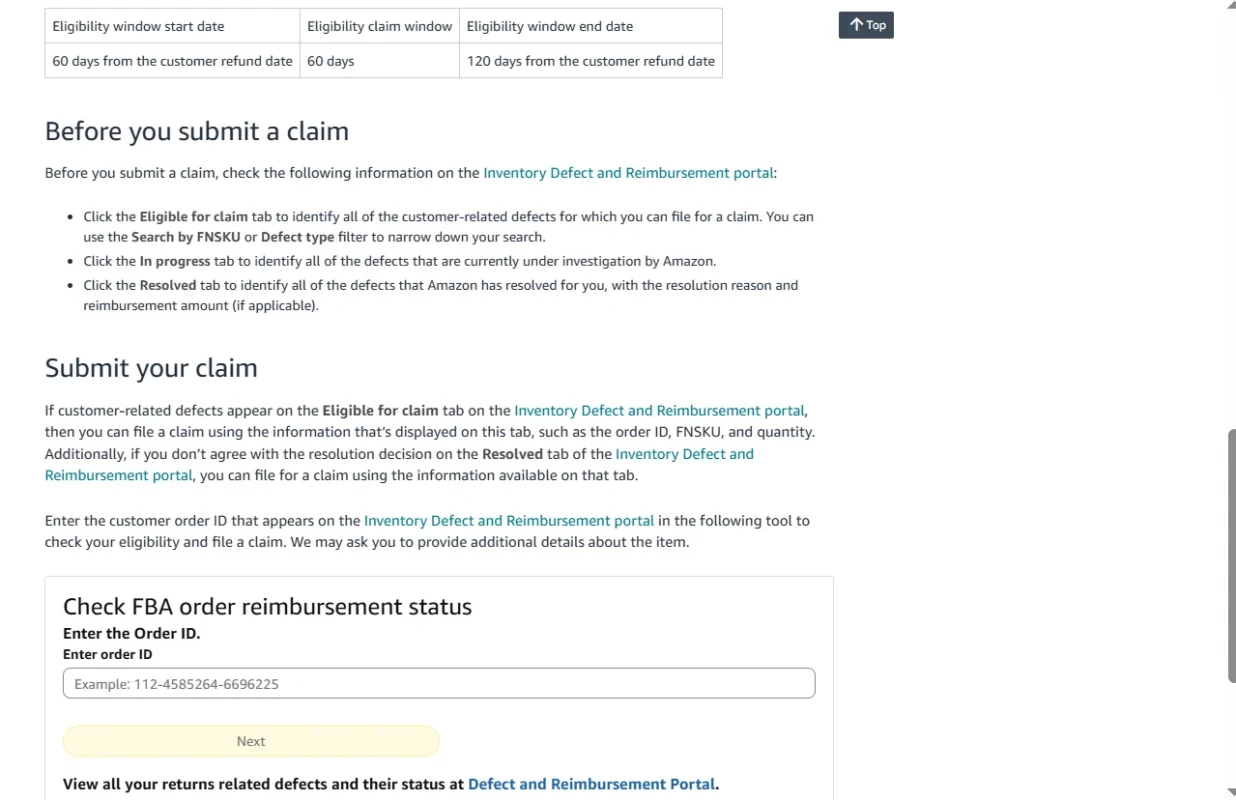
A customer gets a refund, but the item never comes back to you belongs to this category. Amazon was supposed to catch it, and often doesn’t. Additionally, returned items in unsellable condition, wrong items returned by customers, and partial returns where a full refund was issued. These require cross-referencing your returns report against your refund report. Filing window: 60–120 days post-refund.
4. FBA Fee Overcharges
Typical monthly contribution: $50–$2,000+ (ongoing, per error)
Amazon fee overcharges are one of the most overlooked Amazon reimbursement categories, especially when sellers are being charged Amazon incorrect referral or FBA fees without realizing it. Amazon mismeasures a product’s dimensions or weight and assigns a higher size tier, overcharging you on every unit sold under that miscalculation.
One fee error of $1.40/unit on a product that moves 5,000 units is $7,000 in overcharges. These are among the easiest Amazon FBA reimbursement claims to prove, the math is objective, but they require knowing how to look for them. Recovery here is ongoing until the error is corrected.
5. Removal and Disposal Order Losses
Typical monthly contribution: $50–$1,500
This is the type of Amazon FBA reimbursement where you request your inventory back, and Amazon confirms the removal, but the units don’t arrive. Filing window: 15–75 days for lost-in-transit removal cases.
What We Have Recovered for Our Client Accounts With Amazon Reimbursement Services?
The table below shows actual reimbursement recoveries generated by our Amazon reimbursement services across four managed seller accounts over a full calendar year. These are real recovery numbers tracked through our reimbursement audits, claim filing process, follow-ups, and case escalations.
| Month | FBA Claims Recovered | Lost Warehouse & Other | Grand Total |
| January | $8,800 | — | $8,800 |
| February | $5,885 | — | $5,885 |
| March | $5,070 | — | $5,070 |
| April | $7,528 | — | $7,528 |
| May | $10,315 | $4,299 | $14,614 |
| June | $19,027 | $5,702 | $24,729 |
| July | $8,366 | $7,081 | $15,447 |
| August | $10,449 | $7,993 | $18,442 |
| September | $12,254 | $5,219 | $17,473 |
| October | $8,879 | $4,777 | $13,656 |
| November | $5,227 | $5,890 | $11,117 |
| December | $4,953 | $4,167 | $9,120 |
| Annual Total | $106,753 | $45,128 | $151,881 |
With our Amazon reimbursement services, $151,881 recovered across four accounts in one year.
Two things worth noting in this data:
First, the ramp from January through June. Amazon FBA reimbursement recoveries nearly tripled over those six months, not because errors spiked, but because a structured weekly audit process takes time to mature. When you first establish a proper tracking system, there’s often a backlog of missed discrepancies to work through. Once cleared, recovery stabilizes into a predictable monthly range.
Second, the “Lost Warehouse & Other” column only appears from May onward. That’s when the process was expanded to cover additional claim categories beyond the basic FBA types. The jump from $7,528 in April to $14,614 in May is entirely explained by adding coverage for claim types that were previously being missed.
How Amazon FBA Reimbursement Policy Change Affects How Much You Can Recover
Amazon’s reimbursement policy change has directly affected how much sellers can recover from warehouse loss and damaged inventory claims. Before March 31, 2025, Amazon typically reimbursed sellers close to the product’s selling price. If Amazon lost a product selling for $50, sellers could previously recover close to that amount.
Now, Amazon only reimburses sellers based on manufacturing cost, the actual sourcing or production cost of the product, excluding shipping, customs, and other related expenses. So if that same product costs $12 to manufacture, the reimbursement amount now drops closer to $12 instead of the original selling price.
Because of this change, Amazon FBA lost inventory reimbursements (warehouse), which are now significantly lower than they were before. This has made it even more important for sellers to actively track all reimbursement categories instead of relying heavily on warehouse-loss claims alone. Categories like inbound shipment discrepancies, customer return issues, and FBA fee overcharges are unaffected by this policy change and now contribute a much larger share of total Amazon FBA reimbursement recovery.
Another important point is that Amazon now estimates manufacturing costs if sellers have not updated that information inside Seller Central. In many cases, Amazon’s estimated cost is lower than the seller’s actual sourcing cost, which further reduces reimbursement payouts. So, you have to update the accurate manufacturing cost data inside Seller Central to maximize Amazon reimbursement recovery under the new Amazon FBA reimbursement policy.
Case Study: How We Saved $100K+ for Our Client With Our Amazon Reimbursement Services
One of the 7-figure 3P sellers we worked with was already using a well-known Amazon reimbursement tool before switching to our Amazon reimbursement services. While the tool was handling basic claims like inbound shipment discrepancies and warehouse losses, a deeper audit revealed several gaps in the reimbursement process.
The seller was being charged a 15% fee on all Amazon FBA reimbursements, including auto-reimbursements processed directly by Amazon. At the same time, several high-value claim categories, including damaged inventory disputes, customer return issues, and FBA fee overcharges, were not being tracked consistently. The process also lacked active follow-ups and escalation handling on unresolved cases.
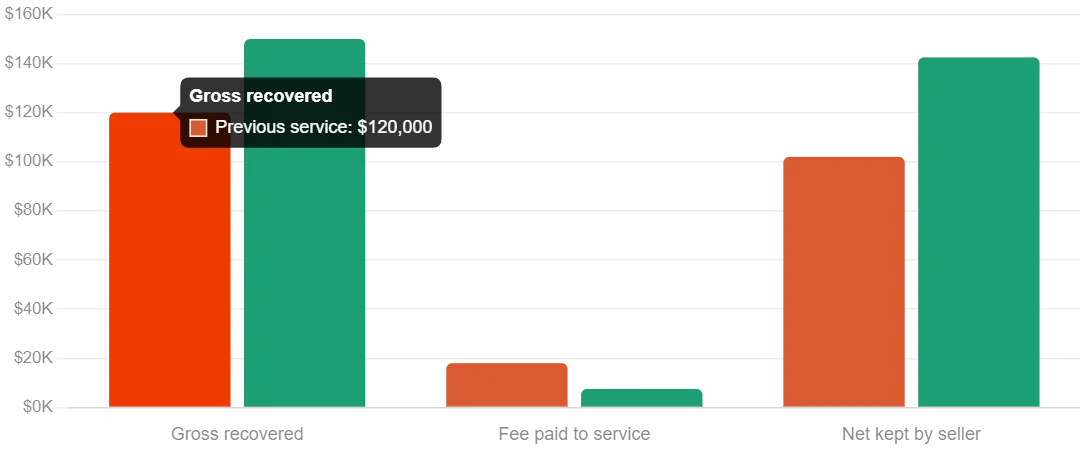

After taking over the account, we expanded Amazon FBA reimbursement claim process coverage across all major reimbursement categories, implemented structured case tracking, and actively followed up on every unresolved claim. We also separated Amazon auto-reimbursements from manually recovered claims and only charged our fee on reimbursements we actually recovered through our own work.
The result was significantly higher Amazon FBA reimbursement recovery and much higher net recovery retained by the seller. Based on the account’s reimbursement volume, the difference between a 15% fee and our 5% fee structure alone represented over $15,000 per year staying inside the business. Combined with improved claim coverage and recovery management, the total impact exceeded $100,000 over time.
This case highlights an important reality: the quality of Amazon reimbursement services depends on claim coverage, follow-up discipline, escalation handling, and fee transparency, not just brand recognition.
Frequently Asked Questions
1. How much money can small Amazon sellers recover with Amazon reimbursement services?
Small Amazon sellers doing $80,000–$150,000 in annual FBA revenue can typically recover around $1,500–$5,000 per year through Amazon reimbursement services when all major reimbursement claim categories are being audited consistently.
2. Does Amazon’s 2025 reimbursement policy reduce how much sellers can recover?
Yes, Amazon’s 2025 reimbursement policy reduced warehouse-loss reimbursement payouts because Amazon now reimburses sellers based on manufacturing cost instead of selling price. However, reimbursement categories like inbound shipment discrepancies, customer return issues, and FBA fee overcharges are still fully recoverable.
3. How long do Amazon reimbursement claims take to get paid?
Most simple Amazon reimbursement claims are resolved within 7–14 days when the claim is properly documented. More complex reimbursement claims, including damaged inventory disputes and FBA fee overcharges, can take 30–60 days if escalations or additional follow-ups are required.
4. What is the difference between Amazon reimbursement software and Amazon reimbursement services?
Amazon reimbursement software mainly automates claim detection and submission. Amazon reimbursement services include human oversight, claim reviews, follow-ups, escalation management, and manual dispute handling for unresolved reimbursement claims.
5. Can too many Amazon reimbursement claims hurt your Amazon seller account?
No, filing legitimate Amazon reimbursement claims does not hurt your Amazon seller account. Issues usually happen only when sellers repeatedly submit unsupported or inaccurate reimbursement claims that violate Amazon policy.
6. Do Amazon reimbursement services work for FBM sellers too?
Yes, Amazon reimbursement services also work for FBM sellers. FBM reimbursement claims commonly include incorrect return charges, fee discrepancies, and customer refund issues related to merchant-fulfilled orders.
Conclusion
Most Amazon sellers can realistically recover 1–3% of their annual FBA revenue through properly managed Amazon reimbursement services. Across four managed seller accounts alone, we recovered over $151,000 in a single year through structured audits, claim filing, follow-ups, and escalations.
How much you recover depends on how frequently your account is audited, how many claim categories are being tracked, and how effectively unresolved cases are managed. With Amazon’s 60-day claim window now in place, a passive Amazon FBA reimbursement claim process leaves significant money unclaimed.
At AMZDUDES, our Amazon reimbursement services focus on full claim coverage, active case management, and transparent recovery tracking, with fees charged only on reimbursements we actually recover. Book a free consultation call with our team to find out how much unrecovered money may already be sitting inside your Amazon account.