
Key Takeaways
- A strong Amazon advertising strategy starts with the basics, the right keywords, clear campaign structure, and well-optimized listings, before increasing ad spend.
- Sponsored Products help drive sales, Sponsored Brands build brand visibility, and Sponsored Display helps you reach shoppers beyond search results.
- Regularly tracking metrics like CTR, conversion rate, ACoS, ROAS, and TACoS helps you understand what’s working and where to improve.
- Advanced tactics like dynamic bidding, DSP, and A/B testing help improve results once your campaigns are stable.
- In 2026, sellers who adapt to AI tools, video ads, and placement-based bidding will have a stronger advantage over competitors.
Amazon advertising is no longer optional for sellers who want consistent growth. In 2026, competition is higher, amazon ppc costs are smarter, and the marketplace rewards sellers who treat advertising as a strategic system rather than a simple traffic source.
A strong Amazon advertising strategy helps you do more than generate clicks. It increases visibility, improves organic ranking, protects market share, and drives long-term profitability. Yet many sellers still struggle because they launch campaigns without a clear structure, clear objectives, or a plan for optimization.
This guide walks through how experienced advertisers approach Amazon ads today, how to build a result-driven Amazon advertising strategy from basics to expert level, so you can run smarter campaigns, increase sales, and maximize ROI.
Understanding Amazon Advertising
Before building a winning Amazon advertising strategy, it’s important to understand how Amazon ads actually work.
Amazon functions as a search engine that prioritizes the intent of the shoppers. As the shoppers here are ready to purchase, only the listings and ads that instantly convert them get priority from Amazon. This means even if you are running ads with high bids, that’s not enough. You also need to maintain high listing quality, relevance, and provide a top-notch shopper experience.
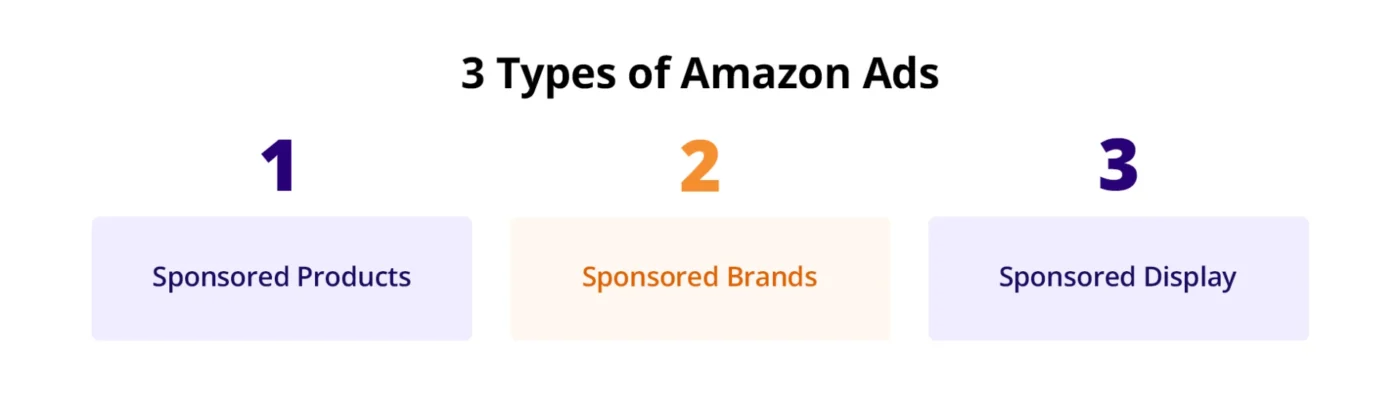
Before getting into how to make a high-converting Amazon advertising strategy, let’s understand the 3 types of Amazon ads:
1. Sponsored Products
Amazon Sponsored Products are the foundation of almost every Amazon-sponsored products strategy. These ads promote individual listings directly inside search results and product pages. They are keyword or product-targeted and typically deliver the highest direct sales volume.
2. Sponsored Brands
A strong Amazon-sponsored brands strategy helps sellers increase visibility at the top of search results. These ads showcase multiple products, custom messaging, and video formats, making them ideal for brand building and category dominance.
3. Sponsored Display
Sponsored Display campaigns allow advertisers to reach shoppers both on and off Amazon through retargeting and audience-based placements. They’re useful for expanding reach and re-engaging interested customers.
How to Build an Amazon Advertising Strategy in 2026?
A profitable Amazon advertising strategy is built on strong fundamentals. Many Amazon sellers jump straight into bidding and scaling, only to discover that rising costs and poor conversion rates quickly eat into margins. In reality, if you want to build an Amazon advertising strategy that gives you maximum conversions, you need to work on the structure.
Before you explore advanced tactics, you need a solid foundation that aligns targeting, budget, and listing quality with shopper intent.
Below are the core elements you need to pay attention to to make an Amazon advertising strategy in 2026:
1. Identify Keywords
Amazon Keyword strategy sets the foundation of its advertising strategy because Amazon functions as a search engine. The platform’s algorithm determines ad placements based largely on relevance, which means understanding how customers search is essential before launching campaigns.
Start by identifying keywords that represent clear buying intent. These are terms shoppers use when they are closer to making a purchase rather than researching. For example, “stainless steel water bottle insulated” typically converts better than broad discovery terms like “water bottle.”
A strong keyword strategy should include:
- High-intent keywords that closely match your product
- Long-tail search terms that reflect specific use cases or problems
- Competitor and alternative product keywords to capture comparison shoppers
- Negative keywords to prevent irrelevant clicks and wasted spend
In practice, many advertisers begin to broaden search term data and then gradually narrow campaigns toward exact match keywords that consistently drive sales. The goal is not simply to chase high search volume; it’s to align keywords with buyer intent and conversion potential.
2. Select Channels and Budget
Amazon offers multiple advertising formats, but you don’t have to spend your investment on all of the Amazon ad types.
Most sellers begin with Sponsored Products because they deliver direct conversion opportunities and immediate visibility within search results. As performance data grows, advertisers typically expand into Sponsored Brands to increase brand presence and into Sponsored Display to support remarketing and audience expansion.
A practical budget structure often looks like this:
- Core budget dedicated to Sponsored Products for sales generation
- Growth budget allocated to Sponsored Brands for visibility and brand-building
- Expansion budget used for Sponsored Display campaigns that reach shoppers beyond search
Budgets can range widely depending on category competitiveness, but the key is to avoid spreading spending too thin. Testing a smaller group of products initially allows you to gather reliable performance data before scaling. Experienced advertisers focus the budget on proven winners rather than funding every SKU equally.
3. Targeting Options
Once your keywords and budgets are in place, the next decision is how precisely you want Amazon to target shoppers. Amazon provides two primary targeting methods:
- Automatic targeting: With automatic campaigns, Amazon’s algorithm decides when and where to show your ads based on product information and shopper behavior. This is particularly useful when launching new products or when you need keyword discovery data. Automatic campaigns help uncover search terms you may not have identified during research and often reveal unexpected converting keywords.
- Manual targeting: Manual campaigns give advertisers full control over keywords, bids, and targeting precision. You can target specific search terms, products, or categories and adjust bids based on performance data. This level of control is essential for scaling profitability because it allows you to prioritize high-performing keywords while reducing spend on weak terms.
In most mature accounts, advertisers use both methods strategically, automatic campaigns for discovery and manual campaigns for control and scaling.
4. Crafting Compelling Ad Content
With Amazon PPC Optimization, you can drive traffic, but listing is what turns the traffic into shoppers. So, your Amazon advertising strategy must include optimizing the content. So, before increasing bids or expanding budgets, ensure your product listings are optimized to support ad performance.
Amazon’s algorithm heavily favors products with strong conversion signals, meaning that if you have better listings, you will get lower costs and improved visibility.
High-performing listings typically include:
- Clear, keyword-rich titles that instantly communicate value
- Strong main images and supporting lifestyle visuals that build trust
- Benefit-focused bullet points that address shopper pain points
- A+ Content that answers questions and reduces purchase hesitation
- Competitive pricing supported by strong reviews and social proof
Amazon has introduced AI tools to help sellers create listing content faster, but experienced advertisers know that generic copy rarely outperforms messaging tailored to real customer intent.
Advanced Amazon Advertising Strategy Building Techniques
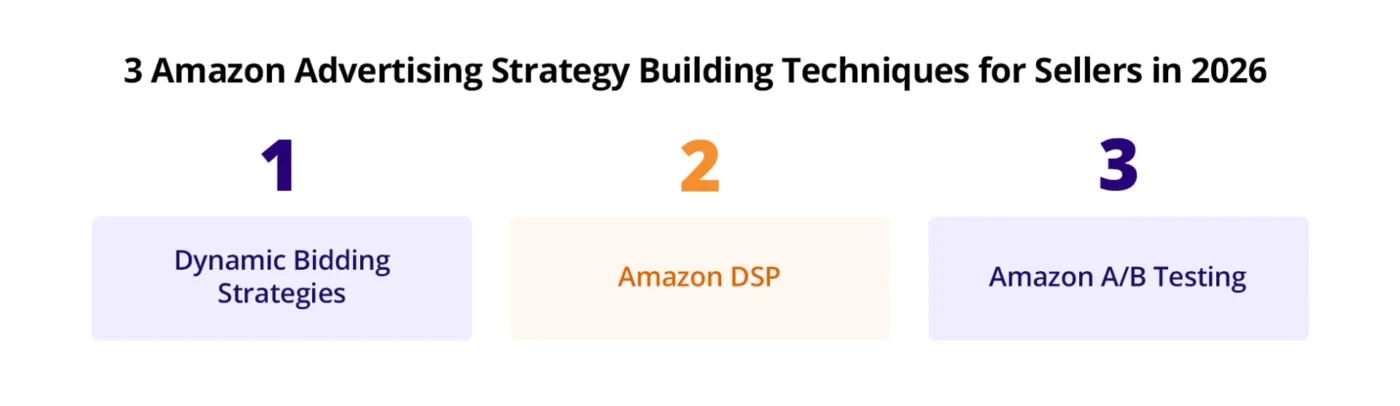
Once your core campaigns are stable and consistently generating data, advanced tactics help you move from simply running ads to actively scaling profitability. These techniques allow you to improve efficiency, reach new audiences, and uncover incremental growth opportunities that many sellers overlook.
1. Dynamic Bidding Strategies
Amazon’s dynamic bidding system automatically adjusts bids in real time based on the likelihood that a click will convert. Instead of relying solely on fixed bids, dynamic bidding allows Amazon’s algorithm to increase or decrease bids depending on shopper behavior, placement, and historical performance.
For most sellers, choosing the right bidding mode depends on campaign goals:
- Down Only reduces bids when conversion probability is low, helping control spend and protect margins. This option works well for new campaigns or products with tighter profitability targets.
- Up & Down allows Amazon to increase bids when conversion likelihood is high. This Amazon advertising strategy is useful when campaigns already perform well, and you want to capture more market share aggressively.
Regardless of bidding mode, advertisers should regularly review placement data. Top-of-search placements often perform differently from product-page placements, and bid adjustments should reflect those differences rather than applying one strategy across all placements.
2. Amazon DSP
Amazon DSP (Demand Side Platform) expands your reach beyond Amazon’s search results by allowing you to run display and video ads across Amazon-owned properties and third-party websites.
While Sponsored Products and Sponsored Brands focus on capturing active shoppers, DSP helps brands influence customers earlier in the buying journey and re-engage them after they leave Amazon.
You should include this in your Amazon advertising strategy if you want to:
- Retarget shoppers who viewed your product but didn’t purchase
- Launch new products to broader audiences
- Building long-term brand awareness outside Amazon search
3. Amazon A/B Testing
Continuous testing is one of the most reliable ways to improve campaign performance over time, and it must be a part of your Amazon advertising strategy. Small changes to listings or creatives often produce significant improvements in conversion rate, which can reduce ACoS more effectively than aggressive bid adjustments.
Advertisers should regularly test:
- Main product images
- Titles and value propositions
- Pricing or promotional offers
- Video creatives
- Sponsored Brands ad copy
The goal of testing is not just to improve Amazon ad metrics but to strengthen the overall shopping experience. Better conversions improve both paid and organic performance, creating a stronger Amazon advertising strategy over time.
Amazon Advertising Trends 2026
The sellers who outperform competitors in 2026 are not necessarily spending more; they’re adapting faster to how Amazon advertising is evolving. Understanding these shifts helps you future-proof your campaigns and build an Amazon advertising strategy that will bring the number of sales you want.
1. AI-Assisted Campaign Management
Automation and AI tools are playing an increasingly important role in campaign management. Amazon and third-party platforms now offer systems that assist with bid optimization, keyword expansion, and budget allocation based on real-time performance signals.
AI is particularly useful for:
- Adjusting bids based on conversion probability
- Identifying new keyword opportunities
- Reallocating budgets toward high-performing campaigns
- Forecasting trends and performance changes
While automation reduces manual workload, strategy remains human-driven. Sellers who combine AI efficiency with clear business goals typically outperform those relying entirely on automation.
2. Video Ads Becoming Standard
Video has moved from an optional enhancement to a core performance driver, especially within Sponsored Brands campaigns.
Video ads stand out because they immediately demonstrate product benefits and capture attention quickly in crowded search results. On mobile devices, where much of Amazon browsing happens, motion content often generates higher engagement than static images.
Strong video ads usually:
- Show the product in use within the first few seconds
- Focus on problem-solving rather than features alone
- Include text overlays for sound-off viewing
As competition increases, a modern Amazon-sponsored brands strategy should include video assets whenever possible to maintain visibility and improve conversion rates.
3. Retail Media Integration
Amazon is no longer operating as a standalone advertising platform. It is now a core part of the broader retail media ecosystem, where brands connect shopper data across multiple channels to create consistent customer journeys.
Many advertisers are combining Amazon campaigns with external channels such as social media and display advertising, using insights from one channel to improve performance in another.
This shift means Amazon ads are evolving from isolated Amazon PPC campaigns into components of larger growth systems. So, if you want to capture the maximum audience, you should be considering both acquisition and long-term brand value in your Amazon advertising strategy.
4. Placement-Based Bidding Importance
Placement optimization has become increasingly important as competition rises. Rather than applying uniform bids across all placements, advertisers are adjusting bids based on where ads appear and how shoppers behave in those environments.
Top-of-search placements often deliver:
- Higher click-through rates
- Stronger conversion rates
- Increased organic ranking momentum
Experienced advertisers analyze placement-level performance and apply bid modifiers strategically in their Amazon advertising strategy so that the budget is directed toward placements that drive the strongest returns.
How to Measure the Performance of Amazon Advertising Strategy in 2026?
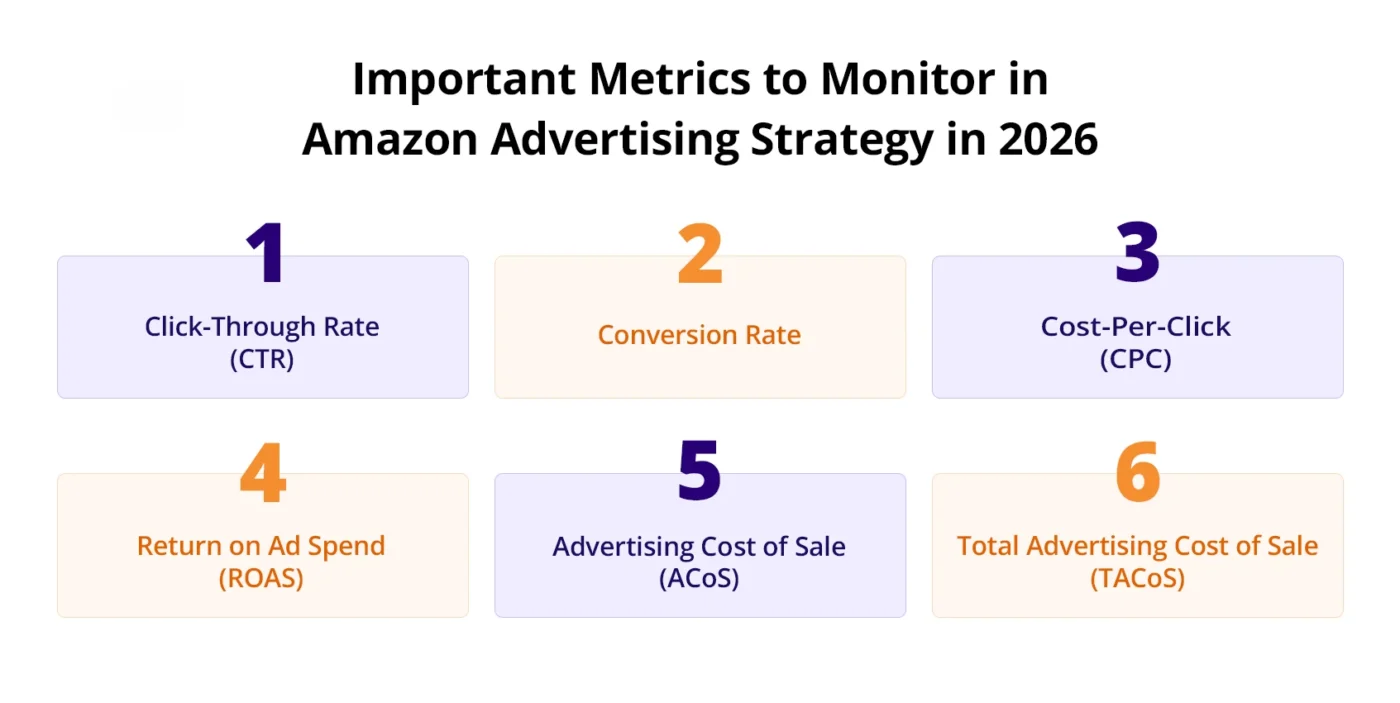
Data is what separates average sellers from top performers. Include monitoring these metrics as part of your Amazon advertising strategy and use them to guide optimization decisions.
Click-Through Rate (CTR)
If CTR is low, improve your main image, title clarity, or targeting relevance because shoppers aren’t finding your ad attractive or relevant. If CTR is high but sales are low, your listing or offer needs improvement rather than more traffic.
Conversion Rate
If the conversion rate is low, optimize your amazon listing, especially images, pricing, reviews, and bullet points, before increasing ad spend. If the conversion rate is high, scale budgets and bids to capture more profitable traffic.
Cost-Per-Click (CPC)
If Amazon CPC is rising, tighten targeting, add negative keywords, and reduce bids on poor-performing terms. If CPC is low but impressions are limited, increase bids strategically to gain more visibility.
Return on Ad Spend (ROAS)
If ROAS is low, reduce spend on inefficient keywords and improve conversion rate before scaling. If ROAS is strong, gradually increase the budget to expand reach while monitoring profitability.
Advertising Cost of Sale (ACoS)
If ACoS is above your break-even point, lower bids, improve listing conversion, or refine targeting. If ACoS is healthy and stable, consider scaling to improve organic ranking and sales velocity.
Total Advertising Cost of Sale (TACoS)
If TACoS decreases over time, ads are improving your organic sales and overall account health. If TACoS keeps increasing, ads may be driving sales without strengthening organic growth; reassess strategy.
Conclusion
Building an Amazon advertising strategy in 2026 is more advanced, more competitive, and more rewarding for sellers who approach it strategically. Success comes from mastering the fundamentals, adapting to new trends, and consistently optimizing based on performance data.
Whether you’re launching new products or scaling an established brand, the key is to build a system that evolves with the marketplace. The most successful sellers don’t just run ads; they run a strategy. Want to get help in building the best Amazon advertising strategy in 2026? Book a free consultation call now.