

Key Takeaways
- Consistent performance matters more than short spikes. Even when an Amazon ad campaign delivering strong results looks good, steady outcomes are what truly support forecasting and long-term growth.
- ROAS alone does not define ad health. To understand real Amazon ad performance, teams must also track CPC stability, conversion behavior, and spend pacing, not just one metric.
- Unclear results weaken confidence. When teams do not understand what delivering means in Amazon ads or why performance shifts, budgets feel risky and scaling slows down.
- Predictability comes from structure and signals. Using clear Amazon key performance indicators and clean campaign structure turns Amazon PPC into a reliable, data-driven system instead of guesswork.
- Growth only works when results stay within range. A strong Amazon growth strategy depends on predictable campaigns, where brands can plan ahead and scale budgets with confidence.
Amazon ads often feel confusing. One month performs well. The next creates doubt. You review reports, yet clarity stays out of reach. This pattern is common in Amazon PPC advertising, even when results look acceptable.
Most Amazon PPC accounts do not fail because performance is weak. They fail because results change without warning. ROAS swings reduce budget confidence and weaken forecasting. Inventory flow becomes harder to manage. Leadership trust declines when outcomes lack precision.
This creates hesitation. You delay budget decisions. You question whether Amazon PPC management can support growth. Real progress does not come from isolated wins. It comes from repeatable outcomes that improve efficiency and visibility.
Consistency is not luck or higher spend. It is a designed system built through structure and optimization. When results behave as expected, confusion fades and control returns.
What “Consistent Amazon PPC Performance” Actually Means
(Not Vanity Metrics)
Consistency in Amazon PPC is often misunderstood. Many Amazon PPC teams expect flat ROAS every week. That expectation creates confusion when numbers naturally move. Markets change. Competition reacts. Demand shifts. Consistency is not sameness.
True consistency means controlled movement within ranges you already understand. Results do not surprise you. When numbers shift, the reasons are clear. This is the difference between reacting to reports and running professional Amazon PPC management with confidence.
To make this practical, consistency shows up in specific ways:
- Stable CPC ranges: Your cost per click stays within defined limits by intent type. Discovery traffic behaves differently from buying traffic, and that difference is expected. This improves efficiency and keeps Amazon PPC metrics predictable.
- Predictable CVR by intent bucket: Conversion rates remain steady when grouped by search intent. Buying terms convert reliably. Discovery terms support learning without distorting performance.
- Spend pacing aligned to inventory: Budgets increase only when FBA inventory flow can support demand. Spend does not surge ahead of stock levels. Forecasting stays intact.
- NTB contribution that holds during scale: New to Brand orders do not collapse when budgets rise. Growth remains balanced instead of short-lived.
Consistency is not something you explain after the fact. It is the ability to explain outcomes before they happen. Strong Amazon PPC management focuses on insight and precision so performance feels planned, not accidental.
Why Inconsistent Amazon PPC Destroys Trust
(Even When ROAS Looks “Fine”)
At first, an inconsistent campaign does not feel dangerous. ROAS looks acceptable. Sales still come in. On the surface, Amazon PPC advertising appears to be doing its job. Underneath, trust is slowly breaking.
For Founders and Operators
When performance shifts without warning, cash flow becomes hard to predict. You cannot rely on forecasts because demand changes too often. Inventory reorders turn into risky decisions instead of planned moves. This creates fear around scaling budgets, even when Amazon advertising growth opportunities exist.
For Marketing Teams
Inconsistency forces teams into reaction mode. Bids change daily. Budgets move without clear learning. Clean optimization cycles disappear, making it difficult to understand what actually works. Conversations shift from strategy to attribution debates. Instead of using Amazon PPC metrics to guide decisions, teams spend time defending results.
For Agencies and Partners
Agencies feel the pressure quickly. Reporting becomes defensive rather than forward-looking. Short-term optimizations aim to save the current month instead of building stability. Strategic authority weakens as confidence fades. Even experienced Amazon PPC management experts struggle when structure is missing.
The deeper issue is not efficiency. It is trust. When results cannot be explained with precision, Amazon PPC feels risky. Over time, it becomes a cost center instead of a growth engine, regardless of ROAS.
The Causes of Weak Amazon PPC Performance
(That Most Accounts Ignore)
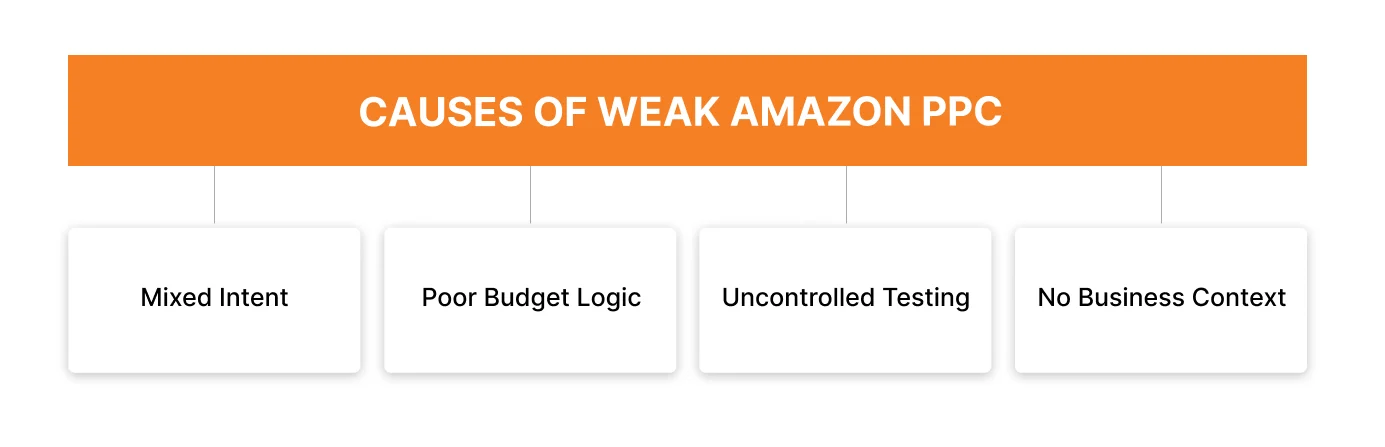
A single bad decision is rarely the cause of weak Amazon PPC performance. It usually builds over time through structural gaps that go unnoticed. Reports still show activity. Spending continues. Results look fine until trust starts slipping. This is where strong Amazon PPC management makes the difference between control and confusion.
Mixed Intent Inside the Same Campaigns
Many accounts mix discovery and buying terms in one place. This creates competition between very different types of traffic. Discovery searches absorb spend without clear purchase intent. Buying searches lose visibility when budgets tighten. Amazon CPC metric rises, but conversions do not follow. When you track Amazon PPC campaign delivering performance closely, this pattern shows up as cost growth without real efficiency gains.
Budget Allocation by Campaign, Not SKU Role
Budgets are often assigned by campaign structure instead of product importance. Hero SKUs that drive revenue lose momentum when spend is spread evenly. Support SKUs quietly absorb budget without delivering meaningful returns. This imbalance weakens overall performance and distorts Amazon PPC metrics. Visibility drops where it matters most, while waste increases elsewhere.
Uncontrolled Testing
Testing is necessary, but uncontrolled testing creates noise. Too many variables change at once, making results hard to interpret. Baselines disappear, and teams lose confidence in what works. Without protecting proven setups, even strong campaigns lose stability. Optimization should build insight, not uncertainty.
Optimization Without Business Context
Many optimizations ignore the broader business picture. The product lifecycle stage is overlooked, even though launch and mature products behave differently. Inventory health is ignored, leading to spending that demand cannot support. New to Brand growth is chased without balancing retention. When these signals are disconnected, performance weakens.
The issue is not effort. It is structured. Consistency does not come from constant tweaks. It comes from alignment, precision, and a clear system that supports forecasting, inventory flow, and long-term profitability.
How Consistent Amazon PPC Performance Is Engineered
(The System View)
Consistency does not come from reacting faster. It comes from building a system that behaves predictably. This is where Amazon PPC management shifts from execution to strategy. Instead of chasing weekly results, you design how performance should behave over time. That design becomes the foundation for control, forecasting, and profitability.
Product Lifecycle-Aligned Amazon PPC Strategy
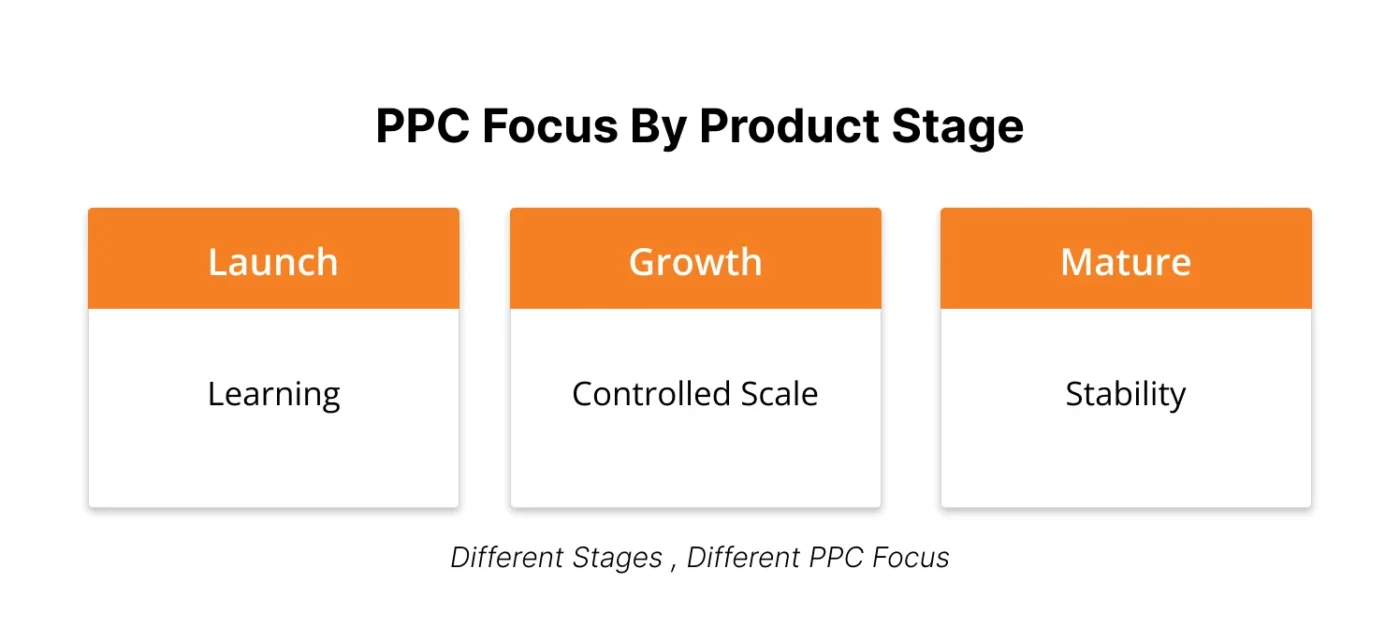
Every product sits at a different stage of its journey. Treating them the same creates confusion. Launch products need visibility and signal acquisition. The goal is learning, not efficiency. Growth-stage products require controlled expansion, where winning terms scale without disturbing balance. Mature products need stability and profit protection, where precision matters more than experimentation.
One structure cannot serve all stages. An Amazon product launch setup will waste money on mature products. A profit-focused setup will stall new products. Aligning Amazon PPC to lifecycle stage ensures Optimization supports the business instead of fighting it. This alignment is a core principle of professional Amazon PPC management.
Intent-Led Keyword Segmentation
Not all keywords exist to convert. Discovery terms help you learn how shoppers search. Buying terms exist to drive Efficiency. Mixing them creates noise and unstable results. Separating them creates clarity.
Discovery terms support learning without pressure. Buying terms deliver predictable performance. Proven winners receive exact-match protection to preserve results. This structure stabilizes conversion rates by intent bucket. CPC behavior becomes easier to manage. Algorithms learn faster because signals stay clean. Many teams consider this the best Amazon PPC optimization strategy because it reduces waste while improving Insight.
Budgeting by SKU Role
Budgets should follow product importance, not campaign layout. Hero SKUs drive revenue and require protected budgets. Gateway SKUs support expansion and need capped growth. Support SKUs contribute but must operate within efficiency ceilings.
This approach improves forecast accuracy. Inventory planning becomes easier because demand behaves predictably. Margins stay protected because spending does not leak quietly. When budgets reflect SKU role, inventory flow stays aligned with demand.
Consistent Amazon PPC performance is not accidental. It is engineered through structure, discipline, and scalability. When these elements work together, performance becomes something you can rely on, not react to.
Why Consistency Changes How Amazon PPC Is Perceived
Trust in Amazon PPC is not built by one good report. It is built when outcomes behave as expected. With strong Amazon PPC management, results stay within known ranges. Surprises become rare. Planning becomes possible.
Trust grows when three things happen consistently:
- Results fall within expected ranges
Performance moves, but it does not swing wildly. ROAS, spend, and volume behave in ways you already anticipate. - Variance has clear explanations
Changes are tied to demand, competition, or inventory flow. Nothing feels random. Insight replaces guesswork. - Decisions become proactive
Teams adjust before problems grow. Optimization happens with intent, not urgency.
When trust exists, the impact spreads quickly:
- Budget approvals become easier because risk feels controlled
- Teams are more willing to scale without fear
- Partnerships last longer and feel collaborative
- Strategic conversations replace constant firefighting
This shift changes how Amazon PPC is viewed internally. It stops feeling like an expense that needs constant justification. It starts behaving like a system that supports forecasting and profitability. Questions such as is Amazon advertising worth it become easier to answer when performance feels reliable.
Consistency changes perception because it restores confidence. When Amazon PPC metrics can be explained with precision, decision-making becomes calmer and more deliberate. Amazon PPC earns its place as a growth lever, not a variable cost.
When Amazon PPC becomes predictable, it becomes investable.
How Consistent Amazon PPC Leads to Measurable Growth
Consistent Amazon PPC changes how growth feels. It removes guesswork. It replaces pressure with control. When systems behave predictably, you stop managing ads day to day and start managing outcomes. This is where Amazon PPC management turns into a growth engine.
Scaling Without Breaking Efficiency

Scaling only works when signals stay clean. Consistency protects those signals and makes expansion safer.
- Clean signals support controlled budget increases
Intent separation and structured bidding keep learning stable. Spend rises in steps, not spikes. Efficiency holds as volume grows. - Fewer surprises at higher spend levels
Performance stays within known ranges. You are not reacting to sudden drops. Optimization stays deliberate and calm. - Confidence replaces hesitation
You know what to expect before budgets increase. Scaling feels planned, not risky. This is how professional Amazon PPC management supports Scalability.
When growth follows structure, results feel earned. Tracking progress becomes clearer when you track Amazon PPC campaign performance across stable baselines.
Better Inventory and Cash Flow Planning
Advertising instability creates operational stress. Consistent Amazon PPC removes that pressure.
- Predictable demand curves
Sales volume behaves within forecasted ranges. Forecasting improves across marketing and operations. - Reduced stockouts and overstock
Spend aligns with inventory flow. Demand does not surge ahead of supply. Amazon FBA inventory management becomes effective. - Improved cash flow control
Revenue timing becomes more reliable. Marketing spend supports planning instead of disrupting it.
When demand is predictable, conversations around Amazon PPC advertising cost become strategic, not reactive.
Stronger Long-Term ROAS
Short-term efficiency matters. Long-term profitability matters more.
- Less wasted spend
Budgets support proven paths. Discovery and testing stay contained. Waste declines steadily. - Higher customer lifetime value
New Brand acquisition stays balanced. Retention improves as intent quality rises. - Sustainable NTB growth
New customers scale without collapsing efficiency. Growth compounds instead of resetting.
This is the real answer to questions like is Amazon PPC worth it. Consistent Amazon PPC does not just improve ad metrics. It builds measurable business growth you can plan, scale, and trust.
What to Look for in an Amazon PPC Partner If You Want Consistency
If consistency is your goal, the partner you choose matters. Strong results come from structure, not promises. When evaluating Amazon ads advanced partners, focus on how they think, not just what they show.
Look for these clear signals:
- They talk in systems, not shortcuts
The conversation centers on structure, precision, and Optimization. You hear how decisions connect, not isolated tactics. - They show variance control, not only best months
Performance is discussed in ranges. Wins and dips are explained with Insight. This supports forecasting and trust. - They align Amazon PPC with inventory and lifecycle
Spend follows inventory flow. Strategy changes as products move from launch to growth to maturity. - They protect winners before chasing new tests
Proven SKUs stay stable. Testing is controlled. Efficiency comes first.
These signals reveal a deeper mindset. Strong partners view consistency as a management discipline, not a feature. This approach makes conversations around Amazon PPC management pricing clearer and more practical.
The most reliable partners do not sell quick outcomes. They help you build systems that support scalability and long-term profitability. Consistency is not a tool you install. It is a philosophy you apply every day.
Conclusion
This guide walked you through a simple truth. Good months do not build real growth. Consistency does. When Amazon PPC performance behaves within expected ranges, trust follows. Budget decisions get easier. Forecasting improves. Inventory flow stays aligned. Amazon PPC stops feeling risky and starts feeling reliable.
The next step is practical. Review your current setup honestly. Look at how intent is separated. Check whether budgets follow SKU roles. Assess if performance supports forecasting or forces reaction. This clarity tells you where control is leaking.
At AMZDUDES, we help brands turn Amazon PPC into a predictable growth system. Our Amazon PPC services focus on optimization that supports scalability and long-term profitability, not short-term spikes. We work as a partner, not a vendor, guiding decisions with insight and discipline.
If you want Amazon PPC that shows up consistently and supports real growth, let’s start with clarity. Book a consultation with our experts today.