
Key Takeaways
- If your ACoS has stayed above 36% for two months and you cannot find the cause, you need an Amazon advertising agency.
- When your organic rank has not improved after 60 days of active advertising, your launch strategy is failing, an Amazon ads agency knows what timeline to expect and how to convert ad spend into organic lift instead of wasted clicks
- If competitors hold multiple sponsored placements on your main keywords while you have only one at the bottom, hiring an agency is cheaper than outspending them.
- When you are managing PPC between other urgent tasks instead of with daily intention, you need to find an Amazon advertising agency.
- If you have tried every tutorial, restructured campaigns, and watched every setting but the same problems keep recurring, it’s the clearest sign you need an agency.
You set up your campaigns. You watched the tutorials. You tweaked bids, swapped keywords, tried automatic, tried manual, and your ACoS is still increasing.
Sound familiar?
If your profits are being compromised because of high Amazon advertising costs, the number of sales you’re generating is not matching your spending, or your campaigns feel stuck, it’s not a small optimization issue. It’s a sign that your current setup isn’t built to help you scale efficiently.
Most sellers don’t realize this early enough and end up wasting the budget trying to fix structural problems with surface-level changes. This guide breaks down 7 clear signs you need to find an Amazon advertising agency, so you can identify the problem early and fix it before more spending is lost.
What are the Ideal Amazon Benchmarks?
Before getting into the signs you need an Amazon Ads agency, here’s a quick reference for what average and good look like on Amazon right now. It’s a useful context for the sections below.
| Metric | Platform Average (2025 – 2026) | Top Performer |
| ACoS | 30.2% (range: 25–36%) | 22–25% |
| TACoS (mature brand) | ~15% | Under 10% |
| Average CPC | $1.18 | Varies by category |
| CTR (Sponsored Products) | 0.34% | 0.45%+ |
| Conversion Rate | 9.96% | 10–15% |
| Waster Ad Spend | 20–30% of the budget | Under 10% |
Top 7 Signs You Need to Hire Amazon Advertising Agency
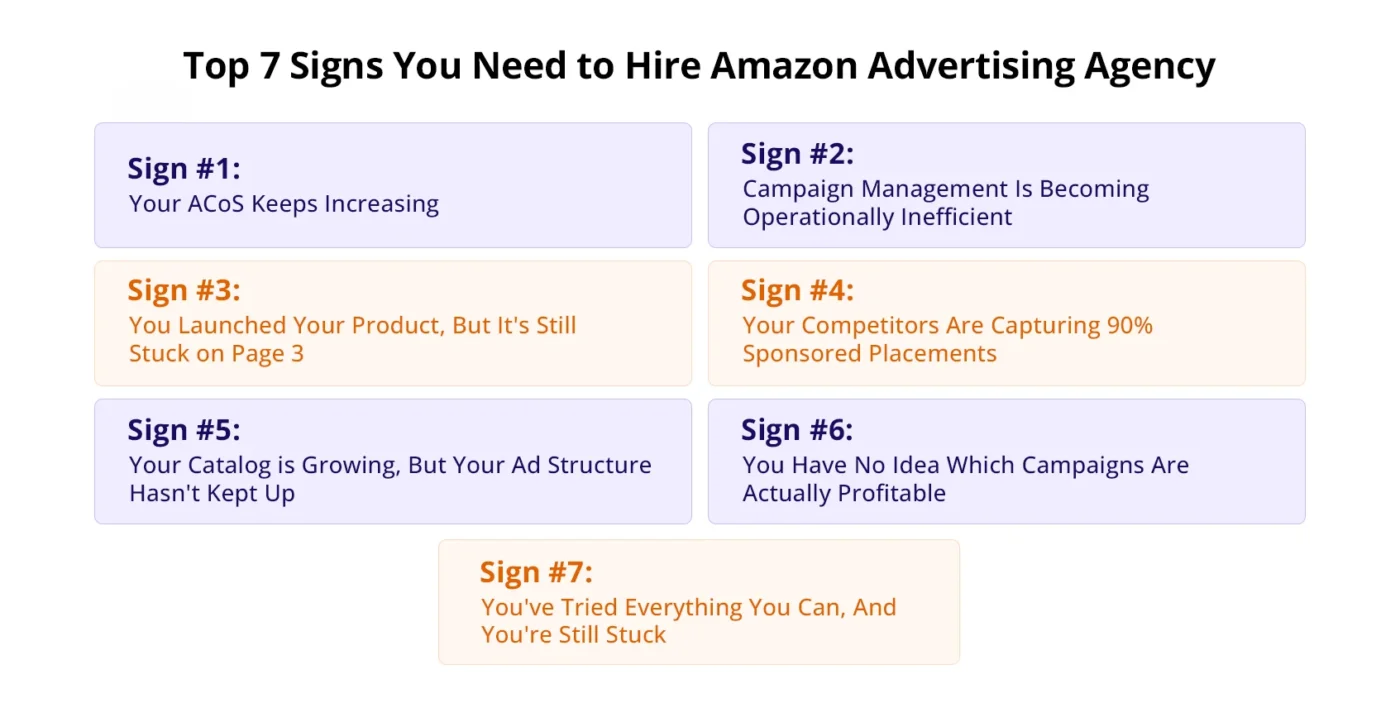
Sign #1: Your ACoS Keeps Increasing
The average ACoS across Amazon sellers is around 30% right now. Healthy, profitable accounts run between 22–25%. If yours is consistently above 36% and you aren’t in the middle of launching a new product, simple bid adjustments won’t solve the problem.
Rising ACoS usually points to a few common problems: campaigns built heavily on broad match keywords without negative terms to filter irrelevant traffic, automatic campaigns that were never reviewed or transitioned into manual, and budgets spread too thin across too many campaigns. When any of this is done, the result is predictable, you end up paying for clicks from shoppers who were never going to buy in the first place.
Learn how to find negative keywords for Amazon FBA to stop wasting ad spend on search terms that will never convert.
In our audits at AMZDUDES, one of the most common situations we see is sellers running broad match campaigns without adequate negative keyword lists. We worked with a client spending over $6,000/month, where nearly 40% of clicks were coming from search terms completely unrelated to their product. After restructuring the account and building out proper negative keyword coverage, ACoS dropped from 41% to 24% within eight weeks.
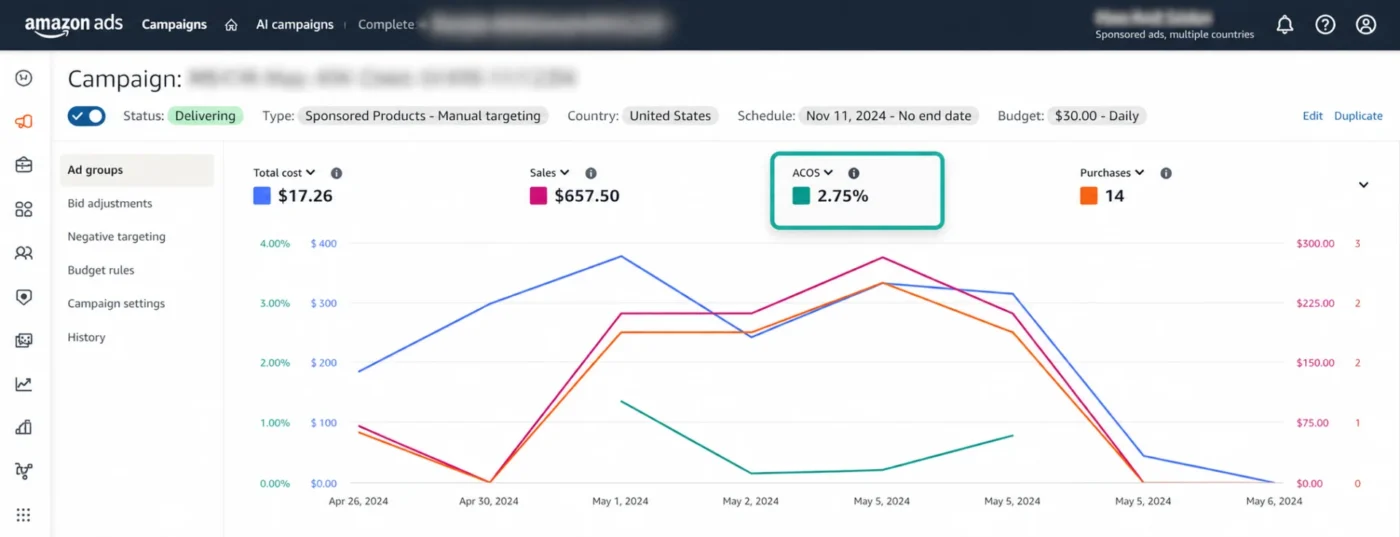
That kind of diagnosis isn’t something you can spot in a quick dashboard review. If your ACoS has been moving in the wrong direction for more than two months and you can’t identify the specific cause, that’s a clear signal that you need a dedicated Amazon advertising agency with experience lowering ACoS strategically.
Sign #2: Campaign Management Is Becoming Operationally Inefficient
Effective Amazon advertising management isn’t a “set it and forget it” task. It demands daily bid checks, weekly search term analysis, budget pacing, match type testing, negative keyword maintenance, and seasonal adjustments. Checking in once a week simply isn’t enough to see great results.
In fact, over 45% of sellers say managing their advertising strategy is the most challenging part of running their business. That number makes sense given how much the platform has expanded. When you’re managing Amazon PPC alongside sourcing, operations, customer service, and inventory, your ads end up getting reactive attention instead of a proactive strategy.
The typical result is that campaign management becomes something you do between other urgent tasks, not something you lead with intention. This is exactly why 24/7 accessibility is crucial in PPC management, because reactive attention never beats a proactive, always-on strategy.
An Amazon ad agency that specializes in this work, supported by proper tooling and dedicated teams, is able to reduce campaign management time by 30–50% while actually improving results.. Not because they have a secret trick, but because the work is handled by Amazon campaign management experts.
Sign #3: You Launched Your Product, But It’s Still Stuck on Page 3
Paid ads do more than just generate sales. Each sponsored placement sends conversion signals to Amazon’s algorithm, and over time, those signals help improve your organic ranking. When this is working well, you should eventually see 60–70% of your sales come from organic sources, with ads supporting visibility rather than carrying the entire load.
During a launch, it’s healthy to see a higher ACoS, typically 35–45%, as you build momentum. But then, you have to conduct strong Amazon PPC keyword research to identify the keywords that are more likely to convert, then reduce the ad spend as your organic rankings improve.
Where most sellers get stuck is in how they manage this phase. Some hold back too much because the ACoS looks high. Others spend on broad keywords that bring clicks without conversions. Both approaches slow down progress.
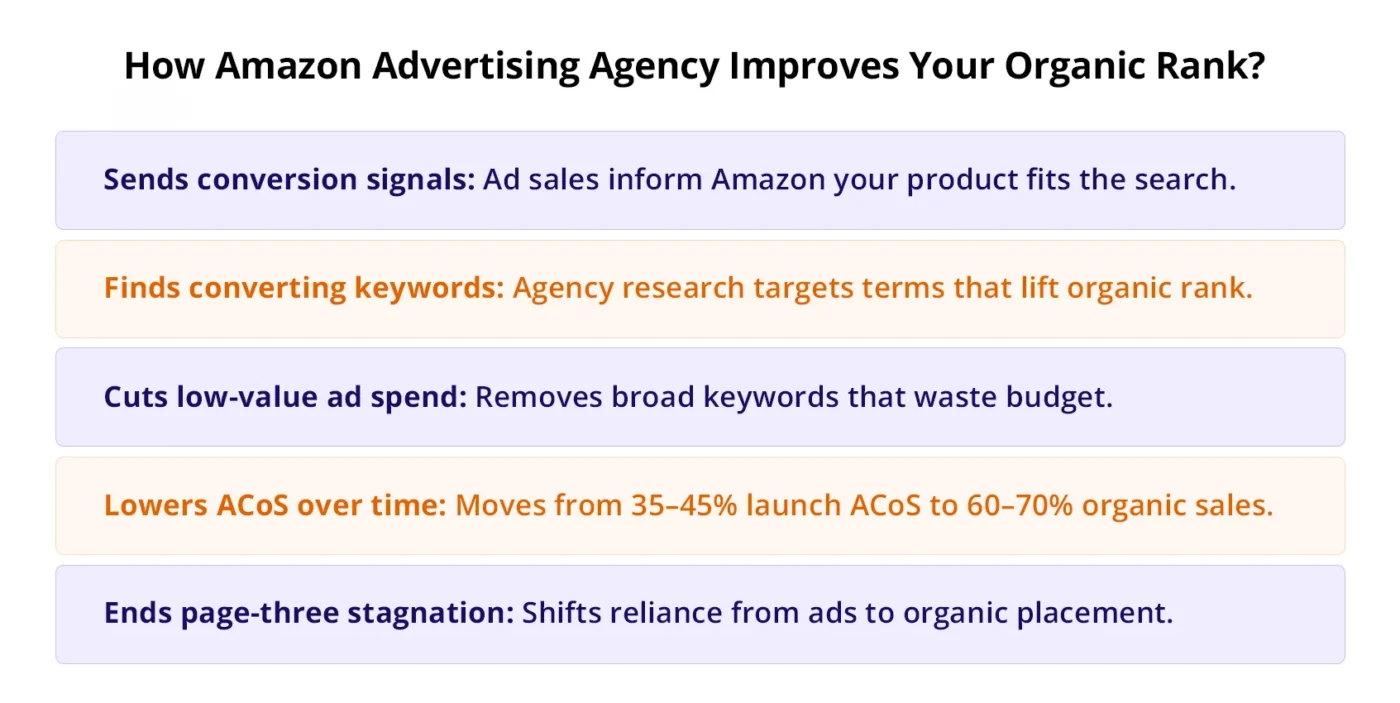
If you’ve been live for 60 days or more and your organic rank hasn’t meaningfully improved, your launch strategy needs a different approach. This is where an experienced Amazon advertising agency can step in, because they’ve run this process across enough accounts to know what actually works, and what timeline you should realistically expect.
Sign #4: Your Competitors Are Capturing 90% Sponsored Placements
Open Amazon and search for your main keyword. Look at the sponsored results before your product appears. If competitors have multiple placements, a Sponsored Product at the top, a Sponsored Brand banner above that, a Sponsored Display on product pages, and you have just one placement, that too at the bottom, it means your current strategy isn’t designed to compete for visibility.
CPCs have increased significantly over the past few years. The average cost-per-click on Amazon is $1.18 in 2026, up from $0.71 before 2020. In competitive categories, it goes much higher, Health & Personal Care averages $2.10 per click, Consumer Electronics $2.85, and Supplements can exceed $6.00. During Prime Day and the Q4 holiday period, CPCs spike an additional 20–30%.
With such high Amazon advertising costs, you need an experienced Amazon advertising agency that knows how to win the sponsored placements for your brand without draining your pockets. A well-versed Amazon ads management agency doesn’t win on placement by outspending everyone.
They win by knowing when to push top-of-search bids, a tactic fully explained in this Amazon bid management complete guide, along with knowing when to pull budget from underperformers, which keywords have long-term ranking value beyond their direct conversion rate, and how to coordinate multiple ad formats to build a visible presence across a category.
Sign #5: Your Catalog is Growing, But Your Ad Structure Hasn’t Kept Up
What works for five products doesn’t work for twenty-five. As catalogs grow, campaign structure tends to get messy, products grouped for convenience, budgets spreading across SKUs without clear allocation, high-margin and low-margin products competing for the same daily spend.
Amazon’s advertising platform now includes eight ad format types: Sponsored Products, Sponsored Brands, Sponsored Display, DSP, Online Video, Streaming TV through Prime Video, Audio Ads, and Amazon Marketing Cloud for custom audiences. Managing these across a growing catalog, with proper segmentation, match-type hierarchy, and product-level profitability targets, requires dedicated operational capacity.
For complex catalogs, AI-driven campaign management typically delivers 20–35% improvement in ACoS and 15–25% better conversion rates compared to manual bidding. The improvement comes from structure: each product in its own campaign with its own budget logic, match types kept separate, high performers given dedicated spend, and underperformers caught early instead of quietly draining budget. To understand how the Amazon PPC team improves Amazon performance at scale, look beyond software to the people and processes behind the structure.
If your campaigns have started to feel like something you’re maintaining reactively rather than managing proactively, that’s a sign the structure needs expert-driven Amazon advertising services.
Sign #6: You Have No Idea Which Campaigns Are Actually Profitable
Amazon’s reporting shows clicks, impressions, spend, and attributed sales. What it doesn’t show clearly is whether any of that is making you money after Amazon’s fees, which now consume over 50% of many sellers’ revenue when you add up referral fees, FBA costs, and ad spend together.
ACoS is a useful metric, but it’s incomplete on its own. TACoS, Total Advertising Cost of Sale, measures ad spend against total revenue, including organic. A 35% ACoS campaign can be healthy if it’s building organic rank and your TACoS is sitting at 12%. The same campaign is damaging your margins if there’s no organic lift and your TACoS matches your ACoS.
Beyond TACoS, profitable sellers track new-to-brand purchase rates (are ads bringing in new customers or cannibalizing organic sales?), inventory velocity (are ads creating stockout risk?), and product-level profitability after all fees. Amazon’s average conversion rate is 9.96%, about 7–8x higher than most e-commerce platforms, that’s a real advantage. But it only shows up in your profit if you’re tracking the right numbers.
If budget decisions are being made based on ACoS alone and you don’t have a clear view of TACoS or product-level profitability, that’s a visibility problem that’s costing money. Start with Amazon PPC metrics to understand which numbers actually matter, then consider whether you need to find an Amazon advertising agency for your business.
Sign #7: You’ve Tried Everything You Can, And You’re Still Stuck
This one doesn’t need a benchmark. You’ve restructured campaigns, done keyword research, watched the tutorials, and worked through every setting. And the account still isn’t performing the way it should.
This isn’t a lack of effort. Amazon PPC at a competitive level requires a combination of data volume, pattern recognition across many accounts, and platform depth that takes time to develop. Knowing the right tactics is different from knowing which tactic is right for a specific account, category, or point in the auction. That judgment comes from managing a lot of accounts over a long period of time.
The sign isn’t that something went wrong. Things go wrong and get fixed, that’s normal. The sign is when the same problems keep recurring without a clear diagnosis, or when you can see the account isn’t where it should be, but can’t identify specifically why.
At that point, the more useful question is how to find the best Amazon advertising agency to step in.
How to Find the Best Amazon Advertising Agency
If any of the signs above feel familiar, you’re probably ready to find an Amazon advertising agency. Here’s a straightforward process for evaluating your options and signing the deal with the best Amazon advertising agency.
- Step 1: Define what you need before reaching out. Be specific about your goal: ACoS reduction, a structured product launch, full Amazon ads management, or DSP. Agencies specialize differently, and having a clear objective helps you filter quickly.
- Step 2: Check for verified Amazon Ads Partner status. Amazon’s partner badge requires verified campaign performance, minimum managed spend, and certified exams. It’s a basic check that confirms the agency has been validated directly by Amazon.
- Step 3: Ask for Amazon case studies relevant to your category. ACoS benchmarks vary significantly by category. Electronics typically run around 24%, Toys & Games around 27%, and some culinary categories see the highest averages on the platform. A case study without category context isn’t useful. Look for before-and-after data that includes TACoS, not just ACoS.
- Step 4: Ask what gets reported and how often. Do they report on TACoS, profitability, and new-to-brand sales? Or just impressions, clicks, and ACoS? Agencies that lead reporting with impression volume are optimizing for metrics that look good, not metrics that reflect your actual business performance. Weekly data access with monthly strategic reviews is a reasonable standard.
- Step 5: Understand the Amazon PPC agency pricing and do the math. Fees typically range from a flat monthly retainer to 10–20% of managed ad spend. At $10,000/month in ad spend, a 15% fee is $1,500/month. That cost needs to show up clearly in reduced waste or improved revenue to make sense. Ask the agency to walk through a realistic return model before you commit.
- Step 6: Use the discovery call to evaluate their mindset. An Amazon ads agency, which is best at its work, asks more questions than they answer in the first conversation. They want to understand your margins, category, account history, and current structure before proposing anything. If the first call is mostly about the agency’s credentials and service packages, that’s a pitch. A genuine partner spends most of the first call understanding your situation.
- Step 7: Start with a 90-day pilot. Confident agencies don’t need long contracts to prove their value. A 90-day pilot gives enough time to see structural improvements: cleaner campaign architecture in the first 30 days, measurable ACoS movement by day 60, and a documented review at the end. Be cautious of any agency that pushes to rebuild campaigns entirely from scratch on day one. Your campaign history contains months or years of performance data. That history should be studied, not deleted.
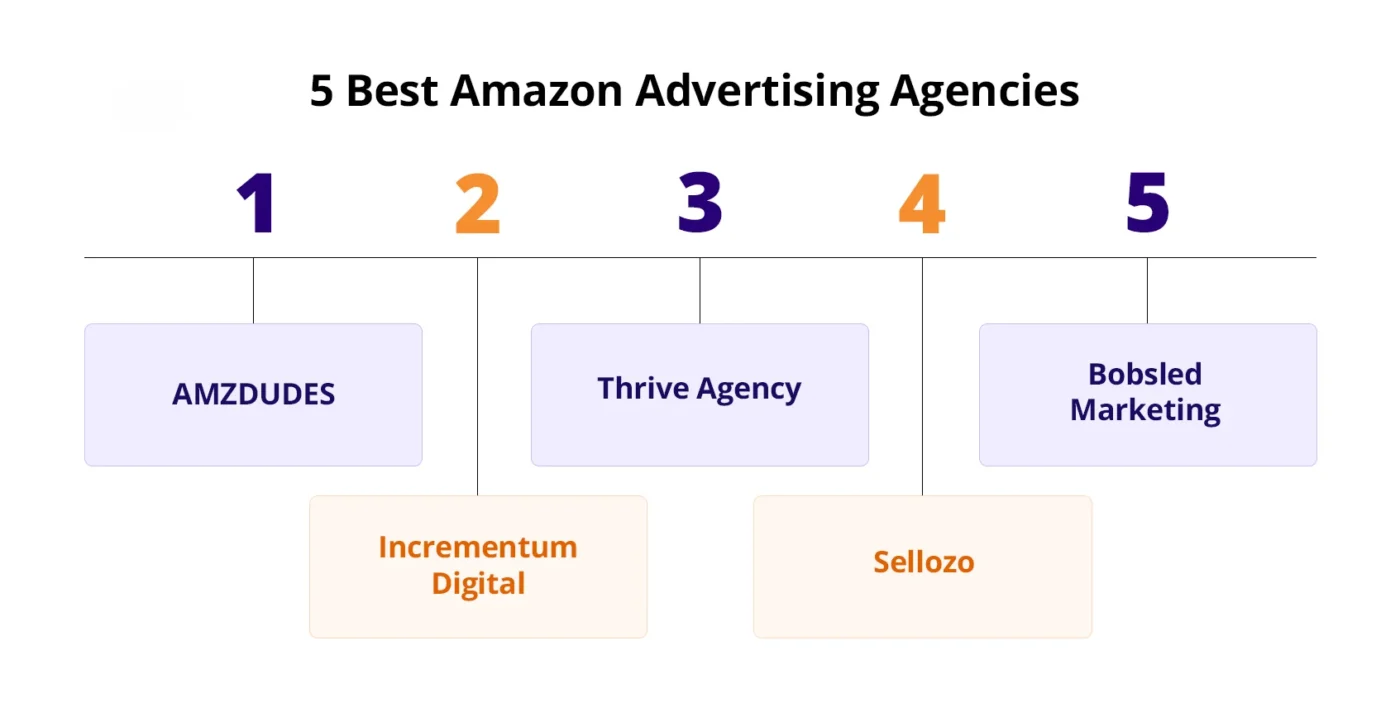
5 Best Amazon Advertising Agencies
Following is the list from which you can find the best Amazon advertising agency. We’ve vetted this list after evaluating the quality of Amazon advertising services they are offering, their ratings, testimonials, and the results they have generated for their clients:
1. AMZDUDES
Best for: Sellers who want focused Amazon PPC management with direct account ownership and clear performance reporting.
AMZDUDES is a specialist Amazon advertising agency with 5+ years of experience managing Sponsored Products, Sponsored Brands, Sponsored Display, and DSP campaigns.
AMZDUDES builds every engagement on transparency and results. They start with a full account audit before making any changes. This preserves your existing campaign history and data. Clients have direct access to their account manager, and they receive weekly performance reporting across ACoS, TACoS, and product-level metrics, and get a clear Amazon Ads strategy at the start that outlines exactly what will happen and why.
The track record speaks for itself. Since 2020, over 50 brands have trusted AMZDUDES to manage their Amazon advertising. AMZDUDES delivered more than $50 million in verified revenue, increased average profit margins by 65%, and average ROI increased by 180% for those clients.
The recognition from independent platforms aligns with those results. On Trustpilot, AMZDUDES maintains a 4.5-star rating, and on Clutch, which is a platform known for rigorous, verified reviews, they hold a 5-star rating. They’re also consistently ranked among the best Amazon advertising agencies, a distinction earned through verified performance rather than self-promotion.
Book a free Amazon ads account audit with AMZDUDES to find what’s wrong, what’s missing, and exactly what to fix first.
2. Incrementum Digital
Best for: Private-label brands scaling through advanced PPC and DSP strategy.
Incrementum is led by former Amazon sellers, which gives them a practical context that purely agency-side teams sometimes lack. Their strength is in full-funnel advertising, connecting Sponsored Products performance to DSP audience strategy, and their reporting is transparent around profitability metrics. A practical choice for brands above $500,000 a year in Amazon revenue, looking to scale.
3. Thrive Agency
Best for: Brands that need advertising management as part of a broader Amazon strategy, including content and SEO.
Thrive integrates PPC management with listing optimization, A+ content, brand store design, and Amazon SEO into one service. Their published case studies include a 4.87x ROAS and 265% brand store traffic growth for a client onboarded in 2024. Well-suited for brands that want a single agency covering multiple Amazon touchpoints rather than a standalone PPC specialist.
4. Sellozo
Best for: Sellers managing 20+ SKUs who want AI-driven campaign automation at a predictable flat fee.
Sellozo built its service around proprietary AI that manages bid adjustments and keyword harvesting in near-real-time, capturing hourly ACoS fluctuations that manual management misses. Their flat-fee pricing model gives cost predictability that percentage-of-spend pricing doesn’t. A practical option for catalog-heavy sellers who want automation-driven management without high overhead.
5. Bobsled Marketing
Best for: Brands where advertising performance is being affected by broader operational or content issues.
Bobsled’s team includes former Amazon employees and certified specialists. Their service covers PPC, DSP, listing optimization, SEO, FBA compliance, and fulfillment strategy, which makes them useful when ad performance is connected to issues that go beyond campaign structure alone.
Conclusion
If any of these seven signs sound familiar rising ACoS, stalled organic rank, invisible placements, or simply being stuck despite trying everything, your Amazon advertising strategy needs more than a quick fix. You need a proven system that turns wasted spend into sustainable organic growth.
That’s exactly what expert Amazon advertising services deliver: lower ACoS, higher organic sales, and campaigns built to scale.
If you’re seeing any of these signs, AMZDUDES is a full-service Amazon agency that is the best choice to fix them. With over $50 million in verified revenue, a 65% average profit increase, and transparent, account-level reporting, they don’t just manage ads, they transform performance.
Book a free Amazon ads account audit today and find out what’s wrong, what’s missing, and what to fix first.
Frequently Asked Questions
1. What does an Amazon advertising agency do?
An Amazon advertising agency manages your Amazon paid ads end-to-end. This includes Sponsored Products, Brands, Display, and DSP, plus keyword research, bid management, negative targeting, and performance reporting. The best agencies also track organic rank and profitability, not just ACoS.
2. How much does an Amazon advertising agency cost?
Most Amazon ad agencies charge either a flat monthly retainer of 1,500 –5,000 per month or a percentage of ad spend between 10–20%. For example, a 10,000 per month in ad spend, an Amazon ads agency charges 1,500 as the Amazon advertising management cost.
3. How do I know if an Amazon PPC agency is performing?
If you want to know if an Amazon advertising agency is performing, track TACoS (should decrease), new-to-brand rate (should increase), organic rank for key keywords (should improve), and product-level profit (should grow). Ignore agencies that only report clicks and impressions.
4. When should I hire an Amazon advertising agency?
You should hire an Amazon advertising agency when your monthly ad spend reaches 5,000–15,000. Below that, part-time management works. Above that, wasted spend, missed rankings, and competitor pressure make an agency cheaper than doing it yourself.
5. Is an Amazon ad agency worth it for small sellers?
Yes, if the spend is at least $5,000/month. The agency typically pays for itself by cutting wasted clicks, removing bad search terms, and improving organic rank, often increasing profit even after the fee.