
Key Takeaways
- Before scaling, look whether your next step is stable enough or not. With Amazon PPC, you can predict the conversion rates and take the next step smartly.
- Assign SKU roles and spend accordingly. Hero, Growth, Support, and Clearance roles of the SKUs helps you bring future profits from Amazon PPC campaigns.
- Structure by buyer intent. Discovery, Validation, and Conversion funnels turn traffic into clean signals which helps you in scaling efficiently.
- Convert paid rank into organ rank as well. Use Amazon sponsored product ads to lift keyword rank, then let organic sales carry long-term margin.
- Track leading signals, not just ROAS. CPC trends, CVR stability, rank movement, and budget usage show whether Amazon PPC is driving real long-term growth.
Amazon PPC is more than just a traffic tool in 2026. Industry benchmarks show that sponsored ads can account for over 40–50% of total product sales in competitive categories, and in many searches, paid placements dominate the first page. As more brands compete for the same keywords, CPC keeps rising, and short-term tactics stop delivering stable results.
If your goal is Amazon long term growth, your PPC funnel must be built for consistency, not spikes. It needs clean signals, predictable performance, and a structure that compounds results over time instead of chasing quick wins.
This guide shows you how to build an Amazon PPC strategy step by step for long term growth, so you can control waste, protect margin, and turn Amazon ads into a sustainable growth source for your business.
What Amazon Long Term Growth Means for Your Brand
Amazon long term growth means building a system where performance stays within clear ranges, budgets grow without hurting efficiency, and organic rank improves alongside paid visibility.
In practical terms, Amazon long term growth means stable CPC trends, consistent conversion rates as traffic increases, and ad spend that builds demand over time. Your Amazon long term strategy should help you forecast results with confidence and plan growth week by week.
Amazon PPC plays a central role because it controls how shoppers discover your products, how quickly you build rank on key terms, and how much data Amazon’s system learns about your listings. When built the right way, PPC becomes the foundation for Amazon advertising growth that compounds over time.
Step-by-Step Guide to Build an Amazon PPC Strategy for Amazon Long Term Growth
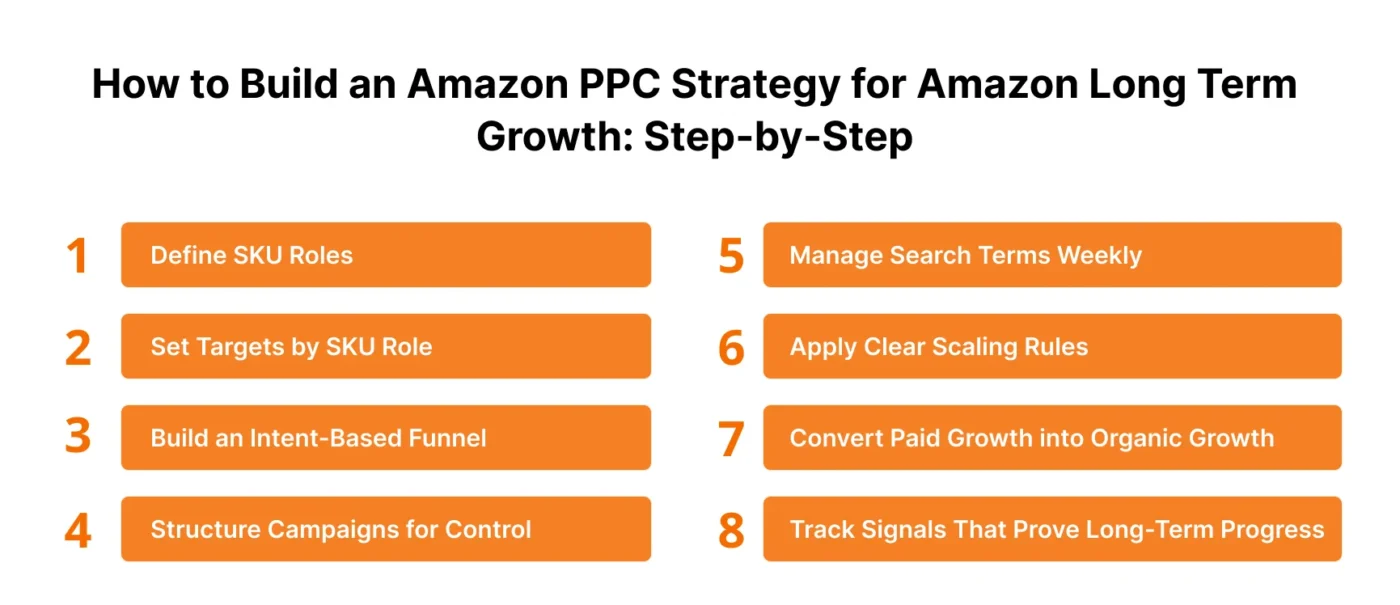
To achieve Amazon long term growth, you need a structured approach that treats Amazon ads like an operating system, not a set of isolated campaigns. Follow the steps below in order. Each one builds on the previous and removes a specific risk that blocks sustainable scale.
Step 1: Define SKU Roles
Before you set up campaigns or bids, you must define what role each product plays in your business. Not every ASIN should be treated the same, and assuming they should is one of the fastest ways to lose control of spend.
Start by classifying every SKU into clear roles such as hero SKUs that drive profit and rank, growth SKUs that need visibility and learning, support SKUs that protect brand coverage, and clearance SKUs that require controlled exit. This classification ensures that your Amazon PPC strategy aligns with business priorities rather than just traffic potential.

When SKU roles are defined, budgets stop being emotional decisions. You know exactly which products deserve aggressive investment and which ones require restraint. This clarity is essential for Amazon long term growth, because it prevents over-scaling weak products while under-supporting your true growth drivers.
Step 2: Set Targets by SKU Role
Once roles are clear, you need Amazon PPC performance targets that match those roles. A single ACOS goal across the entire catalog rarely supports Amazon long term growth, because different products serve different purposes at different stages.
Your hero SKUs should carry efficiency-focused targets that protect margin while maintaining rank. Growth and launch SKUs may allow higher ACOS if visibility and data acquisition are the priority. Clearance SKUs should operate under strict limits to avoid waste. This creates a role-based Amazon PPC strategy that connects spend to long-term outcomes, not just short-term ratios.
By setting targets this way, your team stops asking whether ACOS is good or bad in isolation. Instead, you evaluate whether spend is doing the job it was assigned to do inside your Amazon long term strategy.
Step 3: Build an Intent-Based Funnel
Traffic quality matters more than traffic volume when your goal is Amazon long term growth. To control quality, your campaigns must be structured around buyer intent rather than just match types.
Create three clear layers. Discovery campaigns are used to explore new search behavior and gather data at controlled bids. Validation campaigns refine that data to identify consistent converters. Conversion campaigns focus only on proven, high-intent terms that deserve Amazon PPC scaling.
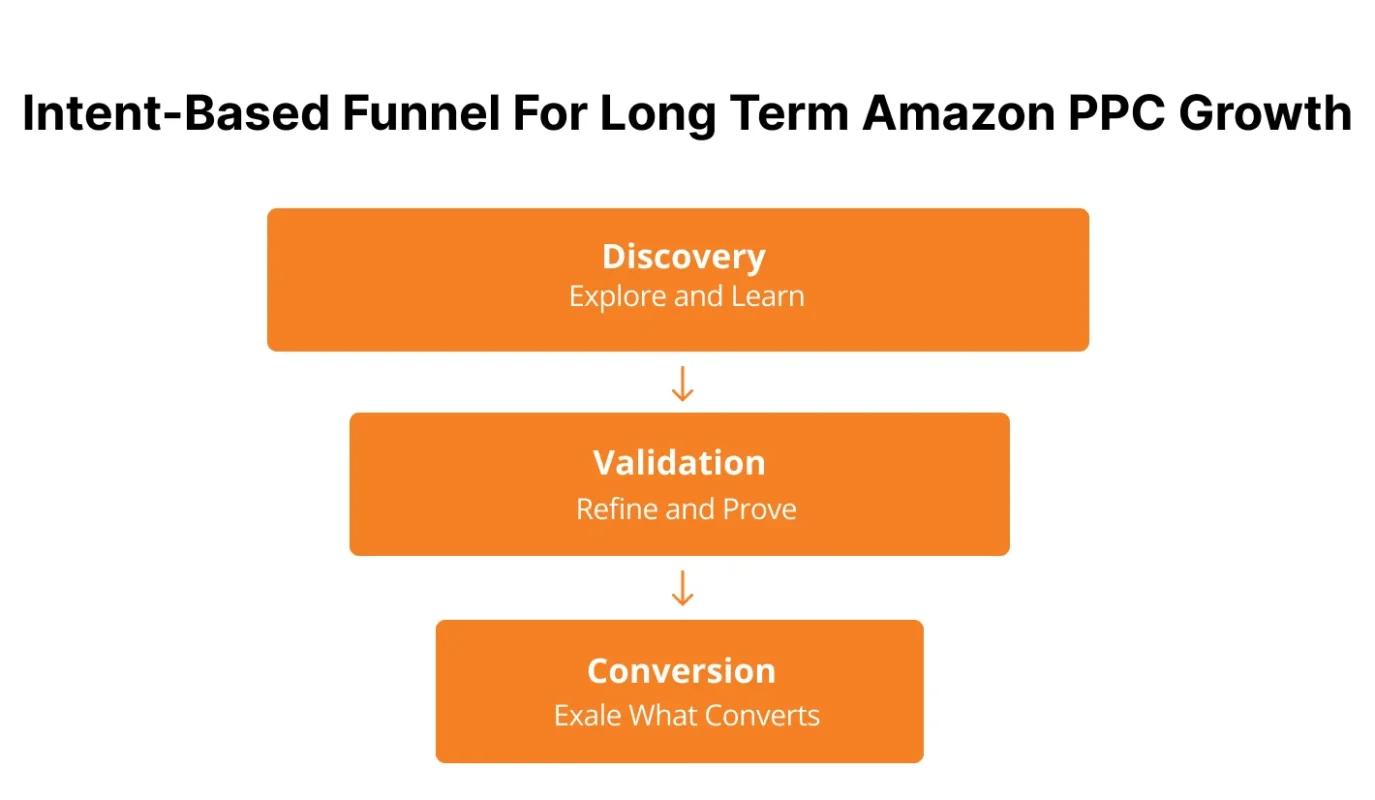
This funnel allows your Amazon PPC strategy to learn without contaminating performance. Testing traffic never distorts your core efficiency, and your best keywords for Amazon PPC stay protected from noisy experimentation. This structure is the backbone of advanced Amazon PPC strategies used by brands that scale without losing stability.
Step 4: Structure Campaigns for Control
With intent layers defined, your next step is to structure campaigns so that control is built into the system. This means separating testing from scaling, isolating top performers, and avoiding mixed traffic that hides true performance signals.
Your discovery campaigns should never share budgets with conversion campaigns. Your proven keywords should not compete with broad exploration. Every campaign group should have a single purpose that is easy to evaluate.
This level of structure ensures that when performance shifts, you know exactly where the problem lives. That clarity is critical for Amazon long term growth, because it prevents reactive changes that often fix one issue while creating another.
Step 5: Manage Search Terms Weekly
Most wasted spend in Amazon PPC does not come from bids. It comes from ignored search terms. If you want real control, search term management must become a weekly operating process, not an occasional cleanup.
Every week, review your reports to identify converting terms that should be moved into exact match campaigns. At the same time, negate irrelevant or high-cost terms that do not align with buyer intent. Over time, this process tightens your funnel and improves signal quality.
This is one of the few Amazon PPC strategy hacks that consistently drives efficiency without sacrificing growth. Clean queries help Amazon understand your product better, which directly supports Amazon ads growth and more predictable scaling.
Step 6: Apply Clear Scaling Rules
Scaling is where most Amazon PPC structures break. Budgets increase, traffic expands, and suddenly CPC spikes or conversions drop. To protect Amazon long term growth, scaling must follow rules, not instincts.
Before increasing any budget, confirm that CPC trends are stable, conversion rates remain within an acceptable range, and your product has enough inventory to sustain demand. If performance is volatile, scaling will only amplify the problem.
The best Amazon PPC strategy scales only what behaves. This discipline ensures that growth comes from strength, not from chasing short-term momentum that fades as soon as competition reacts.
Step 7: Convert Paid Growth into Organic Growth
True Amazon advertising growth is not measured only in paid sales. It is measured in how effectively PPC improves organic rank and reduces long-term dependency on ads.
Use your conversion campaigns to push hero keywords higher in organic results. As rank improves, monitor how organic sales increase and gradually reduce paid pressure where possible. This creates a compounding effect where PPC builds visibility and organic demand carries margin.
This step is critical for Amazon long term growth, because it transforms PPC from a permanent cost into a strategic accelerator that strengthens your overall position in the category.
Step 8: Track Signals That Prove Long-Term Progress
ROAS and ACOS tell you what happened. They do not tell you what will happen next. For Amazon long term growth, you must track leading signals that reveal whether your system is healthy.
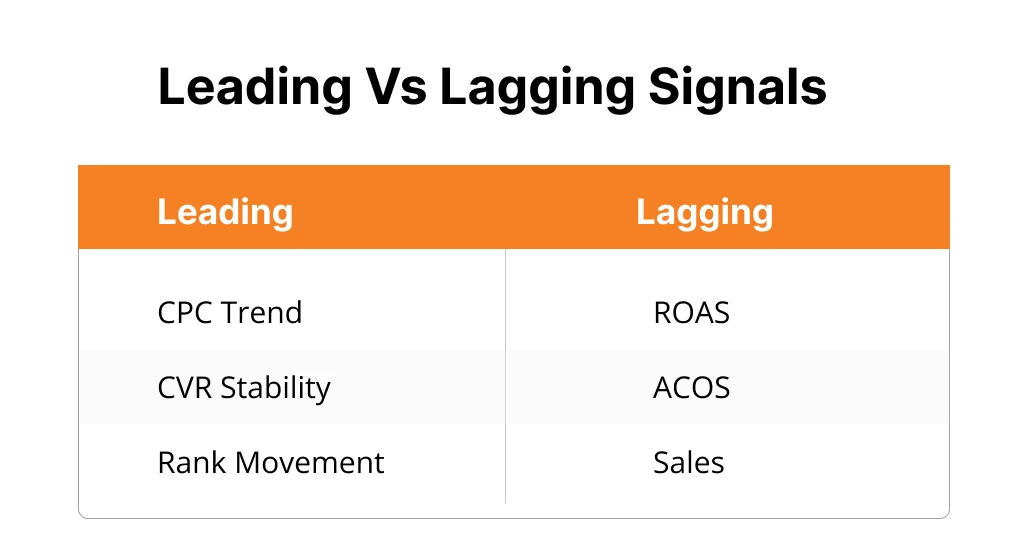
Focus on CPC stability, CVR consistency, organic rank movement, and budget pacing by SKU role. When these signals remain controlled, your growth is sustainable. When they drift, risk is building even if surface metrics still look fine.
This approach helps you understand how to succeed with Amazon PPC strategy over time, because you are managing the drivers of performance, not just the outcomes.
Common Mistakes That Limit Amazon Long Term Growth
Many brands invest heavily in Amazon marketing but still struggle to achieve Amazon long term growth because the account is built on weak foundations. Spend stays active, but performance signals remain unstable. Over time, this leads to rising CPC, inconsistent conversions, and unreliable scaling.
1. Using the Same Approach for Every SKU
When all ASINs follow one structure and one target, margin differences and lifecycle stages get ignored. Budget shifts toward products that cannot hold efficiency at scale, while true drivers lose focus. This weakens Amazon long term growth and reduces overall control.
2. Focusing Only on ACOS
When ACOS becomes the main goal, visibility often gets reduced too far. Keyword coverage shrinks, rank progress slows, and future demand becomes harder to build. Over time, this limits Amazon advertising growth and keeps performance from compounding.
3. Scaling Without Stability
Budgets should grow only when CPC and conversion rates stay within expected ranges. Scaling during volatility increases risk and breaks forecasting. This makes Amazon long term growth harder to sustain.
4. Relying on Frequent Bid Changes
Regular bid changes create activity but rarely fix structural problems. Without clean funnels, clear separation, and strong search term control, performance remains reactive. A stable Amazon PPC strategy depends more on structure than constant tuning.
5. Ignoring Search Term Waste
Uncontrolled queries slowly drain the budget through low-intent traffic. If waste is not removed weekly, CPC rises and conversion rates soften. This reduces efficiency and weakens the base for Amazon long term growth.
6. Mixing Testing and Scaling Traffic
When discovery and conversion traffic run together, signals get distorted. Strong terms carry the cost of testing, and true performance becomes unclear. Separating both is essential for advanced Amazon PPC strategies.
7. Tracking Only ROAS and Sales
ROAS and sales show results, but they do not show stability. For Amazon long term growth, CPC trends, CVR consistency, rank movement, and budget pacing matter just as much. These signals tell you if the system can scale without breaking.
Wrapping Up
Amazon PPC can either become a recurring cost that you constantly fight, or it can become a structured system that drives Amazon long term growth year after year. The difference lies in how you build it.
When your Amazon PPC strategy is based on SKU roles, intent funnels, disciplined search term control, and rule-based scaling, you stop reacting to noise and start operating with clarity. Your ads no longer chase sales. They build visibility, protect margin, and unlock real Amazon growth opportunities that compound over time.
At AMZDUDES, we help brands design and execute advanced Amazon PPC strategies that focus on stability first and scale second. Our approach is built around clean signals, predictable performance, and long-term profitability, not just short-term efficiency.
If you want to turn your advertising into a true growth engine and capture the full potential of growth opportunities Amazon offers, book a consultation call now with the team at AMZDUDES. With our Amazon PPC management, we’ll help you assess your current performance and map the next stage of your Amazon long term strategy with confidence.