Key Takeaways
- An all-in-one Amazon PPC system shows how every ad drives better traffic, more sales, and long-term profit for your brand.
- One team running your Amazon PPC management keeps decisions consistent and makes scaling safer and more predictable.
- Split Amazon ads management increases ad costs because signals get messy and spend goes to the wrong places.
- Sellers often overspend when they can’t see which ASINs really drive results across their Amazon PPC campaigns.
- Full Amazon PPC services help most for growing brands and large catalogs, while smaller accounts may not need full setup yet.
Most brands outgrow basic Amazon PPC faster than they expect. Your campaigns need precision. Your decisions need insight. Your advertising needs a system that supports real scalability. That is when the workload becomes heavier for internal teams.
You are not looking for tricks. You want efficiency. You want visibility you can trust. You want a structure that turns scattered signals into a clear direction. When every part of Amazon PPC works together, your brand moves with more confidence and stronger profitability.
This blog explains what a one stop Amazon PPC ad solution includes and why it matters for your growth. You will see how the full Amazon PPC stack connects and what your team gains when one coordinated system manages every step.
What is an All-in-One Amazon PPC Solution?
An all-in-one Amazon PPC solution covers your complete advertising workflow. You get visibility across your full funnel. You gain precision in how each signal supports your next decision. This removes confusion and strengthens profitability.
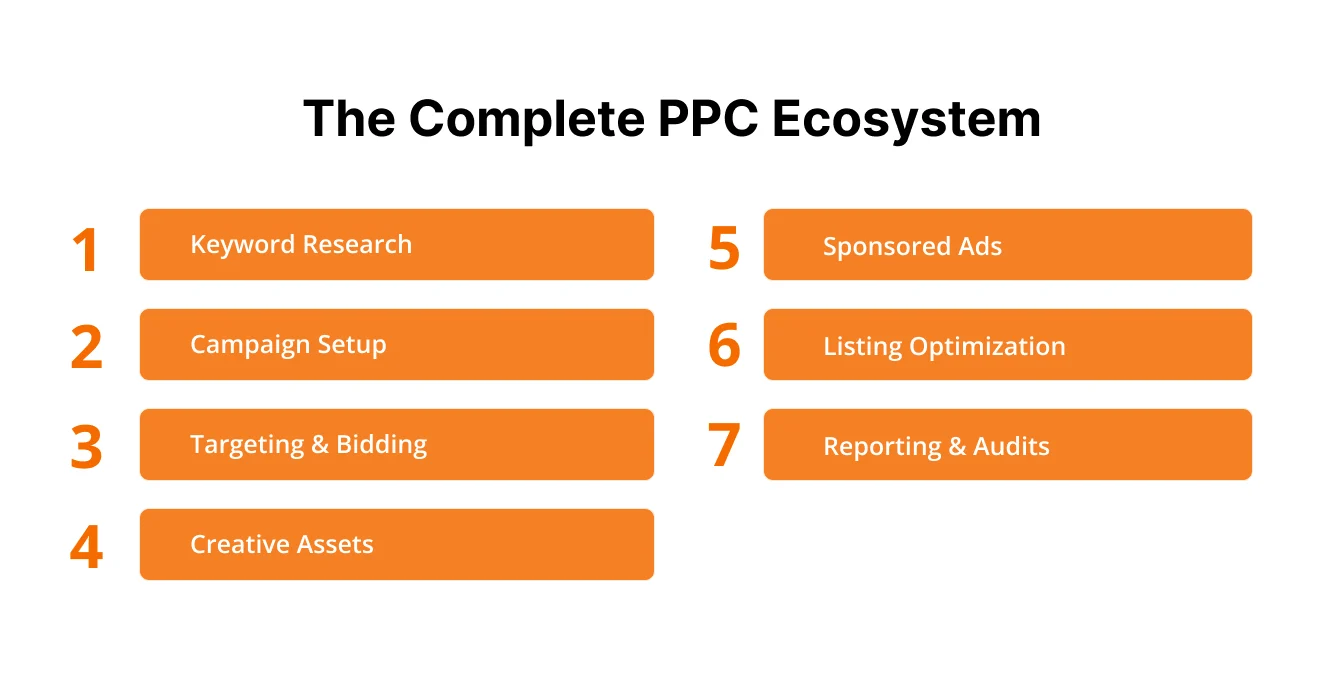
It begins with the core elements of Amazon PPC. Each one plays a specific role.
Keyword Research
Amazon PPC keyword research sets the foundation for every ads decision. Clean inputs ensure campaigns are built on real shopper intent, not assumptions. By mapping keywords to clear intent stages, your structure stays efficient and wasted spend is minimized from the start.
Campaign Setup
An Amazon PPC campaign structure is meant to support specific objectives rather than convenience. Match types are assigned intentionally, placement settings follow proven performance patterns, and naming conventions stay consistent across ASINs. This creates clarity and makes scaling easier without adding complexity.
Targeting and Bidding
Bidding decisions are guided by real performance signals, not isolated metrics. Amazon PPC targeting aligns with funnel stages so discovery, consideration, and conversion traffic are handled differently. This approach speeds up decision making and improves accuracy as data accumulates.
Ongoing Optimization
The process of Amazon PPC optimization is continuous and systematic. Low-performing search terms are removed, budgets are moved to ads that bring sales, and negative keywords are added to stop your own ads from competing with each other. Every change is made to improve conversions and protect profit, not just increase visibility.
Creative and Ad Formats
Ad creative is designed to help shoppers choose your product. Images and copy are created to lift conversions and keep brand messages consistent across ads. Sponsored Products, Sponsored Brands, and video ads are used with clear purpose, based on where shoppers are in their buying journey.
DSP and Retargeting
Amazon DSP and retargeting ads expand reach beyond keyword limitations. These campaigns build awareness, re-engage warm shoppers, and support scale across longer consideration cycles. The result is stronger demand capture throughout the full customer journey.
Reporting and Audits
Reports turn your Amazon PPC data into clear answers. Regular Amazon PPC audits show what drives sales, where money is wasted, and how changes impact results. Forecasts connect ad performance to inventory and market demand so you can plan with confidence.
An all-in-one Amazon PPC solution brings everything into one system. Campaigns become easier to manage, decisions become clearer, and your brand builds steady, long-term profit with more control.
Why Fragmented Amazon PPC Setups Fail Most Brands
When Amazon PPC is split across tools or teams, campaigns stop working together. Targeting, bids, and ads don’t share signals, so performance becomes harder to read and decisions are made with gaps in the data. This leads to wasted spend, lower efficiency, and slower growth across your product range.
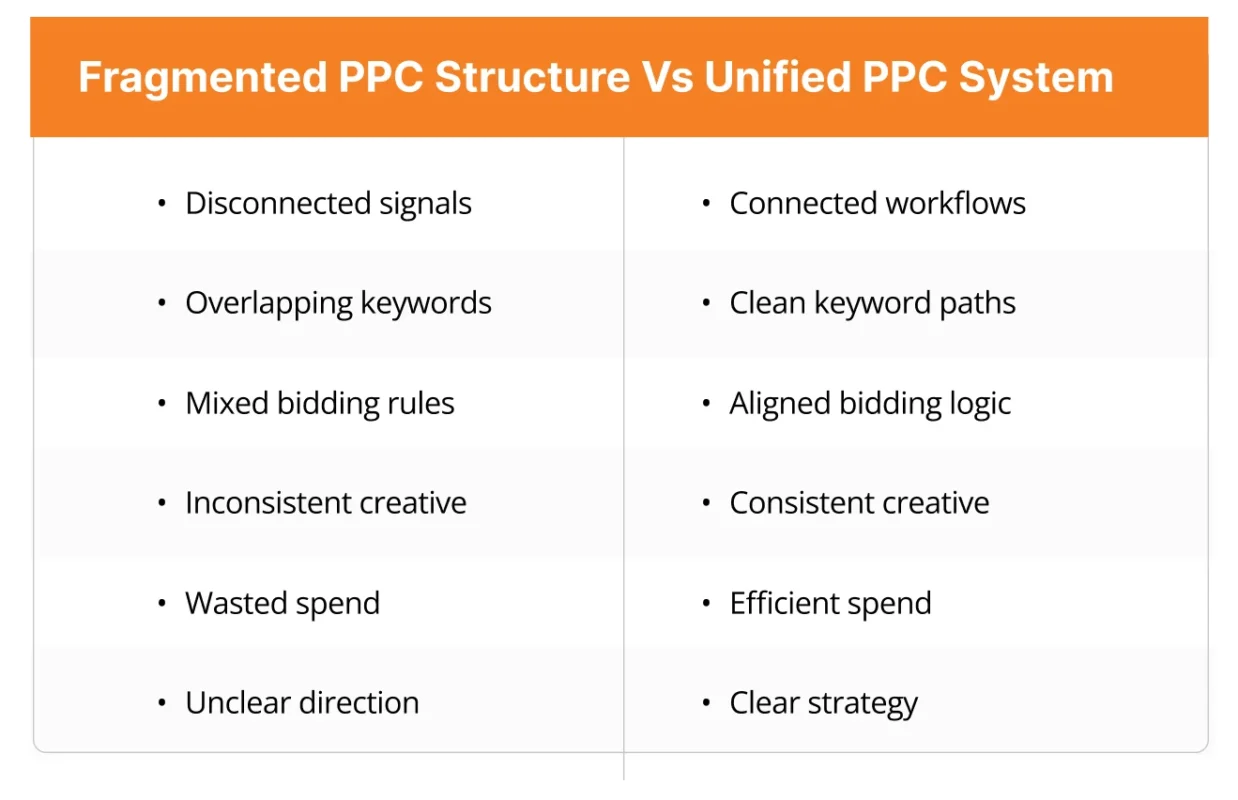
Disconnected Workflows Weaken Signal Quality
When teams operate independently, actions stop reinforcing outcomes. Bid changes are made without creative context. Creative updates launch without targeting alignment. Reports explain what happened, but not why it happened.
Without connected workflows, brands lose:
- A shared understanding of true performance drivers
- Consistency in how campaigns respond to category shifts
- Clarity on how individual ASINs support portfolio-wide goals
Instead of guiding strategy, data becomes reactive. Optimization slows, and visibility becomes unstable.
Duplication Creates Internal Competition
When campaigns aren’t connected, the same keywords end up in multiple places. Auto, broad, and manual campaigns start chasing the same shoppers, and Sponsored Products, Brands, and Display overlap without a plan.
This internal competition raises CPCs without improving conversion. Spend is dispersed across similar ads instead of building a clear path to purchase, so the account looks active while efficiency quietly drops.
Inconsistent Bidding Breaks Performance Predictability
When campaigns use different bidding rules, Amazon gets mixed signals. Some ads chase growth, others try to cut costs, and many stay fixed even when the market changes.
The result is performance instability:
- TACoS becomes unreliable
- Forecasting loses accuracy
- Optimization decisions conflict instead of compounding
Teams see movement, but they cannot confidently explain what caused it or how to scale it.
Funnel Signals Stop Informing One Another
When Amazon PPC is fragmented, data stops flowing between stages. What happens at the top doesn’t guide mid-funnel ads, and buyer behavior doesn’t shape retargeting. Sales end up disconnected from what created the demand.
This removes critical insight:
- How shoppers progress before purchase
- Which ASINs act as entry points versus closers
- Which funnel stages need refinement rather than more spend
Ad spend increases, but learning decreases.
Attribution Becomes Misleading
When Amazon PPC operates individually, attribution rewards the last visible action instead of the full journey. Branded searches mask discovery weaknesses. One campaign takes credit for momentum created elsewhere. DSP and Sponsored Ads operate without shared context.
Amazon PPC campaigns reporting shows wins, but decisions optimize around partial truth. Long-term efficiency erodes while surface metrics look stable.
Structural Leakage Limits Scaling
When your Amazon PPC setup isn’t connected, money slowly leaks out. Low-value placements stay active, poor search terms keep running, and weaker ASINs take budget from proven performers. At the same time, every change has to be made in many places, which slows the work.
How Connected Amazon PPC Strategy Eliminates Waste and Improves Efficiency
A connected Amazon PPC strategy gives your campaigns one shared direction. Each action becomes more intentional. Each adjustment becomes more meaningful. This structure replaces scattered decisions with a system built for clarity, efficiency and long-term profitability.
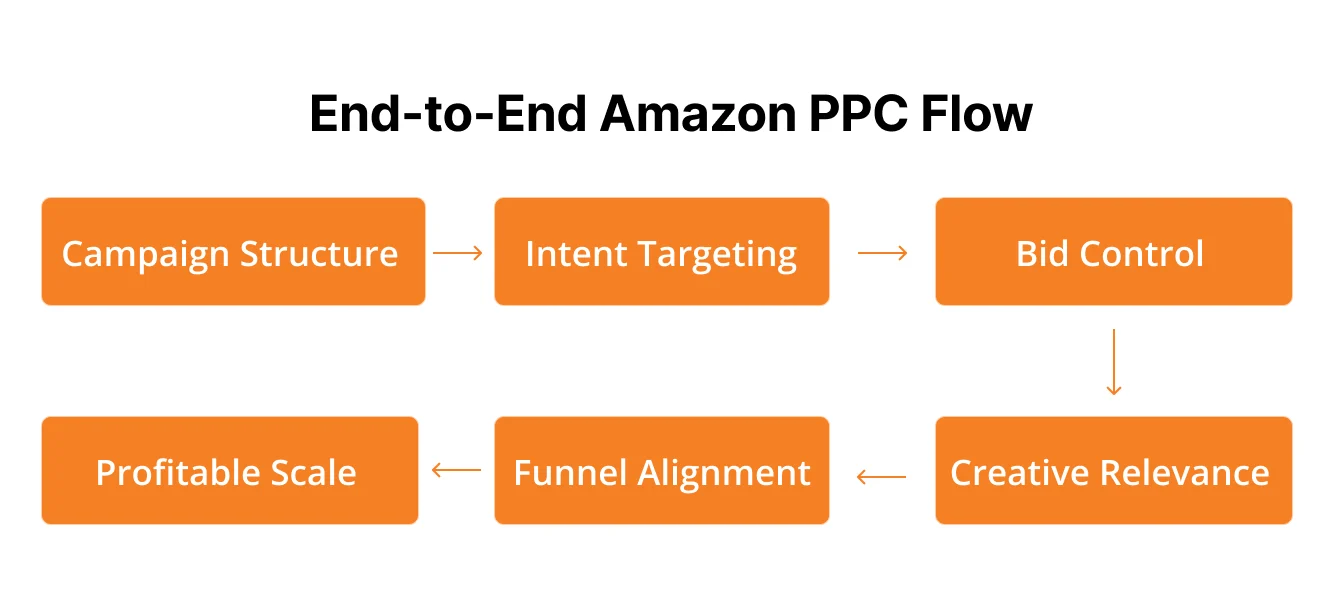
Shared Signals Strengthen Every Decision
When every campaign reads from the same performance indicators, your account becomes easier to steer. High-value terms move through the system with more intention. Shifts in CTR or conversion highlight real opportunities instead of random spikes. This shared signal flow helps your team identify patterns quickly and adjust with confidence.
Aligned Decision Rules Keep Your Account Stable
connected Amazon PPC relies on consistent rules for budgeting, targeting and adjustments. This creates stable momentum across your catalog. Your campaigns no longer move at different speeds. Each one follows the same standards for evaluation and improvement. That stability improves forecasting and turns optimization into a predictable process.
Intent-Based Keyword Paths Reduce Waste
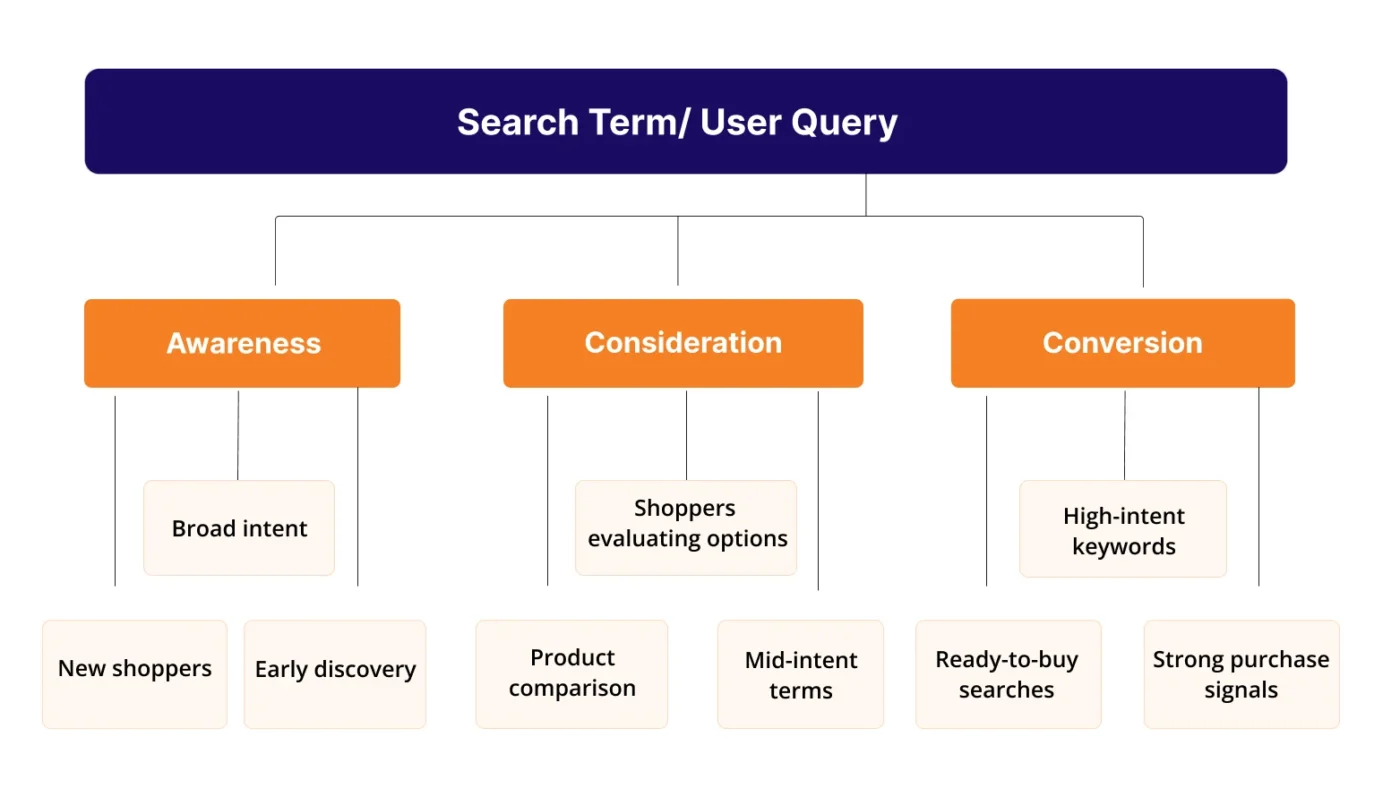
A connected structure groups keywords by intent, not by guesswork. Entry terms guide early traffic. Mid-intent terms support evaluation. High-intent terms drive conversion. This pathing keeps spend aligned with shopper behavior. Your ads qualify traffic with more accuracy, which reduces irrelevant clicks and improves efficiency.
Centralized Negative Control Sharpens Target Quality
One central system manages how your account excludes noise. You refine search traffic with more precision. You prevent internal competition before it appears. This creates cleaner pathways for each funnel stage and protects your budget from low-intent queries that drain profitability.
Funnel Synchronization Strengthens Every Stage
A connected strategy times your funnel stages so they support one another. Awareness builds the right audience. Consideration reinforces relevance. Retargeting recovers demand. Each layer benefits from the signals above it. This synchronization improves scalability because shoppers experience your brand in a consistent sequence.
connected Amazon PPC is not about adding more campaigns. It is about giving your structure one coordinated direction. You reduce waste. You improve efficiency. You gain a foundation that supports steady visibility and long-term profitability without the friction of scattered decisions.
Why Amazon PPC Performs Better Under One Team
Putting all your Amazon PPC tasks under one team gives your brand a clear path. Changes happen faster, results make more sense, and you know why performance goes up or down each week. Instead of reacting to problems, you guide growth with control.
Balanced Spend Across Your Catalog
When one team manages every ASIN, spend follows one plan. Strong products support the rest instead of competing. Seasonal items get attention without pulling budget from core sellers. This keeps results steady and protects profit when the market shifts.
Growth That Scales With Control
Scaling works best when the same team handles everything under Amazon PPC advertising management, including but not limited to budgets, targeting, and bidding. Spend increases follow clear rules, not flukes. You know how much your account can handle and how fast you can grow without putting results at risk.
Stronger Conversions Through Aligned Creative
When creative decisions sit with one team, improvement becomes consistent. They see how shoppers respond across all Amazon PPC ad types and placements. Over time, they learn which messages attract clicks, which visuals hold attention, and which formats lead to sales. Each update builds on proven results instead of guesswork.
Faster Testing With Smoother Execution
When targeting, bids, and creative are handled together, testing becomes easier. Ideas move into campaigns quickly, results come back sooner, and adjustments happen without delays. This keeps performance improving even in competitive categories where speed matters.
Clear Feedback That Improves Decisions
All performance signals in one place make patterns easier to spot. Changes in demand show up earlier. Your team sees how the catalog is really performing and can act before small issues grow bigger.
Who an All-in-One Amazon PPC Setup Works Best For
Not every brand needs everything under one system right away. But some brands reach a point where managing Amazon PPC in pieces starts to slow them down. As campaigns grow, separate workflows create confusion instead of progress. For these brands, running Amazon PPC campaigns under one clear structure makes performance easier to manage and growth more stable.
Brands Getting Ready to Grow
As revenue increases, Amazon PPC becomes harder to manage. More campaigns are added. More data needs attention. A single Amazon PPC setup helps keep things organized as volume grows. It allows brands to scale without losing control or hurting performance along the way.
Brands With Many Products
Brands with multiple products benefit when all Amazon PPC activity is managed together. Each product serves a purpose. Some bring in new shoppers. Others convert. When one team manages everything, those roles stay clear, and the full catalog performs better as a whole.
Brands With Tight Profit Margins
In categories where margins are slim, small mistakes in Amazon PPC cost real money. A combined Amazon PPC setup helps reduce waste and keeps spend focused on what works. This makes it easier to stay profitable even when competition is strong.
Brands in Highly Competitive Markets
When competitors increase spend or change strategy, slow reactions lead to lost visibility. One Amazon PPC team can respond quickly, adjust targeting, and protect key placements without sharp swings in performance.
Teams That Are Short on Time
Many internal teams simply do not have the time for a full-time Amazon PPC management. Campaign updates slow down. Creative changes take longer. Performance becomes inconsistent. A one-stop Amazon PPC setup removes that daily pressure and allows internal teams to focus on products, planning, and operations.
Brands that fit these situations gain clearer control over their advertising. Performance becomes easier to manage, decisions become simpler, and growth continues without unnecessary stress.
How to Check If an Agency Is Truly All-in-One
Not every Amazon PPC advertising agency that claims to be “all-in-one” actually works that way. A real setup is easy to recognize once you know what to look for. These checks help you see whether an agency runs Amazon PPC as one connected system or just labels separate work as integrated.
Can They Clearly Explain Their System?
A true all-in-one Amazon PPC partner should be able to explain their setup in simple terms. You should understand how campaigns work together, how data moves from early searches to final purchases, and how each ASIN supports the overall plan.
A clear explanation usually includes:
- how different campaign types support each other
- how performance signals move through the funnel
- how individual products play different roles in growth
If an agency struggles to explain this clearly, it often means the work itself is disconnected. When the system is real, the explanation is simple.
Do Their Campaigns Follow the Same Rules?
In a connected setup, targeting and bidding follow one clear approach. Campaigns are guided by the same rules and priorities, and changes are made for clear reasons. If different campaigns behave differently with no clear explanation, the setup is still fragmented.
Is Keyword Exclusion Managed in One Place?
A real all-in-one approach uses one shared method to control which searches are excluded. This avoids overlap between campaigns, protects spend, and keeps each stage of the funnel focused. When exclusion is handled in pieces, budget leaks and internal competition appear.
Are Their Processes Easy to Understand?
A strong Amazon PPC advertising agency should make its work easy to follow. You should be able to clearly understand how changes are tested, how decisions are made, and how results are reviewed from one week to the next.
This means knowing:
- what is being tested and why
- how performance decisions are reached
- how results influence the next set of actions
When processes are visible, improvement becomes steady and predictable. When they are vague or hidden, work happens in isolation and results are hard to trust. If an agency cannot clearly explain how work moves from decision to action, the Amazon PPC setup is not truly connected.
Do They Give Direction, Not Just Numbers?
Good Amazon PPC partners do more than send reports. They explain what changed, why it happened, and what should happen next. You should receive guidance you can act on, not just data to interpret on your own.
A true all-in-one Amazon PPC setup is consistent, open, and clearly structured. If an Amazon PPC advertising agency cannot show these qualities early, their approach is likely a collection of separate efforts rather than one connected system.
Final Thoughts
A connected Amazon PPC system brings clarity, efficiency, and more predictable profitability. This guide showed why fragmented setups fall behind and how a unified approach improves control and forecasting.
If you see friction in your signals, workflow, or scalability, it’s a sign your system needs alignment.
AMZDUDES provides Amazon PPC services that connect optimization, targeting, creative, and analytics into one system. We also apply Amazon competitor analysis services so your strategy reflects real market pressure, not just internal metrics.
If you want your ads to scale with more confidence and less effort, our Amazon PPC management services can help you move forward.
Book a strategy call with AMZDUDES today.
Frequently Asked Questions
1. Do high-ranking products on Amazon still need advertising?
Yes. Ranking alone does not protect visibility. Competitors shift bids, shopper behavior changes and categories evolve. Advertising helps maintain momentum, protect your position and support long-term profitability with steady traffic signals.
2. I need help with Amazon advertising. Where should I start?
Begin by identifying the gaps in your current structure. Look for issues in targeting, bidding, creative or reporting. A coordinated Amazon PPC ad solution helps you rebuild these elements with precision so your campaigns support clear and consistent growth.
3. Do I need Amazon advertising specialists who are experts at campaign optimization?
Specialists bring accuracy, insight and efficiency. They understand how signals interact across formats and how each decision affects performance. This expertise helps your brand reduce wasted spend and improve scalability with a more reliable system.
4. How does an all-in-one Amazon PPC team improve results compared to managing ads internally?
A single team aligns every part of your strategy. They manage keywords, bids, creative and reporting under one process. This reduces volatility and supports faster learning cycles, which leads to stronger performance and clearer forecasting.
5. What type of brands see the most benefit from a complete Amazon PPC solution?
Brands with growing catalogs, rising competition or limited internal bandwidth gain the most value. These brands need consistent decision making, structured optimization and steady visibility to scale with confidence.