Key Takeaways
- Understand the differences first: Seller Central means you sell to customers, while Vendor Central means you sell to Amazon.
- Decide who should control your brand: Choose Seller Central for full control, or Vendor Central if you’re comfortable giving Amazon retail authority.
- Prioritize margins or wholesale volume: Select Seller Central for higher margins, or Vendor Central for bulk wholesale scale.
- Plan around cash flow cycles: Go with Seller Central for faster payouts, or Vendor Central if you can manage longer payment terms.
- Align the model with your business structure: Base your decision on your margins, operations, and long-term growth goals.
When it comes to selling on Amazon, choosing the sales channel is crucial. Amazon’s marketplace offers two primary sales channels: Amazon Seller Central (for third-party or 3P sellers) and Amazon Vendor Central (for first-party or 1P sellers).
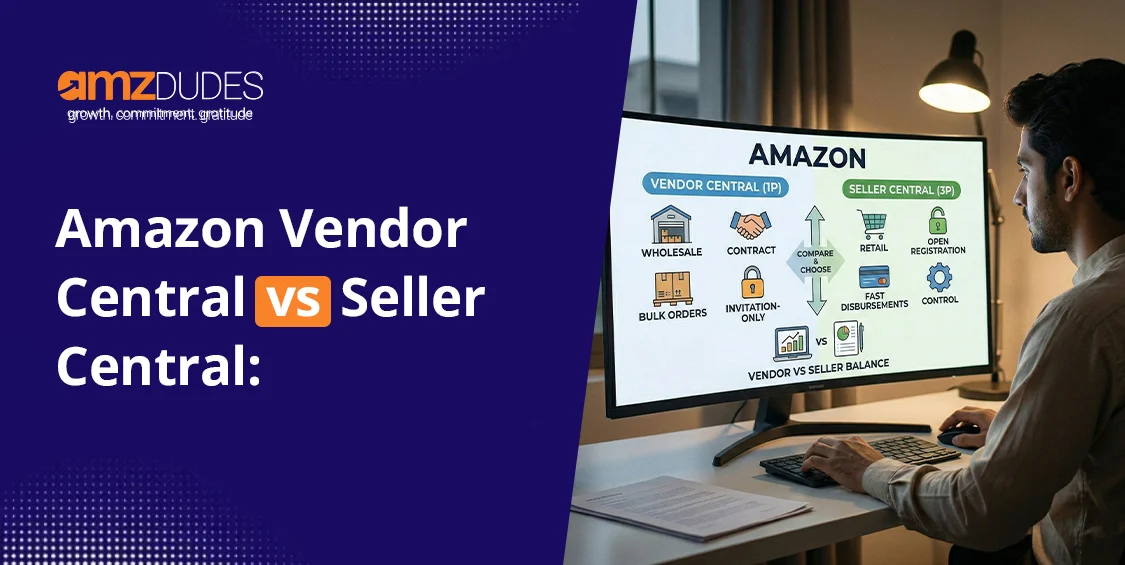
Under the Seller Central model, brands act as third-party (3P) sellers. Brands list products on Amazon and sell them directly to consumers. In contrast, the Amazon Vendor Central model operates on a first-party (1P) structure, where brands sell their products wholesale to Amazon. Amazon purchases items via purchase orders (POs) and then sells them under “Sold by Amazon”.
Amazon Vendor Central and Seller Central offer distinct advantages, each catering to different business models.
This guide provides a clear overview of Amazon Vendor vs Seller Central, focusing on the differences. It helps you understand which model is right for your brand so you can make the right decision when stuck between wholesale and marketplace selling.
Amazon Seller Central Overview
Amazon Seller Central follows a third-party (3P) marketplace model, where brands sell directly to consumers on Amazon’s platform. As a Seller Central participant, you maintain full control over your Amazon product listing, pricing, inventory management, shipping, and customer service.
Anyone can sign up and sell (subject to Amazon’s policies). Sellers create an account by choosing between an Individual or Professional selling plan, depending on sales volume and business needs. Once approved, brands can list products, enroll in Fulfillment by Amazon (FBA) for logistics support, or handle fulfillment independently through FBM (Fulfilled by Merchant).
Seller Central participants use Amazon’s Seller Dashboard to manage listings, inventory, orders, and performance. They are responsible for everything from listing creation to performance metrics. You receive payments directly from customers and keep the profit margin between your wholesale and selling prices. Success in this model heavily depends on how effectively you manage operations and optimize growth drivers, such as pricing, inventory planning, and advertising, to name a few.
Amazon Vendor Central Overview
Amazon Vendor Central operates on a first-party (1P) model, where brands act as wholesale suppliers to Amazon. It’s an invite-only program for brand owners and manufacturers who want to sell their products wholesale to Amazon. As a Vendor, you set the wholesale price and ship products to Amazon. Amazon becomes the retailer and resells the products directly to customers, managing pricing, promotions, and customer service.
Vendor Central provides access to Amazon’s massive customer base and fulfillment capabilities, but with less control over the end-to-end selling process.
Amazon Vendor Central vs Seller Central: Key Differences

The fundamental difference between Vendor Central and Seller Central lies in ownership and control. If you choose Seller Central, you remain the retailer and sell directly to the end customer. In Vendor Central, Amazon becomes the retailer after purchasing your inventory. Let’s further see how this difference impacts critical areas of your business.
Control Over Pricing and Inventory
On Vendor Central, Amazon buys your products at wholesale and resells them. Amazon becomes the owner of the products, and you lose control over pricing as Amazon sets the retail prices. This can reduce your ability to maintain higher profit margins.
On the other hand, with Seller Central, you have control over pricing and inventory. You decide retail price, promotional discounts, and restocking timelines. This allows you to manage prices. Though competition and the market have a significant role in determining the price, the final decision will always be yours. If managing margins and flexibility is your priority, Seller Central is a better option.
Profit Margins
As a Vendor Central participant, you sell your products at wholesale prices to Amazon, so your margins are typically low. Amazon handles operations, but it comes with a cost. Your margins highly depend on the wholesale terms negotiated with Amazon.
With Seller Central, you can expect higher net margins compared to wholesale. You can keep a larger portion of the retail price after paying Amazon’s referral and fulfillment fees. Even after accounting for these fees, you can still gain more profit compared to Vendor Central.
If maximizing profitability is your ultimate goal, Seller Central is your best choice. Vendor Central is mostly preferred by brands prioritizing exposure over higher margins.
Cash Flow & Payment
Cash flow operates very differently under Seller Central (3P) and Vendor Central (1P). Under the Seller Central model, brands get payments faster (weekly or biweekly). This structure allows brands to reinvest capital quickly.
In contrast, Vendor Central operates on longer payment terms, typically Net 30, Net 60, or even Net 90 days. This means Amazon pays at least a month after issuing and receiving the purchase order, which can create longer cash conversion cycles. These longer payment cycles can affect cash flow for smaller businesses.
When planning finances, vendors should consider this factor and should be prepared for delayed payments. Amazon also reserves the right to impose chargebacks if packaging, labeling, or timing requirements are not met.
Marketing Control
Sellers maintain full marketing control under Seller Central. Professional sellers can run Sponsored Products, Sponsored Brands, and Sponsored Display campaigns with keyword targeting. You can run targeted ad campaigns and track their performance more closely.
In contrast, Vendor Central offers limited control over marketing and advertising. Vendors often need to coordinate with an Amazon account manager for certain retail promotions or deal participation.
Additionally, Amazon may request marketing allowances or slotting fees to promote vendors products. These added costs, combined with reduced retail control, can make it more challenging for vendors to independently manage and optimize their advertising strategy.
For brands focused on growth and visibility, Seller Central’s advanced advertising tools allow for more targeted campaigns.
Which Platform Is Right for Your Brand in 2026?
In 2026, Amazon will continue operating both Vendor Central (1P) and Seller Central (3P) models, but the right choice depends on your brand’s priorities, margins, and growth strategy. Each option offers different levels of control, operational responsibility, and growth potential.
1. Vendor Central
Vendor Central typically suits large, established brands or manufacturers, especially those invited by Amazon. Choose Vendor Central if:
- You operate on a strong wholesale model with healthy manufacturing margins
- You prefer bulk purchase orders instead of managing individual customer orders
- You want Amazon to handle retail pricing, customer service, and front-end selling
- You have the operational capacity to meet Amazon’s compliance and chargeback requirements
- You prioritize retail presence through “Sold by Amazon”
2. Seller Central
Seller Central is the best entry path for emerging brands. Choose Seller Central if:
- You want full control over pricing, listings, and brand positioning
- You prioritize higher margin potential over wholesale volume
- You want direct control over PPC and advertising strategy
- You value access to detailed performance and customer data
3. Hybrid Strategy
Many brands use both platforms to diversify Amazon sales. You can choose a combination of both if:
- You want Vendor Central for bulk wholesale volume while maintaining Seller Central for higher-margin SKUs
- You want to reduce risk by not depending entirely on one sales channel
- You plan to use Seller Central for better pricing control and advertising flexibility
- You want to test new products on Seller Central before scaling through Vendor Central
- You aim to balance retail credibility “Sold by Amazon” with brand control and data access
Conclusion
The decision between Amazon Vendor Central and Seller Central depends on your business priorities. Choosing between Amazon Vendor Central vs Seller Central ultimately comes down to how a brand wants to operate, scale, and control its presence on Amazon.
If control over your brand and higher profits are essential, Seller Central is the best option. However, if you want a more automated process with less management burden on your shoulders, Vendor Central is a better fit.
If you need clarity across both models, AMZDUDES provides full Amazon account management services. Book a free consultation to get direct expert assistance.
Frequently Asked Questions
What is the main difference between Amazon Vendor Central and Seller Central?
The core difference lies in who acts as the retailer. In Seller Central (3P), you sell directly to customers and control pricing, inventory, and advertising. In Vendor Central (1P), Amazon purchases your products at wholesale and resells them, controlling retail pricing and operations.
Which model offers higher profit margins?
Seller Central generally provides higher margin potential because you sell at retail price and pay Amazon referral and fulfillment fees. Vendor Central operates on wholesale pricing, which usually results in lower margins.
How do payment terms differ between 1P and 3P?
Seller Central sellers receive payments weekly or biweekly, depending on their setup. Vendor Central vendors are paid based on negotiated terms such as Net 30, Net 60, or Net 90 days.
Can a brand use both Vendor Central and Seller Central?
Yes. Some brands adopt a hybrid strategy, using Vendor Central for wholesale scale while maintaining Seller Central for margin control, brand positioning, or specific product lines.
Which platform is better for new or emerging brands?
Seller Central is typically the preferred starting point for emerging brands because it offers easier entry, full pricing control, and access to detailed customer and advertising data.