

Key Takeaways
- The Amazon A10 algorithm ranks performance, not keywords. High conversion rate and consistent keyword-specific sales velocity are what push listings to page one.
- Indexing is only eligibility. If you’re indexed but not ranking, your performance signals are weaker than competitors for that keyword.
- Target keywords you can realistically win. Analyze page one review counts and estimated daily sales required before choosing your primary ranking target.
- Structure your listing strategically. Place your primary keyword early in the title, distribute secondary terms across bullets, and use backend fields for additional coverage without duplication.
- Dominate your brand search results. Optimize and defend branded keywords so competitors can’t outrank you for your own name.
In 2026, Amazon SEO is no longer just about inserting keywords into your listing. It’s about performance. Amazon ranks products based on how well they convert, how consistently they sell, and how relevant they are to shopper intent.
More than 80% of purchases happen on page one, which means if you’re not visible, you’re invisible.
Effective listing optimization isn’t cosmetic. It directly impacts click-through rate, conversion rate, and sales velocity, the core signals that determine ranking. If you want to understand how to rank products on Amazon, you need a strategy built around data, not guesswork.
This guide breaks down how Amazon’s algorithm works in 2026 and how to optimize your listing to drive sustainable organic growth, not just temporary traffic spikes.
What Is Amazon SEO and Why It’s Different From Traditional SEO
Amazon SEO is the process of optimizing your product listings to increase visibility, improve rankings, and drive sales within Amazon’s search results. But unlike Google SEO, Amazon is not trying to answer questions, it’s trying to generate transactions.
Traditional search engines reward content depth, backlinks, and authority. Amazon rewards sales performance. The algorithm prioritizes products that are most likely to convert into purchases, because that directly increases marketplace revenue.
You can drive external traffic or run PPC, but sustainable ranking depends on how well your listing converts that traffic into sales.
How Amazon’s A10 Algorithm Works in 2026
The Amazon A10 algorithm in 2026 is fundamentally performance-driven. Instead of keyword density, A10 prioritizes buyer behavior signals over simple keyword insertion.
Amazon first determines whether you’re eligible to appear, then it decides where you deserve to rank. Understanding this two-layer system is critical if you want predictable organic growth instead of temporary spikes.
The Two Layers of Amazon Search Rankings
1. Indexing (Keyword Eligibility)
Before ranking even begins, Amazon must index your listing for a keyword. If you’re not indexed, you cannot rank, regardless of PPC spend or reviews.
Indexing is based on keyword placement across:
- Title
- Bullets
- Backend search terms
- Attributes
- Structured catalog data
Think of indexing as permission to compete.
2. Ranking (Performance-Based Ordering)
Once indexed, Amazon orders products based on performance signals. This is where most sellers win or lose. Ranking is dynamic and constantly recalculated based on how shoppers interact with your listing compared to competitors.
Core Amazon Ranking Factors Explained
Here’s what the A10 algorithm heavily weighs in 2026:
- Keyword Relevance: Precise alignment between search query and listing content improves initial placement and ad efficiency.
- Conversion Rate (Unit Session %): Higher conversion rates tell Amazon your product satisfies buyer intent. Strong listings outperform higher-traffic but low-converting competitors.
- Keyword-Specific Sales Velocity: Amazon tracks how many sales you generate for a specific keyword, not just total sales. Consistent velocity builds ranking momentum.
- Click-Through Rate (CTR): Your main image, title, price, and reviews determine whether shoppers click. Higher CTR improves competitive positioning.
- Reviews and Star Rating: Quantity and quality of reviews influence trust and conversion. A 4.5 star product consistently outperforms a 4.1 star competitor in tight niches.
- Fulfillment Method (FBA vs FBM): FBA products often receive ranking preference due to Prime eligibility, faster shipping, and stronger customer experience signals.
- Inventory Stability: Frequent stockouts reset ranking momentum. A10 favors stable, consistently available listings.
- Pricing Competitiveness: Overpriced listings suppress conversion. Competitive pricing improves both CTR and sales velocity.
- Return Rate & Customer Experience Signals: High return rates, negative feedback, or poor post-purchase experience can suppress visibility.
- External Traffic Impact: Amazon increasingly rewards qualified external traffic (Google, TikTok, email) that converts, especially when it drives incremental sales velocity.
Amazon Indexing Explained: How to Get Your Product Indexed
What Does Indexing Mean on Amazon?
Indexing means Amazon’s system has recognized your listing as relevant for a specific search term based on the keywords present in your listing fields. When a shopper types that term, your ASIN becomes eligible to appear in the results.
However, being indexed does not guarantee placement on page one. It only means you’re in the pool of competing products for that keyword.
How to Check If Your Product Is Indexed on Amazon
- Manual Search Test: Search your ASIN followed by the exact keyword in the Amazon search bar. If your listing appears, it is indexed for that term.
- Helium 10 Index Check: This tool allows quick verification across multiple keywords and highlights indexing gaps.
- Jungle Scout Indexing Tools: Useful for bulk testing and identifying where your listing may be missing keyword eligibility.
- Identifying Deindexing Issues: Common causes include backend keyword removal, category changes, flat-file overwrites, or suppressed listings. Regular audits help prevent silent traffic loss.
How to do Keyword Research for Amazon SEO?
- Go to Amazon and type your main product term into the search bar to identify your core keyword.
- Enter that keyword into a research tool (Helium 10, Jungle Scout, etc.) and export all related keyword suggestions.
- Remove any keywords that are not directly relevant to your exact product.
- Sort the remaining keywords by search volume and identify strong high- and mid-volume candidates.
- Search your top keyword options directly on Amazon and analyze page one competition, including review counts and brand dominance.
- Estimate how many daily sales are required to rank on page one for each keyword and eliminate unrealistic targets.
- Identify 3–5 competitors ranking on page one for your primary keyword and run reverse ASIN analysis on them.
- Extract overlapping keyword patterns from competitors and add relevant gaps to your list.
- Select one primary keyword and 5–10 closely related secondary keywords based on relevance and achievable competition.
- Assign your primary keyword to the title, distribute secondary keywords across bullet points, and place remaining variations in backend search terms without duplication.
How to Optimize Your Amazon Product Listing for SEO
Once your keyword research is complete, listing optimization becomes execution. Every part of your listing should reinforce relevance while supporting conversion. If a section doesn’t improve clarity or strengthen indexing, it shouldn’t be there.
How to Optimize Your Amazon Product Title
Your title carries the strongest indexing weight in Amazon SEO, so your primary keyword should appear early, ideally within the first 60–80 characters where it remains visible on mobile. For newer listings, using the exact-match version of your main keyword helps send a clearer relevance signal to the Amazon A10 algorithm.
Keep the structure clean and consistent:
“Brand, primary keyword, core differentiator, then size or variant”
Example of Ideal Amazon Product Title

Ultra Focus Nootropic Pouches, Nicotine-Free & Caffine-Free with Enfinity Paraxanthine and Alpha GPC, Cool Mint, 3 Cans
Avoid repeating the same root word in multiple forms. If your title reads unnaturally or feels overloaded, it will reduce click-through rate, which ultimately weakens ranking performance. Study the top competitors in your niche and match the structural standard, not the keyword stuffing.
How to Optimize Amazon Bullet Points for Rankings
Bullet points expand keyword coverage while guiding buying decisions. Each bullet should focus on one core benefit and integrate a relevant secondary keyword naturally within the sentence.
Instead of repeating the exact same phrase from your title, use root variations and closely related terms. Amazon indexes root words, so forcing exact repetition doesn’t strengthen ranking. It often just harms readability.
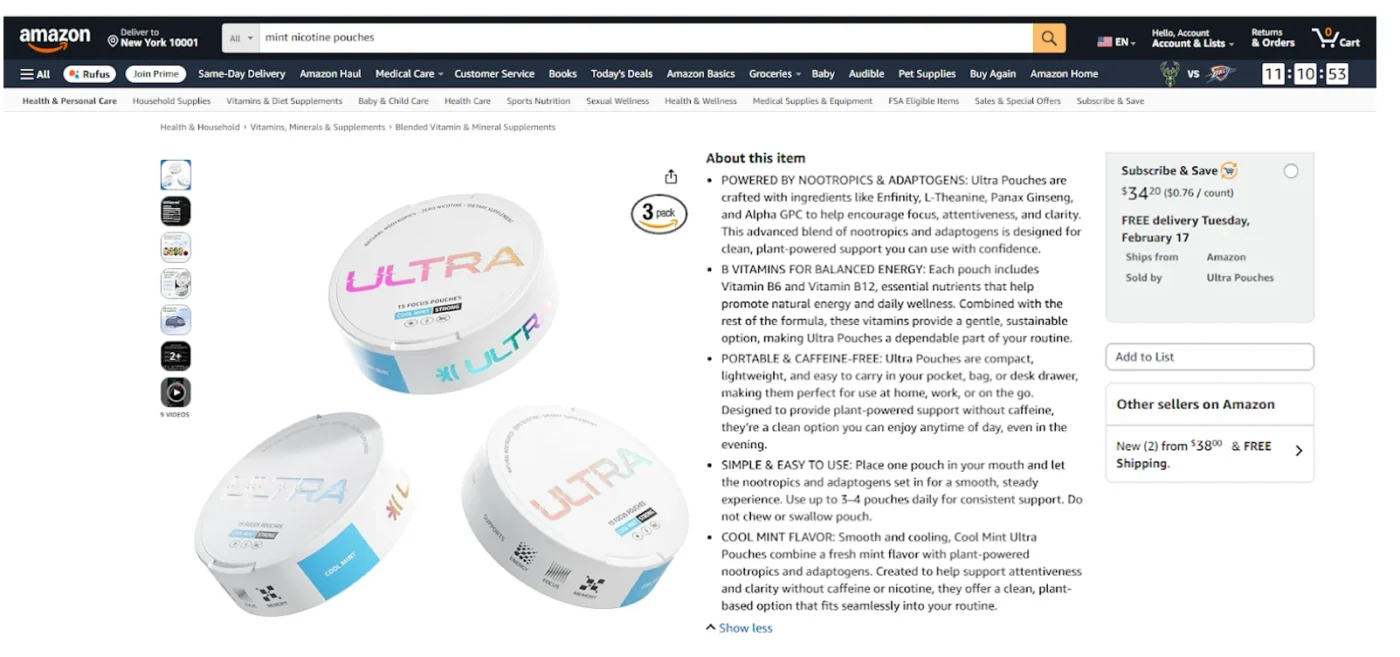
Keep bullets concise and structured so they are easy to scan. Buyers skim. If they can’t quickly understand value, conversion drops, and conversion rate is a direct ranking signal under both the Amazon A9 algorithm and the Amazon A10 algorithm.
Optimizing Product Descriptions and A+ Content
Descriptions and A+ Content support ranking indirectly by improving conversion. Use this space to expand on features, clarify use cases, and address concerns buyers commonly raise in reviews or Q&A.
Rather than repeating bullet points, deepen the explanation. Show how the product solves a specific problem. Reinforce your main keyword naturally in headers and body copy, but prioritize clarity over density.
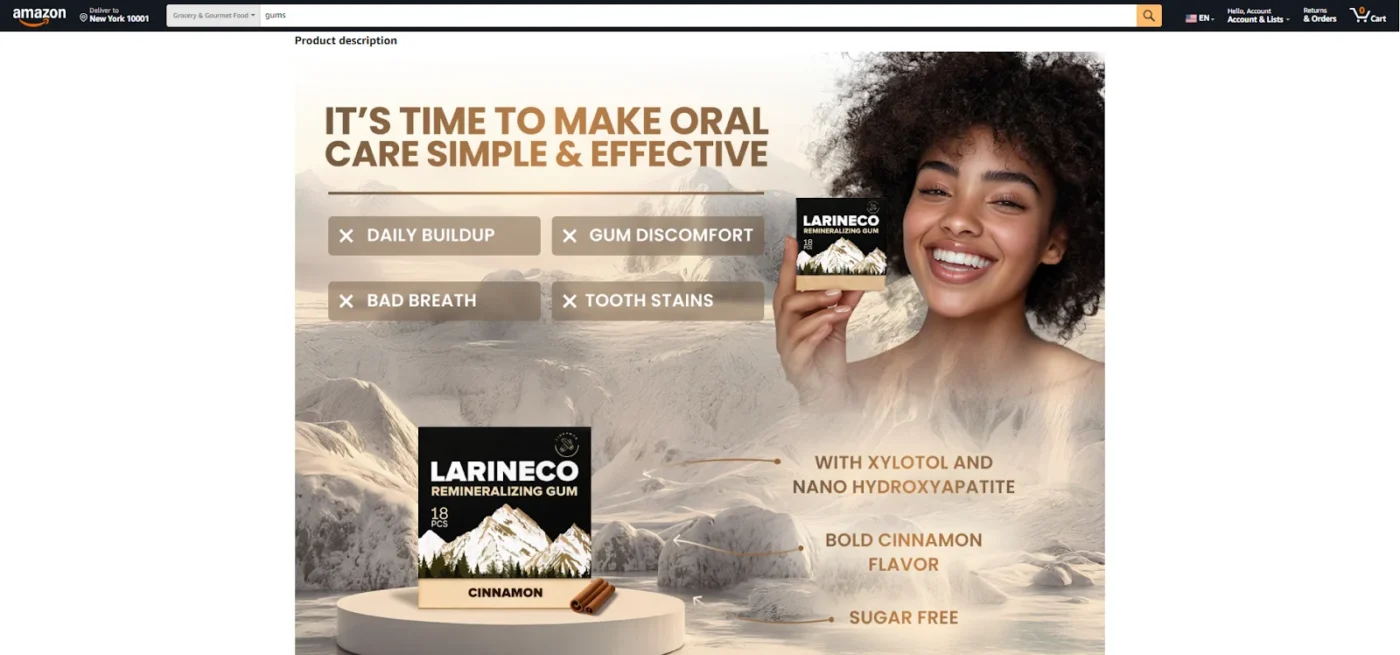
Comparison charts in A+ Content help buyers make faster decisions, especially in competitive categories. When buyers understand differentiation quickly, conversion improves, and improved conversion strengthens organic ranking.
Backend Search Terms Optimization Strategy
Backend search terms exist to expand coverage, not duplicate visible content. Use this space for synonyms, alternate phrasing, and variations that didn’t fit naturally into your title or bullets.
Avoid repeating keywords already used in visible fields. Amazon’s system reads the listing as a whole, and redundancy doesn’t increase ranking power. Separate keywords with spaces only, and use the full character limit efficiently without inserting irrelevant phrases.
Backend optimization is about completing your keyword coverage so that your listing is fully eligible without cluttering the customer-facing copy.
Advanced Amazon SEO Strategies for Competitive Niches (2026)
Once foundational Amazon SEO is in place, competitive categories require a different level of strategy. Following strategies will help you outrank your competitors in 2026 with Amazon SEO:
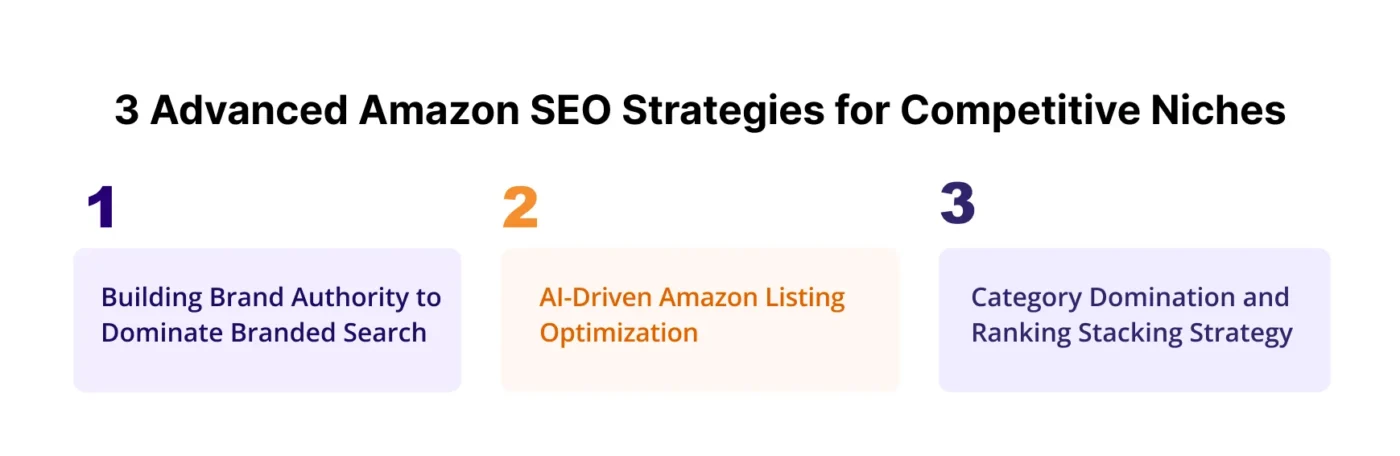
1. Building Brand Authority to Dominate Branded Search
As your brand grows, branded searches increase, and competitors will target them. Optimize your listings to rank first for your own brand terms and run Sponsored Brand campaigns to defend top placements. Strong branded conversions reinforce authority signals in the Amazon A10 algorithm. Owning your brand search space protects long-term ranking stability.
2. AI-Driven Amazon Listing Optimization
Competitive niches require continuous refinement, not static listings. Use performance data to test title structure, keyword positioning, and benefit emphasis based on conversion trends. Monitor search term shifts and adjust placement accordingly. Iterative, data-backed updates outperform random edits.
3. Category Domination and Ranking Stacking Strategy
Expand strategically with tightly related variations to increase search surface area. Consolidated reviews strengthen authority and improve conversion across all variations. Structure listings to target distinct keyword clusters to avoid cannibalization. Control more placements on page one to reduce competitor visibility.
Conclusion
Amazon SEO in 2026 is about performance, not keyword stuffing. The Amazon A10 algorithm rewards listings that convert well, generate consistent sales velocity, and align with buyer intent. Indexing gets you eligible, conversion and structured optimization get you ranked. If your listing isn’t growing, the issue is likely structural, not traffic.
Ready to rank higher and scale sustainably? Book a free consultation call with AMZDUDES and get a data-driven audit of your Amazon listing and SEO strategy. Let’s move you to page one, and keep you there.
Frequently Asked Questions About Amazon SEO
1. How does Amazon SEO actually work?
Amazon SEO works by optimizing your product listing so Amazon’s algorithm recognizes it as relevant and high-performing. First, your listing must be indexed for a keyword. Then Amazon ranks it based on conversion rate, sales velocity, reviews, pricing, and customer experience signals.
2. What is the Amazon A10 algorithm and how is it different from A9?
The Amazon A10 algorithm is the updated version of Amazon’s ranking system. While A9 focused heavily on keyword relevance and sales, A10 places more emphasis on buyer behavior signals like conversion rate, consistent sales performance, and qualified external traffic.
3. How long does it take to rank on Amazon organically?
It depends on competition. Low-competition keywords can move within a few weeks if you generate consistent sales. Highly competitive keywords may take months of sustained sales velocity and strong conversion rates to reach page one.
4. Why is my product indexed but not ranking?
Being indexed means Amazon recognizes your listing as relevant. Ranking depends on performance. If your conversion rate, reviews, pricing, or sales velocity are weaker than competitors, your listing will remain lower in search results.
5. Do I need Amazon PPC for Amazon SEO to work?
Organic ranking and PPC are separate, but they influence each other. PPC can help generate initial sales velocity and data, which strengthens organic ranking signals. In competitive niches, PPC often accelerates organic growth.