Key Takeaways
- Visibility is everything on Amazon, and Amazon PPC advertising puts your product where shoppers are already looking.
- Winning with PPC management Amazon means building the right structure, choosing smart keywords, and managing Amazon PPC spend wisely.
- A low ACoS is great, but tracking TACoS shows how your ads support your entire brand growth.
- You can save a lot on ads by blocking irrelevant clicks and focusing only on what converts.
- The right Amazon advertising agency or Amazon PPC experts acts like a partner, understands your market, and helps you grow without wasting your budget.
All You Need to Know About Amazon PPC Management
With over 310 million active users, Amazon is a leading platform where you can build and scale your business. Though such an extensive user base of Amazon also attracts the sellers, it raises the competition. If you are also an Amazon seller, you must have heard of Amazon PPC advertising. It’s a paid but cost-effective way that brings visibility and ultimately sales. According to SellerApp, 79% of Amazon sellers acknowledge that PPC is their primary driver of sales.
However, if you have just stepped into this platform, you must be wondering what Amazon PPC management is and how Amazon PPC management services actually work. You will get to know about all in this detailed Amazon PPC guide, as here, we will discuss every aspect of PPC management on Amazon. By the end of this guide, you will be able to launch your first full-fledged Amazon advertising campaign that can generate substantial revenue for your business.
Whether you are looking to manage Amazon PPC yourself or hire professionals, this guide covers everything you need to know about Amazon sponsored ads management and Amazon paid ads management.
So, let’s get into it:
Understanding Amazon PPC Management
What is Amazon PPC?
Amazon PPC (Pay-Per-Click) is a way to advertise your business on Amazon. It helps sellers and brands get higher reach that ultimately drives sales. Amazon sellers can launch a PPC ad campaign and advertise the products they want. This is the foundation of effective Amazon Pay-Per-Click account management.
Helium 10 defines this advertising model as:
“Sellers are only obliged to pay when the action is being done.”
The best part of this model is that no one clicks on the ad. You don’t need to pay a penny. In the Amazon PPC model, you will only be charged when a potential customer clicks on the ad.
How Does Amazon PPC Work?
Before I introduce you to how to set up campaigns and what the right tools are, let me first give you an overview of how Amazon PPC works. This process is at the heart of what any Amazon PPC manager does daily. Let’s look over an example:
Imagine you are selling metal straws on Amazon and want to advertise them. Now,
- You create an ad campaign in Amazon’s advertising console. This is the first step in any Amazon PPC management service.
- You choose the keyword “metal drinking straws” and set a bid of $1.00 per click.
- A shopper goes to Amazon and types “metal drinking straws” into the search bar.
- Amazon runs an auction in the background. It compares your bid and ad relevance with other sellers bidding on the same keyword.
- Your ad wins a spot and shows up in the search results (mostly at the top).
- The shopper sees your product and clicks on it.
- You’re charged (up to $1.00) for that click.
- If the shopper buys your straws, you earn a sale. If not, you still only pay for the click.
Why is PPC Important for Amazon Sellers?
As you are clear on what Amazon PPC is and how it works, a WHY must be popping in your mind. Statistics reveal that over 150 million people make purchases on Amazon each year, and in 2025, this number is expected to grow significantly, with total sales projected to exceed $700 billion. This clearly shows that Amazon holds a strong potential for sellers.
However, we can’t ignore the increasing competition. According to SellerApp, there are approximately 9.7 million sellers on Amazon. This makes product visibility a serious challenge. Your product could easily end up on the third, fifth, or even tenth page of search results. Yet, studies show that 45% of shoppers don’t even scroll past the second page.
This is where PPC management Amazon helps you, as it positions your brand at the top of the search results so that you can get:
- More impressions
- Higher click-through rates
- Increased conversions
- Ultimately, more sales and revenue

What Are the Different Types of Amazon PPC Ads?
There are 3 main types of Amazon PPC ads, and understanding them is crucial for comprehensive Amazon sponsored ads management:
- Sponsored Products (SP): Sponsored Products are the most commonly used ads. They appear in search results and product pages and are targeted using keywords, ASINs, or categories. Aiming to promote a single product listing? This category is for you.
- Sponsored Brands (SB): Want to establish your brand identity? Sponsored Brands help you in doing so. These ads appear at the top of search results and include your brand logo, a custom headline, and multiple product listings.
- Sponsored Display (SD): Someone scrolls past your or your competitor’s product, and you want to pop up on their screens again? Sponsored Display ads do the same and increase reach and recapture missed sales.
What Does an Amazon PPC Manager Do?
An Amazon PPC manager offers Amazon PPC management services and handles all the PPC related tasks for your brand. Hiring a skilled Amazon PPC manager is often the first step for brands serious about scaling. These tasks include:
- Keyword research and bid management
- Structuring campaigns for performance and scale
- Monitoring ACoS, TACoS, and ROI metrics
- Identifying underperforming ads and making data-driven adjustments
- Testing creatives and copy
- Generating transparent reports to track success
How to Build a High Converting Amazon PPC Campaign?
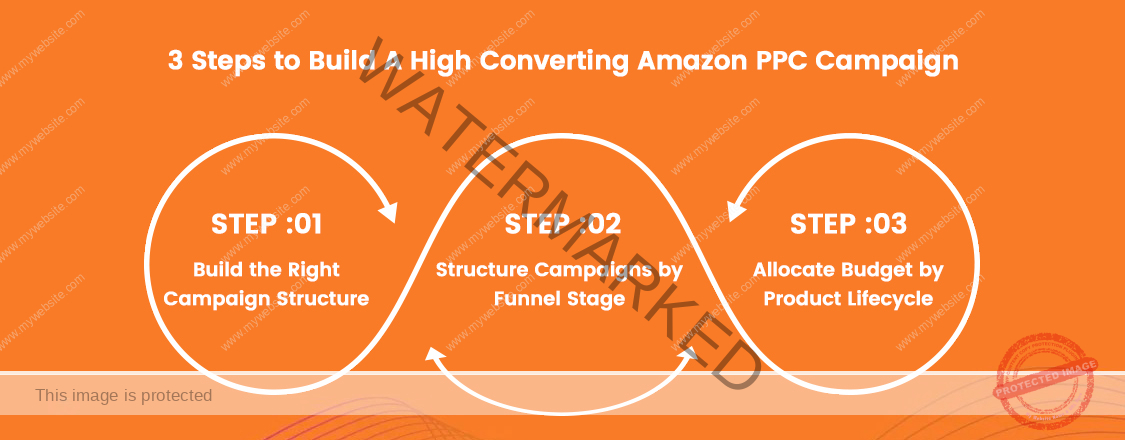
Before delving into the intricacies of Amazon PPC management, you first need to understand that setting up an Amazon PPC campaign is not about directly jumping into the ads. If you don’t structure your campaign properly or have no plans for scaling it, soon your PPC campaign will be consuming your budget without giving results. Below, I have discussed how to structure scalable campaigns using a proven Amazon PPC strategy setup framework, which is the hallmark of expert Amazon advertising management:
Step 1: Build the Right Campaign Structure
This is the foundation of professional Amazon sponsored ad management.
Option A – SKAGs (Single Keyword Ad Groups):
- What to do: Create one campaign per match type, and one ad group per keyword.
- Use it for: High-volume, high-converting keywords.
- Pro Tip: Focus on your top 5–10 revenue-driving keywords only.
- Why it works: It gives you precise control over bidding, and you can track performance easily.
Option B – Broad-Based Targeting:
- What to do: Group related keywords into ad groups for faster discovery.
- Use it for: New products or campaigns in early stages.
- Pro Tip: Use dynamic bids: down only to reduce risk during testing.
How?
For a collagen supplement, create:
- A SKAG for “hydrolyzed collagen peptides”
- A broad group for “anti-aging supplement”, “joint support powder”
Step 2: Structure Campaigns by Funnel Stage
Instead of playing a blind game, group your customers based on their customer journeys and target accordingly using Amazon PPC targeting and retargeting strategies. Let’s move to the table below:
| Funnel Stage | Campaign Type | End Result | Example Keyword |
| Awareness (TOFU) | Broad Match / Auto | Drive trafficKeyword discovery | “Healthy supplements” |
| Consideration (MOFU) | Phrase Match / ASIN Targeting | Capture the attention of the shoppers looking for similar products | “Collagen powder for joints” |
| Conversion (BOFU) | Exact Match / Branded | Close high-intent sales | “Vital proteins collagen” |
Step 3: Allocate Budget by Product Lifecycle
Best PPC management services ensure that your PPC budget changes as your product grows. Here’s how to align it with each stage:
Launch Stage
- Spend 70–80% on Auto and Broad Match campaigns.
- Use high daily budgets to gather data and drive traffic.
- As your goal is exposure, your ACoS may be high. But it’s completely fine.
- Run ASIN/category targeting to explore placement options.
Tip: Review search term reports weekly to find converting keywords.
Growth Stage
- Shift budget to Exact and Phrase Match campaigns.
- Reduce spend on low-performing keywords.
- Add Sponsored Brands to increase brand presence.
- Use Budget Rules to scale on high-traffic days.
Tip: Only scale campaigns with proven low ACoS and solid ROAS.
Maturity Stage
- Cut back on broad or high-ACoS campaigns.
- Invest in Sponsored Display for retargeting missed buyers.
- Double down on branded keyword defense with Sponsored Brands.
- Allocate budget to proven winners and test cross-sell ads.
How to Scale Without Increasing ACoS?
Scaling often increases spend, but it doesn’t have to inflate your ACoS. Here’s how to maintain low ACoS using high ACoS optimization techniques:
- Add Negative Keywords Weekly: Cut wasted ad spend by blocking irrelevant clicks.
- Increase Budgets Only on Profitable Campaigns: Use performance thresholds (e.g., campaigns with ACoS < 25% and ROAS > 4).
- Use Search Term Reports: Promote converting terms to exact match campaigns.
- Reinvest Profits: Allocate a fixed % of sales back into ads (e.g., 8–12%).
How to Maximize ROI in Amazon Advertising Optimization & Management?
Whether it’s Amazon PPC or some other advertising model, everyone wants to make every single penny worth it. How to have the maximum ROI in Amazon PPC campaigns? This is the core goal of any Amazon advertising management strategy. Let’s find out:
ACOS vs. TACOS: Why Tracking Both Matters
Many sellers track ACOS (Advertising Cost of Sales) religiously. But the best Amazon PPC management companies track TACOS (Total Advertising Cost of Sales) just as closely, if not more.
ACOS = Ad Spend / Ad Revenue
TACOS = Ad Spend / Total Revenue (Ad + Organic)
When to Use Each?
| Metric | Use Case | What It Shows |
| ACOS | Daily campaign performance | Efficiency of paid spend alone |
| TACOS | Strategic business growth | Impact of ads on total brand performance |
Expert Insight: If your TACOS is decreasing but ACOS remains stable, your ads are driving organic rank and long-term brand lift.
Negative Keyword Strategy
The ad spend on the keywords that aren’t driving any traffic or conversions is the biggest setback in your Amazon PPC campaign. To avoid wasting your ad budget on such keywords, use a negative keyword strategy.
3-Step Negative Keyword Process:
- Run “search term reports” weekly and identify irrelevant and low-converting terms.
- Segment by match type. Especially look over the broad match terms and refine the phrase match terms as well.
- Use account-level negatives to block out brand-irrelevant traffic (e.g., competitor names, product categories you don’t sell).
Without CRO, Your Ads Will Never Perform!
Bidding on the listings that aren’t optimized for conversions only sucks your ad spend. So, your Amazon PPC management must include an on-page conversion strategy. Below mentioned tasks need to be done for an end-to-end CRO:
- Optimize Images: Your listing must have 5-6 high-quality, clear, lifestyle + infographic images. The background of the main image should be white, without any other items like accessories. It must be captivating enough to stop the scroll. The recommended file format is JPEG (.jpg), and the resolution should be 72 pixels per inch with a minimum size of 1000 pixels (for the longest side).
- Write Attention-grabbing Titles: The suggested characters limit for the titles is 100 – 150 characters. Include keywords and separate them with dashes (-) or pipes (|). Mention important details like size, color, and benefits. Include numerics and avoid keyword stuffing.
- Include Reviews: Encourage your customers to drop a review. Aim for 4.3+ star average. If your products keep getting below 4 stars reviews, try to identify the issue, solve them by reaching out to the customers.
- A+ Content: Include keywords so that your content gets noticed by the search engine, and write high-quality content that clearly speaks to “why choose your product”. Tell them how your product will solve their problem.
How to Balance Spend Across Branded vs. Non-Branded Campaigns?
It’s tempting to put most of your PPC budget into branded terms, obviously because they convert better, right? But that’s a dangerous habit if you’re trying to grow beyond your current customer base.
Why Does It Matters?
- Branded PPC = Defensive (protect your turf)
- Non-Branded PPC = Offensive (expand reach)
Ideal Spend Split (by Growth Stage):
| Stage | Branded% | Non-Branded% |
| Launch | 20% | 80% |
| Growth | 30-40% | 60-70% |
| Mature | 50% | 50% (depending on competition) |
How to Measure True Profitability?
An average Amazon PPC management service provider measures the profitability only with ACOS and TACOS. But an expert Amazon PPC management agency must measure contribution margin after factoring in:
- COGS
- FBA Fees
- Shipping & Returns
- Promotions
- Ad Spend
Hiring Amazon PPC Experts or Agencies: What’s Right?
Outsourcing Amazon PPC management becomes crucial if you are aiming to scale your business. However, this decision impacts the overall growth of your business. If you hire the right Amazon PPC experts, they can amplify your business’s growth. Likewise, the wrong Amazon PPC management agency can turn down the overall business’s growth.
Whether you’re debating in-house vs. outsourced PPC, or assessing Amazon PPC experts, this guide helps you make the right call with confidence. This section is vital for anyone searching for an Amazon advertising agency or wondering how to manage Amazon PPC effectively at scale.
In-house vs. Outsourced Amazon PPC Management
If you’re still juggling between managing Amazon PPC in-house or outsourcing it to an Amazon PPC management company, the following comparative overview will help you decide:
| Factor | In-House PPC | PPC Management Agency |
| Cost | High (salaries + tools) | Flexible retainer or % of ad spend |
| Speed to Launch | Slower (training required) | Faster setup with proven frameworks |
| Scalability | Limited by team size | Scales easily with account complexity |
| Tool Access | Often limited | Access to advanced platforms & dashboards |
| Accountability | Full control | Requires strong reporting & communication |
How to Choose the Right Amazon PPC Management Agency?
Before finalizing the deal with any Amazon PPC management agency or Amazon advertising agency, look for the following factors:
1. Experience and Specialization
The first thing to consider is the agency’s experience and specialization. Review their case studies and client testimonials to evaluate their track record with Amazon PPC. If they’ve successfully worked with brands in your niche, that’s cherry on top.
2. Communication and Transparency
Choose an agency that prioritizes clear communication and transparency when it comes to reporting. Ask for their reporting schedule and ensure they report on sales and ROAS, not only impressions and clicks. Understand their pricing model and confirm that there’s no hidden cost.
3. Reputation, Reviews, and Referrals
While onboarding an Amazon PPC management company, don’t forget to check the reviews of their clients on platforms like Clutch and Trustpilot. Another approach to end up with the best Amazon PPC management company is asking for referrals from other sellers or businesses with positive experience.
Automation & Tools in Amazon PPC Management
Still relying on the spreadsheets and managing them manually? Wake up, it’s 2026, mate. As an Amazon seller, you must be implementing the technology to stay competitive. The manual tasks are now replaced by Amazon PPC automation tools. This is a key area where modern Amazon sponsored ads management differs from old-school tactics.
Top Amazon PPC Management Tools in 2026
| Tool | Strength | Why? |
| Perpetua | Full-funnel automation | Ideal for brands managing Sponsored Ads + DSP |
| Pacvue | Enterprise-level data + AI bidding | Combines retail analytics with ad strategy |
| Quartile | Optimization done by AI | Excellent for hands-off campaign scaling |
| Teikametrics | Smart bidding + profitability insights | Tightly aligns ad strategy with margin data |
| Ad Badger | Daily negative keyword automation | Great for lean teams managing in-house |
Role of Automation in Amazon PPC Management
Automation reduces the chances of human error, saves time, improves productivity, and handles bulk tasks. So, implement automation solutions in Amazon PPC advertising, because why not? Consider automating the following tasks with the help of AI-powered Amazon PPC management software so that you can pay attention to what matters most:
- Bid Adjustment
- Budget Allocation
- Search term mining and keyword research
- Negative keyword management
- Campaign creation and structuring
- Rule-based alerts and notifications
- Performance reporting and dashboards
PPC Reporting & Transparency
If you are investing thousands of dollars in Amazon PPC management, the reporting must justify each of your pennies. True Amazon pay-per-click account management is backed by data transparency.
What Should Your PPC Reports Include?
A comprehensive PPC reporting Amazon should include:
1. Performance Metrics
- ACOS, TACOS, ROAS
- Impressions, clicks, CTR, CPC
- Total ad sales vs. organic sales
- Conversion rates by campaign/keyword
2. Spend Breakdown
- Daily/weekly spend trends
- Spend by campaign type (SP, SB, SD)
- Branded vs. non-branded keyword spend
3. Profitability Insights
- Estimated margin after ad spend
- COGS + fee-adjusted profitability per ASIN
- Top-performing vs. underperforming SKUs
4. Keyword Intelligence
- Search term data: high spend, low conversion
- Harvested terms added to campaigns
- Negative keyword actions taken
5. Strategic Annotations
- Changes in bid strategy or targeting
- Notes on campaign testing or launches
- Inventory or pricing factors impacting results
Types of Amazon PPC Reports
Amazon offers multiple types of PPC reports for each of its 3 campaign types.
| Ad Type | Report Types |
| Sponsored Products | Amazon generates following type of reports for Sponsored Products: Search term report Targeting report Advertised product reportCampaign report Placement reportPurchased product report Performance over time report Search term impression share report |
| Sponsored Brands | Keyword reportKeyword placement reportCampaign report Campaign placement report Search term report Search term impression share reportCategory benchmark report |
| Sponsored Display | Campaign report Targeting report Advertised product report Purchased product report |
Which Amazon Ad Reports are Most Important?
- SP and SB Search Term Reports
With these reports, you can get to know which of your targeted keywords are actually converting into sales and which are not performing at all.
- SB Keyword and SP Targeting Reports
If you’re running a Sponsored Brand ad, after the search term report, the keyword report is very important. For Sponsored Product ads, the targeting report holds similar importance. These reports tell how your targeted keyword or ASIN has performed over a certain time.
- Search Term Impression Share Reports
Search term impression share reports are almost similar to the search term report of SP and SB. The only difference is that they contain two extra metrics that are considered important to evaluate the overall performance of a PPC campaign. These two metrics are:
- Search term impression rank
- Search term impression share
Final Verdict
Amazon PPC is a way to grow and scale your business, but only if done rightly. You need to be clear on how to structure Amazon PPC campaigns that drive results, how to track analytics, and the implementation of tools and software for result-driven Amazon PPC management. Whether you choose to manage Amazon PPC in-house or hire Amazon PPC experts, the principles in this Amazon PPC guide will set you on the path to success.
Considering outsourcing the Amazon PPC management of your brand?
At AMZDUDES, we are an Amazon PPC management agency that brings data-driven solutions to all your PPC struggles. Whether you are new to this platform or an established one looking forward to scaling, we have been helping businesses grow for 10 years. Our team specializes in Amazon sponsored ads management, Amazon paid ads management, and comprehensive Amazon pay-per-click account management.
Book A Free Consultation Call Now!
FAQs
Q1: What is Amazon PPC management?
Amazon PPC management is a process of creating, optimizing, and analyzing the ad campaigns on Amazon. It covers everything, including keyword targeting, bid strategy, budget allocation, and performance reporting. It’s the comprehensive service provided by an Amazon PPC management company.
Q2: How to run and manage Amazon PPC campaigns?
To run and manage Amazon PPC campaigns effectively:
- Choose campaign types (Sponsored Products, Brands, Display)
- Perform keyword research
- Set bids and daily budgets
- Monitor performance (ACOS, ROAS, conversions)
- Optimize regularly using negative keywords, bid adjustments, and search term reports.
Many sellers hire an Amazon PPC manager to handle this.
Q3: How does AMZDUDES help in efficient Amazon PPC management?
At AMZDUDES, we don’t just manage Amazon PPC. We treat your brand like it’s our own. Our team builds and runs data-backed campaigns focused on real, measurable growth. We keep you in the loop at every stage, stay transparent with results, and work closely with you to make sure your goals are met. We are a leading Amazon advertising agency dedicated to your success.
Q4: How much does Amazon PPC management cost?
Agencies often charge a percentage of your ad spend (e.g., 10-15%) or a flat fee. Some agencies charge a one-time setup fee (e.g., $500-$2,000) as well. The cost of an Amazon PPC management service varies based on scope.
Q5: How to find the best Amazon PPC management company?
Look for an Amazon PPC management company with:
- Amazon-specialized expertise
- Proven case studies
- Transparent reporting & communication
- Data-driven strategy
- Clear pricing with no hidden fees