
Key Takeaways
- Amazon PPC management services handle campaign strategy, optimization, and monitoring to reduce wasted ad spend and improve ROI.
- Most services include account audits, strategic campaign setup, keyword research, bid optimization, continuous monitoring, and performance reporting.
- Professional PPC management saves sellers time and prevents costly mistakes from manual campaign management.
- Results typically appear within weeks; significant improvements usually develop over a few months.
- Management services are valuable for sellers of all sizes who want to scale efficiently without the complexity of self-management.
Running Amazon PPC campaigns yourself is time-consuming and complex. Without a proper strategy, budgets disappear into low-performing keywords, bid wars, and inefficient campaign structures.
Professional PPC management services handle campaign optimization, keyword strategy, bid management, and performance monitoring, turning advertising spend into predictable, profitable results.
This guide explains what PPC management services are, how they work, what they deliver, and whether they’re right for your business.
How Amazon PPC Management Services Benefit Sellers
Reduce Wasted Ad Spend
Experts identify underperforming keywords and irrelevant traffic draining your budget. Many sellers waste 30-40% of ad spend on low-intent keywords or overlapping campaigns. Professionals redirect spending toward high-converting terms and clean up inefficiencies.
Improve Keyword Strategy
Professional research finds high-intent keywords you might miss, identifies search intent patterns, and discovers competitor gaps. Rather than guessing at keywords, experts use data analysis to find terms where your product has the best chance of converting. This process typically follows a structured Amazon PPC keyword research methodology, combining competitor analysis with search-term data to prioritize the highest-converting opportunities first.
Optimize Bids Strategically
Rather than guessing at bid amounts or letting Amazon’s automated bidding spend excessively, experts adjust bids based on performance, competition, and placement data. The right bid on the right keyword at the right time maximizes visibility while protecting profitability. Getting this balance right is central to overall Amazon PPC optimization, since even a well-researched keyword list underperforms if bids aren’t calibrated to match its conversion potential.
Save Time
Campaign management is time-intensive, including keyword research, bid adjustments, pausing underperformers, testing new keywords, monitor trends. This easily becomes 10-15 hours per week. Professional services free up that time so you can focus on product development, sourcing, or business strategy.
Scale with Confidence
As your advertising grows, managing campaigns manually becomes impossible. Professional services are designed for growth. They handle complexity, test new opportunities at scale, and keep campaigns competitive as your product catalog expands.
Data-Driven Decisions
Regular reporting translates raw data into clear insights and actionable recommendations. Instead of staring at dashboards wondering what to adjust, you get strategic direction: “These keywords have 3x better ROI. Scale them. These keywords have no conversions. Pause them.”
6 Key Elements of Amazon PPC Management
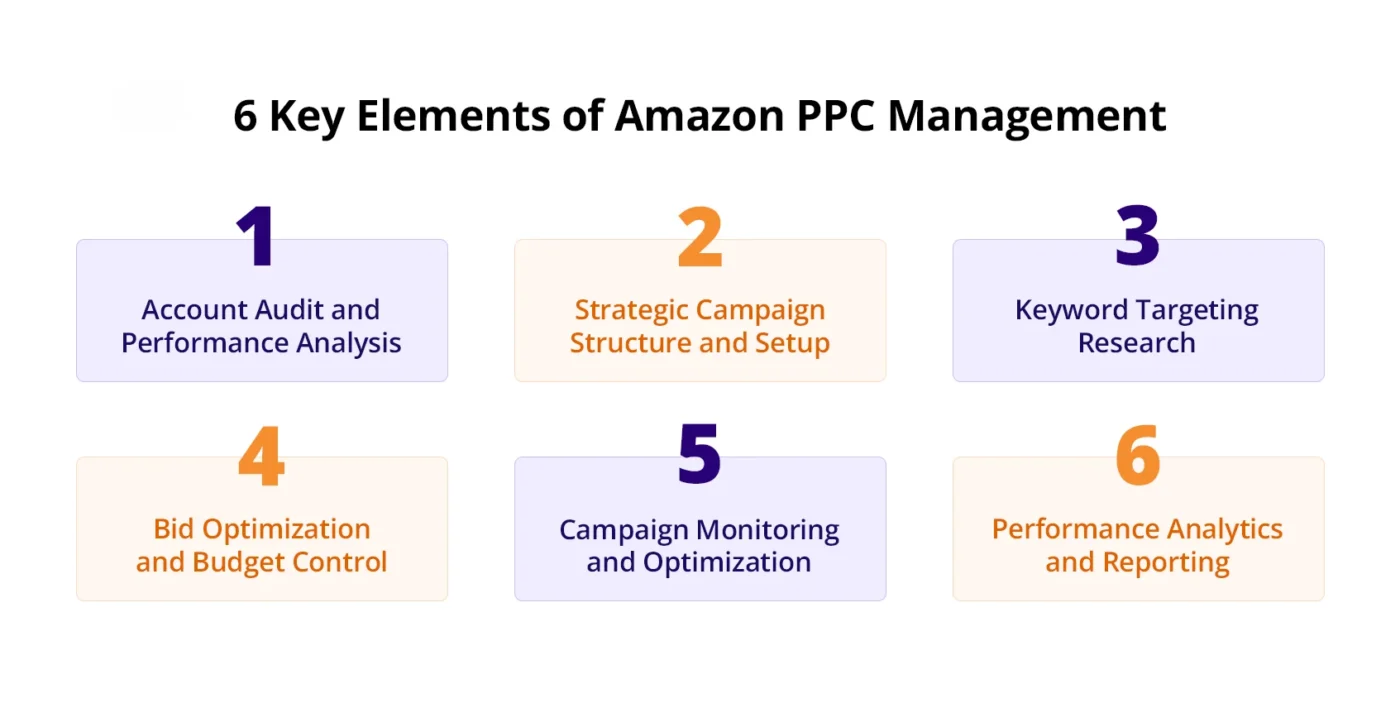
1. Account Audit and Performance Analysis
The process starts with a comprehensive audit of your current campaigns. Experts review campaign structure, keywords, conversion rates, ACoS, ROAS, and budget allocation to identify inefficiencies and wasted spend.
They analyze which campaigns are profitable, which are money-losing, where the budget is concentrated, and where opportunities are being missed. This reveals the true state of your advertising, not what Amazon suggests, but actual performance against your business goals.
This foundation-setting step reveals where strategic changes will have the biggest impact and prevents investing in the wrong areas.
2. Strategic Campaign Structure
Effective campaigns are organized by match type (exact, phrase, broad), product category, keyword intent, or customer journey stage, not left as a jumbled mess of hundreds of unrelated keywords.
With proper structure, keyword performance is clear. You know which campaigns drive conversions, which drain budget, and where to invest for growth. Disorganized campaigns hide performance problems, you might think you’re breaking even when you’re actually losing money on half your campaigns.
Structured campaigns also make ongoing optimization faster and more efficient.
3. Keyword Targeting Research
Professionals conduct detailed keyword research to identify high-intent terms that actually drive conversions for your product. They analyze competitor keywords, search intent, conversion rates, and relative competition.
High-intent keywords target shoppers actively looking to solve the problem your product solves. Low-intent keywords waste budget on browsers with no immediate purchase intent.
They also use negative keywords strategically to filter out irrelevant traffic, preventing wasted spend on searches that will never convert.
4. Bid Optimization and Budget Control
Bids are adjusted based on performance data, competition levels, and placement to maximize returns. A keyword converting at 5% needs a higher bid than one converting at 0.5%. Budget allocation is continuously monitored to prevent overspending on low-performing keywords.
The goal is consistent performance while maintaining profitability. Over-bidding increases traffic but kills margins. Under-bidding reduces visibility. The right bid hits the sweet spot.
This requires ongoing adjustment as market competition changes and your performance data accumulates. Sellers managing this in-house often turn to Amazon PPC automation tools to handle real-time bid adjustments at a scale manual management can’t match.
5. Continuous Campaign Monitoring
Professionals regularly review performance, identify underperforming keywords to pause, test new opportunities, monitor market changes, and respond quickly to shifts in competition or seasonality.
This constant optimization prevents a gradual performance decline. Without monitoring, campaigns slowly degrade as competition increases, customer behavior shifts, or new products enter the market.
Monitoring also catches opportunities if a keyword suddenly has lower competition, and increasing the bid makes sense. If a competitor disappears, you can capture their traffic.
6. Performance Analytics and Reporting
Regular reports track key metrics like ACoS, ROAS, conversion rates, click-through rates, and ad spend. More importantly, experts translate data into clear recommendations and action plans.
Instead of raw dashboards, you get: “Your top 10 keywords are driving 60% of revenue at 18% ACoS. Scale them. Your bottom 20% of keywords cost $5,000/month for 2 conversions. Pause them.”
This clarity makes decision-making straightforward and results measurable.
Timeline: When Do You See Results?
- Weeks 1-2: Account audit, campaign restructuring, initial optimization.
- Weeks 2-4: First performance data from restructured campaigns. Early signs of improvement in keyword targeting and bid efficiency.
- Weeks 4-8: Measurable improvements visible: lower ACoS, better conversion rates, more controlled ad spend.
- Months 2-3+: Significant performance gains as experts identify patterns, scale profitable campaigns, and optimize budgets.
Most sellers see notable improvements within 4-8 weeks. Sustained growth develops over 3+ months as strategies compound.
Is Amazon PPC Management Worth It?
For Established Sellers: Absolutely. If you have significant ad spend, professional management typically returns more than it costs through better ROI and reduced waste.
For Growing Sellers: Yes, if you lack time or PPC expertise. Professional guidance prevents costly mistakes and accelerates scaling.
For New Sellers: Consider it once you have a foundation to optimize. Early-stage sellers benefit more from learning the basics first.
The math is simple: if management costs 10-15% of ad spend but improves ROI by 20-30%, it pays for itself many times over.
Key Differences: Managed vs. Self-Management
| Aspect | Self-Managed | Professional Management |
| Time Required | 10-15+ hours/week | Minimal (expert handles it) |
| Keyword Research | Basic | Comprehensive, data-driven |
| Bid Optimization | Manual, reactive | Continuous, data-based |
| Performance Insights | Limited | Deep analysis + recommendations |
| Scalability | Difficult | Designed for growth |
| Cost of Mistakes | High | Prevented |
What to Look for in a PPC Management Service Provider
Not all PPC management services are equal. When evaluating options, look for:
Account Audit First
Legitimate services start with a detailed audit, not an immediate campaign setup. Running through a proper Amazon PPC audit checklist ensures nothing gets missed during this critical first step, from wasted spend to structural issues.
Transparent Reporting
You should understand exactly what services are being delivered, which campaigns are being managed, and what the monthly work includes. Vague promises about “optimization” mean nothing.
Clear Performance Goals
Discuss specific targets: ACoS reduction, ROAS improvement, or profitability targets. Avoid services that promise vague improvements without specific metrics.
Ongoing Optimization, Not One-Time Setup
PPC management is continuous work. Services that restructure campaigns once, then disappear, aren’t true management. Look for monthly optimization, keyword testing, and bid adjustments.
Communication and Access
You should have access to campaign performance and regular communication about what’s happening. If you can’t see your account, you can’t track progress.
Experience with Your Category
PPC strategy differs by category. Electronics, health products, and consumer goods need different approaches. Services with experience in your space understand category-specific challenges.
Conclusion
Amazon PPC management is time-intensive and requires expertise most sellers lack. Self-managed campaigns rarely achieve optimal profitability, and sellers often waste 30-40% of their budget on inefficient targeting and poor structure.
Here’s the math: management costs 10-15% of ad spend but improves profitability by 20-30%. That’s a clear ROI.
However, PPC doesn’t work in isolation. Strong advertising without optimized listings wastes budget attracting traffic you can’t convert. Strong listings without strategic ads get buried in search results.
AMZDUDES, a full service Amazon agency, brings together Amazon advertising, listing optimization, creative strategy, and customer insights into one unified growth system. This integrated approach prevents the disconnect, better targeting finds the right customers, stronger listings convert them, and coordinated advertising scales profit. Due to our strategic Amazon PPC management, sellers typically see 20-30% ACoS reduction within 2-3 months.
Frequently Asked Questions
Q1: What are Amazon PPC management services?
Professional services that manage your advertising campaigns through strategy, optimization, and monitoring to improve sales and reduce wasted spend.
Q2: How do PPC management services help sellers?
They reduce wasted ad spend, improve keyword targeting, optimize bids, provide data-driven insights, and free up your time to focus on other business areas.
Q3: How long before I see results?
Most sellers see measurable improvements within 4-8 weeks. Significant performance gains typically develop over 2-3 months.
Q4: Is PPC management worth the cost?
If management costs 10-15% of ad spend but improves ROI by 20-30%, it pays for itself. Especially valuable for sellers with large ad budgets.
Q5: Can I manage Amazon PPC myself?
Yes, but it requires 10+ hours per week, expertise in keyword research, bid optimization, and continuous monitoring, areas that professionals specialize in.
Q6: What metrics do management services track?
ACoS, ROAS, conversion rates, click-through rates, ad spend, and conversion trends to measure efficiency and guide optimization.
Q7: How is the budget allocated across campaigns?
Experts allocate budget to high-performing campaigns and keywords while reducing spend on underperformers. Allocation is adjusted based on performance data.
Q8: Do management services work for all product types?
Yes, though strategies differ by category. Services adapt approaches based on competition, seasonality, and product type.
Q9: What’s a typical ACoS improvement from management?
Depends on the starting point. Poorly optimized accounts often see a 20-40% ACoS reduction. Well-optimized accounts might see 10-15% improvement. Focus should be on profitability, not just ACoS reduction.
Q10: How often should campaigns be adjusted?
Daily/weekly for monitoring, adjustments based on data weekly, and strategic reviews monthly. Constant small optimizations prevent the need for big reactive changes.