
Key Takeaways
- High ACoS is rarely a bidding problem. It is almost always a structural problem: the wrong keywords absorbing the wrong budget, mixed intent ad groups, weak listings failing to convert traffic, or campaigns running without a clear architectural logic.
- In our Health and Household Amazon advertising case study, ACoS dropped from approximately 165% to approximately 61%, and monthly revenue nearly tripled, driven by separating keyword intent, removing wasted spend, and improving the listing itself.
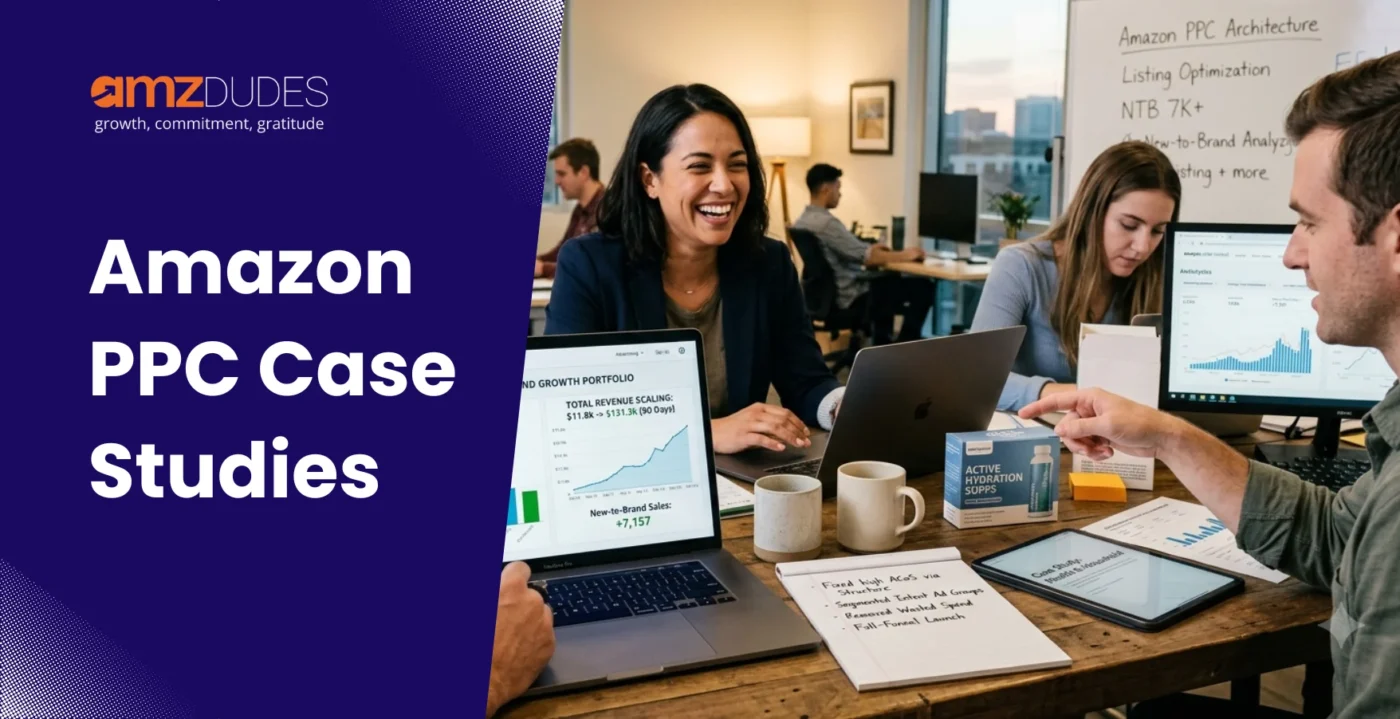
- In our Bath and Body brand Amazon PPC case study, revenue scaled from $11,885 to $131,329 in 90 days after fixing ad compliance issues, rebuilding the catalog, and launching a full-funnel discovery-to-conversion campaign structure.
- In our Sports Nutrition Amazon advertising case study, a brand with zero Amazon presence generated 7,157 New-to-Brand customers, $324K in first-time sales, and 12.29x ROAS in under 10 months by pairing structured PPC with Subscribe and Save strategy and Amazon Marketing Cloud audience targeting.
- Across all three cases, the fix was not simply adjusting bids. It was rebuilding the structural foundation of how campaigns, listings, and customer data worked together.
Most Amazon sellers experiencing high ACoS respond the same way: they lower bids, reduce budgets, or pause campaigns. Sometimes this helps temporarily. More often, it simply reduces visibility without fixing the underlying problem, and sales decline alongside ACoS rather than improving.
The three Amazon PPC case studies in this guide each started from a different situation, but they share the same root cause: the campaigns were built on a foundation that could not support profitable growth regardless of how the bids were set. What changed the outcome in every case was not a bid adjustment. It was a structural rebuild.
Why ACoS Gets High in the First Place
Understanding what actually causes high ACoS is the first step toward fixing it. The most common culprits are structural, not tactical.
Mixed Intent Ad Groups
When broad, exploratory searches and high-intent, purchase-ready searches run together in the same ad group at the same bid, the budget is distributed without discrimination. High-volume, low-converting searches absorb most of the spend because they generate more impressions and clicks, while the specific, high-intent searches that actually convert get minimal exposure. The result is a campaign that looks busy but converts poorly across the whole. Solving this requires more disciplined Amazon PPC keyword research, specifically separating exact-match, purchase-ready terms from broader discovery terms at the ad group level rather than lumping them together.
Wasted Spend on Irrelevant Traffic
Auto campaigns and broad match campaigns inevitably surface irrelevant search terms. If these are not regularly reviewed, negated, and removed, the account accumulates a growing layer of spend that generates clicks without any realistic chance of generating a sale. In mature accounts with no negative keyword discipline, this waste can represent 20 to 40% of total ad spend.
Listing Conversion Rate Problems Disguised as PPC Problems
A campaign sending 1,000 clicks to a listing converting at 5% will generate 50 orders. The same campaign sending those same clicks to a listing converting at 10% generates 100 orders. In the second scenario, every click is twice as valuable, and ACoS is halved, without any change to the campaign itself. When ACoS is high, a weak listing conversion rate is often the root cause, not the bids. Improving this starts with Amazon conversion rate optimization, focused on the specific listing elements, images, copy, and trust signals that determine whether a click becomes a sale.
No Campaign Architecture Designed for Scale
Campaigns built quickly, without clear intent segmentation, match type separation, or budget logic, tend to work acceptably at low spend levels and fall apart as budgets grow. The structural gaps that are manageable at $2,000 per month become expensive at $10,000 per month. Fixing ACoS at scale requires rebuilding the architecture, not just adjusting numbers within a broken structure.
Case Study 1: Health and Household Brand: From 165% ACoS to 61%, With Revenue Tripled
The Situation
A Health and Household brand with a strong product, positive reviews, and consistent baseline sales had been managing PPC entirely in-house. The team was active: bids were adjusted daily, budgets monitored closely, and campaigns were live. Despite this effort, growth had stalled. Any attempt to increase ad spend caused ACoS to spike sharply.
By September, ACoS reached approximately 165%. The brand was spending more on advertising than the ads were returning in revenue.
The Problem
The audit revealed the issue was not the product, the category, or the reviews. It was the campaign architecture.
Campaigns were built around large, catch-all keyword groups where broad, generic searches and high-intent, purchase-ready terms were mixed into the same ad groups at the same bids. This made it structurally impossible to control where the budget was going. High-volume, low-intent searches were absorbing the majority of spend, while the purchase-ready searches that actually drove conversions were receiving minimal exposure.
The ad groups contained up to 40 or more keywords each, which meant Amazon’s algorithm had no way to distinguish which searches deserved aggressive bidding and which needed to be contained or negated. The account also had no consistent negative keyword process, allowing irrelevant search terms to accumulate spend month after month.
The listing itself was also contributing to the problem. Backend search terms were not fully optimized, and the listing copy was not addressing the top buyer objections in the category, which suppressed the conversion rate on every click the campaigns generated.
What We Did
The rebuild started with the foundation, not the bids. Campaigns were restructured around tightly separated keyword intent: exact match campaigns for high-intent, purchase-ready searches with independent budget control, discovery campaigns for broader terms with their own contained budgets, and auto campaigns strictly for search term mining.
Negative keyword management became a weekly discipline. Every Search Term Report was reviewed to identify irrelevant or non-converting searches, which were added as negatives to prevent continued spend. This alone recovered a meaningful portion of the budget previously leaking to searches that had no realistic chance of converting.
The listing itself was improved using real customer review language to address the objections shoppers raised most frequently. Backend search terms were rebuilt from a clean keyword audit. Amazon Subscribe and Save was introduced as a purchase incentive to convert first-time buyers into recurring customers, reducing the ongoing ad spend required to maintain the same revenue base.
The Results
- ACoS improved from approximately 165% to approximately 61%
- Monthly revenue grew from approximately $5,190 to approximately $15,074, nearly tripling
- Close to 89% of ad-attributed orders came from New-to-Brand customers, confirming the advertising was acquiring new buyers rather than cycling through existing demand
- Subscribe and Save subscriptions grew from approximately 30 to approximately 180 active subscriptions
The Lesson
The ACoS problem was not solvable by adjusting bids within the existing structure. The structure itself was the problem. When campaigns cannot distinguish between high-intent and low-intent searches, the budget will always flow to the wrong places, regardless of how the bids are set.
Case Study 2: Bath and Body Brand: From $11,885 to $131,329 in 90 Days
The Situation
Explicit Essentials is a fast-growing Bath and Body brand with strong consumer demand and a personality-driven product range. Amazon was identified as a core growth channel, but the brand’s Amazon presence had not been built to perform as one.
The catalog relied entirely on organic traffic with no structured PPC strategy in place. During the baseline period before onboarding, the account generated one ad-attributed order. New-to-Brand sales were at zero percent, meaning the brand was not reaching any new Amazon shoppers through advertising at all.
The Problem
Three distinct problems were compounding each other.
The first was compliance. The brand’s main listing images contained restricted language that violated Amazon’s advertising policies. This repeatedly caused Sponsored Products and Sponsored Brands campaigns to be disapproved, cutting off paid visibility entirely and making it impossible to run advertising consistently.
The second was the catalog structure. Key ASINs were missing parent-child variation groupings. Individual product variations were scattered across separate listings, which split reviews and sales history, reduced keyword indexing depth, and made it difficult for shoppers to compare options within the same product family.
The third was the complete absence of a PPC architecture. There was no keyword hierarchy, no match type separation, no discovery-to-conversion campaign structure, and no data-backed bidding logic. The brand had no system to acquire new customers through paid search because no such system existed in the account.
What We Did
Before any advertising could run consistently, the compliance problem had to be solved. Main images were redesigned to meet Amazon’s ad eligibility requirements while preserving the brand’s humor and personality. This was the prerequisite for everything else.
With advertising eligibility restored, the catalog was rebuilt. Product variations were consolidated into proper parent-child structures so that reviews, sales history, and keyword relevance were pooled under single listings rather than scattered. Listing copy was rewritten with high-intent category keywords, benefit-driven messaging, and strong visual hierarchies to improve both click-through rate and conversion rate.
A full-funnel PPC architecture was built from scratch. Discovery campaigns targeting broad, category-level searches captured new shoppers who had never interacted with the brand. Conversion campaigns targeting higher-intent, more specific searches focused the budget on the searches most likely to result in a purchase. Ranking campaigns supported organic visibility on priority keywords by combining paid and organic signals. This kind of layered approach is a core part of modern Amazon PPC strategy, where discovery, conversion, and ranking campaigns each serve a distinct role instead of competing for the same budget.
Each campaign type had its own dedicated budget, bid logic, and performance targets, which meant the account could scale into new audience segments without cannibalizing the budget, protecting existing conversions.
Weekly performance reviews refined bidding based on actual conversion signals, expanded keyword coverage into converting search terms discovered through auto campaigns, and negated irrelevant traffic that accumulated as scale increased.
The Results
- Monthly revenue increased from $12,077 at onboarding to $131,711 in December, an approximately 11x increase in 90 days
- Order volume grew from 409 orders to 4,382 orders over the same period
- New-to-Brand customers increased from 373 to 4,018 in December
- New-to-Brand sales grew from $11,100 to $127,200 over the three months
- 96% or more of all customers were New-to-Brand throughout the 90 days, confirming growth was driven by genuine new customer acquisition
- Repeat customers increased from 8 in September to 189 in December, with a peak repeat purchase rate of 10.48%
The Lesson
A great product with genuine demand will not generate meaningful PPC Amazon results if the advertising eligibility, catalog structure, or campaign architecture are broken. All three had to be fixed simultaneously, and in the right sequence, before any advertising investment could produce a return.
Case Study 3: Sports Nutrition Brand: 12x ROAS, 7,157 New-to-Brand Customers, $41K in Repeat Revenue
The Situation
A sports nutrition brand with strong retail and Direct-to-Consumer sales had no Amazon presence. No search visibility, no review history, no established position in competitive sports nutrition searches. The goal was not just to generate initial sales, but to build a system that would compound growth month after month through new customer acquisition and repeat purchase behavior.
The Problem
Starting from zero on Amazon creates a specific set of structural challenges that brands with existing presence do not face.
Competitors were bidding on the brand name, forcing the brand to pay higher customer acquisition costs to appear in searches for its own products. The team was investing in PPC campaigns but had no clear way to track which search terms were driving real buyers versus clicks that did not convert. Large numbers of shoppers were viewing product pages and adding items to cart, but there was no retargeting strategy to bring those high-intent visitors back.
Because the brand was new to Amazon, Subscribe and Save had not been activated, meaning every sale was a one-time transaction with no recurring revenue signal. Amazon’s algorithm uses repeat purchase behavior as a relevance signal for ranking, so the absence of any subscriber base was limiting the brand’s ability to build organic visibility over time.
The product catalog also lacked grouped variations, splitting the small amount of existing reviews and sales history across multiple separate listings rather than concentrating them under consolidated parent ASINs.
What We Did
Before launching any advertising, the catalog was restructured. Listings were rebuilt around how shoppers in the sports nutrition category actually search: energy gels, electrolyte drink mix, endurance carb bundles, sports drink multi-packs, and running nutrition refills. This alignment between listing content and real search behavior is what allows Amazon to correctly classify and index products for the most relevant searches.
Sponsored Products and Sponsored Brands campaigns were launched with a clear intent: reach shoppers searching competitor brands and high-intent category terms where the brand had no existing visibility. Bids were adjusted based on purchase intent signals rather than volume, concentrating spend on the searches most likely to convert rather than the searches generating the most impressions.
Subscribe and Save was activated and promoted through PPC with increased discounts of up to 30% during high-demand periods like Prime Day. The goal was to convert first-time buyers into active subscribers who would reorder on a predictable schedule, creating both a recurring revenue base and a stronger repeat-purchase signal for Amazon’s ranking algorithm.
Amazon Marketing Cloud was used to identify and segment audiences by engagement stage: shoppers who had viewed product pages without purchasing, cart abandoners, wishlist savers, and ad clickers who had not converted. These audiences were re-engaged with targeted ads at controlled frequency, while over-exposed, non-converting audiences had spend reduced to redirect the budget toward shoppers with genuine remaining purchase intent.
The Results
- 7,157 New-to-Brand customers acquired in 10 months
- $324,544 in New-to-Brand sales from first-time buyers
- Amazon PPC generated $48,908.60 in ad-attributed sales from $3,977.93 in spend, a 12.29x ROAS at 8.13% ACoS
- Subscribe and Save subscriptions grew from zero to 107 active subscribers in 7 months, generating 404 repeat orders and $41,029 in recurring revenue
- Repeat purchase rate of 11.7%, with an average reorder interval of 6.2 weeks
The Lesson
Building Amazon from zero requires a different strategy than optimizing an existing account. Acquisition, retention, and repeat-purchase mechanics need to be activated simultaneously from the start rather than in sequence. Subscribe and Save and AMC audience targeting are not advanced tactics to add later. For a consumable category brand, they are part of the foundational strategy.
What These Amazon PPC Case Studies Have in Common
Three different brand stages, three different categories, three different problems. But across all three Amazon advertising case studies, the same structural patterns drove the outcome.
Structure Before Spend
In every case, increasing ad spend before fixing the structural foundation would have produced worse results faster. The Health and Household brand’s ACoS would have climbed higher. Explicit Essentials’ ads would have continued to be disapproved. The sports nutrition brand would have wasted budget on untracked, non-converting searches. The right sequence was always: fix the foundation, then scale.
Listing Quality Is Part of Every PPC Conversation
A campaign cannot convert traffic that the listing cannot close. In the Health and Household case, listing copy and backend keyword improvement were part of the same engagement as campaign restructuring. In the Explicit Essentials case, catalog and image compliance were prerequisites to any advertising at all. In the sports nutrition case, listing alignment with real search behavior was the first step before a single campaign was launched.
Repeat Purchase Mechanics Are a Growth Lever, Not an Afterthought
Two of the three cases featured Subscribe and Save activation as a meaningful driver of revenue improvement. Repeat purchase signals affect Amazon’s ranking algorithm, reduce the ongoing ad spend required to maintain visibility, and create a predictable revenue base that compounds over time. Treating Subscribe and Save as a passive enrollment is a missed opportunity in any consumable category.
Amazon PPC Results Come From Systems, Not Tactics
The outcomes in these cases were not produced by any single tactic: a bid adjustment, a keyword addition, or a campaign pause. They came from rebuilding how campaigns, listings, and customer data worked together as a connected system. That is what makes the results sustainable rather than temporary.
Conclusion
These three Amazon PPC case studies demonstrate a consistent truth: high ACoS and stalled growth on Amazon are structural problems, not bid-management problems. The fix in every case required rebuilding the campaign architecture, addressing the listing conversion rate, and in two of three cases, activating a repeat purchase strategy alongside the advertising work.
AMZDUDES, a full service Amazon agency, connects PPC, listing creative, and customer data into one growth system. If your account has hit a performance ceiling or your ACoS has been climbing despite active management, the path forward starts with understanding what is actually causing it. Our Amazon PPC services are built around exactly the approach demonstrated in these case studies.
Book a free consultation. Call now!
Frequently Asked Questions
What is an Amazon PPC case study?
An Amazon PPC case study documents how a brand’s advertising performance was improved through structured campaign management, listing optimization, and strategic spend allocation. A credible case study shows the starting position, the specific problem identified, the strategy applied, and the verified results, rather than simply reporting a revenue outcome without context.
How long does it take to reduce high ACoS on Amazon?
It depends on how deep the structural problems are. In the Health and Household Amazon advertising case study, meaningful ACoS improvement from approximately 165% to approximately 61% occurred over several months of structural rebuild and listing optimization. Simpler accounts with cleaner existing structures can see initial improvement within 30 to 45 days. Accounts with fundamental architecture problems typically take 60 to 90 days before the structural fixes produce clear, measurable results.
Can Amazon PPC actually lower ACoS while growing revenue?
Yes, and this is exactly what the case studies in this guide demonstrate. The common assumption is that lowering ACoS requires reducing spend, which reduces sales. In reality, if high ACoS is a structural problem, fixing the structure lowers ACoS while simultaneously improving conversion efficiency, which can increase revenue from the same or lower level of spend. All three cases in this guide show both ACoS improvement and revenue growth happening at the same time.
What does a high ACoS actually indicate?
High ACoS most commonly indicates one of three things: wasted spend on irrelevant or low-converting search terms, a listing conversion rate problem that means clicks are not turning into sales at an efficient rate, or a campaign architecture problem where budget is not being concentrated on the highest-intent, highest-converting searches. Adjusting bids addresses none of these root causes directly.
How do these Amazon PPC results compare to industry averages?
Average ACoS across Amazon categories typically falls between 25 and 40%, depending on the category. The cases in this guide achieved ACoS of 8.13%, 16.73%, and approximately 61% (coming from 165%), all within specific categories and competitive contexts. Amazon PPC results vary significantly by category, competition level, listing quality, and how efficiently the campaign architecture separates high-intent from low-intent traffic. These case studies are real results from specific brands, not benchmarks that apply universally.
Does Amazon PPC work for a brand launching on Amazon for the first time?
Yes, as demonstrated in the sports nutrition amazon ppc case study, but the strategy for a new launch differs from the strategy for an existing account. A new brand has no sales history, no review velocity, and no keyword ranking data to build from. The campaign architecture needs to prioritize discovery and New-to-Brand acquisition while simultaneously activating retention mechanics like Subscribe and Save from the start, rather than waiting until organic performance is established.