Key Takeaways
- FBA Fee Increased in 2026: Most sellers will see higher fulfillment costs across multiple product sizes and services.
- Standard-size and Bulky Products are Affected Differently: Small per-unit increases apply to standard-size items, while bulky and extra-large products now follow more precise pricing.
- Additional Fees Raise Total Costs: Inbound placement, aged inventory, and non-FBA service fees can further impact overall profitability.
- Cost control is Still Possible: Optimizing packaging, choosing Amazon-optimized shipment splits, and managing inventory at the FNSKU level can reduce fees.
- Flexibility Protects Margins: Sellers who adapt their pricing, inventory, and fulfillment strategy early are better positioned to stay profitable in 2026.
Amazon has announced that FBA fees will increase in 2026. The e-commerce giant announced the Amazon fulfillment fee increase for 2026 in October 2025 as part of pricing updates. The changes will take effect on January 15, 2026. These updates will impact fulfillment costs, making it essential for sellers to understand what is changing.
This article will walk you through the key changes sellers need to know. The practical strategies are also mentioned that Amazon suggests for sellers to manage the impact of rising fulfillment costs.
Why Amazon Increased Fulfillment Fees in 2026
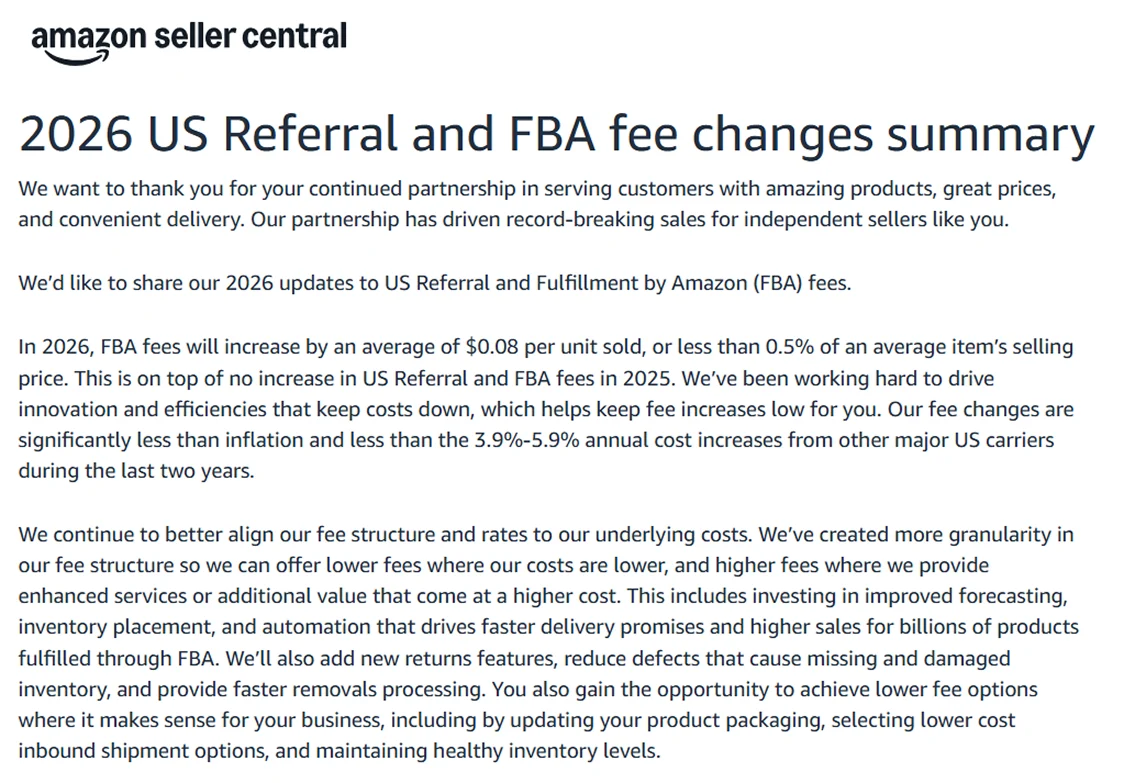
Amazon explains that the 2026 fulfillment fee has increased to better align the fee with operational costs. According to Amazon, investments in automation and faster delivery services have resulted in increased overall fulfillment costs. While the average per unit cost increase is relatively small, these updates reflect Amazon’s focus on service improvements and long term growth of the FBA network.
Breakdown of Amazon Fulfillment Fee Changes in 2026
Here is a detailed overview of how Amazon’s fulfillment fees are changing in 2026.
Standard-Size Product Fee Changes
Amazon fulfillment fee is increased by an average of $0.08 per unit sold, or less than 0.5% of an average item’s selling price. This increase varies by product price and size.
| Product Size | Price Range | Per-Unit Increase / Discount |
| Small Standard-Size | Below $10 | + $0.12 per unit |
| Large Standard-Size | Below $10 | No change |
| All Standard-Size | Below $10 | Effective discount of $0.86 per unit |
| Small Standard-Size | $10 – $50 | + $0.25 per unit |
| Large Standard-Size | $10 – $50 | + $0.05 per unit |
| All Standard-Size | $10 – $50 | + $0.08 per unit (average) |
| All Standard-Size | Above $50 | + $0.31 per unit |
Oversize Product Fee Changes
Amazon has introduced more precise size tiers for bulky and extra-large items. The goal is to better match fees with actual handling and packaging costs. For many bulky products that already ship in their own packaging, fees will decrease, while items that need extra packaging or special handling may face higher charges.
| Product Type | What Changed | Average Fee Impact |
| Small Bulky | New size tier introduced; SIPP discount removed but fees lowered by default | – $2.06 per unit |
| Large Bulky | Split from old bulky tier; updated pricing | – $0.26 per unit |
| Bulky (Non-SIPP eligible) | New packaging fee applied | + $2.07 per unit |
| Large Bulky (Minimal splits) | Inbound placement fee increase | + $0.27 per unit |
| Large Bulky (Amazon-optimized splits) | No inbound placement fee | $0 increase |
| Extra-Large | Fulfillment fees reduced across most tiers | – $2.08 per unit |
| Overmax (Irregular XL) | Fulfillment fees reduced across most tiers | Fee increase |
Additional FBA Fee Changes in 2026
In addition to the standard Amazon FBA fulfillment fees update, Amazon has introduced several other FBA-related fee changes in 2026. These updates primarily affect how inventory is managed and can further affect overall fulfillment costs.
Inbound Placement Service Fees
Amazon is refining inbound placement service fees to better reflect handling and shipping costs across different product sizes and weight ranges.
| Product Type / Scenario | What Changed | Average Cost Impact |
| Standard-Size Products | Inbound placement service fees increased when using minimal splits | + $0.05 per unit |
| Large Standard-Size (3–20 lb) | Introduced 5 new weight-based pricing tiers for more precise handling costs | Fee varies by weight band |
| Misrouted, Late, or Abandoned Shipments | Single inbound defect fee replaces multiple charges | $0.60 per unit |
Aged Inventory and Removal Fees
Aged inventory and removal fees are being adjusted in 2026, with higher monthly charges for long-term storage and a small reduction in removal costs.
| Category | Inventory Age / Condition | Updated Fee |
| Aged Inventory Fee | 12–15 months | $0.30 per unit or $6.90 per cubic foot per month (whichever is higher) |
| Aged Inventory Fee | Over 15 months | $0.35 per unit or $7.90 per cubic foot per month (whichever is higher) |
| Removal & Disposal (Standard-Size) | Under 0.5 lb | – $0.20 per unit |
Non-FBA Amazon Fee Changes
Beyond FBA fee changes, Amazon has implemented several other price increases for services, including:
- Amazon Warehousing & Distribution (AWD): Storage fees in the West region will increase to $0.57 per cubic foot per month, and AWD transportation fees will rise to $1.40 per cubic foot.
- Multi-Channel Fulfillment (MCF): Fulfillment fees will increase by $0.30 per unit on average, primarily impacting 1–2 unit orders.
- Buy with Prime: Fulfillment fees will increase by $0.24 per unit on average, with higher costs for 1–2 unit orders.
How Sellers Can Reduce the Impact of Amazon Fee Increases in 2026
With rising fulfillment costs, Amazon also highlights several ways sellers can reduce fees. These are strategies you can adopt to have better control over costs despite rising fees.
1. Optimize Product Packaging to Lower Fees
Amazon’s fees are heavily influenced by size, weight, and packaging type. Even small reductions in packaging dimensions can move a product into a lower fee category. You should review box sizes and remove unnecessary inserts.
Products shipped in their original manufacturer packaging without additional Amazon packaging qualify for lower FBA fees. If your product packaging is already retail-ready, you can save money here.
2. Choose Lower-Cost Inbound Shipment Options
Amazon charges higher inbound placement fees when sellers choose minimal shipment splits. Instead of choosing minimal shipment splits, you can choose Amazon-optimized shipment splits, as this option charges no additional fees and distributes inventory more efficiently to multiple centers.
3. Maintain Healthy Inventory Levels
With the 2026 changes, Amazon will apply low-inventory-level fees at the FNSKU level instead of the parent ASIN level. This means each variation (size, color, pack) is evaluated separately. By monitoring inventory per FNSKU and improving inventory turnover, you can reduce FBA fees.
Conclusion
As e-commerce evolves, costs continue to shift, and the Amazon fulfillment fee increase in 2026 is a reminder for sellers to stay flexible. Those who will be adaptable will succeed, and it’s only possible by understanding the changes and modifying your strategy as per Amazon’s requirements.
AMZDUDES, as the best Amazon agency, helps brands adapt to these changes with data-driven strategies. Get free consultation for expert guidance to adjust your Amazon strategy for 2026.
Frequently Asked Questions
How much are Amazon fulfillment fees?
Amazon fulfillment fees vary by product size, weight, and category. With recent changes in the FBA fee structure, the fulfillment fee for standard size ranges from $3 to $7 per unit, and for large bulky items it ranges from $8 to $20+ per unit.
How will Amazon’s fee changes impact my brand’s profits?
Amazon’s fee changes can increase your per-unit costs, which may reduce profit margins if you don’t adjust your pricing.
Can sellers reduce the impact of the Amazon Fulfillment Fee Increase 2026?
Yes. Sellers can reduce costs by optimizing packaging, choosing Amazon-optimized shipment splits, and maintaining healthy inventory levels to avoid additional fees.
When do the Amazon fulfillment fee changes take effect?
The updated Amazon fulfillment fee increase for 2026 is scheduled to go into effect on January 15, 2026.
What is changing with Amazon US coupon fees?
Amazon is introducing a cap on variable coupon fees, limiting them to $2,000 per coupon.