
Key Takeaways
- In the US, Amazon no longer preps or labels items for FBA shipments created from January 1, 2026. Every unit must arrive already labeled and packaged to Amazon’s requirements.
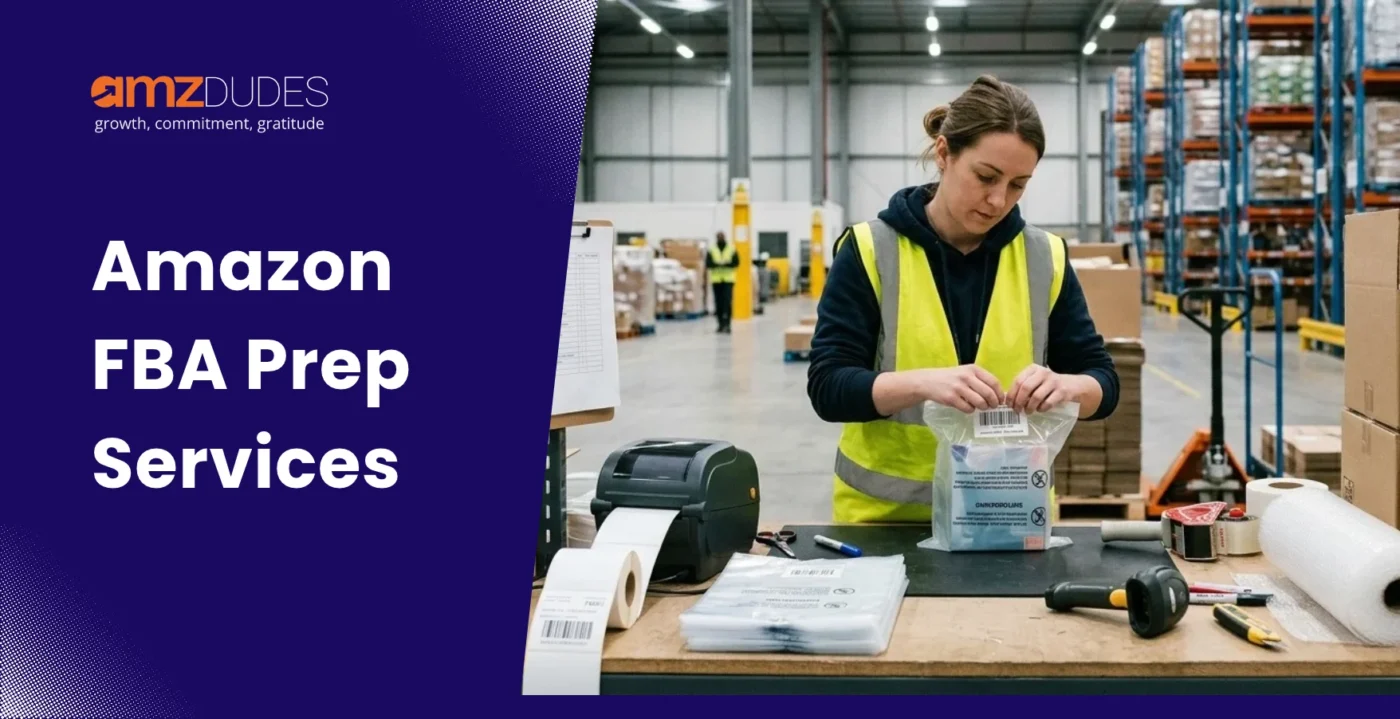
- An FBA prep service handles receiving, inspection, FNSKU labeling, polybagging, protective packaging, bundling, carton and pallet labels, shipment creation, storage, and often returns and FBM orders.
- Most prep centers charge a base per-unit fee, plus add-on fees for extra prep, receiving, storage, and outbound handling. Setup fees and monthly minimums vary.
- Your true cost per unit depends on product type, prep complexity, volume, how well your supplier packages goods, and how long inventory is stored.
- Choose a prep partner based on accuracy, turnaround, peak-season capacity, inventory visibility, liability terms, and clear pricing, not just the lowest per-unit rate.
Every unit you send to Amazon has to arrive ready to sell. That means the right barcode label in the right place, the right packaging for the product type, cartons labeled correctly, and shipments that match what you created in Seller Central. When prep goes wrong, the costs add up quickly: delayed check-in, extra fees, refused shipments, damaged products, and lost sales while inventory sits in receiving.
For years, many sellers relied on Amazon to handle some of this work for a fee. That option has now ended in the US, so sellers must prep inventory themselves, ask suppliers to do it, or use a dedicated prep center.
This guide explains what an Amazon FBA prep service covers, what Amazon requires for different product types, how prep pricing works line by line, what affects your costs, how prep centers compare with in-house and supplier prep, and how to choose a reliable prep partner.
What Is an Amazon FBA Prep Service?
An Amazon FBA prep service is a third-party warehouse or prep center that gets your products ready to ship into Amazon’s fulfillment network. Your supplier ships inventory to the prep center, the prep center inspects, labels, and packages each unit to Amazon’s standards, and then sends compliant shipments to Amazon.
How a Prep Center Fits Into Your FBA Supply Chain
A typical flow looks like this:
- Supplier or manufacturer produces and ships your goods
- Prep center receives, inspects, labels, and packages inventory
- Amazon fulfillment centers or Amazon Warehousing and Distribution (AWD) receive compliant shipments
- Customers receive orders fulfilled by Amazon
Many prep centers also store extra inventory and send smaller shipments to Amazon over time. This helps you stay in stock without overloading your FBA storage.
What Changed in 2026: Amazon No Longer Preps for You
What Amazon Stopped Doing
In the US, Amazon no longer offers prep and item labeling services for FBA shipments created on or after January 1, 2026. Previously, sellers could choose to pay Amazon to apply FNSKU labels, polybag items, add bubble wrap, and complete other prep tasks. Now, inventory must arrive fully prepped and labeled.
This applies across Amazon’s inbound options, including standard FBA shipments and inventory sent through Amazon’s other supply chain services. Sellers who previously relied on Amazon’s prep service must now choose another option.
What Happens If Inventory Arrives Unprepped
If inventory arrives without proper prep or labeling, sellers may face:
- Extra fees for problems found during check-in
- Delays while inventory is held or processed
- Refused or returned shipments in some cases
- Damaged products that may not qualify for reimbursement if prep requirements were not followed
- Account health warnings if problems repeat
Fee amounts and policies can change, so always check Amazon’s current packaging and prep requirements in Seller Central before creating shipments.
Amazon FBA Prep Requirements by Product Type
Amazon’s prep rules depend on what you sell. The table below summarizes common requirements. Always confirm current rules in Seller Central, because requirements can be updated.
| Product Type | Typical Prep Required |
| All units | A scannable FNSKU barcode, unless the product is eligible to use the manufacturer barcode. Other barcodes should be covered |
| Fragile items (glass, ceramics) | Protective packaging, such as bubble wrap or a sturdy box, so the item can survive drops in handling |
| Liquids | Secure, leak-proof caps or seals, and polybags where required. Liquids in glass also need protective packaging |
| Sharp items | Blades and points covered so they cannot cut handlers or packaging |
| Very small items | Placed in polybags so they are not lost |
| Sets and multipacks | Bundled securely so units are not separated, with a clear “sold as set” or “do not separate” label |
| Apparel and textiles | Polybagged or boxed to protect from dust and damage |
| Expiration-dated items | Expiration dates clearly shown on units and cartons in Amazon’s required format, with enough remaining shelf life |
| Polybagged items | Transparent bags of the required thickness, with a suffocation warning on bags with larger openings |
| Hazmat items | Dangerous goods review and documents such as safety data sheets, plus any special packaging and labeling |
Carton and pallet rules also apply, including box content information, shipment labels on each box, and limits on box weight and size.
What an Amazon FBA Prep Service Covers
A full-service Amazon FBA prep service usually includes the following.
Receiving and Inspection
The prep center receives your supplier shipments, counts units, and checks for damage, wrong items, and quantity differences. Good centers report problems quickly with photos, so you can resolve them with your supplier before inventory reaches Amazon.
FNSKU Labeling and Label Removal
Each unit is labeled with the correct FNSKU barcode for your listing. Prep centers also cover or remove old barcodes and supplier stickers so Amazon scans the right label. If you are unsure how FNSKU labels work, our guide on what an FNSKU is on Amazon FBA explains the basics.
Polybagging, Bubble Wrap, and Warning Labels
- Polybagging apparel, small items, and other products that need protection
- Bubble wrapping fragile products
- Adding suffocation warnings and other required labels
Bundling, Kitting, and Multipacks
Prep centers combine multiple items into bundles, gift sets, or multipacks, then label them as one sellable unit. This is useful for creating new offers without changing your manufacturing.
Carton Labels, Case Packs, and Pallet Prep
- Packing units into cartons that meet Amazon’s size and weight limits
- Applying shipment labels to each carton
- Building and labeling pallets for larger shipments
Shipment Creation in Send to Amazon
Many prep centers create shipments in Send to Amazon on your behalf, enter box contents, print labels, and book carriers. You give them the right user permissions in Seller Central rather than your main login.
Storage and Replenishment
Prep centers often store extra inventory and send it to Amazon in smaller batches. This helps you manage FBA capacity, reduce Amazon storage costs, and stay in stock.
Returns, Removals, and FBM Fulfillment
Some prep centers also:
- Process removal orders from Amazon
- Inspect and repackage returned inventory
- Fulfill merchant-fulfilled (FBM) orders as a backup when FBA stock runs low
- Ship to other sales channels
If you want help managing stock levels across Amazon and your prep partner, our Amazon inventory management service covers forecasting and replenishment planning.
How FBA Prep Service Pricing Works
Most prep centers use a combination of fees. Understanding each one helps you compare quotes accurately. The ranges below are approximate and meant only as a general guide. Actual pricing varies by provider, location, and volume.
Base Per-Unit Prep Fees
The base fee usually covers receiving each unit into the prep workflow, a basic inspection, FNSKU labeling, and simple packaging such as a polybag where needed.
- Approximate range: Roughly $0.40 to $1.50 per unit, with lower rates at higher monthly volumes
Add-On Fees
Extra prep is charged on top of the base fee:
- Bubble wrap: roughly $0.50 to $1.50+ per unit
- Bundling and multipacks: roughly $1.00 to $2.50+ per bundle
- Oversize or heavy items: a surcharge, often roughly $0.50 to $2.00+ per unit
- Expiration date or extra warning labels: small per-unit fees
- Sticker removal or relabeling: small per-unit fees
Receiving, Storage, and Outbound Fees
- Receiving: Some centers include receiving, while others charge per carton or per pallet
- Storage: Commonly charged per pallet or per cubic foot each month, often with a free storage period after receiving
- Outbound handling: Carton labeling, box packing, pallet building, and shipment creation may be charged per carton, per pallet, or per shipment
- Freight to Amazon: Usually billed separately or passed through at cost
Setup Fees, Monthly Minimums, and Volume Discounts
- Setup or onboarding fees: Some centers charge a one-time fee, while many waive it
- Monthly minimums: Some centers require a minimum number of units or a minimum monthly spend
- Volume discounts: Per-unit rates often drop as monthly volume increases
Pricing at a Glance
| Fee Type | How It Is Charged | Approximate Range |
| Base prep | Per unit | Roughly $0.40 to $1.50 |
| Bubble wrap | Per unit | Roughly $0.50 to $1.50+ |
| Bundling | Per bundle | Roughly $1.00 to $2.50+ |
| Oversize surcharge | Per unit | Roughly $0.50 to $2.00+ |
| Receiving | Per carton or pallet | Free to a modest fee per pallet |
| Storage | Per pallet or cubic foot per month | Often around $30 to $50 per pallet per month |
| Outbound handling | Per carton, pallet, or shipment | Varies by provider |
| Setup | One time | Often waived, sometimes a one-time fee |
When comparing quotes, ask each provider to price the same sample shipment. This shows your real cost more clearly than comparing headline per-unit rates.
An Example of Your True Cost Per Unit
The figures below are illustrative only, to show how fees combine.
Scenario: A seller sends 2,000 standard-size units per month that need inspection, FNSKU labels, and polybags.
| Cost Item | Calculation | Monthly Cost |
| Base prep | 2,000 units × $0.75 | $1,500 |
| Receiving | 4 pallets × $15 | $60 |
| Storage | 2 pallets × $40 | $80 |
| Outbound carton handling | 80 cartons × $1.50 | $120 |
| Total prep cost | $1,760 | |
| Cost per unit | $1,760 ÷ 2,000 | $0.88 |
In this example, the advertised base rate is $0.75, but the true cost is about $0.88 per unit before freight to Amazon. If the products were fragile and needed bubble wrap, or were sold as bundles, the cost per unit would be noticeably higher.
Always build your true prep cost into your product margins, alongside Amazon fees, advertising, and shipping. Our guide on how to improve inventory turnover and reduce FBA fees explains how to keep overall fulfillment costs under control.
What Affects Your Prep Costs
- Product size and weight: Larger and heavier products take more handling and space
- Prep complexity: Bubble wrap, bundling, and special labels add cost
- Monthly volume: Higher volumes usually earn lower per-unit rates
- Number of SKUs: Many SKUs with small quantities take more time than a few SKUs in large quantities
- Supplier packaging quality: Goods that arrive well packed, labeled, and sorted are faster to process
- Storage time: Inventory held for longer periods increases storage costs
- Location: Prep center location affects inbound and outbound freight costs and, in some cases, sales tax
- Turnaround speed: Rush processing usually costs more
- Error rates: Poor-quality inbound shipments from suppliers lead to extra inspection and relabeling
The easiest way to lower prep costs is to work with your supplier to improve packaging, labeling, and carton consistency before goods reach the prep center.
In-House Prep vs Supplier Prep vs Prep Center
| Option | Strengths | Limitations | Best Fit |
| In-house prep | Full control, no per-unit service fees | Needs space, staff, supplies, and training; hard to scale | Small sellers with low volume and simple products |
| Supplier prep | Products arrive ready for Amazon, fewer handoffs | Quality varies, errors are harder to catch before shipping to Amazon | Experienced suppliers with proven accuracy |
| Prep center | Specialist accuracy, inspection before Amazon, storage, flexible capacity | Per-unit and storage fees, an extra step in the supply chain | Growing brands, multiple suppliers, complex prep, or fragile products |
Many brands use a combination. For example, a supplier may apply FNSKU labels while a prep center inspects, stores, and sends replenishment shipments to Amazon.
How to Choose an Amazon FBA Prep Service
What to Look For
- Accuracy: A clear process for checking labels, counts, and packaging, with a low error rate
- Turnaround time: How quickly inventory is received, prepped, and shipped
- Peak-season capacity: Whether the center can handle higher volumes before Prime Day and Q4
- Software and inventory visibility: An online portal or regular reports showing stock levels, shipments, and issues
- Location: Distance from your suppliers and Amazon fulfillment centers, and any sales tax considerations
- Insurance: Coverage for inventory stored and handled at the facility
- Category experience: Experience with your product type, such as fragile, expiration-dated, or hazmat items
Questions to Ask Before You Sign
- What exactly is included in your base per-unit fee?
- What add-on fees apply to my products?
- How do you charge for receiving, storage, and outbound handling?
- Are there setup fees or monthly minimums?
- What is your standard turnaround time, and how does it change at peak season?
- How do you report damaged, missing, or incorrect inventory?
- Who pays if your team makes a labeling or packaging error?
- Do you create shipments in Send to Amazon on my behalf?
- Can you handle FBM orders or removals if needed?
- Can I see a sample invoice for a shipment similar to mine?
Contract Terms to Check
- Minimum commitments: Monthly volume or spend requirements
- Liability: Who is responsible for errors that cause Amazon fees or refused shipments
- Damage and loss policy: How claims are handled for inventory damaged or lost at the facility
- Storage limits: Free storage periods and long-term storage charges
- Access: Use of Seller Central user permissions, not your main login
- Exit terms: Notice periods and how inventory is returned or transferred if you leave
Red Flags to Avoid
- Very low headline prices with many hidden fees
- No inspection or reporting of inbound problems
- Unclear liability for prep errors
- Poor communication or slow responses during your trial shipment
- No capacity plan for peak season
- Requests for your main Seller Central login
Start with a small test shipment before moving all your inventory. Check accuracy, speed, communication, and the final invoice before committing.
How Prep Centers Help With FBA Capacity Limits
Amazon limits how much inventory sellers can store in FBA. Prep centers help by acting as a buffer between your supplier and Amazon:
- Store bulk inventory outside FBA so you do not exceed your capacity limits
- Send smaller, more frequent shipments based on sales velocity
- Prioritize best sellers when FBA space is tight
- Keep FBM as a backup if FBA inventory runs short
You can also combine a prep center with Amazon Warehousing and Distribution, Amazon’s own upstream storage service. Our guide to Amazon Warehousing and Distribution explains how AWD works, and our article on Amazon FBA inventory management best practices covers how to plan stock levels across your supply chain. For a wider look at fulfillment options, see our comparison of Amazon FBA vs FBM.
Conclusion
Prep is no longer optional for US FBA sellers. With Amazon no longer offering prep and labeling for new shipments, every unit must arrive labeled and packaged to Amazon’s standards. An Amazon FBA prep service handles that work for you, from receiving and inspection to labeling, protective packaging, bundling, carton labels, shipment creation, and storage.
Pricing usually combines a base per-unit fee with add-ons, receiving, storage, and outbound fees, so compare providers by your true cost per unit, not the headline rate. Choose a partner with strong accuracy, reliable turnaround, peak-season capacity, clear reporting, and fair liability terms, and start with a test shipment before moving all your inventory.
Simplify your Amazon FBA operations with AMZDUDES, a full-service Amazon agency can help. From Amazon FBA Prep Services and inventory planning to replenishment management, we help brands keep their operations organized, efficient, and ready to scale. Explore our case studies to see how we support brands throughout their Amazon journey.
📅 Book A Free Consultation Now!
Frequently Asked Questions
What does an Amazon FBA prep service do?
An Amazon FBA prep service receives your inventory from suppliers, inspects it, applies FNSKU labels, adds polybags, bubble wrap, or bundles where needed, packs and labels cartons, and sends compliant shipments to Amazon. Many prep centers also store inventory, create shipments in Send to Amazon, process returns, and fulfill FBM orders.
How much does an Amazon FBA prep service cost per unit?
As a rough guide, base prep often costs about $0.40 to $1.50 per unit, depending on volume and product type. Add-ons such as bubble wrap, bundling, and oversize handling cost extra, and receiving, storage, and outbound fees also apply. Your true cost per unit is usually higher than the advertised base rate.
Does Amazon still offer FBA prep and labeling services?
In the US, Amazon no longer offers prep and item labeling services for FBA shipments created on or after January 1, 2026. Inventory must arrive fully prepped and labeled. Sellers can prep products themselves, ask suppliers to prep them, or use a third-party prep center. Check Seller Central for current requirements in other marketplaces.
What happens if my FBA shipment is not prepped correctly?
Shipments that do not meet Amazon’s prep and labeling requirements can face extra fees, check-in delays, refusal or return, and loss of reimbursement for damage linked to poor packaging. Repeated problems can also affect account health. Following Amazon’s prep rules and using test shipments helps avoid these issues.
Can my supplier prep products instead of a prep center?
Yes. Many suppliers can apply FNSKU labels, polybags, and carton labels before shipping. This works well when your supplier is experienced and accurate. However, errors are harder to catch before inventory reaches Amazon, so many brands still use a prep center for inspection, storage, and quality control.
Do prep centers create shipments in Seller Central?
Many do. A prep center can create shipments in Send to Amazon, enter box contents, print carton labels, and arrange carriers using user permissions you provide. Always add the prep center as a user with limited permissions rather than sharing your main login, and remove access if the relationship ends.
Can AMZDUDES help with Amazon FBA prep?
Yes. AMZDUDES helps sellers manage Amazon FBA prep, including labeling, packaging, bundling, shipment creation, and replenishment planning. We connect prep with inventory planning and FBA capacity, so your products arrive compliant, stay in stock, and avoid unnecessary fees and delays.