Key Takeaways
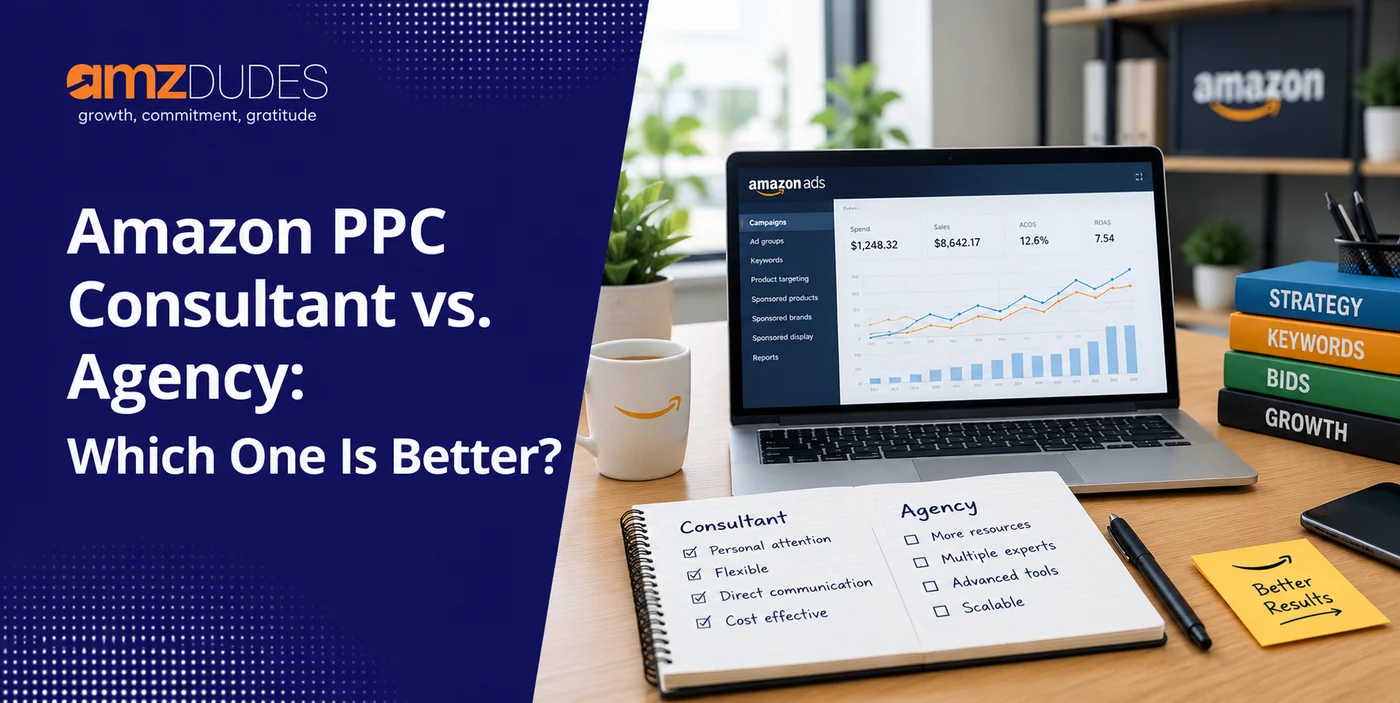
- A consultant gives you strategy and advice; an agency gives you strategy plus the team to execute it. That single difference drives everything else.
- A consultant usually costs less but relies on your team to do the work. An agency costs more but removes the execution burden entirely.
- At high spend, execution capacity, reporting, and access to DSP and AMC usually tip the decision toward an agency.
- A consultant is still the better fit when you already have a strong in-house team and only need direction or an audit.
- The right choice shifts with your ad spend, and at most spend levels a hybrid approach beats committing to one model forever.
Amazon PPC consultant vs agency comes down to execution.
A consultant audits your account and hands you a strategy to run, while an agency runs the whole thing for you. Consultants suit brands with a capable in-house team that needs direction, and agencies suit brands that want the work and the strategy handled together.
This guide compares both across the factors that actually matter at high spend.
You have already decided you need outside help with your advertising. So, now you face a fork that trips up a lot of sellers: a consultant or a full-service agency? Pick the wrong one and you either pay for execution you did not need or get advice with no one to act on it.
The stakes rise with your spend.
According to Amazon’s Q2 2026 earnings (2026), its advertising revenue grew 26%, nearly double the 15% growth of its online store, a sign of how hard brands now compete for the same placements. When you are spending at scale, choosing the right kind of partner is not a small decision, so let us break down exactly what separates the two.
What Is an Amazon PPC Consultant?
An Amazon PPC consultant is a strategic advisor. They audit your account, diagnose what is holding it back, build a plan, and guide your team on how to execute it, usually on a project or retainer basis rather than running every campaign themselves.
A typical consultant engagement starts with a deep audit of your campaign structure, search terms, and wasted spend, followed by a strategy document and a set of recommendations. Some stay on in an advisory capacity, reviewing performance monthly and adjusting the plan, but the hands stay on your side of the table.
Think of a consultant as the architect, not the builder. You, or your in-house team, still do the day-to-day work, which makes a consultant a strong fit when you have people who can execute but lack the strategic clarity to know what to execute.
What Is an Amazon PPC Agency?
An Amazon PPC agency runs your advertising for you, strategy and execution together, as an ongoing service. A team manages your campaigns day to day, optimises bids and keywords, builds structure, reports on performance, and usually offers more than just ads.
A typical agency engagement is a monthly relationship. You get a dedicated manager or pod, a reporting cadence, and continuous optimisation, often alongside listing, creative, and account-health support so the whole funnel works together. The point is that you stop touching the campaigns yourself.
The big advantage is that you hand over the whole channel. As one industry explainer puts it, hiring an agency gets you a team, often for the cost of a single employee. A good Amazon PPC agency also connects your ads to your listings, inventory, and profitability rather than managing campaigns in isolation, which matters more the more you spend.
If you are weighing the broader move, our overview of outsourcing your Amazon PPC explains what good outsourcing looks like.
Amazon PPC Consultant vs Agency: Side-by-Side Comparison
Here is how the two stack up across the six factors that decide most high-spend engagements.
| Factor | Consultant | Agency |
| Cost | Lower fee, but you pay your team to execute | Higher fee, execution included |
| Strategic advice | Their core product; deep, focused | Built into ongoing management |
| Execution capacity | You or your team do the work | A dedicated team does it all |
| Team expertise | One senior expert | A team across PPC, DSP, creative |
| Reporting | Audit plus periodic reviews | Continuous dashboards and cadence |
| Scalability | Scales your thinking, not your hands | Scales execution as you grow |
Cost
A consultant usually costs less upfront, charging for an audit, a project, or a retainer, but that fee does not include execution. You still pay your own team to do the work. An agency charges more, typically a monthly retainer or a percentage of ad spend, but that fee covers the execution too.
Put the numbers in context.
According to NovaData (2026), PPC-only management typically starts at 1,000 to 2,000 dollars per month, while a consultant’s audit or advisory project may be a one-time or lighter cost. The cheaper line item is not always the cheaper outcome, though, because a consultant’s fee sits on top of your internal execution cost.
To understand what sits inside an agency fee, our breakdown of what you are actually paying for with Amazon PPC services is worth a read.
Strategic Advice
Both can give you strategy, but it shows up differently.
A consultant’s entire product is strategic clarity: a clean diagnosis and a plan you can act on.
An agency bakes strategy into ongoing management, adjusting direction as your data and goals shift.
If your single biggest gap is “we do not know what to do,” a consultant delivers that clarity fast and often at a lower cost than a full retainer.
If you want strategy that keeps evolving without you managing it, an agency carries it forward week after week, which suits brands whose situation changes quickly.
Execution Capacity
This is the dividing line.
A consultant advises; your team executes. If you do not have a capable in-house team, that advice can sit unused, which is the most common way a consultant engagement disappoints.
An agency brings its own execution capacity, so nothing depends on your internal bandwidth. At high spend, where there is simply more work to do across more campaigns and more placements, that capacity is often the deciding factor between steady optimisation and a plan that slowly goes stale.
Team Expertise
A consultant gives you the depth of one experienced person, which can be excellent but is narrow. An agency gives you a team with specialists across Sponsored ads, Amazon DSP, creative, and data, so you are not relying on a single individual’s range or availability.
The gap widens at scale, and according to SmartScout (2026), the average Amazon PPC specialist salary exceeds 120,000 dollars a year, so an agency often gives you several specialists for less than the cost of one senior in-house hire.
It also removes single-person risk: if your one expert is on holiday or leaves, an agency’s bench keeps the account moving.
Reporting
A consultant typically delivers an audit and periodic reviews, which is enough when the work is diagnostic.
An agency provides continuous reporting on a regular cadence, so you always know how spend is performing between strategy sessions.
At high spend, continuous reporting is not a nice-to-have. You need to track TACoS and true profitability constantly, because a week of drift at a large budget is expensive to miss.
The deeper the account, the more that ongoing visibility is worth.
Scalability
A consultant scales your thinking but not your hands, and as you grow, the bottleneck becomes your own team’s capacity to execute the plan.
An agency scales execution with you, adding campaigns, channels like DSP and Amazon Marketing Cloud, and new marketplaces as needed.
For a brand that is actively growing, scalability usually favours the agency, since the plan is only as good as the capacity to keep executing it well. A brilliant strategy your team cannot keep up with is not much of an advantage.
How the Right Choice Changes by Ad Spend
The consultant-or-agency answer shifts as your budget grows. Here is a rough guide by monthly ad spend, which you can adjust to your own margins.
Under 10,000 a month: At this level, full agency fees can eat too much of a small budget. A one-time consultant audit to fix structure, followed by self-management, is often the most cost-effective route. You get expert direction without an ongoing retainer.
10,000 to 50,000 a month: This is the grey zone where the decision depends entirely on your team. If you have people who can execute, a consultant gives you direction for less. If you do not, an agency removes the burden and usually earns its fee back through reduced waste. Wasted spend is now large enough to matter.
50,000 a month and above: At high spend, the case for an agency strengthens, because execution capacity, continuous reporting, and advanced tools like DSP and AMC all scale in value with your budget. A consultant still fits if you have a strong in-house team, but most brands at this level want the work handled. Brands advertising like 7 and 8-figure sellers tend to need the depth a team provides.
The thresholds are not rules, just signposts. Your margins, catalogue size, and growth speed can move the line in either direction.
Where a Freelancer Fits
A freelancer sits close to a consultant but leans toward execution.
Freelancers usually run specific tasks, like managing a set of campaigns, rather than owning the whole strategy, and they tend to cost less than both a consultant and an agency.
The trade-off is depth and reliability because a freelancer gives you one person’s time and skill, with less of the team backup and process an agency provides. It is less of the strategic framework a dedicated consultant brings.
Which Is Better for High-Spend Sellers?
There is no universal winner, but at high spend the balance tips in clear directions depending on your setup.
An agency is usually the better fit when you want the channel handled, you do not have a strong in-house team, you need DSP and AMC, or you are scaling across marketplaces. The execution capacity, team depth, and continuous reporting all matter more as your budget grows, which is why brands that want to scale with advanced PPC often choose full-service management.
A consultant is the better fit when you already have a capable execution team and your real gap is direction, or when you want an audit-led rebuild before committing to anything larger. In that case, paying for full agency execution would mean paying for capacity you already have. If you are still deciding whether to bring in outside help at all, our guide on whether to hire an Amazon PPC agency lays out the framework.
A hybrid often beats both. Many high-spend brands keep execution in-house and bring in strategic consulting periodically, or start with a consultant’s audit and move to an agency once the scope is clear. You do not have to pick one model forever, and the smartest brands revisit the choice as they grow.
Common Mistakes When Choosing Between the Two
Most bad outcomes trace back to a handful of avoidable errors. So, watch for these before you sign anything.
Hiring an agency when you only needed direction: If you have a capable team and a clear gap in strategy, paying a full retainer means paying for execution you already own. A consultant would have cost less and solved the real problem.
Hiring a consultant when no one can execute: The opposite mistake is just as costly. A brilliant strategy document sitting unused because your team has no time or skill to act on it is money wasted. Be honest about your internal capacity before choosing the advisory route.
Choosing on price alone: The cheapest fee is rarely the cheapest outcome once you factor in your own time, the ramp period, and the cost of waste left uncut. Skipping category-specific proof: A partner who has only worked in unrelated categories is a bigger risk than their pitch suggests. You should ask for results in brands like yours, and treat vague answers as a warning sign.
What to Look for in Either One
Whichever model you choose, the markers of a strong partner are the same.
Look for proof in your category, full transparency and account access, and a profit-first approach that tracks total profitability rather than a flattering ACoS number.
The best partners also connect your ads to your listings and inventory instead of managing campaigns in isolation, and they explain their strategy in plain terms rather than hiding behind “it depends.”
Before you sign, run through our list of questions to ask before hiring an Amazon PPC agency.
Choose a Consultant If, Choose an Agency If
Use this as a quick gut check.
Choose a consultant if:
- You have a capable in-house team that can execute a plan.
- Your main gap is strategy, direction, or a one-time rebuild.
- You want an audit before committing to ongoing spend.
- You want to upskill your team rather than replace it.
Choose an agency if:
- You want advertising handled end to end, hands-off.
- You lack the internal team or time to execute at scale.
- You need DSP, AMC, or multi-marketplace expertise.
- You want continuous optimisation and reporting as you grow.
Conclusion
The Amazon PPC consultant vs agency decision is really a question about execution.
If you have a capable team and need direction, a consultant gives you clarity for less. If you want the channel handled end to end, especially at high spend where capacity and tools like DSP and AMC matter most, an agency carries both the strategy and the work. For many brands, a hybrid of the two, matched to their current spend and team, is the most profitable answer of all.
If you want help deciding which model fits your account, book a call with our Amazon consulting agency and we will walk you through the right path for your spend and your team.
Book Your Free Call Today. See Brand Cases
Frequently Asked Questions (FAQs)
What is the main difference between an Amazon PPC consultant and an agency?
A consultant advises and builds strategy while your team executes, usually on a project or retainer basis. An agency runs both strategy and execution for you as an ongoing service. In short, a consultant tells you what to do, and an agency does it. AMZDUDES offers both consulting and full management, so brands can choose based on their stage.
Which is cheaper, an Amazon PPC consultant or an agency?
A consultant usually has a lower fee, since it does not include execution, but you still pay your own team to do the work. An agency costs more because that fee covers the whole channel. The cheaper option on paper is not always cheaper overall, which is why AMZDUDES models the full cost, including your internal time, before recommending a path.
Which is better for high-spend sellers?
It depends on your team. At high spend, an agency usually wins when you need execution capacity, DSP and AMC, and continuous reporting. A consultant wins when you already have an execution team and only need strategic direction. Many high-spend brands, including AMZDUDES clients, use a hybrid of the two.
Can I use both a consultant and an agency?
Yes, and many brands do. A common approach is to keep execution in-house, guided by a consultant, or to start with a consultant’s audit and move into agency management once the plan is clear. A hybrid lets you match the model to each stage of growth rather than committing to one forever.
Is an Amazon PPC freelancer the same as a consultant?
Not quite. A freelancer usually executes specific tasks, like managing a set of campaigns, while a consultant focuses on strategy and diagnosis. Freelancers tend to cost less but offer less team backup and process than an agency. The right choice depends on whether you need hands to execute or a brain to set direction.
Do consultants and agencies both handle DSP and Amazon Marketing Cloud?
A strong consultant can advise on DSP and AMC, but an agency is usually better placed to run them, since both reward scale, dedicated expertise, and ongoing management. If these advanced tools are central to your growth, full-service management is often the more practical route. AMZDUDES runs Sponsored ads, DSP, and AMC for brands advertising at this level.
How do I know if I have outgrown managing PPC myself?
The clearest signs are wasted spend that now adds up to real money, campaigns too complex to manage by hand, and PPC eating time you should spend elsewhere. If two or three of those feel familiar, it is time to bring in a consultant or agency. AMZDUDES often starts brands with an audit so the decision is based on data, not guesswork.
How long before I see results from either option?
Expect early improvements within the first few weeks, especially if the account was poorly structured, with durable gains over two to three months as bids and data stabilise. Neither a consultant nor an agency can deliver real results overnight, and any partner promising that is a red flag worth walking away from.