
Key Takeaways
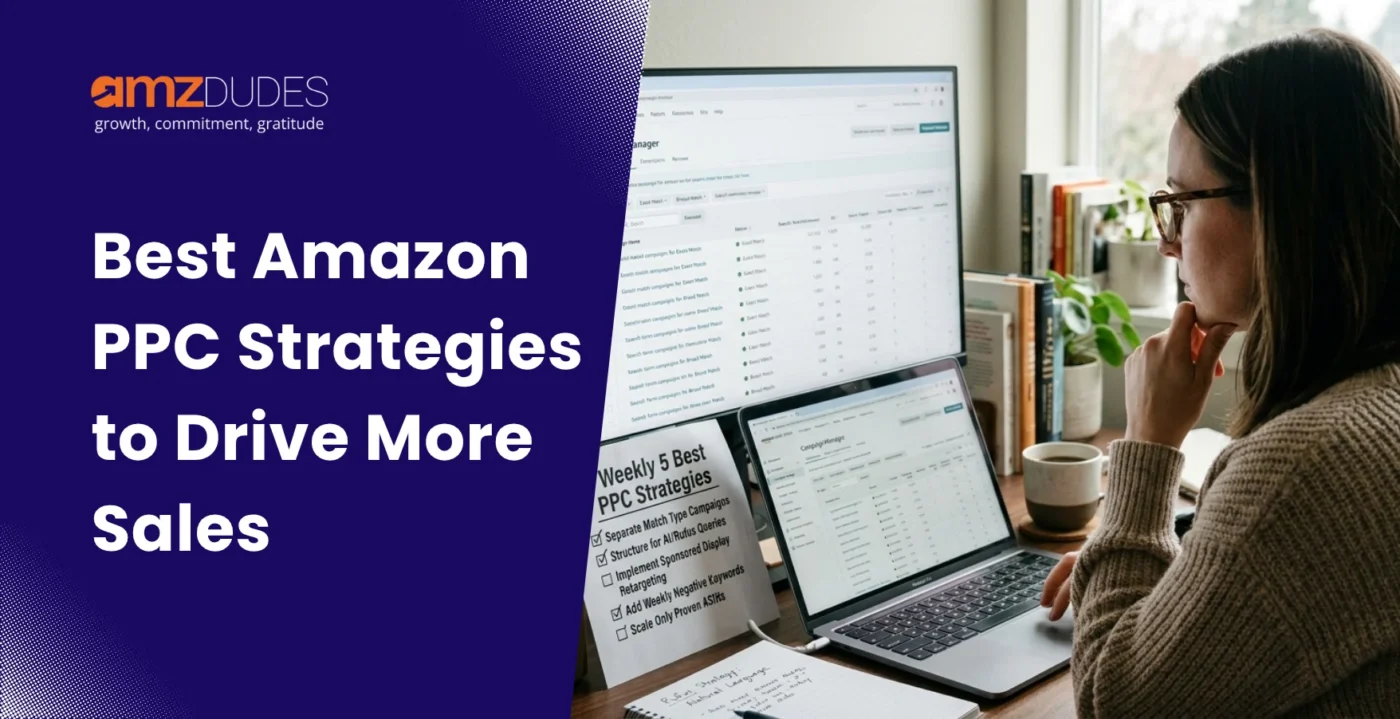
- Driving more sales through Amazon PPC is not primarily about spending more. It is about improving reach, relevance, and conversion so that each dollar of ad spend produces more revenue than it did before.
- Campaign structure is the single most impactful lever. Separating match types into their own campaigns unlocks intent-based bidding and prevents budget from flowing to low-converting broad terms.
- Amazon’s Rufus AI is reshaping how shoppers discover products in 2026. Listings and campaigns structured for natural language questions and comparative queries have measurable visibility advantages.
- Sponsored Display retargeting captures shoppers who already viewed your product, converting warm audiences at a meaningfully lower cost than cold acquisition through Sponsored Products alone.
- Weekly Search Term Report review, disciplined negative keyword additions, and scaling only proven campaigns are the three habits that compound into meaningful long-term sales growth.
Amazon PPC is the fastest way to drive more sales on the platform in 2026, but only when it is executed with discipline. Rising CPCs, AI-driven product discovery through Rufus, and increasing competition in almost every category have made unstructured advertising significantly less effective than it was even 24 months ago. The sellers pulling ahead are not the ones spending the most. They are the ones executing the fundamentals correctly and layering advanced tactics on top.
This guide covers 15 proven Amazon PPC strategies to drive more sales, organized in the sequence a professional account manager applies them: foundation first, then targeting, then bidding, then full-funnel expansion, then optimization at scale. Follow this order, and you build an Amazon PPC strategy that compounds. Skip the foundation, and no advanced tactic will produce lasting sales growth.
What Drives Sales in Amazon PPC (Beyond Just Spending More)
The Three Levers of PPC Sales Growth: Reach, Relevance, and Conversion
Every sale generated through Amazon PPC depends on three connected variables. Reach is how many potential buyers see your ad. Relevance is whether the shoppers seeing your ad are actually in your target market. Conversion is what percentage of the traffic your ad delivers actually buys the product.
Increasing sales does not require increasing all three simultaneously. A well-executed ACoS Amazon PPC strategy typically improves one at a time based on where the current bottleneck sits. A product with a strong conversion rate but weak reach benefits most from broader keyword targeting. A product with strong reach but weak relevance needs better negative keyword discipline. A product with strong traffic but weak conversion needs listing improvements before more advertising spend can help.
Understanding which of the three levers is the current bottleneck determines which of the strategies in this guide will produce the biggest sales lift.
Why More Spend Without Structure Produces Diminishing Returns
The most common mistake in Amazon PPC campaign strategy is treating budget as the primary lever. Adding budget to a well-structured campaign produces more sales meaningfully. Adding budget to a poorly structured campaign produces more waste with only marginal sales gain. Amazon’s algorithm will always find a way to spend more money, but the incremental sales that spend produces depend entirely on whether the underlying campaign architecture can absorb the increase efficiently.
This is why the strategies in this guide focus on structural improvements before scaling investment. A $1,000 budget applied to a well-optimized campaign structure often produces more sales than a $3,000 budget applied to an unoptimized one.
The Compounding Relationship Between PPC, Organic Ranking, and Sales Velocity
The most valuable long-term output of Amazon PPC is not the direct sales from paid clicks. It is the compounding effect PPC has on organic ranking. Every sale generated through Sponsored Products contributes to your product’s sales velocity in Amazon’s ranking algorithm. Amazon does not distinguish between paid and organic sales when calculating BSR or keyword ranking.
This means a well-run Amazon PPC ad strategy that generates paid sales on your priority keywords will improve your organic ranking on those same keywords over time. As organic sales grow, TACoS declines even if ACoS stays constant. The compounding produces sustainable sales growth rather than sales that disappear the moment you pause the ads.
Foundation Strategies to Set Up Sales Growth
Strategy 1: Start With a Sales-Ready Listing
Advertising drives traffic. Listings convert traffic. A Sponsored Products campaign driving qualified clicks to a listing with a weak main image, thin reviews, or vague bullets will produce below-average sales regardless of how well the campaign is structured.
Before increasing any ad budget, audit your listing against a specific checklist:
- Main image is stronger and clearer than your top three category competitors
- At least 15 to 20 reviews with a rating above 4.0
- Title includes primary keyword in the first 80 characters and reads naturally
- Bullets address the top three purchase objections in your category
- Amazon A+ Content is published and benefit-focused
- Backend search terms use all available character space with genuine keywords
- Price is within a 10 to 15 percent band of top category competitors
If any element needs attention, address the listing before scaling advertising. The best Amazon PPC optimization strategy cannot compensate for a listing that fails to convert the traffic it generates.
Strategy 2: Structure Campaigns by Intent and Match Type
The foundation of a strong Amazon PPC strategy is separating match types into their own campaigns rather than mixing them. Exact, phrase, broad, and auto targeting each serve different purposes and deserve different budgets. When they share the same campaign, budget flows to whichever keyword receives the most clicks (not necessarily the most conversions), which prevents intent-based budget control.
Beyond match type separation, the strongest structures use an intent-based tier system:
- Awareness tier: Broad match and auto campaigns targeting category-level keywords. Small budget, discovery focus.
- Consideration tier: Phrase match campaigns targeting specific use-case queries. Medium budget, testing focus.
- Conversion tier: Exact match campaigns targeting proven-converting keywords. Largest budget, scale focus.
This structure ensures that the searches most likely to convert receive the most budget and most competitive bids, while lower-intent traffic is still captured at controlled cost.
Strategy 3: Set Clear Sales-Focused Campaign Objectives
Every campaign should have a single, specific objective before it launches. Trying to accomplish awareness, conversion, and ranking simultaneously in the same campaign produces average results on every metric and excellent results on none.
For new product launches focused on generating early sales velocity, prioritize aggressive bidding on high-intent keywords through exact match campaigns. For mature products focused on profitability, prioritize tighter keyword control and lower ACoS targets. For brand-building campaigns capturing top-of-funnel awareness, prioritize Sponsored Brands and Sponsored Display placements that would look inefficient by pure ACoS metrics but build downstream sales velocity.
The objective determines everything downstream: which ad types to use, which match types to prioritize, how to structure budgets, and how to evaluate success. Setting it explicitly prevents the most common mistake in advanced Amazon PPC strategies, which is measuring the wrong outcomes.
Targeting Strategies That Reach More Buyers
Strategy 4: Deep Keyword Research and Expansion
Most Amazon accounts target a fraction of the keywords their products could reasonably rank for, which is why Amazon PPC keyword research is one of the highest-leverage ways to expand reach without increasing conversion rate. Expanding your targeted keyword set is one of the highest-leverage ways to drive more sales without any change to conversion rate.
Use Amazon Brand Analytics Search Query Performance (available to Brand Registry sellers) to identify high-volume keywords in your category. Cross-reference against reverse ASIN lookups on your top competitors to identify keywords they rank for that your listing does not target. Long-tail keywords with specific use-case qualifiers, brand-plus-category combinations, and problem-solution queries typically produce higher conversion rates than generic category terms because they signal shoppers closer to a purchase decision.
Add validated new keywords to dedicated exact match campaigns where you can bid on them deliberately with appropriate budgets. This is the systematic expansion process by which a well-managed account continuously grows its addressable market on Amazon.
Strategy 5: Harvest Winning Search Terms Into Manual Campaigns
Auto campaigns are your keyword research engine. Their job is not to be your profit engine. Their job is to surface search terms Amazon’s algorithm matches your products to that you would not have targeted manually.
Every week, review your Search Term Report for search terms in your auto or broad campaigns that generated conversions. These are validated buyer queries. Promote them into dedicated exact match campaigns where you control the bid and budget allocation. Simultaneously, add irrelevant search terms as negatives to prevent budget from continuing to flow into non-converting traffic.
This harvest-to-scale cycle is one of the most reliable ways to grow sales month over month without requiring larger budgets. You are simply moving budget from lower-intent discovery to higher-intent conversion as the data validates which keywords deserve the promotion.
Strategy 6: Use ASIN Targeting to Capture Competitor Traffic
ASIN targeting places your Sponsored Products or Sponsored Display ads directly on competitor product pages. This gives you access to buyers who are actively comparing products in your category and have already demonstrated purchase intent.
Two ASIN targeting strategies work particularly well.
- Defensive brand targeting means placing ads on your own product listings and variations to prevent competitors from stealing shoppers who came to compare. This is a low-risk, high-return placement because these shoppers are already familiar with your brand.
- Offensive competitor targeting means placing ads on competitor listings, particularly those with weaker reviews, higher prices, or lower ratings. When your product is genuinely more competitive on price, quality, or review credibility, appearing on that competitor’s listing captures shoppers who might otherwise have bought them.
ASIN targeting works best when your competitive advantage is genuinely visible in the ad itself. A product priced 15 percent below a weaker-reviewed competitor with a stronger main image is a strong ASIN targeting candidate.
Strategy 7: Optimize for Amazon Rufus and AI Search
Rufus is Amazon’s AI-powered shopping assistant, launched in 2024 and significantly expanded through 2026. It processes natural language questions from shoppers (for example, “What is the best running shoe for flat feet under $100?”) and provides conversational summaries before showing product grids.
Rufus changes how shoppers discover products, which changes how PPC targeting should be structured. Listings and campaigns optimized for Rufus visibility typically:
- Answer specific natural language questions in bullets and A+ Content
- Include long-tail phrases that match how shoppers actually ask questions rather than just what they type into search
- Use comparative language (“best for,” “ideal when,” “designed for”) that Rufus can extract when answering shopper queries
- Have clear category positioning that Rufus can parse when matching products to natural language intent
For Amazon PPC campaigns, this means expanding your keyword targeting to include question-phrased and problem-phrased long-tail keywords, not just the classic category-plus-attribute keywords that worked in earlier years. Products indexed for the terms Rufus surfaces during natural language exchanges appear in AI-driven discovery patterns that competitors targeting only traditional keywords miss.
Bidding and Placement Strategies to Improve Ad Efficiency
Strategy 8: Choose the Right Bidding Strategy for Each Campaign
Amazon offers three dynamic bidding options that determine how Amazon adjusts your base bid in real time.
- Dynamic bids up and down allow Amazon to increase your bid up to 100 percent when a click is judged more likely to convert. Use this on proven campaigns with meaningful conversion history where the algorithm has enough data to optimize effectively.
- Dynamic bids down only allows Amazon to reduce your bid but never increase it. This is the recommended default for most campaigns because it provides downside protection without ceding full control.
- Fixed bids apply your exact bid at every auction without adjustment. Use for testing specific bid levels or when you need to prevent any algorithmic increases from exceeding your target.
For new campaigns without conversion history, start with fixed or down only. Move to up and down on campaigns that have proven consistent efficiency across at least 60 days of data.
Strategy 9: Use Placement Bid Modifiers
Every Sponsored Products campaign allows separate bid modifiers by placement. Top of Search typically drives the highest conversion rate because it captures shoppers at peak search intent. Product Page appears on competitor and related product detail pages, reaching shoppers in comparison mode. Rest of Search covers all other sponsored positions.
These three placements frequently perform very differently from each other, yet many accounts apply a uniform bid across all three. Review your placement performance data monthly and apply modifiers accordingly. If Top of Search is converting at 15 percent and Product Page is converting at 4 percent, a placement modifier increasing your bid by 20 to 40 percent on Top of Search while reducing exposure on Product Page can meaningfully improve overall sales without changing your keyword targets.
For high-performing exact match campaigns, a +10 to +25 percent Top of Search modifier is often justified based on the conversion differential between placements.
Strategy 10: Test Dayparting for Peak Sales Windows
Amazon shopping data consistently shows peak conversion windows in most categories fall between 9 AM to 12 PM and 7 PM to 11 PM. Outside these windows, shoppers browse but buy less frequently, which means your bids are generating clicks that are statistically less likely to convert.
Dayparting (ad scheduling) allows you to increase bids during peak conversion windows and reduce them during low-performance hours. This can meaningfully improve efficiency without changing your total budget: the same spend concentrated during high-converting hours produces more sales than the same spend distributed evenly across the day.
To structure a dayparting test, pull hourly performance data from your account for the past 30 days, identify the top 4 to 6 hours by conversion rate in your specific category, and apply moderate bid modifiers (+10 to +20 percent) during those hours with matching reductions during the lowest-converting hours. Run the test for at least 30 days before concluding.
Full-Funnel Strategies to Capture More Sales
Strategy 11: Add Sponsored Brands and Sponsored Brands Video
Sponsored Brands ads appear in prominent search result positions with your brand logo, custom headline, and up to three products. They are available to Brand Registry-enrolled sellers and serve a purpose Sponsored Products alone cannot: building brand awareness and capturing shoppers earlier in their decision process.
Sponsored Brands Video is a specific format within this category that has consistently outperformed static Sponsored Brands on click-through rate. A short product video playing in search results, leading with a visible product benefit in the first three seconds, captures attention that a static banner does not. In competitive categories where shoppers scroll quickly past standard text ads, Sponsored Brands Video is one of the most effective visibility tools available and typically drives incremental sales that would not have come from Sponsored Products alone.
Strategy 12: Use Sponsored Display Retargeting
Sponsored Display is the most underused ad format for brands that have accumulated meaningful listing traffic but are not systematically converting warm audiences.
The most effective use is views retargeting: targeting shoppers who viewed your product page within the past 30, 60, or 90 days but did not purchase. These are pre-qualified audiences who already know your product and often need only one more exposure to convert. Sponsored Display CPMs on views retargeting are typically among the most efficient formats available because the audience is warm.
For brands with strong Sponsored Products performance already established, adding Sponsored Display retargeting typically produces incremental revenue at attractive efficiency without cannibalizing existing campaigns. This makes it one of the highest-leverage additions available once foundational campaigns are running well.
Strategy 13: Amplify PPC With Coupons and Promotions
Coupons and promotions multiply the effect of PPC by increasing conversion rate on the traffic your ads already generate. A shopper seeing your Sponsored Products ad alongside a visible 10 or 15 percent coupon converts at a meaningfully higher rate than the same shopper seeing your ad at full price.
The most effective way to use promotions with PPC is timing. During major shopping events (Prime Day, Black Friday, Cyber Monday), running Amazon Lightning Deals or percentage-off coupons alongside increased PPC budgets produces significant sales spikes because shopper purchase intent is elevated and your discount amplifies conversion rate on the additional traffic.
For everyday campaigns, running smaller coupons (5 to 10 percent) on your highest-priority ASINs improves campaign efficiency without dramatically eroding margin. The coupon does not need to be large to produce a visible conversion rate lift.
Optimization and Scale Strategies
Strategy 14: Review Search Term Reports Weekly
The single most important habit in ongoing Amazon PPC strategies is the weekly Search Term Report review. Pull the report from Seller Central every week and examine search terms that have accumulated meaningful clicks over the past 7 days.
Look for two specific patterns:
- Search terms with 15 or more clicks and zero orders are confirmed budget leaks. Add them as negative keywords at the exact or phrase match level depending on whether the entire term or just a specific phrase is irrelevant. This recovers budget currently being wasted on non-converting traffic.
- Search terms that generated conversions from auto or broad campaigns are validated buyer queries. Promote them into dedicated exact match campaigns where you can bid on them deliberately with appropriate budgets rather than capturing them incidentally.
Accounts that maintain this weekly discipline consistently produce measurably higher sales per dollar of ad spend than accounts that skip it.
Strategy 15: Scale Only Profitable Campaigns
The instinct when a campaign generates strong sales is to increase its budget significantly to capture more of the same. This is correct in principle but frequently mistimed in practice.
Before scaling any campaign, confirm three things: it has been running with consistent performance for at least 30 days, its ACoS is stable or improving over that window, and its TACoS is holding or declining (indicating organic sales are also growing). A campaign meeting all three criteria is genuinely proven and can absorb budget increases with proportional sales growth.
Scale in increments of 20 to 30 percent, not 100 percent. Large sudden budget increases disrupt the algorithm’s learning and often produce a temporary performance decline before stabilizing. Give each incremental increase 14 to 21 days of data before deciding whether to scale again.
Campaigns that fail one or more of the three criteria should not receive additional budget until the underlying issue is addressed. Adding budget to an unstable campaign accelerates waste rather than producing more sales.
Conclusion
Driving more sales through Amazon PPC in 2026 is not about spending more money. It is about executing the fundamentals correctly and layering advanced tactics on top with discipline. The 15 Amazon PPC strategies in this guide are ordered the way a real account manager applies them: foundation first, targeting second, bidding third, full-funnel expansion fourth, and optimization at scale fifth. Follow this order, and you build a system that compounds. Skip the foundation and no advanced tactic will produce lasting results.
The sellers who consistently drive more sales match their strategy to their current bottleneck rather than applying generic tactics uniformly. Diagnose whether your gap is reach, relevance, or conversion, then apply the specific strategies that address the actual limitation. Combined with weekly Search Term Report discipline and scaling only campaigns that have genuinely proven themselves, this approach compounds into meaningful long-term growth.
If you want a partner who can apply these strategies to your account with senior-led accountability, integrated listing and creative work, and reporting tied to the metrics that actually matter for sales growth, AMZDUDES, a full service Amazon agency, can help. As a leading Amazon PPC Agency, we connect PPC, listing quality, and customer data into one growth system built specifically for scaling revenue rather than chasing surface-level metrics.
Book a free consultation today.
Frequently Asked Questions
What are the best Amazon PPC strategies to drive more sales?
The best Amazon PPC strategy for driving more sales combines a strong foundation (optimized listing, structured campaigns, clear objectives) with targeted expansion (deep keyword research, search term harvesting, ASIN targeting), efficient bidding (dynamic strategies, placement modifiers, dayparting), full-funnel coverage (Sponsored Brands, Sponsored Display retargeting, coupon amplification), and disciplined optimization (weekly Search Term Report reviews, scaling only proven campaigns). No single tactic drives sustainable sales growth alone. The strategies work together as one connected system.
How can I lower ACoS while increasing sales on Amazon?
Lowering ACoS while increasing sales requires improving one of three levers: conversion rate on your listing (through images, reviews, pricing), relevance of your targeting (through negative keywords and Search Term Report review), or bid efficiency (through placement modifiers and dayparting). Adding budget to a well-optimized campaign structure with a strong listing conversion rate produces more sales at the same or better ACoS. Adding budget without addressing structural issues produces more sales at a worse ACoS.
What is the best Amazon PPC campaign strategy for new sellers?
For new sellers, focus on foundational structure before advanced tactics. Start with well-optimized listings that convert traffic, separate exact match, phrase match, broad match, and auto campaigns into their own campaigns, add a strong negative keyword list before launch, and run daily budget levels that allow the algorithm to complete its learning phase. A typical new seller campaign should generate at least 50 to 100 clicks per week to produce meaningful optimization data within the first 30 days.
How often should I review my Amazon PPC campaigns?
Weekly for tactical optimization, monthly for structural changes. Weekly tasks include Search Term Report review, negative keyword additions, small placement and bid adjustments, and budget reallocation across active campaigns. Monthly tasks include new campaign launches, major bid overhauls, targeting refinements, and creative testing evaluation. Daily micro-adjustments typically hurt performance because they never allow the algorithm to complete a stable learning cycle.
What is a good ACoS target for driving sales on Amazon?
There is no universal target because a good ACoS depends entirely on your product’s margin profile. Calculate your break-even ACoS by subtracting all costs (landed cost, referral fee, FBA fee, overhead) from your selling price and dividing by the selling price. Your target ACoS should sit 5 to 10 percentage points below break-even to ensure meaningful profit on ad-driven sales. Average ACoS across Amazon categories tends to fall between 25 and 40 percent, but this average is irrelevant if your specific margin requires a lower figure.
Do I need Sponsored Brands and Sponsored Display, or is Sponsored Products enough?
For most new sellers, Sponsored Products alone is the right starting point because it delivers the highest conversion rate and simplest optimization path. Once Sponsored Products is running efficiently and the account has meaningful sales volume, adding Sponsored Brands (for brand visibility) and Sponsored Display (for retargeting warm audiences) typically produces incremental sales at attractive efficiency. Do not add these formats before Sponsored Products is generating consistent results, as they add operational complexity without solving foundational issues.
How does Amazon Rufus affect PPC strategy?
Amazon Rufus is Amazon’s AI-powered shopping assistant that processes natural language questions and provides conversational summaries before showing product grids. In 2026, Rufus is increasingly shaping how shoppers discover products. Effective advanced Amazon PPC strategies now include targeting question-phrased and problem-phrased long-tail keywords that match how shoppers ask Rufus, using comparative language in listings so Rufus can extract answers, and structuring bullets and A+ Content to answer specific natural language questions. Products optimized for Rufus visibility have measurable advantages over products targeting only traditional keyword patterns.