

Key Takeaways
- Understand different types of reimbursement claims: Identify opportunities across lost inventory, damaged items, customer return issues, overcharged FBA fees, and removal order discrepancies to maximize recovery.
- Follow the 6-step process to file reimbursement claims: Audit reports, validate discrepancies, gather documentation, open a case, submit evidence, and consistently follow up for resolution.
- Stay updated with Amazon reimbursement policies: Changes in claim windows, eligibility, and reimbursement calculations directly impact how much you can recover.
- Maintain strong documentation and tracking: Accurate records (invoices, shipment IDs, reports) significantly increase claim approval rates and reduce rejections.
- Get help from AMZDUDES: Get a performance-driven reimbursement partner to systematically identify claims, ensure compliance, and recover maximum funds.
If you sell through FBA, there are chances you’re losing money without even realizing it. You could have lost inventory, been overcharged, or dealt with customer returns that were never sent back. This all can lead to revenue loss, and Amazon reimbursement can help you get that money back.
These situations happened often, as most sellers lose 1-3% of their annual Amazon revenue to FBA errors that Amazon never flags. Sellers unaware of the reimbursement process and its complexities often feel overwhelmed and unsure where to start.
That’s why it’s important to understand exactly how Amazon reimbursements work. This guide covers everything: the types of Amazon FBA reimbursements you can claim, how to file Amazon reimbursement claims yourself, and Amazon’s reimbursement policies. Whether you do it yourself or get Amazon FBA reimbursement services, the money Amazon owes you is recoverable, all you have to know is where to look.
What is Amazon FBA Reimbursement?
Amazon FBA reimbursement refers to the financial compensation Amazon issues to sellers when errors occur within its Fulfillment by Amazon (FBA) system.
Amazon has a complex logistics system as it handles a large number of logistics functions. Amazon ships 20-25 million packages daily worldwide in 2026. In the United States alone, that translates to 1.6 to 2.3 million packages per day. With a logistic system that extensive and complex, mistakes are bound to happen.
When you use FBA, Amazon takes over critical logistics functions, including storage, order fulfillment, shipping, and customer returns. With this, you rely entirely on Amazon’s systems to accurately track inventory and fees.
In case of errors that lead to issues like damaged inventory or overcharged fees, sellers can be compensated with FBA reimbursements.
If you find a discrepancy that Amazon hasn’t reimbursed you for, you will need to file a claim to request an Amazon FBA reimbursement. To qualify for a reimbursement, the issue must be clearly due to Amazon’s logistical operations or administrative errors, not seller errors or external factors.
Types of Amazon Reimbursement Claim
Amazon’s fulfillment network handles millions of units every day, which means errors are likely to occur. For sellers, each of these errors represents recoverable revenue. The key is knowing where to look and when to file an Amazon reimbursement claim.
Lost Inventory
Lost inventory is one of the largest and most consistent sources of recoverable money for FBA sellers. This typically occurs during inbound shipments, inter-warehouse transfers, or internal fulfillment center handling, where units simply go missing in Amazon’s system without a corresponding sale.
These count drops often go unnoticed unless you actively dig into your reports. As a seller, you can file an Amazon FBA inventory reimbursement claim if you catch any discrepancy. Any unit Amazon cannot account for is eligible for reimbursement, and all you need to have is proper documentation. You need your Shipment ID and proof of what you sent that’s missing.
Damaged Inventory
Damaged inventory includes any units harmed while under Amazon’s control. This includes products damaged during storage, handling between fulfillment centers, or during the fulfillment process when orders get picked and packed.
Some orders that are customer damaged not eligible for reimbursement. If Amazon marks returned inventory as “customer damaged,” they may not reimburse you. For items deemed as warehouse damaged, Amazon reimburses the amount automatically. Every unit Amazon damages while it’s in its possession qualifies for reimbursement. As a seller, you should consistently monitor your damaged inventory reports.
Customer Return Issues
Amazon customer returns are some of the most overlooked reimbursement opportunities. When a customer requests a refund, Amazon often processes it immediately. However, in some cases, the item is never returned, resulting in a loss that sellers have to bear.
In customer return issues, if the item is not returned within 45-60 days, according to Amazon return policy, you’re eligible for an Amazon FBA refund reimbursement. Amazon is supposed to catch these automatically, but it is highly recommended for sellers to keep track of them.
There are other scenarios that qualify for Amazon reimbursements from Amazon sellers’ accounts:
- Items returned in worse or unsellable condition than originally shipped
- Wrong items returned by customers
- Full refunds issued for partial returns
Verify customer returns against your records to ensure you’re not losing money on refunds for items that were never sent back.
Fee Discrepancies and Overcharged Fees
These discrepancies occur when Amazon incorrectly charges sellers for storage or shipping fees based on inaccurate product dimensions or weight. If errors occur in those measurements, you might end up paying too much for every single unit.
For example, Amazon’s system may assign your product to the wrong size tier, such as categorizing a standard-size item as oversize. This can significantly increase your FBA fees across all orders. Sellers should audit FBA fees against Amazon’s fee structure and validate product dimensions regularly. If you catch any discrepancy, you can file a claim for Amazon FBA seller reimbursement for incorrect charges.
Removal Order and Disposal Reimbursements
Removal and disposal reimbursements apply when inventory goes missing or is mishandled during the process of being returned to you or disposed of by Amazon. When you create a removal order, Amazon confirms the quantity to be removed, but discrepancies can occur between what was approved and what is actually received or processed.
These cases are less frequent but highly actionable. Sellers should match removal order reports with received inventory or disposal confirmations to identify missing units. If Amazon cannot account for the full quantity, you are eligible to file an Amazon FBA lost inventory reimbursement claim. Since both the request and expected quantities are documented, these claims are typically straightforward to validate and recover.
Step-by-Step Process to File an Amazon Reimbursement Claim
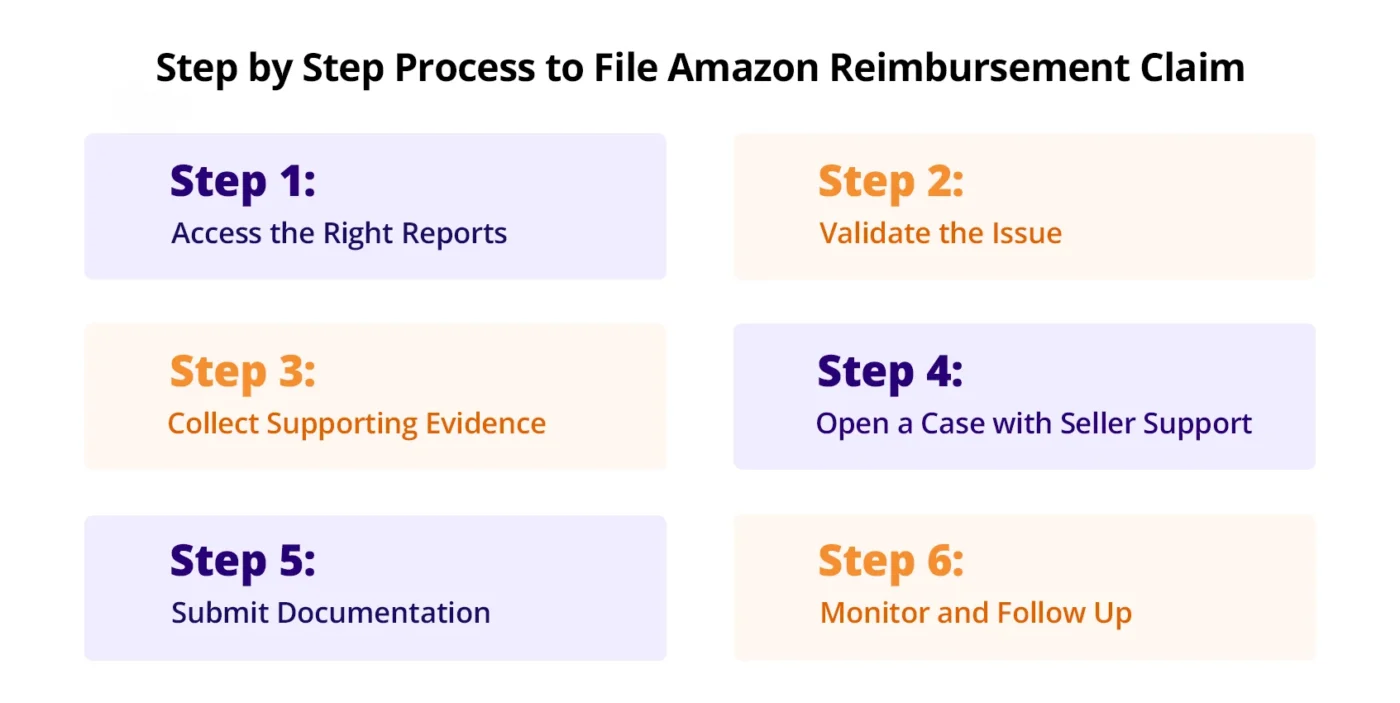
Filing effective claims requires precision. Around 60% of FBA reimbursement claims are rejected due to insufficient or improper documentation. Even valid cases can be denied if not presented correctly. Amazon has implemented an automatic Amazon FBA reimbursement system for proactive and automatic reimbursements in fulfillment centers. Still, the reimbursement process often requires significant time and attention to detail. Here are the ways sellers can file for reimbursement on Amazon to improve their chances of approval:
Step 1: Access the Right Reports
Log in to Seller Central and navigate to relevant reports, such as Inventory Adjustments, FBA Shipments, or Returns, to identify potential discrepancies.
Step 2: Validate the Issue
Confirm the discrepancy by documenting key details: ASIN, SKU, affected quantity, and the type of issue (lost inventory, damage, fee error, or return-related problem).
Step 3: Collect Supporting Evidence
Gather all necessary proof, including shipment records, invoices, tracking details, and any relevant screenshots. Strong documentation directly increases claim success.
Step 4: Open a Case with Seller Support
Create a case under the appropriate category. Clearly explain the issue in a concise, structured manner to avoid back-and-forth delays.
Step 5: Submit Documentation
Attach all supporting files, including a clear breakdown of the discrepancy and proof of ownership or shipment.
Step 6: Monitor and Follow Up
Track your case regularly. While Amazon may respond within a few days, more complex claims can take longer and may require follow-ups.
Since each claim must be submitted individually with proper evidence, the process can become time-intensive for high-volume sellers
Amazon FBA Reimbursement Policy
Amazon reimbursement policies change frequently, affecting claim eligibility and processes. Staying updated ensures sellers can maximize reimbursement opportunities and avoid missed claims due to Amazon policy updates.
As of 2026, reimbursements from Amazon are primarily based on the estimated manufacturing cost of the item rather than the selling price. This is a major policy change that reduced potential reimbursement amounts for many sellers.
Below are other policies to keep in mind:
Eligibility Requirements
To qualify for reimbursement, your inventory must meet a few critical conditions:
- The item must be actively enrolled in FBA at the time of loss or damage
- It must comply with FBA product and inventory requirements
- Shipment details (quantity and items) must match your shipping plan
- The item must not be customer-damaged, defective, or pending disposal
- Your seller account must be in good standing when filing the claim
How Reimbursement Is Calculated
Amazon calculates reimbursement differently based on when the issue occurs:
Pre-order (before sale): Reimbursement is typically based on your sourcing cost (what you paid to acquire the product)
Post-order (after sale/returns): Reimbursement is based on the customer refund or replacement value, minus applicable fees
Amazon may use your submitted cost data or estimate it based on similar products if not provided. The maximum reimbursement per unit is capped at $5,000.
Reclaim Your Profits With Amazon FBA Reimbursement Services
The hidden costs of ignoring reimbursements are huge. Most Amazon FBA sellers making $500K+ annual revenue are leaving $5,000-$15,000 unclaimed every year, considering sellers lose 1-3% of their annual revenue to FBA errors. This is a significant amount and can impact your net profit.
Most sellers ignore it as it takes time to manually outsource the task of requesting reimbursements across thousands of SKUs. This is where Amazon reimbursement service for FBA sellers can be a relief. The best FBA reimbursement service providers in the market solve the reimbursement puzzle and recover lost profits from Amazon FBA errors.
AMZDUDES is a performance-driven Amazon FBA reimbursement partner built for sellers who want complete financial visibility and recovery accuracy. AMZDUDES takes a policy-compliant approach, focusing on eligible cases.
By systematically tracking inventory events and validating discrepancies against Amazon’s policies, AMZDUDES has consistently enabled sellers to recover up to 95% of valid claims, with many clients reclaiming $10,000–$50,000 within the first six months. This is delivered through a zero-risk model, ensuring sellers recover lost revenue without compromising compliance or account health.
Conclusion
Amazon FBA reimbursements are a core part of protecting your margins. Every day you are not carrying out an Amazon audit reimbursement is a day you’re losing money. Amazon’s fulfillment process is built for speed, not accuracy. Errors happen at every stage, and most sellers never identify them to claim reimbursement.
You can do this yourself by building a weekly audit habit. Pull your Amazon reimbursement reports and cross-check everything for accuracy. In case you find discrepancies, file claims before it’s too late.
For sellers looking for Amazon FBA reimbursement services, you can reach out to us. AMZDUDES, as a full service Amazon agency, helps sellers recover their profits. We have professionals providing Amazon reimbursement services.Book a free consultation call now.
Frequently Asked Questions
What is Amazon FBA reimbursement?
Amazon FBA reimbursement is the compensation Amazon provides to sellers for errors within its fulfillment system, such as lost inventory, damaged items, incorrect customer returns, or overcharged FBA fees. Sellers must identify and file claims to recover these funds if Amazon does not reimburse them automatically.
How do I claim Amazon reimbursement?
To claim Amazon reimbursement, log in to Seller Central, identify discrepancies in reports (inventory, returns, or fees), gather supporting documents (invoices, shipment details), and open a case with Seller Support. Submit clear evidence and follow up until the claim is resolved.
What types of issues qualify for Amazon FBA reimbursement?
The most common issues that qualify include:
- Lost inventory in fulfillment centers or during shipping
- Damaged inventory while under Amazon’s control
- Customer returns that are not sent back
- Overcharged FBA fees due to incorrect dimensions or weight
- Missing items from removal or disposal orders
How long do I have to file an Amazon reimbursement claim?
Most Amazon reimbursement claims must be filed within 9 to 18 months, depending on the issue type. For example, lost inventory and shipment discrepancies typically have stricter timelines, so regular audits are essential to avoid missing deadlines.
Does Amazon automatically reimburse sellers for FBA errors?
Amazon does issue some automatic reimbursements, but not all errors are detected. Many discrepancies go unnoticed, which is why sellers need to manually audit their accounts or use reimbursement services to recover missed funds.