

Key Takeaways
- MER measures total marketing performance: MER shows how efficiently your total marketing spend generates revenue, giving a broader view.
- MER is calculated using revenue and marketing spend: You can calculate MER by dividing total revenue by total marketing spend for the same period.
- A good MER depends on your business model: The ideal benchmark depends on profit margins, customer acquisition costs, and growth stage.
- Follow 5 practices to improve MER: Set clear goals, target the right audience, improve customer retention, use analytics tools, and continuously optimize campaigns to increase marketing efficiency.
- MER should guide long-term growth decisions: Tracking MER consistently helps businesses understand whether their marketing spend is supporting profitable growth over time.
The marketing world is full of metrics all competing for attention. The problem is that most of these metrics only show one part of the picture. That is where Marketing Efficiency Ratio (MER) becomes valuable.
MER gives you a broader view of how efficiently your marketing spend is driving total revenue across all channels. It’s one of the most important metrics marketers use to measure impact. The metric helps you understand whether your overall marketing investment is producing profitable growth.
For brands scaling across e-commerce platforms, MER has become one of the most important metrics for measuring performance. In this guide, we will explain what MER is, how to calculate it, what a good MER looks like, and the strategies you can use to improve it.
What is MER in Advertising
Marketing efficiency ratio (MER) measures how well your marketing strategy or campaign performs holistically. MER as a metric considers the total effects of all your marketing efforts, letting you determine how efficiently your marketing efforts generate revenue across different channels. As it’s more holistic, it allows you to see the bigger picture.
Instead of looking at individual campaign performance in isolation, MER compares your total revenue against your total marketing spend. This gives you a broader understanding of whether your overall marketing strategy is driving profitable growth.
For example, a strong MER can show that your paid ads, email campaigns, influencer partnerships, organic traffic, and repeat purchases are working together effectively. A declining MER, on the other hand, may indicate rising acquisition costs, lower conversion rates, or inefficient spending across channels.
What is the Marketing Efficiency Ratio MER Formula?
Now that you know the MER definition, you’re ready to learn the MER formula. To calculate MER, take your total revenue and divide it by your total marketing spend.
MER = Total Revenue ÷ Total Marketing Spend
The result will be a decimal number that you can use as a percentage.
How To Calculate Marketing Efficiency Ratio
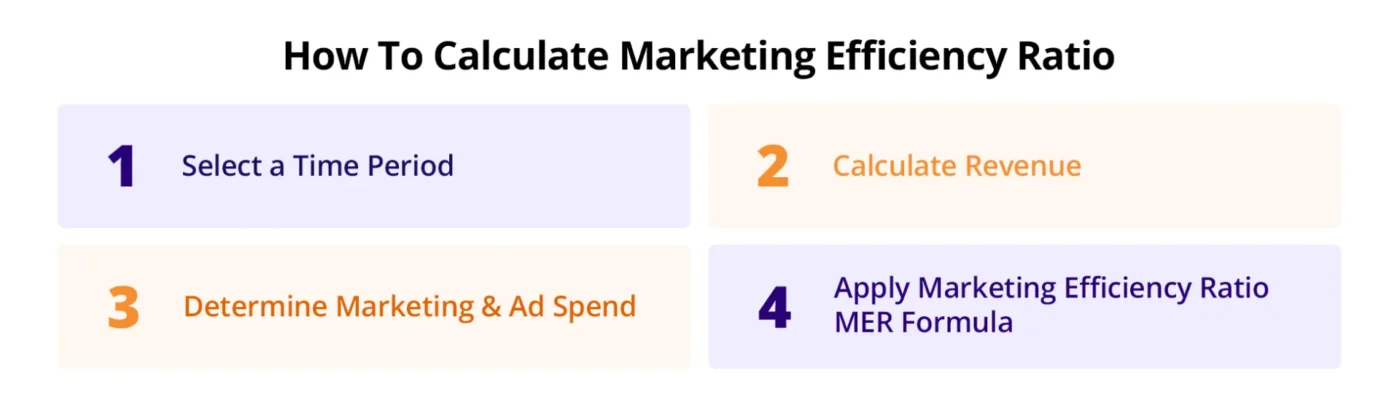
You can calculate MER by following the steps:
1. Select a Time Period
Start by choosing the time period you want to analyze. Most businesses calculate MER weekly, monthly, quarterly, or annually. The key is to make sure your revenue and marketing costs come from the same timeframe so the numbers stay accurate.
2. Calculate Revenue
Collect revenue data. MER reflects sales revenue from a specific time period tied to your marketing campaigns. Pull revenue data from the ecommerce platform that reflects all sales. MER works best when full revenue is included in the equation.
3. Determine Marketing And Ad Spend
Once revenue is calculated, add up all marketing-related costs for the same period. Many businesses make the mistake of only including ad spend, but MER is more accurate when it includes all marketing expenses.
4. Apply Marketing Efficiency Ratio MER Formula
Gather revenue numbers and total ad spend details for your selected date range and apply the following formula:
Marketing Efficiency Ratio = Total Revenue / Total Marketing Spend
For example, if a business generated $85,000 in total revenue and spent $17,000 on marketing during the same period, the calculation would look like this:
MER = $85,000 (total sales revenue) / $17,000 (total marketing spend) = 4 (marketing efficiency ratio).
To express MER as a percentage, simply multiply your results by 100.
In this example, a MER of 5 would equal 500%, meaning the business generated five times its marketing investment in revenue.
What is a Good Marketing Efficiency Ratio Benchmark
A good Marketing Efficiency Ratio benchmark depends on your industry, profit margins, average order value, customer acquisition costs, and growth stage. There is no single MER target that works for every business because some brands can operate profitably at a lower MER while others need a much higher ratio to stay sustainable.
A good MER benchmark often falls around 5.0 or higher, meaning your business is generating $5 in revenue for every $1 spent on marketing.
A scaling startup aiming for customer acquisition might work with a lower MER in the short term, while a mature brand might aim for a higher ratio to sustain profitability.
5 Best Practices To Improve Marketing Efficiency Ratio
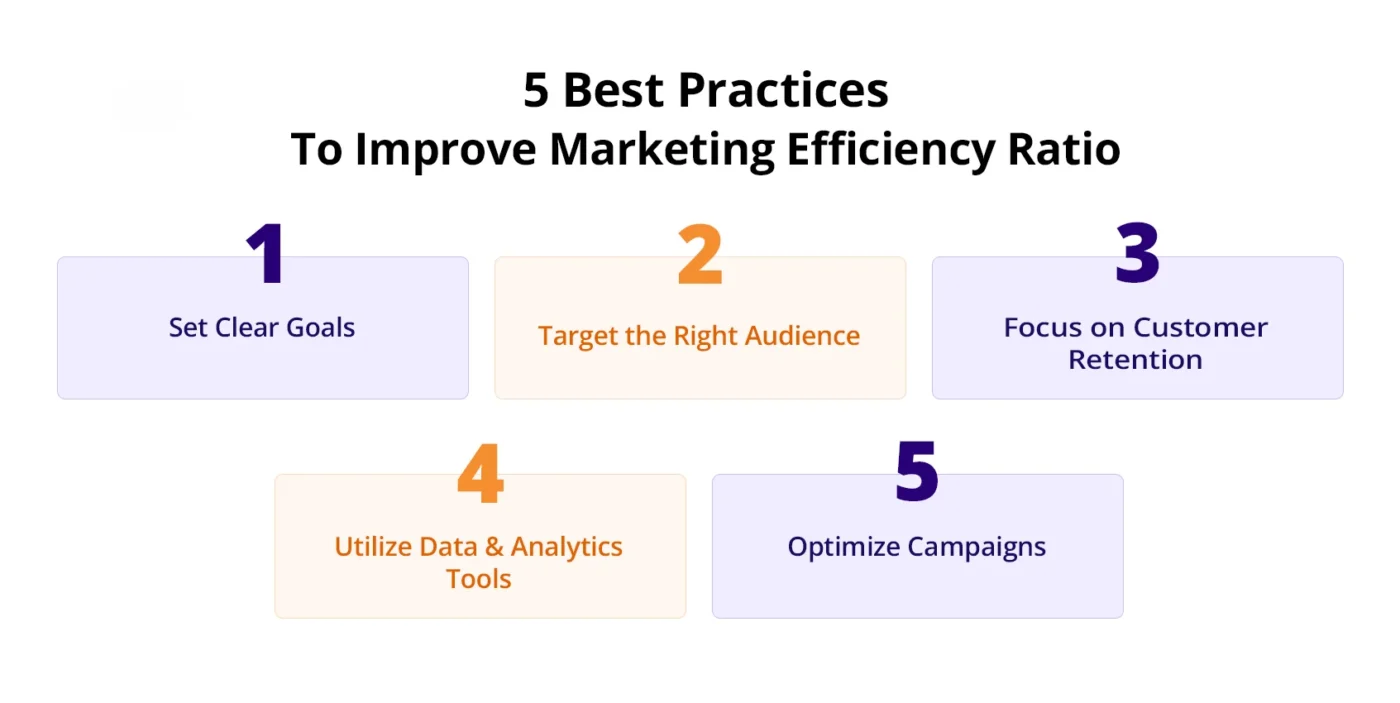
Improving marketing efficiency ratio is crucial for maximizing the impact of your marketing efforts. Here are some best practices to improve your marketing efficiency ratio:
1. Set Clear Goals
Improving MER starts with setting clear marketing goals. Clear goals provide direction and allow you to measure performance accurately.
Set goals around metrics like revenue growth, customer acquisition, repeat purchases, average order value, or conversion rates. Having specific goals makes it easier to allocate spend, measure campaign success, and identify which activities are improving your overall MER.
2. Target the Right Audience
Reaching the wrong audience can quickly reduce marketing efficiency. Even strong offers and creative campaigns will struggle if they are shown to people who are unlikely to buy.
Customize your messaging, content and channels to resonate with your target audience. This increases the chances of engagement and ensures your resources are invested in people most likely to convert.
3. Focus on Customer Retention
Retaining existing customers is often far more cost-effective than constantly acquiring new ones. Businesses that increase repeat purchases and customer loyalty can generate more revenue without increasing marketing spend at the same pace.
According to research, increasing customer retention rates by just 5% can increase profits by 25% to 95%. This is because returning customers are more likely to buy again, spend more per order, and require lower acquisition costs. It is best to implement strategies like personalized communication, loyalty programs, and exceptional customer service to foster long-term relationships.
4. Utilize Data and Analytics Tools
Marketing decisions are more effective when they are based on real performance data rather than assumptions. Companies can gain valuable insights into what works and what doesn’t by analyzing and interpreting customer behavior, market trends, and campaign performance data.
Keeping track of performance enables brands to allocate resources more effectively. You can use analytics tools to gain insights into customer behavior, campaign performance, and market trends. This information will enable you to refine your strategies and allocate resources effectively.
5. Optimize Campaigns
Improving MER requires continuous campaign optimization. Regularly evaluate performance of your marketing strategies to identify what’s working and what needs to be improved. Fine tune your campaign to ensure your resources are allocated to the most effective strategies.
Conclusion
Marketing Efficiency Ratio is one of the most useful metrics for understanding the true impact of your marketing efforts. Achieving an optimal marketing efficiency ratio (MER) requires continuous monitoring and adjustment. With our guide, you can better understand how to calculate MER, and direct your marketing efforts toward strategies that generate the strongest return.
If you need expert assistance for improving marketing efficiency ratio, AMZDUDES can help. As a full-service Amazon agency, AMZDUDES helps brands improve performance. We provide the best Amazon marketing services to help brands build profitable long term strategy for their business on Amazon. Get free consultation now!
Frequently Asked Questions
What is MER Marketing?
Marketing Efficiency Ratio (MER) in marketing measures how much revenue your business generates for every dollar spent on marketing. It is calculated by dividing total revenue by total marketing spend. MER helps brands evaluate overall marketing performance.
Why is MER important for ecommerce brands?
MER gives ecommerce brands a broader view of marketing performance by combining all channels into one metric. It helps you understand whether your total marketing spend is driving profitable growth.
What is considered a good MER?
A good MER depends on your business model, margins, and growth stage. In general, an MER between 4 and 6 is considered healthy for many ecommerce brands. Higher-margin businesses may be profitable at a lower MER, while brands with tighter margins often need a higher MER to stay profitable.
Is a higher MER always better?
Not always. A very high MER may mean your business is not spending enough on growth opportunities. Some brands intentionally accept a lower MER in the short term to acquire customers, or launch new products.
What is the difference between MER and ROAS?
MER looks at total revenue compared to total marketing spend across all channels. ROAS only measures the revenue generated from a specific advertising campaign or platform. MER is better for evaluating overall business performance, while ROAS is better for campaign-level optimization.