
Key Takeaways
- Improve targeting and campaign structure: Segment campaigns, use long tail keywords, and add negative keywords to reduce wasted spend and drive more profitable traffic.
- Use video and Sponsored Display to expand reach: Capture more attention, retarget shoppers, and increase visibility both on and off Amazon
- Use AMC and AI for better decisions: Use customer journey insights and automation tools to improve targeting, forecasting, and campaign performance.
- Focus on profitability and bidding strategy: Scale budgets based on product margins, choose the right bidding model, and adjust bids using enough performance data to improve profitability.
- Test and optimize continuously: Review search term reports, refine bids, and test ad creatives regularly to improve long-term results.
Amazon advertising is more competitive in 2026 than ever. More sellers are entering the marketplace, CPCs continue to rise, and brands are fighting harder for the same placements and customers. Amazon advertising campaign strategy that worked a few years ago may no longer be enough in the current competitive scenario.
To stay competitive, brands need to go beyond the basics and build effective Amazon advertising strategies. This guide covers 10 proven Amazon PPC strategies 2026 that can help you stay ahead.
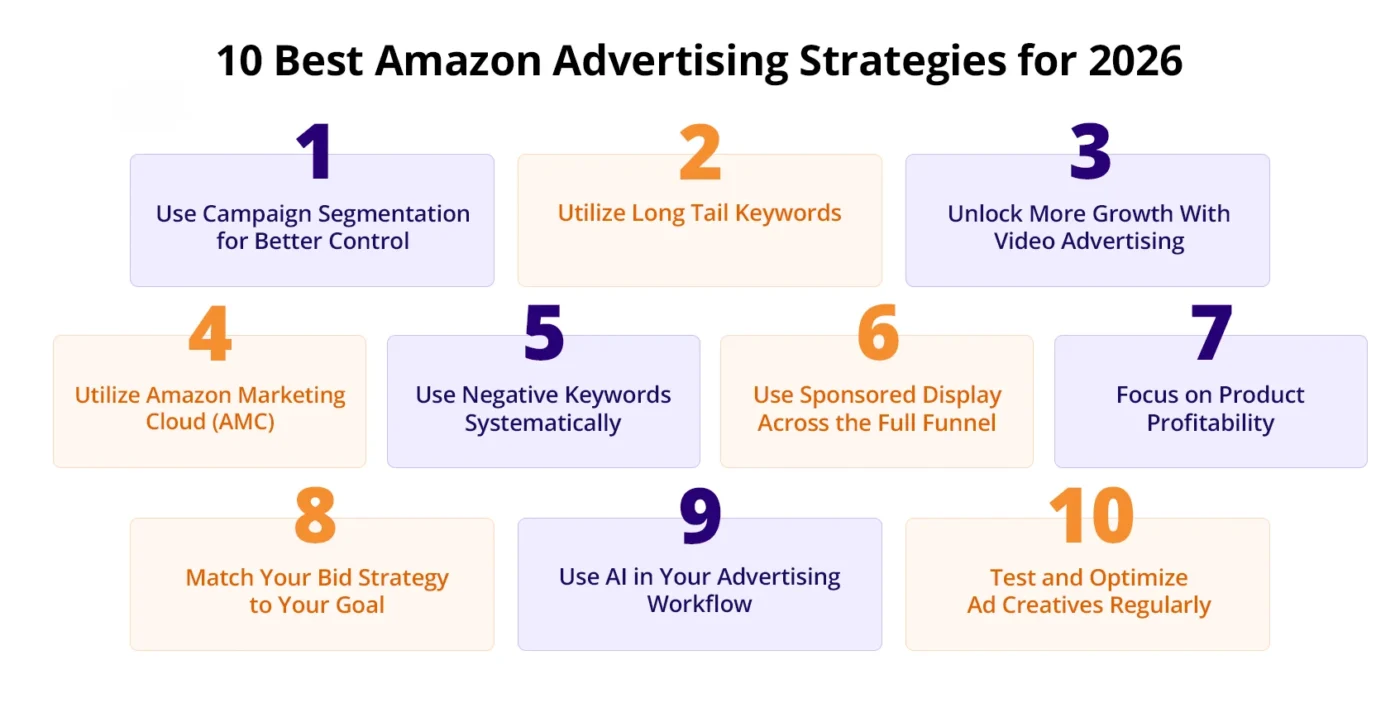
1. Use Campaign Segmentation for Better Control
Segmenting your campaigns gives you more control over performance and budget allocation. Instead of grouping everything, separate campaigns based on factors such as:
- Match type
- Product category
- Keyword intent
- Top-performing products
- Brand versus non-brand terms
- Device type or placement
Campaign segmentation allows you to track performance against specific goals for each segment. This makes it easier to identify what is working and where the budget should be shifted.
2. Utilize Long Tail Keywords
Sellers starting on Amazon often make the mistake of utilizing broad keywords in their advertising campaign. As broad keywords often have higher volume and generate more traffic, advertisers often opt for them without realizing that they also come with higher competition and lower conversion rates.
Long tail keywords are highly recommended for Amazon PPC campaigns as they have less competition and often drive more profitable sales. You can use tools like Amazon Brand Analytics, search term reports, Helium 10, Jungle Scout, and Amazon autocomplete suggestions to identify long tail keyword opportunities that closely match shopper intent. By utilizing long tail keywords, you can optimize your budget to achieve consistent Amazon ad campaign growth.
3. Unlock More Growth With Video Advertising
One of the most exciting trends for advertisers is the increasing use of video. 82% of marketers say video marketing has given them a good ROI. Customers are 64% more likely to buy a product after seeing a video. Amazon allows you to use video as part of your ad campaign. To use Amazon video features (like A+ video or Sponsored Brands), you must enroll in the Amazon Brand Registry.
Video ads have become a must-have for brands advertising on Amazon because they consistently drive higher engagement. In the past, video advertising opportunities were mostly available to larger brands, but Amazon now gives businesses of all sizes access to premium video placements.
Amazon’s streaming TV Ads on platforms like Fire TV and Freevee are increasingly becoming a performance driver rather than just a brand awareness tool. Prime Video alone now reaches around 115 million ad-supported viewers in the United States every month, while Amazon’s global ad-supported audience has surpassed 315 million monthly viewers. This gives brands a major opportunity to reach shoppers through premium video placements and direct them back to their product pages. Sponsored Brands Video has also expanded across Amazon search results and product detail pages, giving brands more opportunities to capture shopper attention.
4. Utilize Amazon Marketing Cloud (AMC)
Amazon Marketing Cloud gives advertisers deeper visibility into how shoppers interact with ads before making a purchase. AMC now provides granular, cross-channel attribution, letting brands map the entire customer journey. This allows you to adjust budgets based on what’s driving results at every stage of the purchasing journey.
AMC is no longer only useful for advanced enterprise advertisers. Even smaller teams can use AMC to build highly targeted audiences without complications. For example, brands can create audience segments based on shoppers who viewed a product but did not purchase, repeat buyers, high-value customers, or shoppers who interacted with a video ad. These audience insights can then be used to improve targeting and allocate ad spend more efficiently.
5. Use Negative Keywords Systematically
Negative keywords prevent your ads from showing for irrelevant searches. Most sellers ignore them or set them once and rarely update them. This results in wasted ad spend. It is highly recommended to add negative keywords and, if you have already added them, review and update them regularly based on your search term reports.
Pull your Search Term Report and look for keywords that are generating clicks but not conversions or are not relevant to your product. These are strong candidates to add as negative keywords so you can reduce wasted spend and improve campaign efficiency.
Negative keywords serve as a filter that helps you block irrelevant traffic before it wastes your budget. They support the broader goal of showing ads to shoppers who are more likely to buy.
6. Use Sponsored Display Across the Full Funnel
Amazon Sponsored Display (SD) ads are perfect for retargeting and reaching shoppers both on and off Amazon. This gives you a great opportunity to re-engage customers who didn’t convert the first time. You can reach more of your ideal buyers and drive performance across the entire buying journey, from awareness to purchase and repurchase.
With its ability to retarget customers outside Amazon, sponsored Display holds promise for those looking to maximize their brand’s reach. The more external traffic you drive back to your listings, the more Amazon is likely to reward you with stronger rankings, which can lead to more organic visibility and traffic over time.
7. Focus on Product Profitability
Understanding your profit margins is important, especially when you are scaling. Many sellers increase ad budgets as soon as they see more sales. However, if you do not understand profit margins first, you can end up spending more on ads than the product can support.
Every SKU has different profitability metrics, including manufacturing cost, advertising cost, Amazon fees, and actual margin. While most sellers know these numbers, far fewer use them to structure campaigns properly. Products with stronger margins can usually support higher bids and larger budgets, while lower-margin products often require tighter controls to remain profitable.
8. Match Your Bid Strategy to Your Goal
Bidding strategically is crucial and the best Amazon advertising strategy. Advertisers need to strategically manage bids to maintain cost-effectiveness while maximizing visibility and conversion rates. Amazon offers three main bidding modes: automatic, manual, and dynamic bidding. Automatic campaigns are best used for keyword discovery because Amazon can surface search terms you may not have targeted manually. They work well as a research tool, but should not be your main profit driver.
Manual campaigns are better for scaling because they give you more control over keyword-level bids, placements, and spend. Dynamic bidding lets Amazon adjust your bids in real time based on conversion likelihood.
Before adjusting bids, make sure you have enough data. A good rule is to wait until a keyword has generated at least 30 to 50 clicks before making changes. This helps you avoid reacting to short-term fluctuations and make decisions based on actual performance trends.
9. Use AI in Your Advertising Workflow
Artificial Intelligence (AI) has emerged as a game-changer. It is a strong tool for empowering advertisers to scale campaigns, save time, and achieve growth. AI tools add genuine value by helping advertisers automate repetitive tasks, identify trends faster, and make better decisions based on performance data.
You can utilize AI tools for keyword research. AI-assisted keyword research tools can surface long-tail variations and semantic keyword clusters that manual research often misses. This helps advertisers build larger and more relevant keyword lists before validating them with search volume and relevance data.
You can also use AI tools for listing optimization by generating multiple versions of titles, bullet points, descriptions, and images at scale. This is especially useful for new product launches and large catalogs that are difficult to refresh manually regularly.
10. Test and Optimize Ad Creatives Regularly
Even the best-targeted campaign can underperform if the creative is weak. Your main image, video, headline, product title, and copy all influence whether a shopper clicks on your ad or ignores it. Testing different creative variations helps you understand which messaging, visuals, and formats drive the strongest engagement and conversions.
Amazon’s Manage Your Experiments tool runs controlled tests on titles, images, and A+ Content. This helps you compare different versions of your creative and identify which one delivers better click-through rates, conversions, and sales. Instead of relying on assumptions, you can use actual shopper behavior to make better creative decisions.
Conclusion
Amazon advertising in 2026 is no longer just about increasing budgets or targeting high-volume keywords. Brands that want to stay competitive need to build smarter campaigns.
The most successful advertisers will be the ones who test consistently and adapt quickly as Amazon continues to evolve. By applying these Amazon advertising strategies, brands can create a more profitable advertising strategy for long-term growth. If you are looking for expert assistance, you can reach out to us. Book a free consultation with AMZDUDES to get connected with our Amazon marketing service team.
Frequently Asked Questions
What is the best Amazon advertising strategy for 2026?
The best Amazon advertising strategy for 2026 is a combination of campaign segmentation, long tail keywords, negative keywords, Sponsored Display, video advertising, and AI-driven optimization. Relying on only one tactic is no longer enough in a highly competitive marketplace.
Why are long tail keywords important for Amazon PPC?
Long tail keywords are important because they usually have lower competition and higher conversion rates. They help advertisers target shoppers with stronger purchase intent and reduce wasted ad spend.
Are video ads worth using on Amazon?
Yes, video ads are becoming one of the most effective ad formats on Amazon. They help products stand out in crowded search results and improve conversions by showing shoppers how the product works and why it is valuable.
How often should I optimize my Amazon ad campaigns?
Amazon ad campaigns should be reviewed and optimized regularly, ideally every week. This includes checking keyword performance, adding negative keywords, adjusting bids, reviewing search term reports, and testing new creative variations.
What is the role of AI in Amazon advertising?
AI helps advertisers automate time-consuming tasks such as keyword research, bid adjustments, search term analysis, and listing optimization. It can help brands save time, make faster decisions, and improve campaign performance more efficiently.