
Key Takeaways
- Prioritize ranking to drive revenue: Focus on improving your search visibility because if your listing isn’t ranking, your product isn’t being seen by customers.
- 7 listing mistakes that hurt ranking: We have outlined the common mistakes that if left unresolved can prevent your Amazon listing from achieving rankings.
- Fix Poor Keyword Strategy, Poor Title Optimization, and Missing Backend Search Terms: Align your listing with high-intent search terms, structure your title, and utilize backend fields.
- Eliminate Weak Bullet Points, Poor Image Optimization, and Missing or Poor Descriptions: Focus on benefit-driven messaging, high-quality visuals, and persuasive descriptions to improve CTR and conversion rates.
- Stop Ignoring Customer Reviews: Actively manage feedback and optimize your listing based on real customer objections to strengthen ranking stability.
Amazon is the world’s most powerful sales-oriented search engine. A survey done by Skai found that 56% of consumers go to Amazon first when shopping, and 72 percent of shoppers use Amazon to find products. This is critical for sellers because ranking is the primary way to position products in front of those shoppers.
Your ranking directly affects your sales, and if your listing is not optimized, you are invisible to potential online buyers on Amazon.
This comprehensive guide outlines the seven critical reasons why your Amazon listing isn’t ranking. These mistakes can suppress visibility and hurt performance even for high-quality products.
The good news? These issues can be fixed. We break down the proven approach our Amazon listing optimization experts take to resolve these ranking barriers. These issues are not overly technical. By following these insights, you can reposition your listing for improved rankings on Amazon.
7 Amazon Listing Optimization Mistakes and Their Fixes
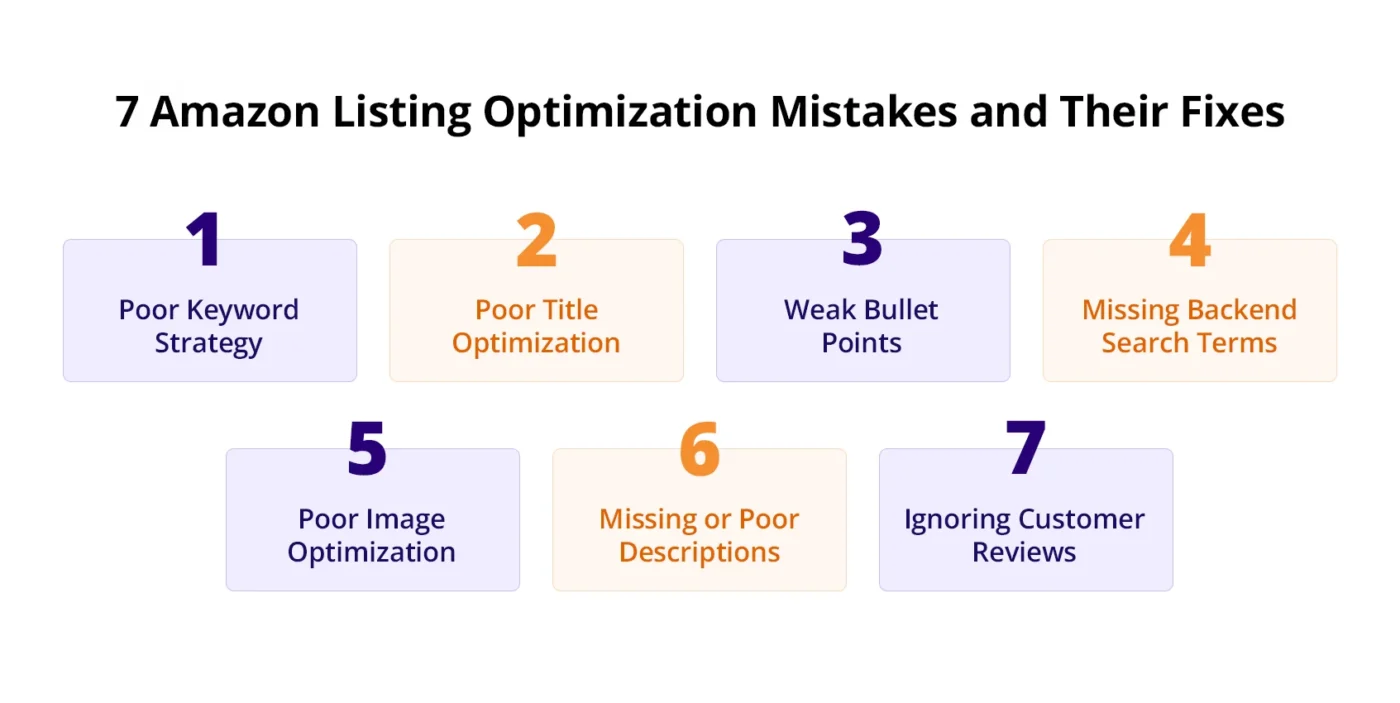
Ranking on Amazon is driven by relevance, performance signals, and conversion strength. If your listing is not gaining traction, these could be the reasons. By resolving these issues by following the fixes, you can increase the relevance of your listing and position it for better ranking on Amazon.
1. Poor Keyword Strategy
Many listings fail at the initial step because of a poor keyword strategy. Many sellers ignore what terms customers are searching for while looking for their product and guess at keywords that result in low visibility. If you are using keywords that nobody searches, your product becomes invisible.
Some sellers chase high-volume keywords without understanding buyer intent. While this may generate visibility, the traffic this broad brings is often not relevant to what the product actually offers. As a result, shoppers click but don’t convert, and these poor conversion signals ultimately hurt your ranking.
Fix
Our SEO experts carry out Amazon keyword research backed by data and expert reasoning
- Use advanced tools like Helium 10 and Jungle Scout to identify high-intent, conversion-focused keywords
- Analyze competitors’ listings to get insights on keywords they are already ranking for.
- Focus on long tail keywords with high buying intent
The longer phrases reflect clear purchase intent. We consistently see stronger ranking results when sellers target specific long-tail phrases. For example, optimizing for “leather office chair with lumbar support” typically converts better than targeting just “office chair.” These high conversion signals further strengthen ranking.
2. Poor Title Optimization
Optimizing Amazon product listing title is crucial for ranking, as the title is the first thing customers see and it carries the highest keyword weight. Many sellers underutilize it, and it’s common to see titles that are too short or too stuffed.
A poor title kills both click-through rates and conversion potential. If shoppers don’t immediately understand what the product is and why it’s relevant to their search, they scroll past, and Amazon’s algorithm responds by reducing visibility.
Fix
Our experts follow a proven structure for title optimization, treating it as a crucial part of Amazon listing optimization.
- Ensure your primary keyword is naturally integrated in the title
- Include key product features that influence purchasing decisions
- We prioritize clarity and content written for shoppers
- Utilize all available character limits ((typically 150–200) without keyword stuffing
Instead of: Office Chair Ergonomic Desk Chair for Home Office
We optimize to: “BRAND Ergonomic Office Chair with Lumbar Support – Swivel Desk Chair for Home Office, Breathable Mesh, 300 lb Capacity.”
3. Weak Bullet Points
Bullet points are concise statements that highlight key product features and benefits to help customers make informed purchasing decisions. Bullet points that focus on features without explaining benefits fail to persuade buyers.
Many sellers simply list specifications without taking into account why this matters for customers. This fails to address customers’ pain points, leading to a lower conversion rate and ultimately lower ranking performance.
Fix
Our experts structure bullet points using a benefit-first framework that addresses customers’ pain points.
- Start bold with the customer benefit
- Support the benefit with a feature that justifies the claim
- Add secondary keywords naturally
Example
All-Day Comfort Without Back Pain: Ergonomic lumbar support system contours to your spine, reducing lower back strain during long work hours, while breathable mesh fabric keeps you cool and comfortable throughout the day.
Amazon sellers get five bullet points, and our experts follow the best practice to address the top concerns through bullet points.
4. Missing Backend Search Terms
Amazon backend keywords are hidden search terms that help improve product discoverability without appearing in your Amazon listing. Just because they are hidden doesn’t mean they are useless.
Backend search terms give you an additional 250 characters to rank for relevant keywords. Most sellers waste this opportunity by leaving it empty or repeating front-end keywords.
Fix
Our experts treat backend search terms as an additional opportunity and utilize them effectively for better ranking.
- Add unique keywords not used in visible copy
- Include synonyms, alternate spellings, and related terms
- Skip punctuation, commas, and promotional language
For a listing targeting “ergonomic office chair,” we avoid repeating that phrase in backend fields. Instead, we add terms like: desk chair with back support, lumbar task chair, swivel computer chair, home office seating, mesh study chair. This captures various ways customers express the same need.
5. Poor Image Optimization
On Amazon, customers can’t physically examine products, so the responsibility is on images to do the selling. When visuals fail to visually communicate quality, functionality, and daily life usage, shoppers hesitate to buy it, and this kills conversion rates.
Fix
Our experts understand that high-quality images build trust, reduce doubt, and directly influence purchase decisions. That is why we optimize images for performance. Our image optimization strategy includes:
- High-resolution main image on pure white background (Amazon’s requirement)
- Lifestyle shots showing the product in use
- Detail shots highlighting key features
- Clear size and dimension visuals and references
- Benefit-driven infographics
Research shows that high-quality product photos had a 94% higher conversion rate. Better conversion rates signal higher relevance to Amazon’s algorithm, improving your organic rankings.
6. Missing or Poor Descriptions
Many sellers either ignore product descriptions or simply repeat their bullet points in the description section. Descriptions provide additional keyword opportunities that support conversion.
A weak or missing description reduces buyers confidence and wastes an opportunity to strengthen your positioning.
Fix
Our experts craft strategic, high-converting descriptions that add depth to the listing
- Write compelling, benefit-focused descriptions that complement your bullets
- Include additional keywords not used elsewhere
- Problem–solution storytelling to build emotional connection
- Clear explanation of use cases and real-world applications
7. Ignoring Customer Reviews
Shoppers rely heavily on the experiences of other customers when making purchase decisions. Amazon product reviews impact both customer trust and Amazon’s algorithm. Many sellers make the mistake of taking a passive approach to reviews and miss valuable opportunities to strengthen credibility.
Products with positive reviews build stronger social proof and remove conversion barriers, ultimately supporting better ranking performance.
Fix
- Implement a systematic follow-up process for genuine review requests
- Use review insights to identify listing improvement opportunities
- Identify objection patterns and take an active approach to resolve them
Conclusion
If your Amazon listing isn’t ranking, it’s time to go beyond guesswork. We help you go beyond this with our Amazon listing optimization services. Our Amazon product listing optimization specialists at AMZDUDES, a full-service marketing agency, combine deep platform knowledge with proven optimization frameworks to help sellers achieve higher rankings.
Along with providing fixes to the issues highlighted in this blog, we also create Amazon listing optimization systems that adapt to algorithm changes. We handle the complexities of Amazon listing optimization so you can focus on growing your business. Book a free consultation to get in touch with our Amazon SEO service experts now!
Frequently Asked Questions
Why is my Amazon listing not ranking even after adding keywords?
Adding keywords alone is not enough. Ranking depends on relevance and performance signals like click-through rate (CTR), conversion rate (CVR), and sales velocity. If your listing gets traffic but doesn’t convert, Amazon reduces visibility.
How long does it take for an Amazon listing to rank?
It depends on competition, keyword difficulty, and sales performance. New listings can take a few days to index, but meaningful ranking improvements typically require consistent Amazon listing optimization and sales over several weeks.
Do backend keywords really help with ranking?
Yes. Backend search terms expand your keyword coverage and improve indexing depth. They don’t replace front-end optimization but support discoverability for synonyms, alternate phrases, and long-tail keywords.
Can poor images affect my Amazon ranking?
Indirectly, yes. Images influence CTR and conversion rate. If shoppers don’t click or convert due to weak visuals, Amazon’s algorithm lowers your organic visibility.
Why am I getting traffic but no sales?
This usually indicates a mismatch between keyword intent and listing messaging. Broad keywords may bring visitors who aren’t ready to buy, lowering conversion rates and hurting ranking performance.