
Key Takeaways
- Treat Account Health as a core priority: If you want to build a sustainable Amazon business, you must actively monitor and protect your Account Health Rating.
- Fix process gaps before they become violations: Audit your sourcing, listings, variations, and documentation regularly instead of waiting for Amazon to flag an issue.
- Take high-risk categories seriously: Intellectual property, authenticity, product safety, and review policies can trigger immediate suspension. Operate with strict compliance controls in these areas.
- Submit structured, data-backed appeals: Always address the root cause, corrective action, and preventative measures clearly and professionally.
- Use the right fixes strategically and strengthen your systems: Address violations properly, then implement preventative controls to ensure the same issue doesn’t happen again.
Amazon Marketplace operates on a trust-based ecosystem where customer experience and product authenticity come first. The platform has strict policies, and Amazon continuously monitors sellers to ensure compliance. Even minor Amazon account health violations can quickly impact your Account Health Rating (AHR), leading to ASIN suppression, listing removal, or in severe cases, full account suspension.
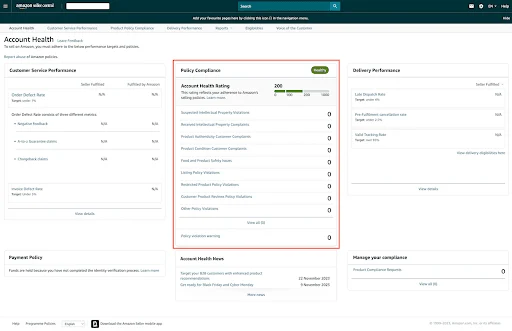
In this guide, we break down the 9 most common Amazon Account Health violations that sellers encounter. These are the issues you’ll find listed under the Policy Compliance section of your Account Health dashboard. For each violation, we explain what it means and provide clear, actionable steps to fix it, so you can respond strategically instead of panicking when an issue arises.
1. Suspected Intellectual Property Violations
Amazon flags suspected Intellectual Property (IP) violations when its systems detect potential trademark, copyright, or design misuse. This happens when there is sufficient evidence that a certain item is being copied or used in a way that may infringe on another brand’s protected rights.
These violations are typically triggered by Amazon’s algorithm-driven monitoring systems. AI bots can also flag a listing if a seller references a brand they do not own or are not authorized to sell. Even mentioning another brand in the title, brand field, backend keywords, SKU, or product description can result in a violation, as it goes against brand policy.
Fix
- Audit the flagged ASIN immediately and identify any unauthorized use of brand names, trademarks, copyrighted images, or protected design elements.
- Remove all non-compliant content from the title, brand field, bullet points, description, backend keywords, and even SKU references.
- Delete or close the listing if you are not an authorized reseller of the branded product.
- Contact the authorized distributor and ask them to vouch for you.
- Submit a concise appeal (if required) outlining the root cause, corrective actions taken, and preventative measures implemented.
2. Received Intellectual Property Complaints
Unlike suspected violations, these occur when a brand owner files a formal complaint through Amazon’s IP reporting system. These are serious and directly affect account health. Common triggers include unauthorized reselling, parallel imports, improper trademark use, or listing counterfeit products (intentionally or unknowingly). Even authentic inventory can trigger complaints if the seller is not an authorized distributor. These complaints could lead to actions such as listing removal or account suspension if the claims are verified.
Fix
Your fastest resolution path is contacting the rights owner and requesting a retraction. If that’s not possible, submit a strong Plan of Action (POA) including:
- Root cause (why it happened)
- Immediate corrective action (inventory removal, listing edits)
- Preventative measures (authorized sourcing, brand approval checks)
Include clear, verifiable invoices dated within 365 days.
3. Product Authenticity Customer Complaints
These complaints arise when customers question the legitimacy of a product they received. Even one complaint can heavily impact account health. When Amazon receives an authenticity complaint, it may take action against the seller, such as removing the listing, suspending the seller’s account, or withholding payments.
Fix
- Sellers must respond quickly and appropriately to resolve these complaints.
- Review sourcing documentation and provide supplier invoices showing manufacturer or authorized distributor details.
- Remove affected inventory via FBA removal order if necessary.
- Strengthen packaging quality control and conduct test buys.
- Work only with verified distributors and maintain proper documentation.
4. Product Condition Customer Complaints
These violations are caused by the condition of a product not being acceptable according to Amazon’s product condition guidelines. The unacceptable condition may relate to customers stating that the product was defective or was not the same as what was stated. This can also occur when a customer believes they are buying a new product but receives a product with open packaging.
Fix
First, identify the exact condition complaint. To do this, navigate to the account health page and select “Product Condition Customer Complaints” under the Policy Compliance section. On this page, you will be able to view the exact reason for the condition complaint and understand which ASINs are impacted.
Next, check whether the issue is FBA warehouse damage, poor packaging, or FBM handling errors. Remove potentially affected inventory immediately.
Finally, submit a structured appeal outlining:
- Root cause
- Immediate corrective action (removals, listing edits, packaging fixes)
- Preventative measures (updated QC process, stricter return inspection SOPs)
5. Food and Product Safety Issues
These are concerns or complaints related to the safety of food or consumer products. Common triggers for this type of violation include customer complaints about adverse reactions, expired products, missing safety labels, and contamination risks. This can put your listings and potentially your entire selling account at risk.
Fix
- Remove all non-compliant inventory immediately.
- Upload required compliance documents (COA, lab reports, FDA registration, safety certificates). Audit expiration date processes and ensure proper FBA labeling.
- Implement a documented compliance checklist before launching any consumable product.
6. Listing Policy Violations
A listing policy violation occurs when a seller changes or misrepresents a product detail page attribute. It includes misinformation, inappropriate content, and even false product claims. These violations negatively impact your Account Health Rating (AHR) and, if repeated, can lead to ASIN suppression or full account suspension.
Fix
If your listing is suspended for breaking these rules, you will go through the appeals process. Your POA must clearly outline three essential components:
Root Cause: Explain exactly what led to the violation
Corrective Actions: Detail the immediate steps taken to fix the issue
Preventive Measures: Describe the long-term systems you’ve implemented
7. Restricted Product Policy Violations
Amazon restricts the sale of illegal or unsafe products. Restricted (gated) Amazon products are items that require sellers to get approval from Amazon before they can be listed. Examples are alcohol, fine art, dangerous goods (hazmat), cosmetics, lithium batteries, etc.
Violations typically occur when sellers list products without checking the gating requirements, ignore hazmat classification rules, or fail to provide compliance documentation. These violations can lead to ASIN suppression, inventory removal, disposal fees, and even account suspension if they pose a high risk.
Fix
When it comes to writing an Amazon policy violation appeal letter for this type of violation, there’s not much that can be done to justify the product. Instead of defending, you should focus on taking action. Clearly explain that you have permanently removed the affected listings and remaining inventory and discontinued sourcing from the related suppliers. Outline the specific steps taken to prevent future occurrences.
8. Customer Product Reviews Policy Violations
These are cases where customer reviews do not adhere to Amazon’s review policies. Amazon doesn’t allow sellers to review their own products or a competitor’s items. It’s also forbidden to ask a reviewer to make, change, or remove a review. When this kind of violation is claimed to have taken place, Amazon may remove reviews, suppress listings, or even suspend the selling account, depending on the severity of the violation.
Fix
- Immediately stop any manipulated or non-compliant review practices.
- Remove packaging inserts that request positive reviews or offer compensation.
- Terminate any third-party agency involved in review manipulation and document the action taken.
- Use only Amazon’s built-in “Request a Review” button for compliant review generation.
- Submit a concise Plan of Action outlining root cause, corrective steps, and long-term prevention measures.
9. Other Policy Violations
This category includes violations that fall outside the mentioned categories but still breach Amazon’s platform policies. These often involve misuse of Amazon programs, improper claims, abusive conduct, incorrect product identifiers, variation misuse, or pricing manipulation.
Many sellers overlook these because they don’t sound severe. Although they may appear less severe, a pattern of these violations can reduce your Account Health Rating.
Fix
Start by carefully reviewing the specific policy cited in your Performance Notification. Next, correct the violation at the listing or account level. This may include deleting duplicate ASINs, correcting variation structures, updating GTIN documentation, removing prohibited claims, or aligning pricing with Amazon’s Fair Pricing Policy.
Finally, submit a structured Plan of Action that includes: root cause, corrective action, and preventative measures.
Conclusion
Amazon Account Health is a necessary part to sustain if you want to ensure an effective, long-term presence on the platform. You need to adhere to Amazon’s policies and guidelines, not just to avoid suspension, but to build a stable business. Successful sellers on Amazon build
strong compliance systems to prevent policy breaches, and if issues arise, they rely on proactive strategies to fix them.
This guide equips you with a clear understanding of the most common Amazon account health violations, why they happen, and how to fix them strategically. By following along, you can significantly reduce the risks and maintain a strong Account Health Rating.
If managing compliance issues feels overwhelming, you can reach out to us. AMZDUDES has served as a reliable Amazon account management service provider, helping brands protect their seller accounts with confidence. Book a free consultation now!
Frequently Asked Questions
What are the main Amazon suspension reasons?
The most common Amazon suspension reasons include intellectual property complaints, selling counterfeit or inauthentic products, food and product safety violations, restricted product policy breaches, and review manipulation.
How do I check my Amazon Account Health status?
You can monitor your account by visiting the Account Health dashboard in Seller Central. Under the Policy Compliance and Performance sections, you’ll see active violations, customer complaints, and metrics impacting your Account Health Rating (AHR). Regular monitoring allows you to take corrective action.
How to fix Amazon account warning issues properly?
Start by carefully reviewing the cited policy in your Performance Notification. Identify the root cause and take corrective action immediately. If needed, prepare a structured Plan of Action that outlines root cause, corrective action, and preventative measures.
Can one violation lead to account suspension?
Yes, in some cases a single violation can result in immediate account suspension. For example, food and product safety issues can trigger instant enforcement if Amazon believes the product poses a risk to customers.
How can I prevent future Amazon account health violations?
Prevention requires proactive compliance management. Conduct regular listing audits, verify supplier authenticity, document sourcing, monitor customer complaints, and stay updated on Amazon policies.