
Key Takeaways
- Underestimating Amazon’s complexity: Many sellers fail because they are not prepared for the platform’s challenges and assume it is easy to succeed.
- Product research is the foundation: Choosing the right product with real demand, manageable competition, and strong margins determines the success of everything that follows.
- Strategic competition and pricing: Competing effectively requires more than lowering prices; it involves smart pricing, strong visibility, and clear product differentiation.
- Profit depends on cost and operations control: Managing Amazon fees, advertising spend, and inventory efficiently is essential to maintaining healthy profit margins.
- Visibility and compliance drive sustainability: Optimized listings improve rankings and conversions, while strict adherence to Amazon policies ensures long-term business survival
Starting an Amazon business may look simple, but it’s not as easy as creating a listing and watching sales come in. Selling on Amazon comes with challenges that can break your business if you are not prepared for them early.
The Amazon platform can be unforgiving. Around 90% of new Amazon FBA sellers fail because they underestimate the complexity of running an Amazon business and are unprepared for the challenges. However, sellers who understand these challenges early are far more likely to succeed. In fact, 64% of Amazon sellers say they become profitable within their first year. The good news is that you can also become part of that profitable group if you understand the common Amazon seller challenges early and build the right systems to overcome them.
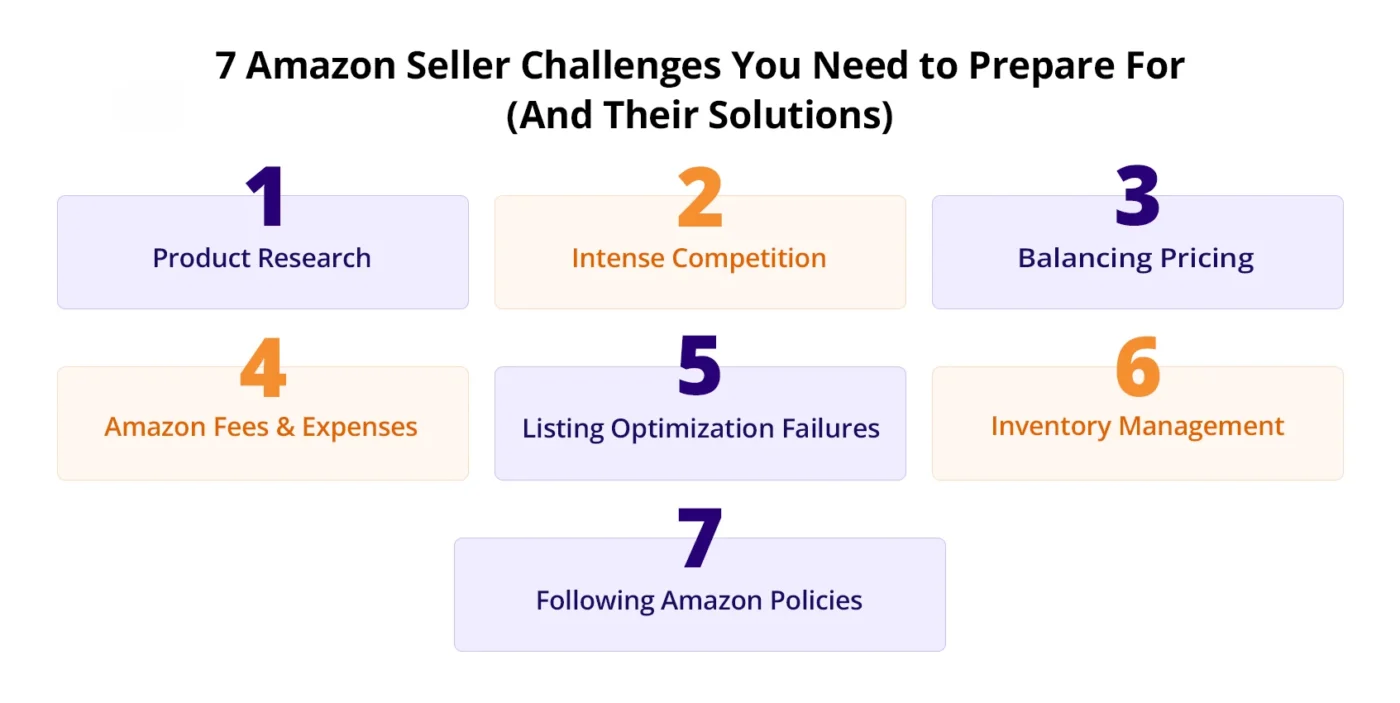
This guide outlines the 7 most common Amazon challenges and solutions to help you avoid costly mistakes and build a stronger Amazon business.
1. Product Research
Product research is one of the biggest Amazon seller challenges because what seems like a great opportunity is often already saturated with competitors.
Many new sellers see a product performing well and assume they can enter the market easily, only to discover that hundreds of other sellers had the same idea. Many sellers choose products with low keyword demand, weak margins, generic features, or niches they do not fully understand. These mistakes often hurt the business before the first sale even happens.
Your product choice affects everything else, including margins, competition, advertising costs, and long-term growth potential. If you choose the wrong product, the other Amazon seller challenges become harder to manage.
Solution
Use research tools like Jungle Scout, Helium 10, and ScoutX to make product research easier and more data-driven. These tools help you analyze competitor activity, keyword demand, ROI, fees, variation data, and profitability before investing in a product.
Amazon’s Product Opportunity Explorer can also help identify trending opportunities directly within the platform if you prefer Amazon-native insights. The key is to focus on products that solve real customer problems, have decent search volume, and are in niches with manageable competition.
2. Intense Competition
With seller numbers increasing on Amazon, competition is getting fiercer every year. Amazon reports that around 550 new sellers join the platform daily, making it harder for brands to stand out. Competition is no longer limited to new sellers entering the market. Established brands, large resellers, and even Amazon itself often compete in the same categories.
With customers expecting faster delivery, better service, and a seamless shopping experience, sellers are under constant pressure to meet the demands. In crowded niches, sellers compete for better pricing, faster delivery, and higher visibility to attract customers.
With growing competition, sellers enter price wars to stay ahead of competitors, which can cut into profits, making growth more difficult on Amazon.
Solution
To stand out in this competitive marketplace, visibility is one of the most powerful advantages a seller can have. Running Amazon PPC campaigns can help your products appear in front of the right customers and improve your chances of generating sales. Target relevant keywords to ensure your product appears in search results and drives more traffic and sales.
Optimize your amazon listing and SEO to win visibility. Use keyword and product research tools to understand customer demand and monitor market trends to stay ahead of the competition.
Focus on unique selling points that set your product apart. Quality, branding, and excellent customer service can help you build a loyal customer base and stand out in a crowded market.
3. Balancing Pricing
Balancing pricing is one of the biggest Amazon seller challenges, especially in saturated categories where competition is intense. Established sellers often lower their prices to attract more customers, making it difficult for newer sellers to compete. This pushes many brands into price wars where profit margins shrink, and long-term growth becomes difficult.
Many sellers assume that the lowest price always wins, but Amazon customers also care about reviews, shipping speed, product quality, and overall value. Constant discounting can make it harder to maintain profitability.
At the same time, pricing products too high to protect margins can lead to lower sales as customers are actively comparing prices, and Amazon supports it and provides better pricing options for customers.
The challenge is finding a balance between staying competitive and maintaining healthy profit margins without competing for cheap pricing.
Solution
Use automated repricing tools like Profasee or SmartRepricer to adjust prices dynamically based on market conditions. These tools help track competitor pricing, protect your margins, and respond to changes without relying on constant manual updates.
You can also create custom pricing rules, set promotional pricing periods, and use cost-based pricing strategies that protect your target ROI. If you are just starting, you can temporarily lower prices for short periods to improve rankings and visibility, then gradually increase them later.
4. Amazon Fees & Expenses
Amazon services come at a cost, and they are constantly rising. You can expect to face referral fees, FBA charges, storage costs, and advertising expenses. These costs add up quickly and reduce profitability, posing Amazon seller challenges. The exact fees vary depending on many factors, including product category, fulfillment method, product size, and many more.
Without proper budgeting and planning, many sellers realize too late that their actual profits are much lower than expected.
Solution
- Understand Amazon’s fee structure before pricing your products.
- Knowing how much Amazon takes from each sale helps you set realistic pricing and profit expectations.
- You should also adjust your budget to account for referral fees, FBA charges, storage costs, and advertising expenses.
- Managing inventory carefully can also help reduce long-term storage fees and improve profitability.
5. Listing Optimization Failures
Appearing on the first page of Amazon search results is critical for increasing clicks and sales, but achieving that visibility requires proper listing optimization. Amazon’s algorithm looks at several factors, including keyword relevance, titles, images, pricing, and customer reviews, to place your listing for higher visibility. Poor listings with incomplete titles, missing keywords, weak bullet points, and low-quality images reduce both search visibility and conversion rates.
Many sellers make the mistake of using generic titles, stuffing keywords unnaturally, or ignoring backend search terms. In some cases, listings can even be suppressed because of formatting issues or content violations.
Even a strong product can struggle if customers do not understand its value quickly. Weak listings make it harder to rank and convert traffic into sales.
Solution
- Start with strong keyword research using tools like Helium 10 or Google Trends to identify terms customers are actively searching for.
- Write clear product titles and optimize them by including important keywords while keeping them easy to read.
- Use bullet points to highlight benefits, and explain what makes the product different.
- High-quality images are equally important. Use professional photos, lifestyle images, comparison visuals, and product demonstrations to make the listing more engaging.
- A+ Content, backend search terms, and strong visuals can further improve both rankings and conversion rates.
6. Inventory Management
Effective inventory management is crucial for sustaining a successful Amazon business. Sellers need to have a balance of inventory, as running out of stock can lead to missed sales, and having excess inventory can add up storage costs. Amazon’s Inventory Performance Index also creates additional pressure as falling below Amazon’s requirements can result in restock limits and reduced Prime eligibility.
Without proper inventory planning, it is harder to maintain profitability on Amazon.
Solution
- Use Amazon’s inventory dashboard or forecasting tools like InventoryLab to predict demand and maintain healthier stock levels. These tools can help track sales velocity, seasonal demand, storage costs, and reorder points more accurately.
- FBA can also simplify storage, packaging, and shipping, reducing the risk of operational issues.
- Regularly monitor inventory levels and adjust purchasing decisions based on real demand trends.
7. Following Amazon Policies
Amazon has strict policies covering everything from product eligibility and listing content to account health and customer service. Failure to comply can lead to warnings, listing removals, suppressed ASINs, or even account suspension.
Many sellers struggle because they do not fully understand which policies apply to the products they sell. Restricted products, review requests, IP complaints, repeat ASIN violations, and poor customer metrics are some of the most common reasons sellers face problems.
Policy enforcement can also feel inconsistent. In some cases, sellers receive little warning before their listings are removed or their accounts are suspended. Preventing violations is most recommended as it is far easier than fixing them later. Small issues can quickly become major problems if they are ignored.
Solution
Take the time to understand Amazon’s seller policies, prohibited product rules, brand requirements, and account health standards. You can also stay updated on Amazon policy changes through official communications and seller forums.
Keeping records of your listings, customer communications, and compliance efforts can also make it easier to resolve issues if they arise.
Conclusion
Selling on Amazon is full of unexpected challenges. The reality of building an Amazon business can be difficult, but with the right strategy and preparation, these challenges can be overcome.
With our guidance, you must have built a better understanding of the most common Amazon seller challenges in 2026 and how to manage them effectively.
Sellers who prepare early and build strong systems are more likely to grow on Amazon. You can also seek expert assistance if managing these challenges becomes overwhelming. AMZDUDES, as a full-service Amazon marketing agency, helps you overcome these Amazon seller challenges. Our team provides the best account management services, handling everything from execution to resolving issues. Book a free consultation to get connected with our experts.
Frequently Asked Questions
What is the biggest challenge for Amazon sellers?
One of the biggest Amazon seller challenges is managing profitability while staying competitive. Rising advertising costs, increasing competition, Amazon fees, and inventory issues can reduce margins quickly if sellers do not have a clear strategy in place.
Why do Amazon sellers struggle with product research?
Amazon sellers struggle with product research because many products already have tough competition. Sellers often choose products with low demand or weak margins, which makes it harder to generate sales and stay profitable.
Why is listing optimization important on Amazon?
Listing optimization is important because it helps products rank higher in Amazon search results and improves conversion rates. Strong titles, relevant keywords, quality images, and clear bullet points make it easier for customers to find and buy your product.
What happens if you run out of stock on Amazon?
Running out of stock can hurt your sales, rankings, and customer trust. Stockouts can also reduce Buy Box ownership, lower organic visibility, and allow competitors to take over your market share.
How can sellers avoid Amazon account suspension?
Sellers can avoid account suspension by following Amazon policies carefully, monitoring account health regularly, and fixing account health violations quickly. Keeping listings compliant and staying updated on policy changes can also reduce the risk of violations.