

Key Takeaways
- Amazon pay per click account management covers far more than adjusting bids, it includes campaign architecture, keyword strategy, targeting alignment, creative decisions, inventory-aware pacing, and reporting that explains what is actually happening.
- Most brands have campaigns running. Far fewer have their Amazon PPC account actively managed, and the gap between the two shows up in ACoS that never improves, keyword coverage that never grows, and spend that never connects to organic rank.
- Fragmented Amazon PPC management, multiple tools, freelancers, or teams touching different parts of the account, creates internal campaign competition, inconsistent bidding signals, and waste that compounds quietly as the catalog scales.
- Professional Amazon pay per click account management connects campaign decisions to listing performance, inventory depth, and customer insight data so advertising drives profit, not just traffic.
Most Amazon sellers have campaigns running. Very few have their Amazon PPC account genuinely managed.
The distinction matters more than it sounds. Campaigns running means ads are live, spend is going out, and a dashboard somewhere is showing numbers. Amazon pay per click account management means someone is actively making decisions about what those campaigns should accomplish, whether the keyword coverage is growing correctly, whether the bids reflect actual margin data, whether the listing quality is limiting what the campaigns can produce, and whether the week-to-week changes are building something that compounds or just maintaining a status quo.
That gap between campaigns running and an account being managed is where most Amazon PPC spend is lost.
This guide explains what professional Amazon pay per click account management actually covers, why fragmented setups consistently underperform, which brands need fully managed Amazon PPC, and how to evaluate whether your current account is being managed correctly.
Amazon Pay Per Click Account Management: More Than Just Adjusting Bids
The most common misunderstanding about Amazon pay per click account management is that it is primarily a bid management activity. Raise bids on converting keywords, lower bids on high-ACoS terms, pause what does not work. Repeat weekly.
Bid management is one component. It is not the system.
Managing Campaigns vs Managing the Account: The Real Difference
Campaign management is tactical, it responds to data that already exists. A keyword has a high ACoS, so the bid goes down. A campaign is running out of budget, so it goes up. These are reactive adjustments within an existing structure.
Account management is structural and strategic, it determines what campaigns should exist, what they should accomplish, how they should relate to each other, and whether the broader context of listing quality, inventory position, and organic rank is shaping how campaigns are built and paced.
The practical difference:
Campaign management asks: What does this keyword’s ACoS tell me about the bid?
Account management asks: Why is this keyword’s ACoS elevated? Is it a bid problem, a listing conversion problem, a match type problem, or an inventory problem, and which of those causes requires which kind of fix?
A seller whose account is being managed at the campaign level will see bid changes week over week. A seller whose account is being truly managed will see the underlying problems diagnosed and fixed, which produces ACoS improvement that holds rather than temporarily improving and then reverting.
Where Most Amazon PPC Setups Leave Money on the Table
The gap between campaign management and account management is where most Amazon PPC spend leaks. The specific patterns that show up most consistently:
Keyword coverage that never grows:
In proper Amazon pay per click account management, the Search Term Report is reviewed every week, not to audit what happened, but to mine new converting search terms and move them into exact match manual campaigns. In most basic setups, the keyword list from launch is essentially the keyword list at month six.
Bids set against benchmarks, not margins:
Amazon suggests a bid range. The category average is a reference. Neither of these reflects your specific product’s profitability, your actual maximum profitable CPC is Profit Per Unit × Conversion Rate, and that number is the only bid ceiling that actually protects your margins. When bids are set against Amazon’s suggested range instead, they may be competitive, but they are not necessarily profitable.
Listing quality limits that campaign optimisation cannot break:
A campaign pointing to a listing with below-average images, fewer than 15 reviews, or a price above category average will consistently underperform regardless of how precisely managed the bids are. True Amazon pay per click account management recognises when the constraint is in the listing, and addresses it, rather than continuing to adjust bids on a problem that is not a bidding problem.
Spend running on out-of-stock ASINs:
Without inventory awareness built into campaign management, budgets continue to be spent on products that shoppers cannot buy. Every click on an out-of-stock listing is pure waste, and the ranking signals built with that ad spend are simultaneously eroding because there is no sales velocity to reinforce them.
What Professional Amazon Pay Per Click Account Management Covers
Understanding the full scope of Amazon pay per click account management is what allows you to evaluate whether what you currently have is adequate and what a more professional setup would look like. Each component below is a distinct management responsibility, not a campaign feature.
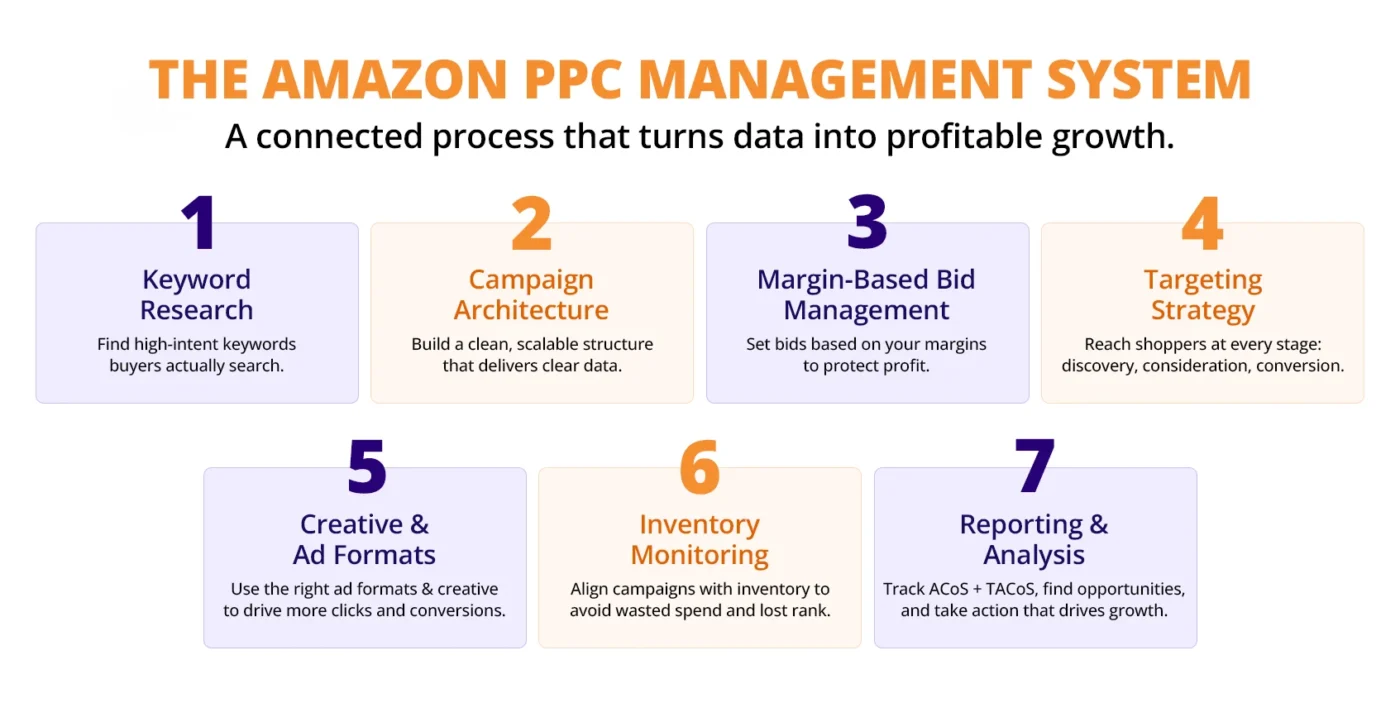
Keyword Research and Campaign Architecture
Amazon PPC campaign management starts before any campaign is created. Amazon Keyword research for pay per click is not a one-time exercise; it is an ongoing process that feeds new converting terms into the campaign structure from live data.
Seed keyword research:
Establishes the initial keyword universe: terms with genuine purchase intent, specific enough to attract buyers rather than browsers, and competitively accessible at CPCs your margin can sustain.
Campaign architecture:
Determines how keywords are organised, by match type in separate campaigns, by ASIN in isolated structures, by intent stage (discovery vs conversion) in separate budget pools. A properly architected Amazon PPC campaign structure produces clean, readable data. A poorly architected one blends signals from different keyword types and different ASINs, making every subsequent optimisation decision less accurate.
Ongoing keyword expansion:
Weekly Search Term Report mining moves proven converting queries from auto and broad campaigns into exact match manual campaigns, systematically growing the account’s library of validated buyer queries rather than relying on the launch keyword list indefinitely.
Bid Management Tied to Your Margin: Not Amazon’s Suggestions
Professional Amazon pay per click account management calculates bid ceilings from your specific unit economics before setting a single bid in Campaign Manager.
Maximum profitable CPC = Profit Per Unit × Conversion Rate
This number, not Amazon’s suggested range, not competitor benchmarks, is the bid ceiling above which every converting click loses money, regardless of keyword quality. Every bid adjustment in a professionally managed account is evaluated against this number.
Effective Amazon bid management requires balancing visibility, conversion efficiency, and profitability rather than simply increasing or decreasing bids based on short-term performance fluctuations.
The bid adjustment framework in managed Amazon PPC:
| Keyword Performance | Action | Timing |
| ACoS below 50% of break-even for 30+ days | Increase bid 10–15% | After 30 days minimum |
| ACoS 50–80% of break-even | Hold – monitor | 2 more weeks |
| ACoS above break-even for 30+ days | Reduce bid 20–30% | After 30 days |
| ACoS above 2× break-even for 30+ days | Reduce 40% or pause | After 30 days |
| Keyword with no impressions despite active bid | Increase bid 25–30% | After 7 days |
Placement bid adjustments are managed separately. Top of Search, Product Pages, and the rest of Search each have different conversion rates and cost profiles. In professional account management, placement multipliers are only applied after Placement Report data confirms that a specific placement converts at or below the target ACoS. Never before.
Bidding strategy selection, Dynamic Down Only for new campaigns, Dynamic Up and Down for established campaigns with reliable conversion history, Fixed for proven top performers where cost certainty is required, is a structural decision made per campaign stage, not a default applied uniformly.
Targeting Across Discovery, Consideration, and Conversion
Amazon’s pay per click account management organises targeting to serve different stages of the shopper journey, not to maximise impressions across all of them equally.
- Discovery targeting uses broad match and automatic campaigns to surface new converting search terms. Conservative bids. Weekly harvest cycles. The purpose is intelligence gathering, not conversion.
- Consideration targeting uses phrase match and competitor ASIN targeting to reach shoppers who are evaluating options. Mid-funnel intent. Moderate bids. Informed by discovery data.
- Conversion targeting uses exact match on validated high-intent terms and your own ASIN defensive targeting. Highest bids. Protected budgets. Built from what the discovery and consideration layers have proven.
When these three targeting layers share campaigns and budgets, their signals contaminate each other. Discovery traffic dilutes the conversion rate signal of high-intent terms. Consideration budgets compete with conversion budgets. The account looks active, but the data is unreadable.
Professional Amazon Ads management separates them so each layer can be evaluated accurately, optimised independently, and funded proportionally to its role.
Creative and Ad Format Strategy Aligned to the Buying Journey
Amazon pay per click account management includes decisions about ad creative, not just which keywords to bid on.
Sponsored Products:
Are the primary conversion vehicle. Product image quality, title keyword placement, and pricing relative to category norms directly affect CTR and CVR. A professional account manager flags listing creative issues that are suppressing campaign performance, because a no-bid change fixes a conversion problem caused by a weak main image.
Sponsored Brands:
Build awareness and capture new-to-brand shoppers at the top of search results. Headline copy, logo placement, and the products featured are creative decisions that determine whether a Sponsored Brands impression produces a click. The best Sponsored Brands creative references the same purchase intent keywords the Sponsored Products campaigns are targeting, creating a consistent signal across the page.
Sponsored Brands Video:
Delivers click-through rates 2–3× higher than static Sponsored Brands in many categories. Video format requires: product visible in the first 3 seconds, designed for silent viewing with on-screen text, 15–30 second duration, and exact match keyword targeting from proven converting terms.
Sponsored Display:
Handles retargeting, re-engaging shoppers who viewed products but did not convert, and reaching audiences based on purchase history and browsing signals. Creative decisions here focus on the remarketing context: different messaging for a shopper who viewed the listing versus one who added to cart but did not buy.
Sponsored Display, DSP, and Demand Capture Beyond Sponsored Ads
Full Amazon pay per click account management extends beyond the core sponsored ads formats to capture demand across the full customer journey.
Amazon DSP (Demand-Side Platform) allows programmatic advertising on and off Amazon – reaching audiences across Amazon properties, third-party websites, and streaming platforms. DSP is relevant for brands with sufficient monthly ad spend (typically $10,000+/month) who want to build awareness among audiences before they arrive on Amazon.
Retargeting through Sponsored Display is available to all professional sellers without a DSP budget requirement. It is one of the most underused components of Amazon pay per click account management, reaching shoppers who have already engaged with the brand and are more likely to convert than cold audiences.
Cross-ASIN demand capture ensures that a shopper who views one product in the catalog is also exposed to complementary or related products. Product targeting campaigns between ASINs, placing ads on your own product detail pages and on competitor pages, extend the brand’s reach across consideration sessions that might otherwise leave without a purchase.
Reporting That Drives Decisions: Not Just Describes Numbers
The final component of professional Amazon pay per click account management is reporting that produces action rather than just documenting activity.
A major responsibility of professional account management is decoding Amazon PPC metrics so sellers understand which numbers require action, which trends indicate opportunity, and which fluctuations can safely be ignored
What proper reporting covers:
- What changed in the account this week, specific campaigns, keywords, bids, structures
- Why it changed, the data signal that triggered the decision
- What the result was, measured against the break-even ACoS and TACoS trend
- What is the next action, not a list of things being monitored, but specific changes planned for the next period
TACoS in the reporting framework: ACoS measures paid ad efficiency against ad-attributed revenue. TACoS (Total Advertising Cost of Sales) measures total ad spend against total revenue, including organic. TACoS is the metric that confirms whether Amazon PPC investment is building organic rank or creating paid traffic dependency.
TACoS = Total Amazon PPC Spend ÷ Total Revenue (organic + paid) × 100
A professionally managed Amazon PPC account tracks both metrics weekly. ACoS declining while TACoS holds stable or improves: the management is working. ACoS declining while TACoS rises: spend cuts are eroding organic rank, and the improvement is cosmetic.
Amazon PPC reports that professional management pulls and actions:
| Report | Frequency | What It Drives |
| Search Term Report | Weekly | Negatives, exact match promotion, keyword expansion |
| Keyword Report | Bi-weekly | Bid adjustments per the break-even framework |
| Placement Report | Monthly | Placement multiplier calibration |
| Advertised Product Report | Monthly | ASIN-level ACoS diagnosis |
| Purchased Product Report | Monthly | Attribution and cross-sell opportunity identification |
Most Amazon PPC performance issues are not caused by bids alone. They are usually structural issues, disconnected campaigns, weak listing conversion, poor keyword flow, inventory gaps, or reporting that lacks actionable direction. Solving them requires account-level management, not just campaign-level adjustments.
At AMZDUDES, a full service Amazon agency, we do not manage campaigns in isolation. We connect advertising strategy with listing creative, inventory data, and customer insights, creating a system where every campaign decision supports stronger conversion, better efficiency, and long-term account growth.
Why Fragmented Amazon PPC Account Management Costs More Than It Saves
Fragmented Amazon pay per click account management, where different tools, freelancers, or teams touch different parts of the account without coordination, is the most common reason Amazon PPC spend underperforms relative to its potential.
The losses from fragmentation are not dramatic. They are quiet and accumulative. By the time the pattern is obvious, months of budget have already produced below-potential results.
Internal Campaign Competition That Raises Your Own Costs
When campaigns are built without coordination, auto campaigns, broad match campaigns, and exact match campaigns all bidding on the same underlying keywords, the account competes against itself.
Auto campaigns surface a converting search term. Broad match campaigns trigger on the same term. Exact match campaigns are also targeting it. Three campaigns from the same seller enter the same auction. The effective CPC for that term rises, not because of external competition, but because internal campaigns are bidding against each other.
Professional Amazon pay per click account management addresses this through negative keyword layering across campaign types: when a term is promoted to exact match, it is added as a negative exact in the auto and broad campaigns that sourced it. This eliminates internal competition and directs all spend on that term through the precisely bid exact match campaign.
Without this coordination, internal competition silently inflates CPCs across the account’s best-converting terms.
Inconsistent Bidding That Sends Mixed Signals to Amazon’s Algorithm
Amazon’s delivery algorithm learns from consistent signals. When campaigns use different bidding strategies, some on Dynamic Up and Down, some on Down Only, some Fixed, and when budget rules conflict across campaigns, the algorithm receives inconsistent instructions about the account’s goals.
Some campaigns signal growth. Others signal cost control. Fixed campaigns never adjust. The result is performance instability, TACoS that fluctuates without a clear cause, forecasting that loses reliability, and optimisation decisions that produce inconsistent outcomes because the algorithm is responding to mixed intent.
In a professionally managed Amazon pay per click account, bidding strategy selection is consistent and intentional: Down Only for campaigns still in the learning phase, Up and Down for campaigns with reliable conversion history, Fixed for proven exact match keywords where cost certainty is required. This consistency gives the algorithm a clear, stable signal to optimise against.
Attribution That Rewards the Wrong Campaigns
Fragmented Amazon pay per click account management produces misleading attribution, where credit for a conversion flows to the last visible campaign action rather than the full sequence that produced the sale.
A branded search campaign captures the final click on a shopper who discovered the product through a broad match discovery campaign two weeks earlier. The branded campaign shows excellent ACoS. The broad discovery campaign shows poor ACoS and gets cut. Discovery dries up. Branded conversions decline two weeks later, but by then, the connection between the two is invisible in fragmented reporting.
Professional account management tracks attribution across the full funnel, understanding which campaigns generate awareness, which generate consideration, and which close the sale, and protects investment in each layer proportional to its role. The branded campaign does not get all the credit. The discovery campaign that fed it is recognised and funded accordingly.
Structural Waste That Compounds Quietly as the Catalog Scales
As the catalog grows, fragmented Amazon PPC account management produces structural waste at an accelerating rate. The same keyword appears in multiple campaigns without coordination. Out-of-stock ASINs continue receiving ad spend. Low-priority support products receive equal budget to core revenue drivers. Negative keyword lists are maintained inconsistently, with different standards in different campaigns, leaving some channels open to irrelevant traffic that others have closed.
Each source of waste is manageable in isolation. Together, as the catalog scales, they represent a growing percentage of total ad spend that produces zero return.
In a connected Amazon pay per click account, structural waste is addressed systematically: regular campaign audits surface duplicate keyword targeting, inventory signals pause campaigns on out-of-stock ASINs automatically, and budget allocation follows product role (core, expansion, support) rather than recent performance signals or default splits.
Which Brands Need Fully Managed Amazon Pay Per Click Account Management
Not every brand needs fully managed Amazon PPC at every stage. Understanding where the transition from self-managed or partially managed to fully managed account management produces the most value helps brands make the timing decision correctly.
Growing Catalogs Where Complexity Has Outpaced Internal Capacity
The point at which Amazon pay per click account management becomes genuinely complex, beyond what a part-time operator or basic tool can handle, arrives faster than most brands expect.
At 5 ASINs with $5,000/month in ad spend, managing campaigns manually with a basic tool is feasible. The account is simple enough to hold in one person’s head.
At 25 ASINs with $25,000/month in ad spend across three categories with different margin profiles, different lifecycle stages, and different competitive landscapes, the combinatorial complexity exceeds what reactive campaign management can handle without structural problems accumulating.
The signal that complexity has outpaced capacity: you know something is wrong with the account, but cannot diagnose specifically which campaigns, which keywords, or which ASINs are causing it. When the account has grown too complex to read accurately, professional Amazon pay per click account management provides the diagnostic layer that makes the data actionable again.
Competitive Categories Where Slow Decisions Cost Placements
In competitive Amazon categories, such as supplements, consumer electronics, beauty, and home goods, CPCs shift daily, and competitive dynamics change weekly. A competitor entering a key keyword, a rival brand running an aggressive Prime Day promotion, a new product launch capturing impression share on terms your account has owned for months: these events require rapid response to protect positioning.
In a manually managed or partially managed account, these events are typically identified in the next monthly report, weeks after the visibility and ranking loss has already occurred. In a professionally managed Amazon Pay Per Click account, they are identified in the weekly Search Term Report review and acted on within days.
Amazon PPC management for growing brands in competitive categories is particularly time-sensitive because the organic rank signals built during the growth phase are vulnerable to competitive disruption, and recovering position costs more in both spend and time than defending it would have.
Teams Managing Campaigns But Not the Account
The most common situation that leads to underperforming Amazon pay per click account management is not neglect, it is a mismatch. An internal team or freelancer who is competent at campaign execution but who was never responsible for account-level decisions: campaign architecture, budget allocation by product role, TACoS monitoring, listing-to-campaign connection diagnosis.
The result: the campaign-level work is done correctly, but the structural decisions that would make campaign-level work more effective are never made. Keywords are managed without a coherent funnel architecture. Bids are adjusted without a consistent margin-based framework. Reports are generated without the account-level interpretation that would identify which ASIN is dragging overall performance.
Transitioning to fully managed Amazon PPC in this situation does not replace what the internal team does well, it adds the account-level layer above it that campaign management alone cannot provide.
How to Evaluate Whether Your Amazon PPC Account Is Being Managed Right
Whether you are assessing your current in-house setup, evaluating a freelancer, or considering a professional Amazon PPC management service, these evaluation criteria apply equally.
Questions That Separate Connected Management From Fragmented Execution
1. Walk me through how you handle a keyword that is generating spend but not converting?
A fragmented manager says: lower the bid or pause it.
A connected account manager says: first check whether the query is genuinely relevant to the product – an irrelevant term should be negated, not bid-reduced. Then check CVR for that keyword to determine whether the problem is traffic relevance or listing conversion. Then check whether the term appears in multiple campaigns and whether internal competition is inflating its effective CPC. The diagnosis determines the action.
2. How do you connect bid decisions to inventory and listing performance?
A fragmented manager describes a bid-only process.
A connected account manager describes specific mechanisms: how inventory signals reduce bids on low-stock ASINs, how CTR data by keyword informs listing creative decisions, and how CVR trends indicate when the constraint is in the listing rather than the campaign.
3. What does your Search Term Report review process look like?
Weekly cadence with specific thresholds: $15+ spend and zero conversions trigger negation. 3+ conversions below the break-even ACoS trigger, exact match promotion and negative exact in the source campaign. Pattern mining for modifier-based expansion. Anything less than this is not professional Amazon pay per click account management, it is periodic maintenance.
4. What metrics does your reporting cover, and what decisions does each metric drive?
ACoS and TACoS tracked together. Bid adjustments triggered by 30+ days of keyword-level data against break-even ACoS. Placement multipliers adjusted from the monthly Placement Report data. ASIN-level diagnosis from the monthly Advertised Product Report. If the answer is “we track ACoS and RoAS and send a monthly report,” the account is being documented, not managed.
What the First 30 Days of Proper Account Management Should Look Like
The first month of professional Amazon pay per click account management is diagnostic, not optimisation.
Weeks 1–2:
Full account audit, Campaign structure review (match type separation, ASIN isolation, naming conventions), Search Term Report analysis across 60–90 days (wasted spend, exact match gaps, negative keyword coverage), bid levels against break-even ACoS per product, TACoS trend, listing-to-campaign connection diagnosis. Output: a prioritised findings document ranked by financial impact with specific actions and timelines.
Weeks 3–4:
Priority fixes, obviously wasted spend, negated. Internal competition is eliminated through cross-campaign negative layering. Campaigns paused on out-of-stock ASINs. Campaign structure rebuild begun, match type separation, ASIN isolation, and budget allocation by product role.
What should not happen in the first 30 days: mass bid changes based on insufficient data, claims of dramatic ACoS improvement before the structure is clean, or silence. An account manager who jumps straight to bid adjustments before diagnosing the structural issues is treating symptoms while the causes continue compounding.
Red Flags That Tell You Your Account Needs a Different Approach
The same keywords from the launch period are still the only keywords in manual campaigns:
No Search Term Report mining has occurred. The account is static, not managed.
TACoS is never mentioned:
An account manager who only reports ACoS is optimising a campaign-level metric while the business-level metric, whether advertising is building or eroding organic rank, is invisible.
Bids were last changed more than 60 days ago on most keywords:
Amazon’s competitive landscape shifts faster than that. Static bids in a dynamic auction environment mean the account is not responding to market changes.
No negative keywords have been added since the first month:
Every week of active advertising generates irrelevant search term data that should be negated. An account with a static negative keyword list has not been managed, it has been left running.
No exact match campaigns have been built from auto or broad campaign data:
The most important structural upgrade in Amazon pay-per-click account management is harvesting proven converting search terms and isolating them in exact match campaigns with margin-based bids. If this has not happened after 60+ days of campaigns running, the account is missing its primary efficiency mechanism.
Campaigns are running on out-of-stock ASINs:
Inventory awareness is a baseline account management responsibility. Its absence is a clear signal of fragmented or disconnected management.
Your Campaigns Are Running, But Is Your Account Actually Being Managed?
Successful Amazon pay per click account management goes far beyond adjusting bids or keeping campaigns active. Real growth happens when campaign structure, keyword strategy, listing quality, inventory signals, and reporting all work together as one connected system.
AMZDUDES is a full service Amazon agency that helps growing brands move from reactive campaign management to structured account management. We unify your sponsored ads, listing creative, customer insights, and performance data into a single strategy designed to improve efficiency, expand keyword coverage, and support long-term profitable growth.
Our Amazon PPC services are designed for brands that need more than routine campaign adjustments. The result is an account where every layer strengthens the next: campaigns uncover new conversion opportunities, listing data shapes bid decisions, and inventory signals guide smarter budget allocation.
We also offer a free account review to identify management gaps, uncover wasted spend, and show what a more structured Amazon PPC management system could unlock for your catalog.
Frequently Asked Questions
What is Amazon Pay Per Click account management?
Amazon pay per click account management is the ongoing process of planning, structuring, optimising, and reporting on Amazon sponsored advertising campaigns, Sponsored Products, Sponsored Brands, Sponsored Display, and DSP, to drive profitable revenue growth. It goes beyond adjusting bids to include campaign architecture, keyword strategy, targeting alignment, creative decisions, inventory-aware pacing, and reporting that explains what is happening and why. The distinction between campaign management (tactical, reactive) and account management (structural, strategic) is where most Amazon PPC underperformance originates.
What is the difference between Amazon PPC campaign management and account management?
Campaign management responds to existing data, adjusting bids, pausing keywords, and reviewing performance. Account management determines what campaigns should exist, how they should be structured, what they should accomplish, and how they connect to listing quality, inventory signals, and organic rank. Campaign management asks, “What does this keyword’s ACoS tell me about the bid?” Account management asks, “Why is this keyword underperforming, and which of the possible causes requires which kind of fix?”
What does managed Amazon PPC include?
A professional managed Amazon PPC covers: keyword research and campaign architecture, margin-based bid management, targeting strategy across discovery, consideration, and conversion traffic, creative and ad format decisions, Sponsored Display and DSP retargeting, inventory-aware campaign pacing, and weekly reporting that explains what changed and drives next-period decisions. Each component is a distinct management responsibility, not a feature of a tool.
How do I know if my Amazon PPC account is being managed correctly?
Five signals that indicate proper management: the Search Term Report is reviewed and actioned weekly; bids are calculated against your margin (Profit Per Unit × Conversion Rate), not Amazon’s suggested range; exact match campaigns are continuously built from converting search term data; TACoS is tracked alongside ACoS; and campaigns are paused on out-of-stock ASINs. If any of these are absent, the account is likely being maintained rather than managed.
What is Amazon advertising management?
Amazon advertising management is the broader discipline of managing all forms of Amazon paid advertising, including Sponsored Products, Sponsored Brands, Sponsored Display, and DSP, as a coordinated system aligned to brand growth goals. It includes campaign execution but extends to budget allocation across the catalog, funnel-stage targeting strategy, competitive positioning, and the connection between advertising decisions and organic rank, listing performance, and inventory management.
Why does fragmented Amazon PPC management cost more than it saves?
Fragmented management, multiple tools or teams touching different parts of the account, produces internal campaign competition (campaigns bidding against each other on the same terms), inconsistent bidding signals that confuse Amazon’s delivery algorithm, misleading attribution that misidentifies which campaigns are driving value, and structural waste that compounds as the catalog grows. Each source of waste is manageable in isolation. Together, they represent a significant percentage of total ad spend that produces below-potential results.
Which brands benefit most from fully managed Amazon pay per click account management?
Three situations where full account management produces the clearest improvement: growing catalogs where account complexity has outpaced internal capacity, competitive categories where slow responses to market changes cost placements and organic rank, and brands whose current setup manages campaigns competently but lacks the structural and strategic layer above it. Amazon PPC management for growing brands is particularly high-value because the organic rank signals built during the growth phase are most vulnerable to competitive erosion when management is fragmented.
How much does Amazon pay for a per-click account management cost?
Management fees vary by scope and model. For a full breakdown of pricing tiers, fee structures, and how to evaluate whether professional management is worth the investment for your specific account, see our Amazon PPC agency pricing guide.