
Key Takeaways
- Pricing varies by ad spend and complexity. Most brands pay $1,000–$4,000/month based on spend, catalog size, and strategy depth.
- The cheapest option is rarely the most cost effective. Real value comes from agencies that improve margins, reduce waste, and boost ranking signals.
- Strong PPC management includes far more than bid changes. You’re paying for structure rebuilding, keyword funnels, creative testing, and forecasting.
- Evaluating pricing requires margin clarity and capability assessment. Know your TACOS, margins, and internal skill gaps before judging agency value.
- Weak PPC setups cost more than a mature agency. CPC waste, rank slowdown, and margin compression often exceed the cost of expert management.
If you are trying to understand Amazon PPC agency pricing, you are not alone. Every brand wants to grow profitably, control wasted spend, and protect margins. But choosing the best Amazon PPC agency is not easy when pricing structures, deliverables, and promises vary so much.
This guide breaks everything down so you can make a confident decision. You will learn how pricing works, what you actually get for your money, how to judge value, and whether Amazon ads are worth it for your brand.
Pricing Benchmarks: What Most Amazon PPC Agencies Charge in 2026
Before comparing services, you need actual pricing. Most brands search for Amazon PPC agency pricing reviews because pricing varies widely. Here is a simple benchmark so you can self-qualify.
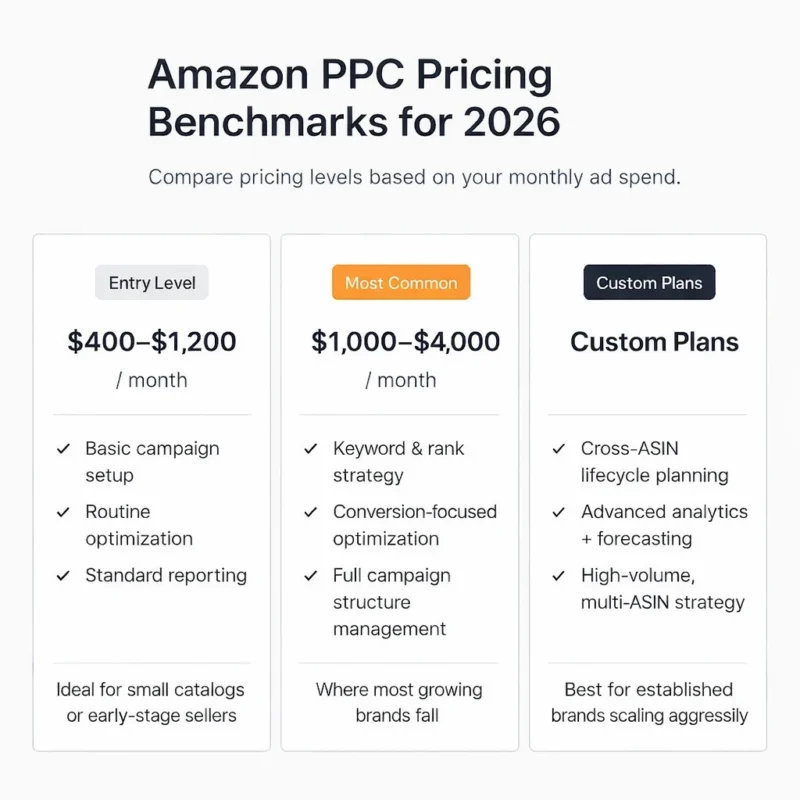
Small brands (<$10,000 ad spend per month)
Typical Amazon PPC management pricing: $400–$1,200/month
Best for beginner brands testing ads or managing a small catalog. These plans usually include basic campaign setup, optimization, and reporting.
Mid-market brands ($10,000–$50,000 ad spend per month)
Typical Amazon ads management pricing: $1,000–$4,000/month
You get deeper keyword strategy, rank planning, Amazon PPC reporting, conversion support, and bigger campaign structures. Most brands fall in this range.
High-spend brands ($50,000+ ad spend per month)
Pricing: Custom retainer or hybrid model
Large brands need cross-ASIN strategy, lifecycle planning, forecasting, and in-depth analytics. Pricing scales with complexity.
Extra Fees That Some Agencies Charge
Many brands forget to account for additional costs that sit outside standard Amazon PPC management pricing. These often include Amazon display ads pricing, pricing for Amazon video ads, Amazon ad pricing for DSP, AMC analytics fees, creative production, and one-time audits or rebuild projects.
Because these services require extra strategy, data work, or creative resources, agencies usually charge for them separately. Understanding these add-ons upfront helps you estimate what the most cost effective Amazon PPC agency would really cost based on your catalog size, ad mix, and growth goals, rather than being surprised later by rising monthly bills.
Amazon PPC Agency Pricing Models Explained
Not all agencies price the same. Here are the most common structures and how they work.

Percentage of Ad Spend
This is the most common structure in Amazon ads pricing, where you pay a fixed percentage of your total monthly ad spend as the management fee. As your budget increases, the agency fee rises automatically with it. This makes the cost closely tied to how aggressively you advertise. It is simple to understand and easy to start with, especially for brands already investing heavily in ads.
Pros:
This model scales naturally with your business, so support grows as your ad spend grows. It works well for brands that are expanding fast and want their agency effort to increase alongside budget. There is no need to renegotiate fees every time you spend changes.
Cons:
Costs can rise quickly even if performance does not improve, since higher spend alone increases fees. Without strong controls, this can encourage overspending rather than efficiency. Brands must watch TACOS and margins closely to avoid paying more for the same results.
Flat Monthly Retainer
Many brands prefer flat Amazon advertising pricing because it offers predictable, fixed costs each month. You know exactly what you will pay regardless of small changes in ad spend or daily activity.
This model is well suited for brands that want cost control and stable planning without surprises. You pay a fixed monthly fee for ongoing PPC management services, covering campaign setup, optimization, reporting, and strategy.
Pros:
Pricing remains stable, which makes budgeting simple and removes the fear of rising fees as spend increases. It is ideal for brands with moderate, steady ad budgets that value control and long-term planning. You can focus on performance without worrying about management costs creeping up.
Cons:
This model can be less flexible if your ad spend increases quickly or your account becomes more complex. In some cases, the fixed fee may not fully reflect the extra work required as you scale. You may need to renegotiate if growth outpaces the original scope.
Hybrid or Performance-Based Pricing
Some agencies combine a base retainer with additional fees tied to ad spend and performance results. This model aims to balance stable management support with incentives linked to growth.
It is often positioned as a way to align agency success with your business outcomes. You pay a fixed monthly retainer, plus a percentage of ad spend, and an extra bonus when specific targets like revenue, ROAS, or growth milestones are achieved.
Pros:
This model aligns incentives around growth, encouraging the agency to focus on driving higher revenue and stronger performance. It can work well for brands that are in aggressive expansion mode and want partners motivated by upside. When structured clearly, both sides win as the business grows.
Cons:
Costs can add up quickly if multiple fee layers stack together, especially during high-spend months. Without clear caps and definitions, you may end up paying more than expected for similar outcomes.
It is also harder to compare with standard Amazon ads pricing because every agency defines performance bonuses differently.
Project-Based or Audit-Only Pricing
These are short-term engagements focused on reviewing, fixing, or restructuring specific parts of your PPC account rather than managing it month to month. They are designed to give fast clarity on what is broken and what needs improvement.
You pay a one-time fee for a defined scope such as a PPC audit, campaign rebuild, or limited-time optimization sprint. The work is delivered within a fixed period, usually with clear findings and recommendations. Once the project ends, ongoing management is not included.
Pros:
This model lets you evaluate an agency’s expertise before committing long term and helps you quickly uncover wasted spend or structural issues. It is useful for cleaning up accounts after poor performance or internal mismanagement.
Cons:
Because support is short term, results may fade if changes are not maintained consistently. It does not replace full Amazon ads management when you need continuous optimization and scaling. You may still need a long-term partner to sustain performance after the project ends.
What You Actually Get When You Pay for Amazon PPC Management
Most brands assume they are paying for simple bid adjustments. But mature agencies deliver far more. Here is what is included in high-quality Amazon PPC management pricing:

1. Campaign Rebuilding and Structure Optimization
A strong PPC foundation starts with clean, well-organized campaigns. Rebuilding your structure improves visibility, reduces wasted spend, and gives you tighter control over how each ASIN performs. This step creates the stability your scaling efforts depend on.
2. Keyword Expansion and Match Type Mapping
Agencies build keyword funnels that capture high-intent searches while opening new paths for new-to-brand buyers. Proper match-type mapping spreads risk, improves coverage, and strengthens your ranking momentum across core and long-tail terms.
3. Bid Optimization and Signal-Based Decisions
Smart teams use search term data, ranking signals, and margin thresholds to guide every bid. They balance automation with manual oversight so you get efficient spend, stronger intent matching, and less volatility in ACOS and TACOS.
4. Conversion Optimization Support
Better ads only work when your product page converts. Agencies test creatives, refine listing clarity, and strengthen A+ content to remove friction for shoppers. These improvements lift CVR and amplify the impact of your PPC spend.
5. Audience Development & Retargeting
Strong PPC management also includes retargeting buyers through Sponsored Display, video placements, and custom audiences. These decisions connect directly to Amazon display ads pricing and pricing for Amazon video ads, ensuring your spend reaches the right shoppers at the right time.
6. Transparent Reporting and Weekly Insights
You get clear explanations for ACOS shifts, TACOS trends, and ASIN-level performance movements. Weekly communication helps you stay aligned, react faster, and understand exactly how your money is being used.
7. Forecasting and Rank Planning
Forecasting ties your PPC spend to inventory, margins, and future demand. Rank planning maps out how each ASIN can climb search results without overspending. This is where PPC investments turn into long-term, compounding growth.
How to Evaluate If an Agency’s Pricing Is Worth It
Many brands ask is Amazon PPC worth it? or is advertising on Amazon worth it? The answer depends on how well PPC connects to your margins, data, and growth strategy.

Here is a simple decision framework.
Compare Costs With Your Profit Margins
You must judge Amazon PPC agency pricing against what your business can actually afford to spend, not just what fits your budget. The real question is whether the fee helps you protect and grow profit, not just manage ads.
You must align pricing with TACOS, contribution margin, inventory capacity, and ranking goals. These tell you how much room you have to invest while still staying profitable. If an agency can reduce wasted spend, improve efficiency, and strengthen visibility, the fee often pays for itself. This is why brands look for the most cost effective Amazon PPC agency, not simply the cheapest one.
Identify Gaps Your Team Cannot Cover
Many internal teams manage day-to-day tasks well but struggle with deeper strategy and analysis as accounts grow. These gaps often become growth bottlenecks over time. An agency should add skills you cannot easily build in-house.
Internal teams often struggle with data modeling, cross-ASIN growth strategy, creative iteration, keyword funnel mapping, forecasting, and AMC analysis. These areas require experience, systems, and constant testing. If an agency fills these gaps, Amazon PPC management pricing becomes a growth driver rather than an expense, because you gain capabilities that directly impact revenue and efficiency.
Detect Red Flags in Pricing and Communication
These issues show up often in Amazon PPC agency pricing reviews:
- Guaranteed ACOS promises
- No weekly reporting
- Poor data transparency
- Overdependence on automation
- No catalog-level planning
If you see any of these red flags, keep searching.
The Real Cost of Not Hiring a Mature PPC Agency
Many sellers underestimate the hidden costs of poor Amazon PPC management. This is why questions like are Amazon ads worth it or is Amazon advertising worth it become important.

Here is what you risk without professional support:
1. Higher CPC Waste
Weak keyword mapping sends your budget toward irrelevant clicks instead of real purchase intent. This drives up CPC, drains spend quickly, and reduces the efficiency you expect from Amazon PPC.
2. Slower Organic Rank Growth
Organic ranking depends on steady, high-quality PPC signals. When campaigns are poorly structured, your ASINs fail to build the momentum needed to climb search results, slowing down long-term visibility.
3. Poor Budget Allocation
A major part of Amazon ads pricing waste comes from spreading the budget too thin or investing in the wrong match types. Without strategic allocation, you lose control over ACOS, TACOS, and overall profitability.
4. Missed New-to-Brand Sales
Without proper targeting and audience strategy, competitors capture buyers who should have discovered your products. This reduces both short-term sales and long-term brand growth.
5. Margin Compression
Inefficient bids and weak structures force you to pay more for the same traffic. Over time, this erodes margins, increases TACOS, and limits your ability to scale without financial pressure.
6. Long-Term Structural Damage
Bad campaign setups can take months to repair because they distort data, weaken ranking signals, and create unstable performance trends. Rebuilding these frameworks often requires more time and investment than starting clean. These losses often cost far more than the Amazon advertising pricing of a skilled agency.
How to Choose the Right Amazon PPC Agency for Your Budget
Here is a clear checklist for selecting the most cost effective Amazon PPC agency, not just the cheapest one.
- Ask for examples of past campaign structures: This shows how they think before spending your money.
- Check if they connect PPC to SEO and CRO: Strong PPC performance requires full-funnel alignment.
- Confirm weekly communication practices: You must know what is happening and why.
- Review their ranking strategy: Good agencies plan for both offensive and defensive keywords.
- Request a 90-day roadmap: This reveals structure, competence, and intent.
- Ensure they can manage Amazon DSP if needed: This matters if you are evaluating amazon display ads pricing or pricing for Amazon video ads.
Choosing right saves money, time, and wasted PPC investments.
Is Hiring an Amazon PPC Agency Worth the Investment?
Yes, if your brand is ready to scale, maintain margins, improve visibility, and reduce wasted spend. Good agencies turn PPC into a predictable, data-driven engine for growth.
And no, it may not be worth it if:
- Your listings aren’t converting their full potential yet
- Inventory planning needs more stability to protect sales velocity
- Ad budgets are currently too conservative to capture demand
- You’re looking for fast ACoS improvements without losing growth momentum
But for most growing brands, working with the most cost effective Amazon PPC agency is one of the smartest PPC investments you can make.
You get stronger control, cleaner data, and more predictable performance. And you avoid the costly mistakes that come from weak campaigns and unclear strategy.
Conclusion
Decoding Amazon PPC agency pricing comes down to one question: will the investment protect your margins and accelerate your growth? When PPC is managed with clean structure, precise targeting, and consistent data analysis, the returns speak for themselves.
A mature agency like AMZDUDES helps you reduce wasted spend, strengthen ranking velocity, and create predictable performance across your entire catalog with Amazon PPC management services. If you’re ready to gain better control, improve efficiency, and scale with confidence, now is the right time to bring in expert support. Book a consultation call and see how a tailored PPC strategy can transform your Amazon performance.
FAQs
1. What is the average Amazon PPC agency pricing for most brands?
Most mid-market brands pay $1,000–$4,000 per month, depending on spend levels, catalog size, and strategic needs.
2. Is Amazon PPC worth it for small or new brands?
Yes, as long as listings, margins, and inventory are stable. Small brands often start with entry-level PPC management to ensure efficient spend and clean structure.
3. How do I know if an agency is the most cost effective Amazon PPC agency for my brand?
Look for agencies that improve TACOS, protect margins, communicate clearly, and offer a structured 30-day roadmap, not those that rely on automation or promise guaranteed ACOS.
4. Why do some agencies charge extra for DSP, video ads, or AMC analytics?
These channels require additional strategy, data work, and creative assets. Their pricing is separate because they function as advanced ad layers, not standard PPC.
5. What are the red flags when evaluating Amazon PPC management pricing?
Guaranteed ACOS promises, no weekly reporting, unclear data sources, poor catalog-level planning, and pricing that doesn’t match the complexity of your account.