
Key Takeaways
- Amazon Global Selling gives sellers access to 20+ international marketplaces across North America, Europe, Asia-Pacific, and the Middle East from a single unified account structure.
- International sales generated $142.9 billion for Amazon in 2024, growing 8.9 percent year-over-year, and roughly 45 percent of established US sellers already operate in at least one international marketplace.
- The most important decision when expanding is which marketplace to enter first. Match product-to-market fit, competition intensity, and compliance complexity to your operational readiness.
- Fulfillment options range from country-specific FBA to Pan-European FBA to Multi-Channel Fulfillment. The right choice depends on volume, margin, and how many markets you plan to enter.
- Tax compliance is the most commonly underestimated challenge. VAT registration in Europe, GST in Canada and Australia, and IOSS for EU imports each have specific rules that require attention before your first sale.
- Localization goes beyond translation. Currency, buyer behavior, seasonal patterns, and even color and messaging conventions differ meaningfully across markets and affect conversion rates.
Amazon’s international operations are one of the fastest-growing components of the largest ecommerce platform in the world. For sellers who have built a successful business on their home marketplace, the next question is often not whether to expand internationally, but where and how to start.
This guide covers everything you need to know about the Amazon Global Selling program in 2026: how it works, which marketplaces to consider, what is required to get started, how to choose the right first market, fulfillment options, tax and legal compliance, and the common challenges most sellers underestimate before their first international launch.
Amazon Global Selling Explained
How the Program Works
Amazon Global Selling is a program that allows sellers to list and sell their products across multiple international Amazon marketplaces without setting up separate businesses in each country. Rather than operating 20 independent Amazon accounts across 20 different national websites, sellers manage their global presence through Amazon’s unified account structure with dedicated tools for cross-listing, currency conversion, and international fulfillment.
The program has expanded significantly over the past three years. Amazon now operates approximately 20 marketplaces globally spanning North America, Europe, Asia-Pacific, and the Middle East, with recent additions including Sweden and Poland in Europe. Sellers based in one country can now reach hundreds of millions of shoppers across categories and geographies they could not have accessed through their home marketplace alone.
One Seller Central Account, Multiple Marketplaces
The practical structure of Amazon Global Selling is elegantly simple: you can link accounts across regional groupings to manage everything from one interface. North America (US, Canada, Mexico, Brazil) shares a unified account. Europe (UK, Germany, France, Italy, Spain, Netherlands, Sweden, Poland, Belgium, Turkey) shares another. Japan and other Asia-Pacific markets have their own linked accounts. This linked structure means product listings, inventory, and reporting can flow across marketplaces within a region without duplicative account management.
For a US-based seller expanding to Canada, this means creating listings in the Canadian marketplace uses the same interface, same product data, and the same overall account infrastructure as your existing US selling operation. For a US seller expanding to the UK or Germany, a separate European seller account is required, but the underlying account structure and tools operate on the same principles.
Why Sellers Need to Expand Internationally in 2026
The case for expanding internationally has strengthened significantly in 2026 for three specific reasons.
Domestic advertising costs are rising faster than international costs. On amazon.com, competitive CPC in most categories has risen year-over-year for four consecutive years. On amazon.com.au, amazon.pl, and amazon.se, competitive CPCs remain meaningfully lower because fewer sellers are competing for the same auction inventory. Expanding into markets with less advertising competition creates efficient acquisition channels that no longer exist at scale in the US marketplace.
Revenue diversification protects against single-market risk. A seller relying entirely on Amazon.com revenue is exposed to any change in US category dynamics, algorithm updates that affect their specific category, or seasonal contractions specific to the US market. Sellers with revenue distributed across three or four marketplaces have structural protection against any single market underperforming.
International demand for well-positioned brands continues to grow. Amazon’s international sales grew 8.9 percent year-over-year in 2024, faster than the overall ecommerce growth rate in many mature Western markets. The shoppers driving that growth are actively looking for products from established brands with strong reviews, which is exactly the profile a successful domestic Amazon seller can bring to a new market.
Amazon’s Global Marketplaces at a Glance
Amazon operates roughly 20 international marketplaces in 2026 across four major regional groupings.
North America
US (amazon.com): The largest Amazon marketplace globally, with the deepest buyer base but also the most competitive advertising and category dynamics. Ideal as a home market for US-based sellers and as a target for sellers based elsewhere.
Canada (amazon.ca): The most natural first expansion for US sellers. Similar consumer behavior, English-language listings can often be reused with minor adjustments, and shipping infrastructure between the two markets is well-established.
Mexico (amazon.com.mx): Growing marketplace with meaningfully lower competition than the US in many categories. Requires Spanish-language listings and some category-specific compliance considerations.
Brazil (amazon.com.br): Emerging marketplace with strong long-term growth potential. Portuguese-language listings and Brazilian regulatory requirements make it more operationally complex than Canada or Mexico.
Europe
The European marketplaces share a linked account structure that makes managing multiple markets significantly easier than opening independent seller accounts in each country.
UK (amazon.co.uk): Most natural European expansion for US sellers. English language, mature buyer base, well-developed FBA infrastructure. Since Brexit, VAT and customs requirements have changed and now require dedicated attention.
Germany (amazon.de): Largest European market outside the UK by revenue. German-language listings required, and German buyers are particularly quality- and detail-conscious in product descriptions.
France, Italy, Spain (amazon.fr, amazon.it, amazon.es): Southern European markets each requiring native-language listings. Pan-European FBA enables efficient inventory distribution across all three from a single stock pool.
Netherlands (amazon.nl), Sweden (amazon.se), Poland (amazon.pl), Belgium (amazon.com.be): Newer or smaller European marketplaces with strong growth potential and typically lower competition than the major markets.
Turkey (amazon.com.tr): A distinct market operationally, with Turkish-language listings and specific regulatory requirements.
Asia-Pacific
Japan (amazon.co.jp): Third-largest Amazon marketplace globally after the US and Germany. Japanese-language listings are essential, and Japanese buyers are particularly demanding on packaging quality and product presentation.
Australia (amazon.com.au): Growing rapidly, with less category competition than US or UK marketplaces. Attractive first international marketplace for many established sellers, particularly consumer brands.
India (amazon.in): Massive potential buyer base but operational complexity is significant. Local company registration is often required, and cross-border FBA availability is limited.
Singapore (amazon.sg): Smaller marketplace but strategically valuable as an entry point to Southeast Asian consumer awareness.
Middle East
UAE (amazon.ae) and Saudi Arabia (amazon.sa): The two largest Middle East marketplaces, growing steadily as Amazon expands its regional infrastructure. Arabic-language listings required, and cultural adaptation of imagery and messaging is meaningful.
Egypt (amazon.eg): Newer marketplace with early-stage opportunity for sellers willing to build presence during the early growth phase.
| Marketplace | Opportunity Size | Entry Difficulty | Best For |
| US | Very High | Very High | Foundation market for US-based sellers |
| Canada | High | Low | First expansion for US sellers |
| UK | Very High | Medium | English-speaking European entry |
| Germany | Very High | Medium-High | Sellers ready to invest in translation |
| Australia | Medium-High | Low-Medium | Balanced growth with lower competition |
| Japan | Very High | High | Long-term investment for premium brands |
| Mexico | Medium | Medium | US sellers with Spanish-language capacity |
| Sweden, Poland | Medium | Low-Medium | Early-mover advantage in growing markets |
| UAE, Saudi Arabia | Medium | Medium-High | Brands with regional distribution capability |
| India | Very High | Very High | Long-term strategic investment |
Requirements for Selling Internationally on Amazon
Before you can sell globally on Amazon, several requirements need to be in place.
Professional Seller Account
A Professional Seller account, priced at $39.99 per month in the US and equivalent amounts in other currencies for other regions, is required to access international marketplaces and their associated tools. Individual seller accounts do not have access to Amazon Global Selling features.
For sellers expanding from an existing Professional account, additional accounts in other regions (such as opening a European seller account when you already have a US account) require some verification steps but do not require dissolving your existing account.
Business Registration and Tax Compliance
Amazon requires business registration information appropriate to your seller status. Individual sellers may operate under their personal tax identification. Businesses need to provide their business registration details, tax identification numbers, and where applicable, VAT or GST registration numbers for the markets they intend to enter.
Some marketplaces require local business entities or tax representation to sell. India, for example, effectively requires local business registration or an authorized intermediary. European markets require VAT registration in specific circumstances. Understanding these requirements before you commit to a market is essential.
Product Compliance and Category Restrictions
Product compliance requirements vary significantly by country. Products that are freely sold in the US may require specific safety certifications, regulatory approvals, or labeling in other markets, making Amazon product compliance a critical part of international expansion. Electronics require CE marking in Europe. Children’s products, toys, and food supplements have distinct compliance regimes in every market.
Before listing a product in a new marketplace, verify:
- The product is permitted in that marketplace (some restricted categories vary)
- Any certifications or safety documentation required for your category
- Language and labeling requirements
- Import restrictions or duties on your specific product
Trademark and Brand Registry Considerations
Amazon Brand Registry is region-specific. A trademark registered in the US and enrolled in Brand Registry for amazon.com does not automatically extend to protection in the EU, UK, Australia, or Japan.
To access Brand Registry benefits including A+ Content, Sponsored Brands advertising, and Brand Protection tools in a new marketplace, you typically need a registered or pending trademark in that region’s jurisdiction. In the EU, a single EU trademark now covers all EU marketplaces. In the UK, a separate UK trademark is required post-Brexit. Japan, Australia, and other markets each have their own trademark systems.
For sellers planning expansion into multiple markets, filing international trademarks or beginning trademark applications in target markets several months before your intended launch prevents delays once you are ready to enroll in Brand Registry.
How to Choose the Right First Marketplace
Match Your Product to Buyer Demand in Each Region
The single most important research step before expanding is validating that meaningful buyer demand exists for your specific product category in your target market. A product that sells well in the US does not automatically sell well in Germany or Japan. Consumer preferences, competitive dynamics, and cultural context differ meaningfully across markets.
Practical validation methods include reviewing amazon.co.uk (or your target marketplace) for the top-ranking products in your category, examining review counts and rating patterns for those products to gauge market depth, and searching your primary keywords in the target marketplace’s language to see whether category leaders exist and how developed the category is.
If the top-ranking products in your category on your target marketplace have thousands of reviews, the category is established and competitive. If they have only dozens of reviews, the category is early-stage with less established competition but also potentially less buyer demand.
Assessing Competition and Entry Difficulty
Beyond raw demand, assess how competitive the specific marketplace and category are. Consider:
Number of established competitors: Categories with 3 to 5 dominant brands are typically easier to enter than categories with 20+ established competitors.
Advertising cost: Sponsored Products CPCs in newer marketplaces like amazon.se, amazon.pl, and amazon.com.au are typically 30 to 50 percent lower than equivalent US CPCs.
Language and cultural distance: English-speaking markets (UK, Canada, Australia) have low entry difficulty for US sellers. German and Japanese markets require translation investment. Middle East markets require cultural adaptation beyond translation.
Regulatory and tax complexity: Some markets require significant compliance work. Others are relatively straightforward.
Practical Starter Marketplaces
For a US-based seller, the natural starter marketplace ranking is: Canada (lowest friction), UK (largest English-speaking European market), Australia (rapid growth with lower competition), then Germany or Japan (highest opportunity but greatest operational complexity).
For a UK-based seller, the natural starter ranking is: US (largest total market opportunity), Germany or France (Pan-European FBA makes multi-market expansion efficient), Canada, then Australia.
For an Australia-based seller, the natural starter ranking is: US (largest opportunity), UK, Canada, then Germany.
The right first market balances opportunity size against operational readiness. Starting with a market that is too complex for your current bandwidth typically produces slower results than starting with a simpler market and building experience before entering more complex ones.
Step-by-Step: How to Get Started With Amazon Global Selling
Once you have selected your target marketplace, the actual setup process for how to sell globally on Amazon follows a clear sequence.
Set Up Your International Seller Account
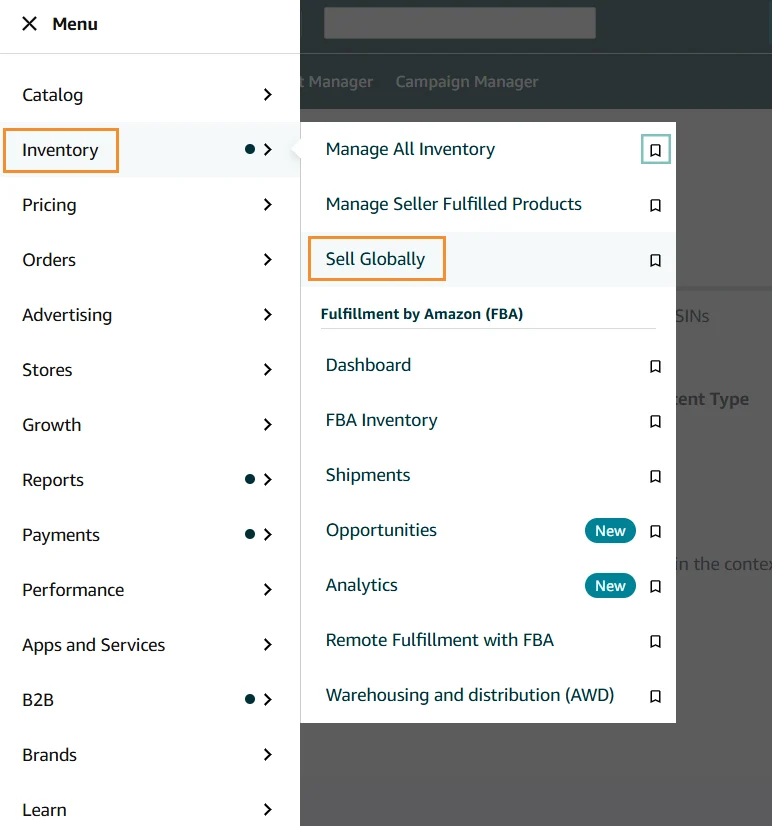
Sign in to your existing Seller Central account. Navigate to Inventory, then Sell Globally. From here, Amazon presents the available marketplaces you can register for.
For marketplaces within the same regional grouping as your existing account (such as Canada and Mexico for a US-based account), the setup process leverages your existing account credentials with minimal additional verification.
For marketplaces in a different region, such as expanding a US account into Europe, you will need to create a linked European seller account, provide additional business and tax documentation appropriate to that region, and complete Amazon’s verification process. This typically takes 1 to 2 weeks depending on how quickly you provide requested documentation.
Use Build International Listings to Cross-List From Your Home Marketplace
Amazon’s Build International Listings (BIL) tool allows you to synchronize your existing product listings from your source marketplace to your new target marketplaces. This copies your listings, product information, and images into the new marketplace and can automatically adjust pricing based on currency conversion and rules you set.
BIL is the fastest way to establish an initial presence in a new market. It also creates a foundation you can then customize with market-specific optimization rather than starting from scratch.
However, BIL should be treated as a starting point, not a finished implementation. Cross-listed content typically needs meaningful localization before it will perform well.
Localize Your Listings for Each Market
Localization goes beyond translation. A truly localized listing addresses:
Language and translation: Use professional translation services or native speakers for markets outside English-speaking territories. Machine-translated listings typically underperform significantly because the translations read as unnatural to native speakers.
Keywords and search behavior: Keyword usage varies by country. What US shoppers search may not match what German or Japanese shoppers search for the same product. Use marketplace-specific keyword research tools to identify the actual terms buyers use in your target market.
Cultural adaptation of imagery and messaging: Product images, lifestyle contexts, and marketing messages that work in one culture may fall flat or seem strange in another. Review your creative choices against local competitor listings to assess cultural fit.
Local specifications and standards: Measurements, sizes, and specifications should reflect what buyers in that market expect. US shoe sizes are different from UK and EU sizes. US electrical specifications differ from European ones.
Configure Fulfillment and Currency Conversion
Choose your fulfillment strategy for the new marketplace. Enable Amazon Currency Converter for Sellers (ACCS) or Amazon Seller Wallet to accept payments in the customer’s local currency and receive payouts in your home currency.
Amazon’s currency conversion tools remove one of the most complicated aspects of cross-border selling. Buyers see and pay in their local currency. You see reporting and receive payouts in your preferred currency. Amazon handles the FX in between at competitive rates.
Fulfillment Options for International Amazon Sellers
Fulfillment choice significantly affects your operational complexity, unit economics, and delivery speed.
Amazon FBA in Each Marketplace
Country-specific FBA means sending inventory into Amazon’s fulfillment centers in each marketplace where you sell. Amazon handles storage, order picking, packing, shipping, and customer service for that market.
For most sellers entering a new marketplace with meaningful expected volume, marketplace-specific FBA is the recommended default. It provides the fastest delivery, native customer service, and access to Prime shipping designation, which significantly affects conversion rate.
The tradeoff is upfront cost: shipping inventory to each new marketplace and paying for storage there before any sales are generated. For sellers uncertain about demand in a new market, this represents inventory risk.
Pan-European FBA
Pan-European FBA is Amazon’s inventory network across the European marketplaces. Instead of maintaining separate inventory in the UK, Germany, France, Italy, Spain, and other EU markets, sellers can send inventory to a single European fulfillment center and Amazon automatically distributes it across the network as needed to fulfill orders.
For sellers targeting multiple European markets, Pan-European FBA reduces inventory investment significantly and improves delivery times across all markets. The tradeoff is added tax complexity: distributing inventory across multiple EU countries triggers VAT registration requirements in each country where inventory is stored.
Multi-Channel Fulfillment (MCF)
Multi-Channel Fulfillment allows Amazon to fulfill orders from your existing inventory that come through non-Amazon channels, such as your own website, Shopify store, or other marketplaces. For sellers with existing FBA inventory in one market who receive orders from customers in another market, MCF can serve as a cross-border fulfillment option.
MCF is not the default choice for scaled international selling because unit economics are less favorable than marketplace-specific FBA, but it can be useful for testing initial demand in a new market without committing inventory there.
Seller-Fulfilled Cross-Border Shipping
Sellers can also fulfill international orders themselves, shipping from their home warehouse to international customers. This approach retains inventory control but sacrifices delivery speed and Prime eligibility, both of which affect conversion rate significantly in competitive categories.
Seller-fulfilled shipping is most appropriate for lower-volume categories, high-margin products where slower delivery is acceptable, or early-stage market testing before committing to FBA in a new marketplace.
Tax, VAT, and Legal Compliance
Tax compliance is the most commonly underestimated challenge in international expansion. Getting it wrong can result in penalties, back taxes, and account suspension. This section covers the main regimes but is not a substitute for professional tax advice.
VAT Registration in Europe
Value Added Tax (VAT) is a consumption tax applied throughout the EU and UK. As an Amazon global seller in Europe, you may be required to register for VAT in specific circumstances:
- You store inventory in a country (VAT registration in that country is typically required)
- You sell to buyers in a specific country above certain distance selling thresholds
- You are a non-EU seller shipping goods into the EU
The Pan-European FBA program automatically distributes inventory across countries, which typically triggers VAT registration requirements in each country where inventory is stored (Germany, France, Italy, Spain, Poland, Czech Republic).
VAT rates vary by country and typically fall between 19 and 25 percent for standard rate goods. VAT is paid by the buyer at checkout and remitted by the seller to the relevant tax authority on a quarterly or annual filing basis.
GST in Australia and Canada
Australia’s GST (Goods and Services Tax) applies at 10 percent to most goods sold to Australian consumers. Non-Australian sellers exceeding AUD $75,000 in Australian sales in a 12-month period are required to register for GST. Amazon may withhold and remit GST on behalf of some marketplace sellers under Australia’s low-value imported goods (LVIG) rules.
Canada’s GST/HST varies by province and ranges from 5 percent (GST-only provinces) to 15 percent (provinces with combined HST). Similar registration thresholds and marketplace facilitator rules apply.
IOSS for EU Imports Under €150
The Import One-Stop Shop (IOSS) is an EU system for collecting VAT on low-value goods (up to €150) imported into the EU from outside. Rather than the buyer paying VAT on delivery, IOSS allows sellers to collect VAT at checkout and remit it through a single European filing.
For non-EU sellers shipping goods valued up to €150 into the EU, IOSS registration significantly improves the customer experience by preventing surprise VAT charges on delivery, which reduce conversion rates and increase return rates.
When to Hire a Tax Advisor
For sellers approaching or crossing meaningful revenue thresholds in new markets, engaging a specialist international tax advisor is not optional. Tax rules change, marketplace facilitator rules affect what portion Amazon collects versus what you must remit, and mistakes compound quickly.
Recommended timing: engage a tax advisor with Amazon expertise in your target region before your first shipment of inventory into that market. The cost of professional advice is meaningfully lower than the cost of correcting compliance errors after the fact.
Common Challenges and How to Overcome Them
Language and Localization
The most common expansion mistake is treating translation as sufficient localization. A machine-translated listing typically underperforms a native-quality listing by a meaningful margin because native shoppers can immediately sense unnatural language.
Solution: Use professional translation services or native-language copywriters for markets outside your home language. Budget for this specifically as part of your expansion costs. For meaningful markets like Germany or Japan, this investment pays back quickly through higher conversion rates.
Currency and Payment Flow
Managing revenue in multiple currencies, dealing with FX conversion costs, and tracking profitability across markets adds accounting complexity.
Solution: Amazon Currency Converter for Sellers (ACCS) and Amazon Seller Wallet handle most of the operational complexity, converting buyer payments to your home currency at competitive rates. For scaling businesses, connecting Amazon accounts to specialist multi-currency accounting tools like A2X or Payoneer provides better financial visibility.
Marketing and Advertising Differences by Region
Sponsored Products and Sponsored Brands work similarly across marketplaces, but competitive dynamics, seasonal patterns, and buyer behavior differ, requiring an Amazon advertising strategy tailored to each market instead of simply replicating campaigns from your home marketplace. A PPC strategy that produces a 20 percent ACoS in the US may produce a 35 percent ACoS in Germany until localized creative and keyword strategy is developed.
Solution: Treat advertising strategy in a new market as an experiment, not a copy-paste operation. Start with a controlled budget, learn the market’s specific dynamics, and scale based on what actually converts locally.
Customer Service Across Time Zones
Amazon provides 24/7 customer service in the buyer’s native language for FBA orders, which handles most operational customer service needs. However, seller messaging and product-specific questions still come to you and must be responded to within Amazon’s response time expectations regardless of time zone.
Solution: Use Amazon’s automated message templates for common questions, set up email routing to your team based on marketplace, and for scaling international operations, consider a customer service partner with multi-language capability. The alternative is response time metrics declining below Amazon’s expectations, which affects account health.
Conclusion
Amazon Global Selling is one of the largest structural growth opportunities available to established Amazon sellers in 2026. The rising cost and competitive intensity of domestic markets, combined with the maturing international infrastructure and the buyer demand growing across every major Amazon marketplace globally, makes international expansion a genuinely strategic decision rather than an aspirational one.
The right approach is not to expand to as many markets as possible as quickly as possible. It is to choose the right first marketplace based on your product-to-market fit, operational readiness, and compliance capacity. Then execute that entry well before deciding on the next market. Sellers who move deliberately across markets consistently outperform those who launch simultaneously across five countries and lose momentum in every one.
If you are ready to expand internationally and want a partner who can help you plan the right sequence, manage the advertising strategy for new markets, and integrate localization into your listing optimization, AMZDUDES, a full service Amazon agency, can help. Our team supports Amazon sellers across the US, UK, EU, and Australian marketplaces with an integrated strategy that treats each market’s dynamics on its own terms while building a cohesive global growth plan.
Book a free consultation today.
Frequently Asked Questions
What is Amazon Global Selling?
Amazon Global Selling is Amazon’s program that allows sellers to list and sell products across multiple international Amazon marketplaces from a unified account structure. Rather than opening separate businesses in each country, sellers can access over 20 marketplaces across North America, Europe, Asia-Pacific, and the Middle East through Amazon’s linked account system, using tools like Build International Listings and Amazon Currency Converter to manage cross-border selling operationally.
How do I sell on Amazon globally?
To sell on Amazon globally, start by ensuring you have a Professional Seller account, then navigate to Inventory, Sell Globally in Seller Central to explore available marketplaces. Choose your first target marketplace based on demand, competition, and operational readiness. Set up the required regional seller account, use Build International Listings to cross-list your existing products, localize the listings for the new market, configure fulfillment (typically FBA), and address tax and compliance requirements before your first sale.
Which is the best marketplace to start with for Amazon Global Selling?
The best first marketplace depends on your home market. For US-based sellers, Canada is typically the lowest-friction first expansion because of shared language and similar consumer behavior. UK is the natural first European market for English-speaking sellers. Australia offers rapid growth with lower competition than US or UK marketplaces. Match the marketplace to your operational readiness rather than chasing the highest opportunity size, which is often the most competitive market to enter.
Do I need a business entity to sell on Amazon internationally?
Requirements vary by marketplace. Most European marketplaces do not require a local entity but may require VAT registration under specific circumstances. India effectively requires local business presence or an authorized intermediary. UAE and Saudi Arabia have specific business registration requirements. Verify the exact requirements for your target market before beginning setup, as some can add weeks or months to your timeline if not addressed in advance.
How much does it cost to start selling globally on Amazon?
Beyond the Professional Seller account fee ($39.99 per month or regional equivalent), main costs include translation and localization (typically $500 to $5,000 depending on market and product complexity), initial inventory investment into FBA in the new market, potential VAT registration and compliance costs, and marketing budget to establish initial presence. Total initial investment for entering a meaningful new market typically ranges from $5,000 to $25,000 depending on the market and how ambitious your entry plan is.
What is the difference between Pan-European FBA and country-specific FBA?
Country-specific FBA maintains separate inventory in each country’s Amazon fulfillment centers. Pan-European FBA allows Amazon to distribute inventory across the European network from a single stock pool, improving delivery speed and reducing inventory investment. Pan-European FBA is more efficient operationally but triggers VAT registration requirements in every country where inventory is stored. For sellers targeting multiple European markets seriously, Pan-European FBA typically becomes the right choice once the tax registration complexity is addressed.
What is IOSS and do I need it?
IOSS (Import One-Stop Shop) is an EU system for collecting VAT at checkout on goods valued up to €150 imported into the EU from outside. Without IOSS, buyers pay VAT on delivery, which reduces conversion rate and increases returns. Non-EU sellers shipping low-value goods into the EU should register for IOSS to improve the buyer experience and streamline VAT collection. IOSS is not required for goods fulfilled from FBA warehouses already within the EU.