Key Takeaways
- TikTok ads in 2026 typically cost between $4.20 and $9.00 CPM and between $0.17 and $1.00 CPC. Cost Per View (CPV) ranges from $0.01 to $0.07.
- The minimum campaign budget on TikTok is $500. The daily minimum is $50 at the campaign level and $20 at the ad group level.
- Ad format significantly affects cost. In-Feed Ads run $4 to $8 CPM, Spark Ads $5 to $10 CPM, TopView Ads $10 to $20 CPM, and Brand Takeovers $20 to $50 CPM.
- Audience targeting, industry, creative quality, geography, and seasonality are the five biggest cost drivers on TikTok.
- Most small businesses should start with a $500 to $3,000 monthly test budget. Below this, TikTok’s algorithm cannot collect enough data to optimize delivery effectively.
- Creative variation, broader targeting, and letting campaigns complete their learning phase are the three most effective ways to reduce TikTok ads cost without sacrificing performance.
TikTok has grown into one of the most important advertising channels for brands targeting engaged, high-intent audiences. But the platform’s auction-based pricing model means there is no single answer to how much does TikTok ads cost. The final number depends on your ad format, bidding strategy, audience targeting, and creative quality.
This guide breaks down TikTok advertising cost in 2026 across every dimension that matters: pricing models, ad format costs, the factors that push cost up or down, realistic budget expectations for different business sizes, and practical strategies to reduce spend without losing performance.
TikTok Ads Cost in 2026: The Quick Answer
Average CPC, CPM, and CPV Ranges
TikTok’s advertising costs in 2026 remain competitive with other social platforms and are often lower than Meta’s on a CPM basis for similar levels of engagement.
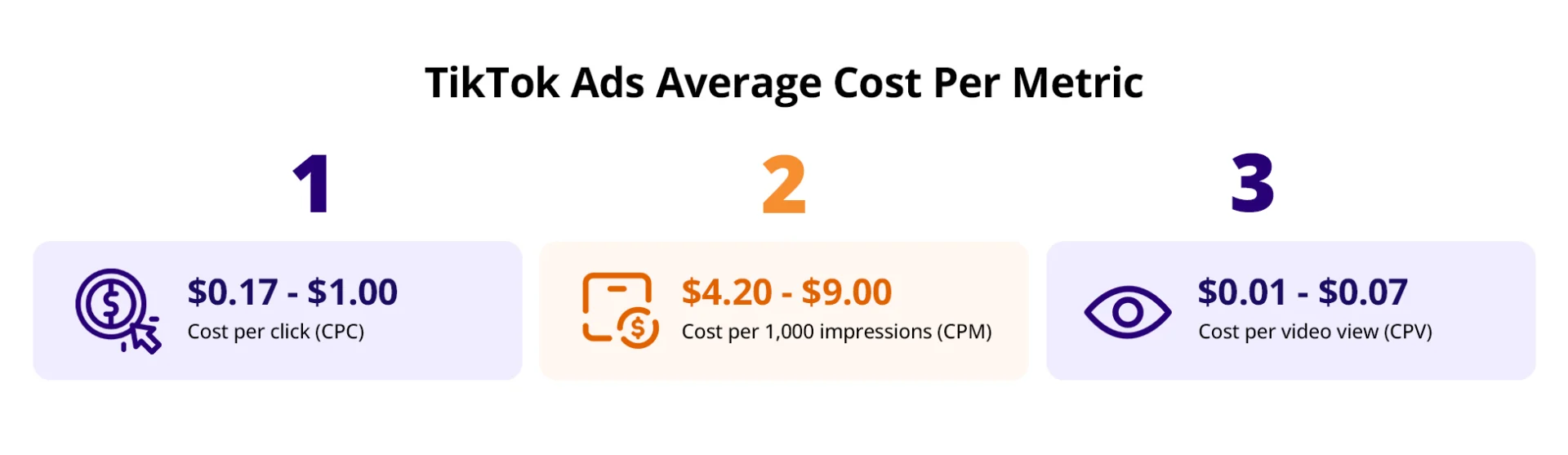
On average, advertisers can expect to pay $0.17 to $1.00 per click (CPC), $4.20 to $9.00 per 1,000 impressions (CPM), and $0.01 to $0.07 per video view (CPV) for views lasting at least two seconds. These figures are general benchmarks, and your actual costs will vary based on factors such as audience targeting, industry, creative quality, bidding strategy, and seasonal demand.
TikTok’s Actual Minimum Budgets
TikTok has specific minimum spend thresholds that campaigns must meet before they run:
- $500 minimum per campaign
- $50 minimum daily at the campaign level
- $20 minimum daily at the ad group level
These minimums exist because TikTok’s algorithm needs sufficient budget to collect enough data during the learning phase to optimize delivery. Campaigns funded below these levels either will not launch or will underperform significantly because the algorithm cannot complete the pattern-finding needed to identify winning audience segments.
What Most Businesses Spend Monthly
Real monthly TikTok ad budgets in 2026 typically fall in these bands:
- Small businesses testing the platform: $500 to $3,000 per month
- Growing DTC brands with an active TikTok strategy: $5,000 to $15,000 per month
- Established brands scaling on TikTok: $20,000 to $100,000 per month
- Enterprise brands running full-funnel campaigns including Brand Takeovers: $150,000 to $500,000+ per month
The floor for meaningful testing is around $500 per month. Below that, you do not accumulate enough data to know whether the results are due to the ads or to random variation.
TikTok Ad Pricing Models Explained
TikTok offers four core pricing models. The right one depends on your campaign goal, not your budget.
Cost Per Click (CPC)
CPC means you pay only when a shopper clicks your ad. You are not charged for impressions or views, only for the users who actually take action.
CPC is the best choice for campaigns focused on driving traffic, conversions, or app installs. It aligns your spending directly with the action you care about. The tradeoff is that CPC rates are higher than CPM rates on an apples-to-apples basis because you are paying for a more valuable outcome.
Average TikTok ads cost per click in 2026: $0.17 to $1.00 depending on targeting and industry.
Cost Per Mille / Thousand Impressions (CPM)
CPM means you pay a set price for every 1,000 impressions your ad delivers, regardless of whether anyone clicks, engages, or converts. You are buying reach, not action.
CPM is the right model for brand awareness campaigns where the goal is exposure to as many people as possible in your target audience. It is also the base model that most auction-based bidding operates on internally.
Average TikTok CPM in 2026: $4.20 to $9.00.
Cost Per View (CPV)
CPV means you pay when someone watches your video for at least two seconds or clicks on it, whichever comes first. This model is specifically designed for video-first campaigns.
CPV is the most cost-efficient way to accumulate video views at scale, making it the right choice for campaigns focused on video engagement, brand storytelling, or content that needs multiple exposures to convey its message.
Average TikTok CPV in 2026: $0.01 to $0.07.
Optimized CPM (oCPM)
Optimized CPM is a TikTok-managed variant of standard CPM where the platform’s algorithm optimizes delivery toward users most likely to take a specific action, such as making a purchase or installing an app. You still pay per 1,000 impressions, but the impressions are algorithmically directed at higher-intent users rather than distributed broadly.
oCPM is well-suited to conversion-focused campaigns where you want the efficiency of impression-based buying combined with the intent-based targeting of a conversion campaign. Average oCPM rates typically fall between $4 and $8, though the effective cost per action can be significantly lower than pure CPM because the impressions are more targeted.
TikTok Pricing Model Comparison
| Pricing Model | Average Cost (2026) | Best For |
| CPC | $0.17 to $1.00 | Traffic, conversions, app installs |
| CPM | $4.20 to $9.00 | Brand awareness and reach |
| CPV | $0.01 to $0.07 | Video views and engagement |
| oCPM | $4 to $8 | Conversion-optimized delivery |
TikTok Ad Costs by Format
TikTok offers multiple ad formats with meaningfully different cost profiles. Choosing the right format for your goal is as important as choosing the right pricing model.
In-Feed Ads
In-Feed Ads appear in users’ For You Page feeds and look visually similar to organic TikTok content. They are the default ad format for most campaigns and offer the best combination of cost efficiency and scale.
Typical cost: $4 to $8 CPM
Best for direct-response campaigns, product launches, and any objective where the ad needs to feel native to the platform.
Spark Ads
Spark Ads promote existing TikTok content, either from your own account or from a creator’s account (with permission). They retain the original engagement metrics, including likes, comments, shares, and follows, and the video feels indistinguishable from organic content because it is organic content that has been amplified.
Typical cost: $5 to $10 CPM
Spark Ads consistently outperform standard In-Feed Ads on engagement rate because they inherit the credibility and interaction signals of organic content. For most brands, Spark Ads should be a core part of the TikTok strategy.
TopView Ads
TopView Ads appear as the first full-screen video users see when they open the TikTok app. They deliver maximum visibility and are impossible for the user to miss.
Typical cost: $10 to $20 CPM (sold as flat daily rates that can start around $50,000 per day)
TopView is a premium format best suited to national campaigns, major product launches, and brand-building efforts by established brands with substantial budgets.
Branded Hashtag Challenge
The Branded Hashtag Challenge invites users to participate in a themed challenge and post their own content using a unique brand hashtag. When executed well, it generates significant organic user-generated content and viral amplification.
Typical cost: Starting around $150,000 for a six-day campaign
This is the highest-effort format on TikTok and is only appropriate for brands with substantial budgets, strong creative concepts, and the audience reach to make participation feel meaningful.
Branded Effects
Branded Effects are custom AR filters, stickers, or lenses that TikTok users can apply to their own videos. They function as an interactive brand asset that spreads through user creation rather than paid placement.
Typical cost: $80,000 to $150,000+ depending on complexity and duration
Best for lifestyle brands, entertainment properties, and campaigns where user creation and participation are the goal.
TikTok Search Ads
TikTok Search Ads appear in the platform’s search results when users search specific keywords. They combine TikTok’s platform-native format with intent-based targeting similar to Google or Amazon search advertising.
Typical cost: $0.10 to $0.30 CPC for standard keywords, higher for competitive terms
Search Ads are one of the most cost-efficient TikTok formats for direct-response campaigns because they capture shoppers with active search intent rather than interrupting their feed.
TikTok Ad Format Cost Comparison
| Ad Format | Typical Cost | Best For |
| In-Feed Ads | $4 to $8 CPM | Default format for most campaigns |
| Spark Ads | $5 to $10 CPM | Amplifying high-performing organic content |
| TopView Ads | $10 to $20 CPM (from ~$50K/day) | Maximum visibility, national campaigns |
| Branded Hashtag Challenge | From $150,000 per six-day campaign | Viral user-generated participation |
| Branded Effects | $80,000 to $150,000+ | Interactive brand assets and AR filters |
| TikTok Search Ads | $0.10 to $0.30 CPC | Intent-based direct response |
Key Factors That Influence TikTok Ad Costs
TikTok ad prices vary dramatically from one campaign to the next. Five factors explain most of the variation.
Audience Targeting and Competition
Your targeting choices affect cost directly. Broad targeting produces lower costs but lower relevance. Narrow targeting produces higher costs but stronger conversion because the audience matches your ideal buyer more precisely.
Targeting “all users 18 to 34” costs meaningfully less per impression than targeting “women 18 to 24 interested in skincare in New York City.” The narrower audience faces more competitive bidding pressure from other advertisers pursuing the same segment.
Cost impact by targeting approach, from lowest to highest:
- Broad targeting: lowest cost, lowest relevance
- Demographic targeting: moderate cost
- Interest targeting: higher cost
- Custom audiences and retargeting: highest cost, highest relevance
Ads targeting Gen Z users (18 to 24) tend to cost more than ads targeting other age brackets because so many brands compete for that demographic on TikTok specifically.
Industry and Vertical
Cost varies significantly by industry. E-commerce and DTC brands typically pay higher rates because the category is intensely competitive on TikTok. B2B advertisers often see lower auction pressure because fewer B2B brands actively advertise on the platform. Regulated industries like finance and health may face higher costs due to platform restrictions and additional approval requirements.
Creative Quality and Engagement
TikTok’s algorithm rewards creative that performs well organically. Ads with strong watch time, high click-through rate, and genuine engagement receive lower effective CPMs because the algorithm distributes them more efficiently. Ads with weak creative that fails to hold attention face higher costs as the algorithm reduces delivery.
This is the single most controllable cost factor. A brand producing native-feeling, high-performance creative can achieve dramatically better cost efficiency than a brand running polished but non-native ads at the same budget level.
Geography and Location
TikTok CPMs vary by geographic market. The US and UK have among the highest CPMs globally due to advertiser competition and Prime advertiser presence. Emerging markets across Southeast Asia, Latin America, and parts of Europe offer significantly lower CPMs, sometimes 40 to 60 percent below US levels.
For global brands, this creates an opportunity to scale efficiently in secondary markets before intensifying competition raises costs.
Seasonality: Q4 and Holidays
TikTok ad costs rise significantly during high-demand periods. Q4 (October through December), covering Black Friday, Cyber Monday, and the holiday shopping season, is the most expensive advertising window of the year. CPMs during peak Q4 can be 30 to 50 percent higher than typical months.
Other cost-sensitive windows include Prime Day (July), back-to-school (August), and Valentine’s Day (early February) for gift-relevant categories.
If your product does not require holiday-timed advertising, running campaigns during lower-competition months (typically January through March and September) delivers better cost efficiency meaningfully.
How Much Should You Budget for TikTok Ads?
Budget sizing depends on your business stage, goals, and how much data you need to accumulate before making decisions.
Small Business Starter Budget
For a small business testing TikTok for the first time, plan for $500 to $3,000 per month for a meaningful test. This budget allows you to run campaigns across multiple ad groups with enough spend for TikTok’s algorithm to complete its learning phase and identify converting audience segments. If your product is also eligible for TikTok Shop, pairing ad spend with a shoppable storefront often produces a stronger return than running ads to an external site alone.
Starting below $500 per month typically does not generate enough data to make confident optimization decisions. You will not know whether the results reflect the ads or random variation across a very small sample of impressions and clicks.
Mid-Size Brand Testing Budget
For an established DTC brand entering TikTok as a new channel with the intent to scale if it works, budget $5,000 to $15,000 per month for the first 60 to 90 days. This budget supports a proper structural test: multiple creative variations, multiple audience segments, and enough conversion volume to attribute performance reliably.
At this budget level, you should be able to identify winning creative and audience combinations within 60 days and begin scaling those winners with confidence.
Enterprise Campaign Budget
For enterprise brands running TikTok as a core channel with full-funnel campaigns including Spark Ads, DSP-style audience targeting, and premium format usage such as TopView or Branded Hashtag Challenges, monthly budgets typically start at $50,000 and can exceed $500,000 for brands running major launches or seasonal campaigns.
The 3-to-5-Day Learning Phase Minimum
Regardless of budget size, TikTok’s algorithm requires a learning phase to optimize delivery. This phase typically takes 3 to 5 days or approximately 50 conversions to complete, whichever happens first.
The most expensive mistake sellers make with TikTok advertising is pausing a campaign after 48 hours because the initial cost per acquisition looks high. Doing so wastes the entire learning phase investment and forces you to restart the algorithm’s optimization from zero if you relaunch. Let your campaigns run at least 5 days before making major structural changes. Your data during the learning phase is not representative of what your steady-state cost will be after the algorithm has optimized.
How to Reduce TikTok Ad Costs Without Losing Performance
Creative Variation and Testing
Creative fatigue is the fastest cause of rising TikTok ad costs. When a single creative is served to the same audience repeatedly, engagement declines, TikTok’s algorithm reduces its distribution, and effective cost per outcome rises.
The fix is producing enough creative variation to keep the algorithm supplied with fresh content to test. Best practice is refreshing your ad creative every 2 to 4 weeks with new variations targeting the same audience. Even small changes such as different opening hooks, alternate music tracks, or updated calls to action extend a creative’s useful life significantly.
An AI creative approach or partnering with a UGC-focused agency helps produce this volume of variation without the cost overhead of traditional production. Testing 5 to 10 creative variations per campaign cycle is more effective than perfecting a single piece.
Broader Targeting to Lower Auction Pressure
Counterintuitively, broader targeting often reduces cost per outcome on TikTok compared to narrow targeting. TikTok’s algorithm is genuinely effective at finding relevant users within a broad audience if the creative is strong. Narrow targeting adds auction pressure without necessarily improving results.
Test broader targeting alongside your narrow segments and let the performance data guide you. Many brands find that “all users 18 to 45 in the US” outperforms narrower interest-based segments on both cost efficiency and total conversion volume.
Letting the Algorithm Complete Its Learning Phase
This is worth repeating because the mistake is so common. TikTok campaigns look expensive during the first 3 to 5 days because the algorithm is testing broadly to identify converting patterns. Pausing during this phase wastes the entire budget invested in learning and forces you to restart from zero on any relaunch.
Set your test budget with the understanding that you are paying for the learning phase specifically, then evaluate steady-state performance only after the phase has completed. A campaign that looks expensive at 48 hours and becomes efficient at day 6 is behaving normally, not underperforming.
Using Spark Ads to Amplify Organic Performance
Spark Ads consistently deliver lower effective cost per outcome than standard In-Feed Ads because they inherit the engagement momentum of organic content. A creator video that has already generated strong watch time and engagement organically will typically continue to perform when boosted through Spark Ads, at lower cost than a paid ad starting from zero engagement history.
Building a pipeline of high-performing organic content, then selectively boosting the best performers through Spark Ads, is one of the most cost-efficient TikTok advertising strategies available in 2026.
Conclusion
TikTok ads cost in 2026 what most sellers pay depends on many variables: the ad format you choose, the audience you target, the industry you operate in, the quality of your creative, and the season you run campaigns in. But the ranges are well-defined and predictable enough to plan against: $4.20 to $9.00 CPM, $0.17 to $1.00 CPC, and $0.01 to $0.07 CPV cover the majority of campaigns running on the platform today.
The two factors that make the biggest difference to your effective cost are creative quality and letting the algorithm complete its learning phase. Strong native creative combined with proper testing discipline consistently produces meaningfully lower cost per outcome than any bidding tactic or targeting hack. If you are new to TikTok advertising, start with a $500 to $3,000 monthly test budget, produce 5 to 10 creative variations, run each campaign for at least 5 days before evaluating performance, and let the results guide your next iteration.
If you want a partner who can build a TikTok Shop and advertising strategy that connects creative, paid campaigns, and shop operations into one growth system, AMZDUDES can help. Our TikTok Shop management services are built around what actually drives cost-efficient performance on TikTok: native-feeling creative, disciplined testing cycles, and campaign structures designed to compound results over time rather than chase short-term spikes.
Book a free consultation today!
Frequently Asked Questions
How much do TikTok ads cost in 2026?
TikTok ads in 2026 typically cost between $4.20 and $9.00 CPM (per 1,000 impressions), $0.17 to $1.00 CPC (per click), and $0.01 to $0.07 CPV (per video view). Final costs depend on your targeting, ad format, industry, creative quality, and seasonality. The minimum campaign budget is $500 with a daily minimum of $50 at the campaign level.
What is the minimum cost to advertise on TikTok?
The minimum cost to advertise on TikTok is $500 per campaign, with a $50 daily minimum at the campaign level and a $20 daily minimum at the ad group level. These minimums exist because TikTok’s algorithm requires sufficient budget to collect enough data during the learning phase to optimize delivery effectively.
How much does a TikTok ad cost compared to Facebook ads?
TikTok CPMs typically range from $4.20 to $9.00, comparable to or slightly lower than Facebook’s $5 to $18 CPM range. TikTok often delivers stronger engagement rates than Facebook, particularly with younger demographics, which can produce lower effective cost per outcome even when the raw CPM is similar.
What are TikTok ad prices for small businesses?
Small businesses should plan a minimum monthly TikTok ad budget of $500 to $3,000. This range allows the algorithm to complete its learning phase and generates enough conversion data to make meaningful optimization decisions. Starting below $500 monthly typically does not produce enough data for reliable performance evaluation.
Why is my TikTok ad cost so high?
High TikTok advertising costs usually result from one of five factors: creative that is not resonating (low watch time and click-through rate), overly narrow audience targeting creating unnecessary auction pressure, running campaigns during peak seasonality (especially Q4), targeting high-cost geographic markets, or pausing campaigns before the learning phase completes. Refreshing creative and testing broader targeting are the two most effective ways to reduce costs.
What is the average TikTok ads cost per click in 2026?
The average TikTok ads cost per click in 2026 ranges from $0.17 to $1.00, with most campaigns landing between $0.30 and $0.60. E-commerce and DTC categories tend toward the higher end due to competitive auction pressure, while B2B and less-competed categories often see CPCs below $0.30.
Which TikTok ad format is most cost-effective?
In-Feed Ads at $4 to $8 CPM offer the best combination of cost efficiency and scale for most brands and are the appropriate default format for direct-response campaigns. Spark Ads at $5 to $10 CPM often deliver even better effective cost per outcome because they inherit the engagement momentum of organic content. TikTok Search Ads at $0.10 to $0.30 CPC are among the most cost-efficient formats for intent-based direct response.