
Key Takeaways
- Inventory controls are getting stricter: Amazon is ending commingled inventory and dropping FBA prep services, which means sellers need stronger labeling, prep processes, supplier coordination, and SKU tracking.
- OTDR enforcement is becoming more targeted: Amazon is focusing more on repeat issues, serious customer complaints, and poor-performing listings instead of isolated mistakes.
- Cash flow pressure is increasing: DD+7 payout delays mean sellers will wait longer to receive funds, making stronger forecasting, reserves, and inventory planning more important.
- FBA costs are rising: Higher fulfillment fees, new fuel surcharges, and updated removal and disposal fee timing make margin management and inventory turnover more critical.
- Returns management is becoming more important: Mandatory prepaid return labels and updated refund timelines mean sellers need more accurate return settings, documentation, and return monitoring processes.
This year has introduced a wave of Amazon marketplace policy news and updates that are hard to ignore. Amazon has introduced several Amazon Marketplace policy updates that can highly impact sellers presence on Amazon.
In this guide, we will break down the latest Amazon marketplace policy news, sellers, and updates, explain what they mean for sellers, and share practical compliance tips to help you protect your account and stay ahead in 2026.
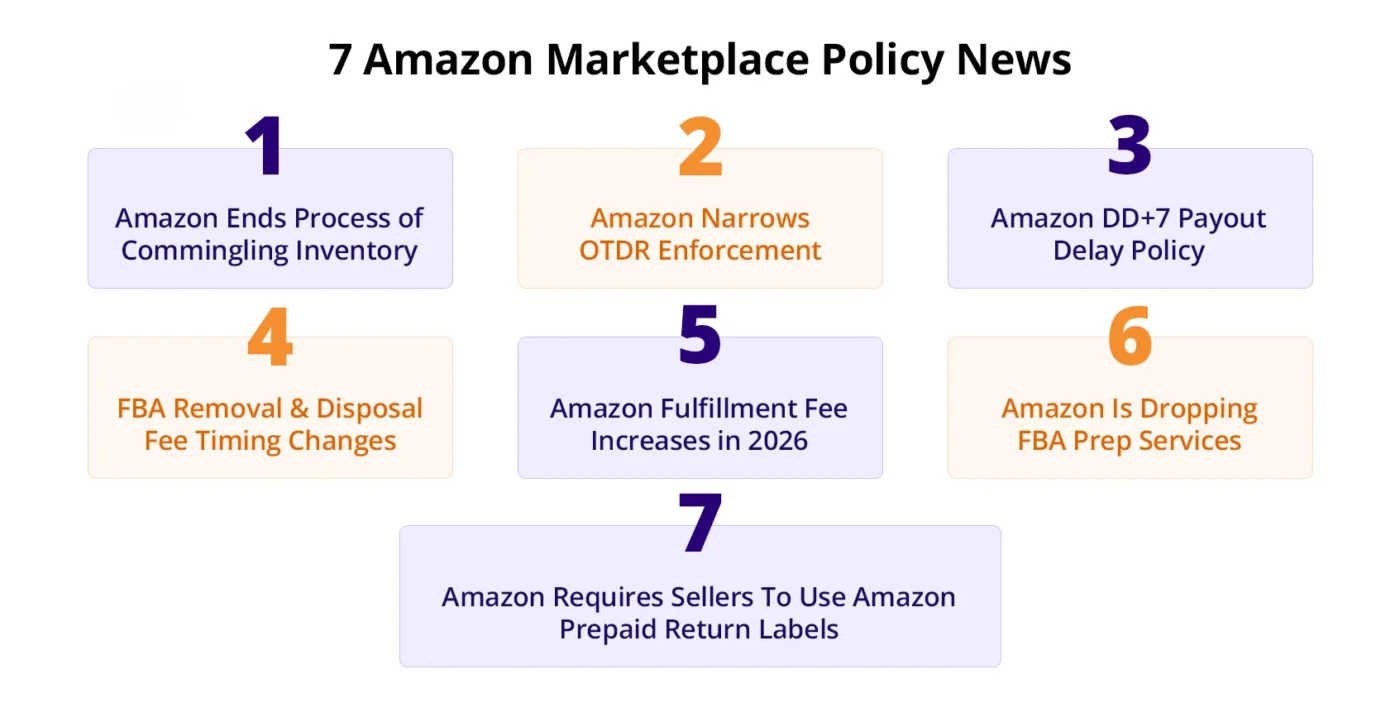
1. Amazon Ends Process of Commingling Inventory
Under Amazon’s previous inventory system, products from multiple sellers with the same UPC or manufacturer barcode could be mixed in fulfillment centers. This process, known as commingling or stickerless inventory, allowed Amazon to ship the nearest available unit regardless of which seller originally sent it.
As part of Amazon’s 2026 policy updates, the company is moving away from commingled inventory practices effective from March 31, 2026. Amazon now places greater emphasis on seller-specific inventory tracking, even for products with the same UPC or manufacturer barcode.
The discontinuation of stock commingling marks the end of an era where identical products from different sellers were stored together in fulfillment centers. Although Amazon says delivery speeds will remain fast, sellers now have more control over inventory quality, traceability, and account protection.
How does this affect sellers
The biggest benefit for sellers is reduced risk. You are far less likely to receive complaints or account issues because of another seller’s defective inventory.
However, sellers who previously relied on stickerless inventory may see slightly higher prep costs, more labeling requirements, and additional operational steps before sending products to FBA.
Brands with private-label products or strict quality-control standards will benefit most because Amazon can now trace inventory more easily back to the correct seller.
This update also means that sellers can no longer assume Amazon will merge identical inventory automatically. Businesses with multiple suppliers, resellers, or wholesale sourcing models will need stronger SKU tracking and warehouse management systems.
Practical Tips
- Use FNSKU labels for all FBA inventory, even if Amazon does not require it.
- Track inventory by supplier and batch number to quickly identify quality issues.
- Inspect inbound inventory more carefully before sending it to Amazon warehouses.
- Monitor customer complaints for recurring issues that may signal supplier problems.
- Use Amazon Transparency or product authentication programs if you sell branded products vulnerable to counterfeiting.
2. Amazon Narrows OTDR Enforcement
Amazon has adjusted the way it enforces the Order Defect Rate (OTDR), narrowing the types of defects that contribute to account health penalties.
Historically, OTDR included a broad mix of negative seller signals such as chargebacks, A-to-Z Guarantee claims, negative feedback, and delivery-related issues. In some cases, sellers could face account warnings or suspensions because of isolated incidents outside of their direct control.
Amazon’s latest policy changes focus OTDR enforcement more narrowly on severe customer-impacting issues rather than minor operational errors. Effective February 28, 2026, Amazon will continue requiring sellers to maintain at least a 90% on-time delivery rate for seller-fulfilled orders.
Previously, if a seller’s OTDR dropped below 90%, Amazon could deactivate all seller-fulfilled listings. Under the updated policy, Amazon will now deactivate only the listings that contribute most heavily to the OTDR decline, while other seller-fulfilled listings can remain active.
However, sellers with OTDR metrics significantly below 90% or those who repeatedly fail to meet the requirement may still face full deactivation of all seller-fulfilled listings.
How This Effect Sellers
This change gives sellers more relief and reduces the likelihood of sudden suspensions caused by one-off problems.
However, Amazon is also becoming more aggressive against repeat offenders. Sellers who consistently generate customer complaints, unresolved refunds, poor communication, or repeated Amazon policy violations may still face strict enforcement.
Account health now depends less on isolated incidents and more on overall operational consistency. Sellers with strong metrics, fast response times, and good customer service are in a much safer position.
Practical Tips
- Respond to customer messages within 24 hours whenever possible.
- Resolve negative feedback and refund requests quickly before they escalate.
- Monitor your Account Health dashboard weekly.
- Keep valid tracking information and proof of delivery for all FBM orders.
- Focus on preventing repeat issues instead of only fixing isolated complaints.
3. Amazon DD+7 Payout Delay Policy
One of the biggest changes impacting seller cash flow is Amazon’s DD+7 payout policy, which now holds seller funds for seven days after an order is delivered. Previously, sellers often received disbursements much sooner after an order shipped. Under the DD+7 model, Amazon waits until the package is marked as delivered and then holds the funds for an additional seven days before releasing payment.
Amazon says this change is designed to reduce fraud, improve reserve management, and ensure there is enough coverage for returns, refunds, chargebacks, and A-to-Z claims.
This update particularly affects FBM sellers because they often experience longer shipping windows compared to FBA sellers.
How This Effect Sellers
The biggest impact is cash flow pressure. Sellers may have to wait significantly longer to access revenue from completed orders. This can create challenges for businesses that rely on fast inventory replenishment cycles, ad spend, payroll, or supplier payments.
FBA sellers are generally less affected because their orders are delivered more quickly, while FBM sellers may face longer delays due to slower shipping timelines. Sellers with seasonal inventory or tight margins may need to adjust their budgeting and forecasting to account for the slower payout cycle.
Practical Tips
- Build larger cash reserves to handle payout delays.
- Forecast inventory purchasing needs further in advance.
- Negotiate longer payment terms with suppliers if possible.
- Use Amazon lending, business credit lines, or working capital solutions carefully if short-term cash flow becomes a problem.
- Prioritize faster shipping methods to shorten the delivery-to-payment timeline.
4. FBA Removal and Disposal Fee Timing Changes
Amazon has also updated the timing and structure of FBA removal and disposal fees. Starting February 15, 2026, Amazon removal fees and Amazon disposal fees will be charged per unit as each item is processed, giving sellers better visibility without changing the fee rates.
This change is part of FBA’s policy and compliance updates designed to give sellers more clarity into their inventory costs.
Previously, fees were collected only after the entire removal or disposal order was completed. Charging per unit makes it easier to match costs to specific SKUs and improves overall inventory tracking.
How This Effect Sellers
Sellers holding slow-moving inventory could see higher costs if they delay removal requests. Businesses that rely on large inventory buffers may face increased storage pressure and higher removal expenses during peak periods.
At the same time, sellers with strong forecasting and healthy sell-through rates may benefit from lower long-term storage costs and more efficient inventory turnover. This change reinforces the importance of inventory planning and proactive SKU management.
Practical Tips
- Review your FBA Inventory Age and Inventory Performance Index reports regularly.
- Remove slow-moving inventory before peak fee periods begin.
- Use promotions, coupons, and PPC campaigns to clear excess stock.
- Forecast inventory demand more accurately to avoid overstocking.
- Create monthly audits for aged, stranded, and low-performing inventory.
5. Amazon Fulfillment Fee Increases in 2026
Amazon has increased several FBA fulfillment fees in 2026, especially for oversized items, low-priced products, and products with high return rates. Sellers using FBA may now face higher per-unit handling, storage, and shipping costs depending on product dimensions, weight, and category. Starting April 17, 2026, a 3.5% fuel and logistics-related surcharge will be applied to fulfillment fees across Fulfillment by Amazon (FBA).
How This Affects Sellers
Higher fulfillment fees can reduce profit margins, especially for bulky products, low-ticket items, and listings with weak conversion rates. Sellers who do not regularly review unit costs may find that previously profitable SKUs are no longer worth selling through FBA.
Practical Tips
- Review profitability by SKU every month.
- Focus on reducing packaging size and dimensional weight.
- Increase prices carefully where possible to protect margins.
- Remove low-margin or oversized products that are no longer profitable.
- Monitor return rates because high-return products can become much more expensive to fulfill.
6. Amazon Is Dropping FBA Prep Services
Starting January 1, 2026, Amazon will no longer offer prep and item labeling services for FBA shipments in the U.S. Sellers who previously relied on Amazon to apply FNSKU labels, polybags, bubble wrap, suffocation warnings, or other prep requirements will now need to handle these tasks themselves or work with a third-party prep provider.
Amazon says this change is happening because most sellers and suppliers now have stronger packaging capabilities and can meet Amazon’s requirements without additional support. The company also wants to reduce delays inside fulfillment centers and improve warehouse efficiency.
How This Affects Sellers
This change will have the biggest impact on sellers who depend on Amazon for labeling, prep work, and packaging compliance. Sellers shipping fragile products, liquids, glassware, toys, or items that require special prep may now face higher labor costs and longer preparation timelines.
Inventory that arrives without the correct labels, packaging, or prep requirements may be delayed, rejected, or become ineligible for reimbursement if items are damaged or lost. Sellers will need to take more responsibility for ensuring every unit is compliant before it reaches Amazon’s warehouses.
Practical Tips
- Audit your SKUs to identify products that previously relied on Amazon prep services.
- Work with suppliers to add labels, polybags, and packaging during manufacturing.
- Use reliable third-party prep centers or 3PL providers if you do not have in-house prep capabilities.
- Make sure every unit has the correct FNSKU label before shipment.
- Build extra lead time into your inventory planning to account for prep and labeling work.
7. Amazon Requires Sellers To Use Amazon Prepaid Return Labels
Starting February 8, 2026, Amazon requires all U.S. sellers to use Amazon Prepaid Return Labels for eligible customer returns. This update removes the previous exemption for high-value items and is designed to create a faster, more consistent return experience for buyers.
Under the updated policy, Amazon automatically provides prepaid return labels through Buy Shipping Services, reducing refund cycle times from 14 days to around 7 days. Sellers no longer need to coordinate return shipping manually through buyer-seller messages, which simplifies operations and reduces support workload.
How This Affects Sellers
This is a major change for FBM sellers because Amazon now has greater control over the return process. Sellers must ensure that return addresses, product dimensions, and shipping weights are accurate to avoid return issues and incorrect shipping charges.
Amazon is also updating the FBM refund timeline. Starting January 26, 2026, sellers will have four calendar days after receiving a returned item to issue a refund instead of two business days. This gives sellers more time to inspect returned products, apply restocking fees where appropriate, and upload evidence for damaged or altered items.
Practical Tips
- Make sure your U.S. return address is accurate and up to date.
- Keep product weights and dimensions updated for accurate return shipping charges.
- Use the Guided Refund Workflow to inspect returns and apply restocking fees if needed.
- Upload photos and documentation for damaged, altered, or incomplete returns.
- Review return rates regularly to identify products with unusually high return activity.
Conclusion
In 2026, staying informed is no longer optional for Amazon sellers. The latest Amazon marketplace policy news updates show that Amazon is putting greater focus on compliance, seller accountability, inventory accuracy, and cash flow controls.
The recent Amazon marketplace policy update has the potential to affect seller operations and profitability. Staying updated on Amazon marketplace policy news 2026 is crucial as it demands compliance from sellers, and those who treat compliance as part of their long-term strategy are likely to maintain a strong presence on Amazon.
If you need support navigating these changes, AMZDUDES can help. Our Amazon marketing experts keep up with the updates and can help you stay compliant and build long-term growth on Amazon. Book a free consultation now!
Frequently Asked Questions
What are the latest Amazon Marketplace policy updates in 2026?
The latest Amazon marketplace policy updates in 2026 include the end of inventory commingling, narrower OTDR enforcement, DD+7 payout delays, prepaid labels requirement, and changes to FBA removal and disposal fees. These updates are designed to improve customer trust, inventory accuracy, and seller accountability.
Why did Amazon end commingled inventory?
Amazon ended commingled inventory to reduce the risk of counterfeit, damaged, or incorrect products being mixed between sellers. Under the old system, one seller could receive complaints or policy violations because of another seller’s inventory. Seller-specific inventory tracking now gives merchants more control and protection.
What is Amazon’s DD+7 payout policy?
Amazon’s DD+7 payout policy means sellers receive their funds seven days after an order is delivered rather than shortly after shipment. This policy helps Amazon cover refunds, returns, and claims, but it can create cash flow challenges for sellers, especially those using FBM.
What is OTDR on Amazon?
OTDR stands for Order Defect Rate. It measures negative customer experiences such as A-to-Z Guarantee claims, chargebacks, and negative feedback. Amazon uses OTDR to monitor seller performance and determine whether an account is at risk of warnings or suspension.
How can sellers stay compliant with Amazon policy updates?
Sellers can stay compliant by reviewing Amazon policy news regularly, monitoring account health metrics, keeping accurate inventory records, responding quickly to customer issues, and auditing any third-party tools connected to their account. Staying proactive is the best way to avoid penalties and protect long-term growth.