

Key Takeaways
- Amazon PPC is often necessary for small and mid-sized sellers to compete. With increasing competition, paid advertising has become a key driver of visibility and sales.
- Amazon PPC can deliver fast results, but it comes at a cost. While it provides instant exposure and control over budgets, rising CPCs can make campaigns expensive.
- Profitability depends on strategy, not just spending. Without proper keyword targeting, bid management, and ongoing optimization, Amazon PPC can quickly drain budgets.
- There are real risks for smaller sellers. High competition, ad fatigue, and limited data in early stages can make it harder to see quick returns.
- Amazon PPC is worth it when managed correctly. For small and mid-sized sellers, strategic execution determines whether PPC becomes a growth tool or a money drain.
With 9 million registered sellers on Amazon and approximately 550 new seller registrations every day, competition on the platform continues to intensify. For small and mid-sized sellers, gaining visibility organically is becoming harder. This makes advertising a necessity, and without strategic Amazon PPC campaigns, it is nearly impossible to stand out.
Amazon’s marketplace is tougher than ever for small sellers. Data shows small sellers spend 127% more on Sponsored Products ads and 34% more on Sponsored Brand ads than big brands. This drives up costs for small sellers as competition intensifies. With such rising expenses, sellers often wonder if it’s worth investing in advertising.
In this guide, we’ll break down how Amazon PPC works, explore its advantages and drawbacks for small and mid-sized sellers to help you decide if investing in Amazon PPC is worth it or not. We will also provide practical strategies that are proven for high Amazon PPC ROI.
Understanding Amazon PPC
Amazon PPC (Pay-Per-Click) is Amazon’s advertising model, where sellers pay only when shoppers click on their ads. These ads appear directly within search results and product pages, giving sellers immediate visibility in a marketplace that has become increasingly competitive.
Investing in Amazon PPC allows companies to enhance product visibility and attract more visitors to their listings, as this helps generate more sales on the site. It’s a valuable tool for sellers looking to grow their presence and reach more customers on Amazon.
The core of Amazon’s PPC lies in its keyword bidding process. Sellers bid on chosen keywords, and these bids determine the placement of their ads in the search results. Amazon uses an auction-style system where ads with higher bids and better relevance get more favorable positions. This means that even if a seller’s bid is not the highest, their ad can still appear prominently if it is highly relevant to the customer’s search query.
4 Benefits of PPC for Small & Mid-Sized Sellers

Amazon PPC advertising offers numerous benefits, especially for small & mid-sized sellers:
1. Instant Visibility
Amazon PPC allows you to get your products in front of potential customers as soon as your campaign goes live. This aspect sets it apart from organic marketing strategies, which take weeks or even months to get you results. The immediate exposure allows small and mid-sized businesses to generate early sales and compete with established brands without waiting for organic rankings to build over time.
2. Budget Control
Amazon PPC gives you complete control over how much you spend. Sellers can set daily budgets and pause campaigns anytime. You also have the option to adjust your spend based on performance. This means you can increase spending on what’s working and cut costs on what isn’t working. This control makes Amazon PPC manageable for small brands.
3. Targeted Reach
Amazon PPC allows sellers to target ads with high precision. This allows sellers to reach the right shoppers who are likely to buy their product. For example, you can target users based on their location, demographics, and the keywords they type into Google or Amazon. This ensures your budget is not wasted in low-quality traffic that only results in increased ad spend.
4. Flexibility
Campaigns can be adjusted quickly based on performance data. For example, if an ad isn’t performing well, you can quickly adjust or replace it and optimize your strategy in real time instead of waiting for the campaign to finish. Sellers can experiment with different keywords, adjust bids, and refine strategies continuously.
4 Drawbacks of PPC for Small & Mid-Sized Sellers
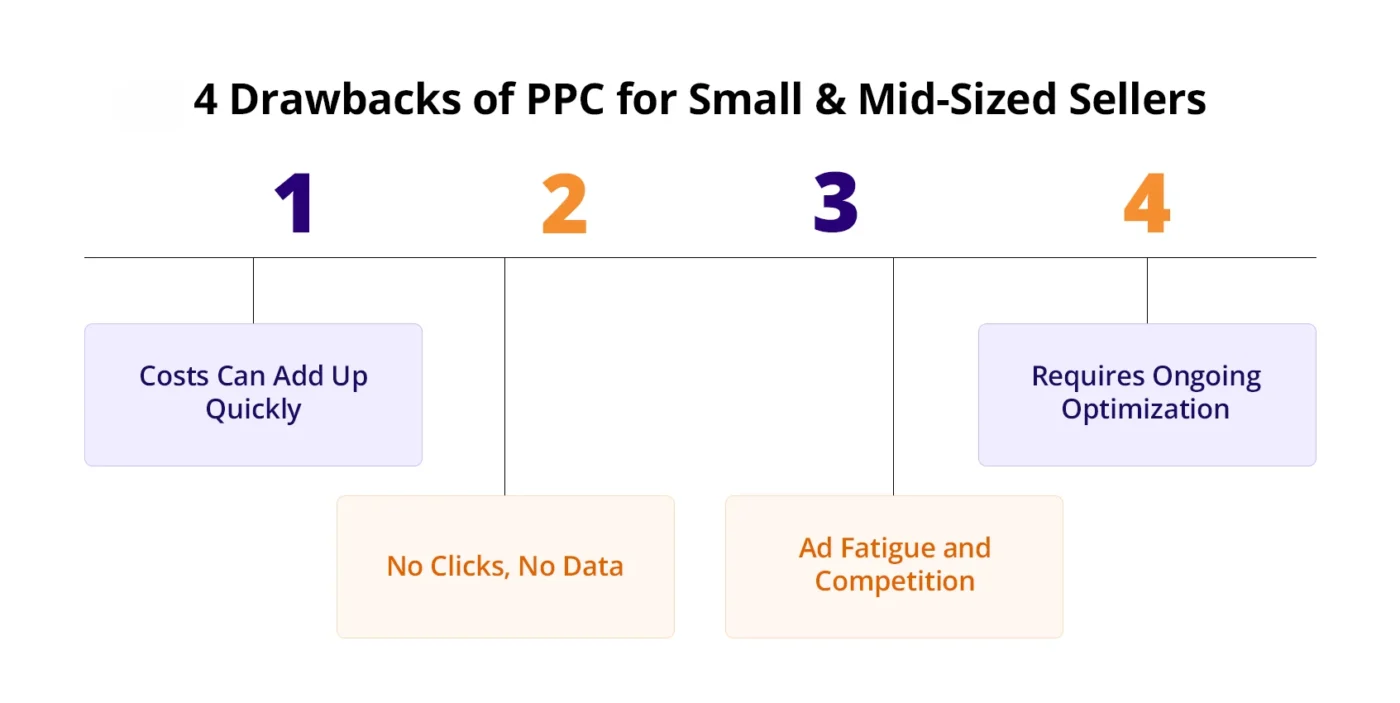
While Amazon PPC offers substantial benefits, it does come with certain drawbacks that you must consider before hopping onto Amazon PPC, including:
1. Costs Can Add Up Quickly
As a new seller, if you are in a competitive market, prices can rise fast. This means that if you are bidding on keywords that many of the established brands are bidding on, the cost per click is likely to be very high.
For example, if you sell generic phone cases and try bidding on highly competitive keywords, larger brands with bigger budgets may dominate those placements. Smaller sellers in these situations have to be more creative and find lower-cost keywords.
2. No Clicks, No Data
Amazon PPC performance relies on clicks to generate insights. Without clicks, you don’t get the valuable data you need, making it harder to optimize keywords and fine-tune your campaign. This slows learning, limits optimization opportunities, and makes it difficult to identify what drives conversions or where the budget should be allocated for better results
3. Requires Ongoing Optimization
Successful PPC campaigns need regular monitoring and adjustment. Only this enables you to build momentum over time. You need to constantly monitor performance and adapt to what’s working. Sometimes you can also see sudden changes on the platform, and if you don’t keep up with them, you are likely to lose your money.
4. Ad Fatigue and Competition
When the same people see the same ad repeatedly, engagement tends to drop; this is called ad fatigue. In crowded markets, this is likely to happen to your ads, resulting in higher CPCs. Sellers must refresh strategies to maintain visibility against aggressive competitors.
How Small & Mid-Sized Sellers Can Make PPC Profitable
Success with Amazon PPC ads requires implementing strategic keyword and campaign management. Follow the tips to make the most of your Amazon ad campaigns:
- Use a Mix of Keyword Types: Combine broad match, phrase match, exact match, and long-tail keywords to capture different shopper intents.
- Add Negative Keywords Regularly: Filter out irrelevant search terms to prevent wasted ad spend and keep your campaigns focused on traffic that is more likely to convert.
- Balance Manual and Automatic Targeting: Effective campaign management involves balancing manual and automatic targeting. Manual targeting allows precise control, and automatic targeting can uncover converting keywords that might otherwise be missed.
- Track ACoS and ROAS Closely: Understanding and optimizing performance metrics such as advertising cost of sales (ACoS) and return on ad spend (ROAS) is crucial for tracking campaign effectiveness.
- Optimize Continuously: Review campaign data regularly to learn what’s working. You can then adjust bids and targeting and reinvest in strategies that drive the best results.
Conclusion
Amazon PPC can absolutely be worth it for small and mid-sized sellers, but only when approached strategically. As competition on Amazon continues to increase, advertising has become a core driver of visibility and sales growth.
PPC offers clear benefits, allowing small brands to compete. At the same time, it poses real challenges. Success on Amazon for small and mid-sized sellers comes from adopting changes and applying effective strategies that we covered in the article.
For small and mid-sized sellers looking to get the most out of their Amazon investment, partnering with an experienced Amazon PPC management agency can make a huge difference. AMZDUDES, a full-service marketing agency, helps new sellers with the right strategy, acting as a reliable growth partner for long-term success. Book a free consultation now.
Frequently Asked Questions
Is Amazon PPC worth it for small sellers?
Yes, Amazon PPC can be worth it for small sellers when campaigns are managed strategically. Amazon advertising generates visibility, which is the most effective way to drive sales.
Can Amazon PPC be profitable with a low budget?
Yes, low-budget campaigns can perform well when focused on high keywords, precise targeting, and continuous optimization. In Amazon advertising, smart strategy matters more than budget.
How long does it take to see results from Amazon PPC?
With Amazon PPC, you can get initial data within days, which helps you optimize campaigns. You can expect sales to follow after that, and this usually takes several weeks after the adjustments.
Can Amazon PPC improve organic rankings?
Yes, increased sales velocity from PPC can contribute to organic ranking as Amazon’s algorithm prioritizes products that generate consistent sales and strong conversion signals. This helps listings gain higher visibility over time.
Do I need an agency to manage Amazon PPC?
It can be beneficial, but it’s not a necessity. Sellers who choose agencies can reduce wasted spend and improve campaign performance through strategy and data-driven decision-making that is backed by expertise.