
Key Takeaways
- Clicks don’t equal profitability: High click volume without conversions eats up your budget and increases ACoS.
- Conversion rate determines scalability: Sustainable Amazon growth depends on improving what happens after the click, not simply increasing traffic or ad spend.
- 4 reasons you are getting clicks without sales: Poor keyword targeting, weak listing, pricing misalignment, and stronger competitor positioning are the main causes behind traffic that fails to convert.
- 5 effective strategies to overcome the issue: Refine keyword targeting, implement negative keywords, optimize your listing, strengthen reviews, and align pricing to turn wasted clicks into profitable sales.
- Optimization is a continuous process: Regular search term audits, competitor analysis, and listing improvements are essential to maintain profitability.
Every business wants to place its products in front of as many potential buyers as possible, especially during a product launch, and generating clicks often feels like the primary objective. But as investment increases and Amazon advertising costs rise, clicks without sales quickly become discouraging. Instead of signaling growth, they begin to reflect wasted ad spend and Amazon revenue loss. For many sellers, generating traffic without conversions becomes one of the most frustrating experiences in their journey.
The disconnect between clicks and conversions is one of the most costly challenges Amazon sellers face. When click volume increases, but sales do not follow, many sellers immediately blame their Amazon advertising strategy. However, the issue is rarely the ads themselves.
In this guide, you will learn what causes this, how this disconnect impacts your business, and, more importantly, how to overcome it to build a more profitable brand. While clicks are an essential first step in driving traffic to your product detail pages, turning that traffic into sales requires strategic optimization beyond advertising alone.
Why is High Clicks, Low Sales Bad for Your Campaign
High clicks with low sales directly damage your campaign’s profitability. Since Amazon operates on a pay-per-click (PPC) model, you are charged for every click, no matter if the click turns into a sale or not. Every click you pay for without a conversion increases your ACoS and reduces your return on ad spend.
Furthermore, if your listing consistently receives traffic but fails to convert, the algorithm perceives your product as irrelevant for those specific search terms. These are considered weak performance signals. This further leads to a decline in your organic search ranking, and you have to pay more for visibility over time.
High clicks and low sales are indications that your campaign needs a breakdown. If this imbalance is left unaddressed, it will continue eating into your budget and reducing profitability.
4 Reasons You’re Getting Clicks Without Conversions on Amazon
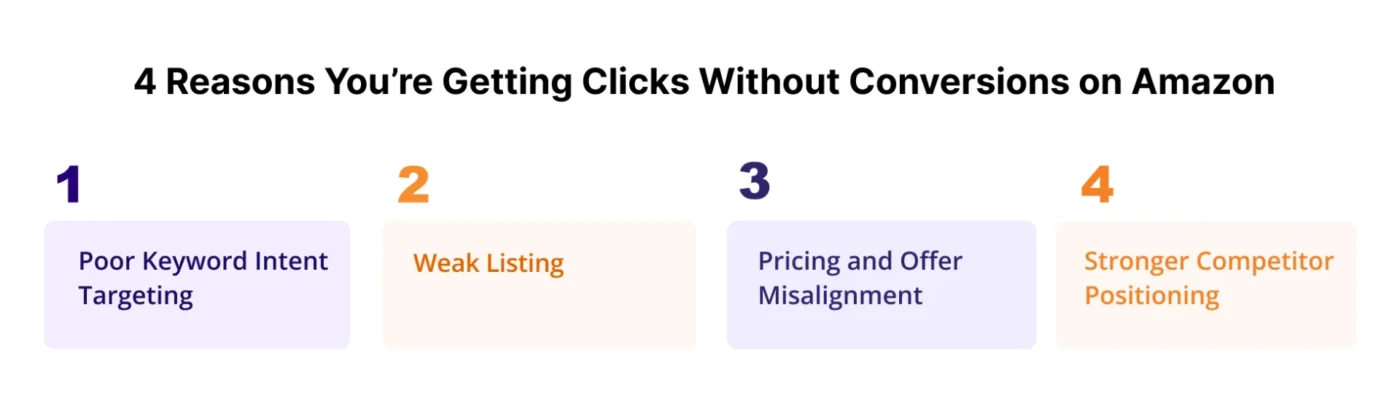
These are the five main reasons why your Amazon account is experiencing clicks without sales:
1. Poor Keyword Intent Targeting
Targeting broad and low-intent keywords brings clicks from shoppers who are browsing but are not ready to purchase. Sellers using generic keywords might rank higher, but there is a huge gap between clicks and sales. This also leads to wasted ad spend as higher clicks without sales means you are paying for browsers, not buyers.
2. Weak Listing
Your listing’s job is to sell the click. A high click rate with low sales indicates a problem on your product page. Your Amazon Ad sends people to your page, but something then makes them leave without making a purchase. This indicates that you need to improve your product page. If your listing fails to deliver the product value, visitors leave without buying.
3. Pricing and Offer Misalignment
High-intent buyers will leave your page if your price is not competitive and the price does not match the perceived value. If competitors offer the same product for less or offer discounts or bonuses, shoppers are likely to turn to them. With a competitive pricing point, you are less likely to get sales. Amazon actively displays similar and alternative products to shoppers, making price comparison effortless. To secure conversions, your offer must remain competitive within your category.
4. Stronger Competitor Positioning
Shoppers compare before they commit. If a competitor has better reviews with stronger branding and value, clicks will shift to them instead of converting on your listing. Even if your ad successfully attracts traffic, buyers will be pulled toward the product that appears more trustworthy and worth the price. This way, your listing becomes a part of the comparison.
5 Strategies to Reduce Wasted Clicks and Increase Sales
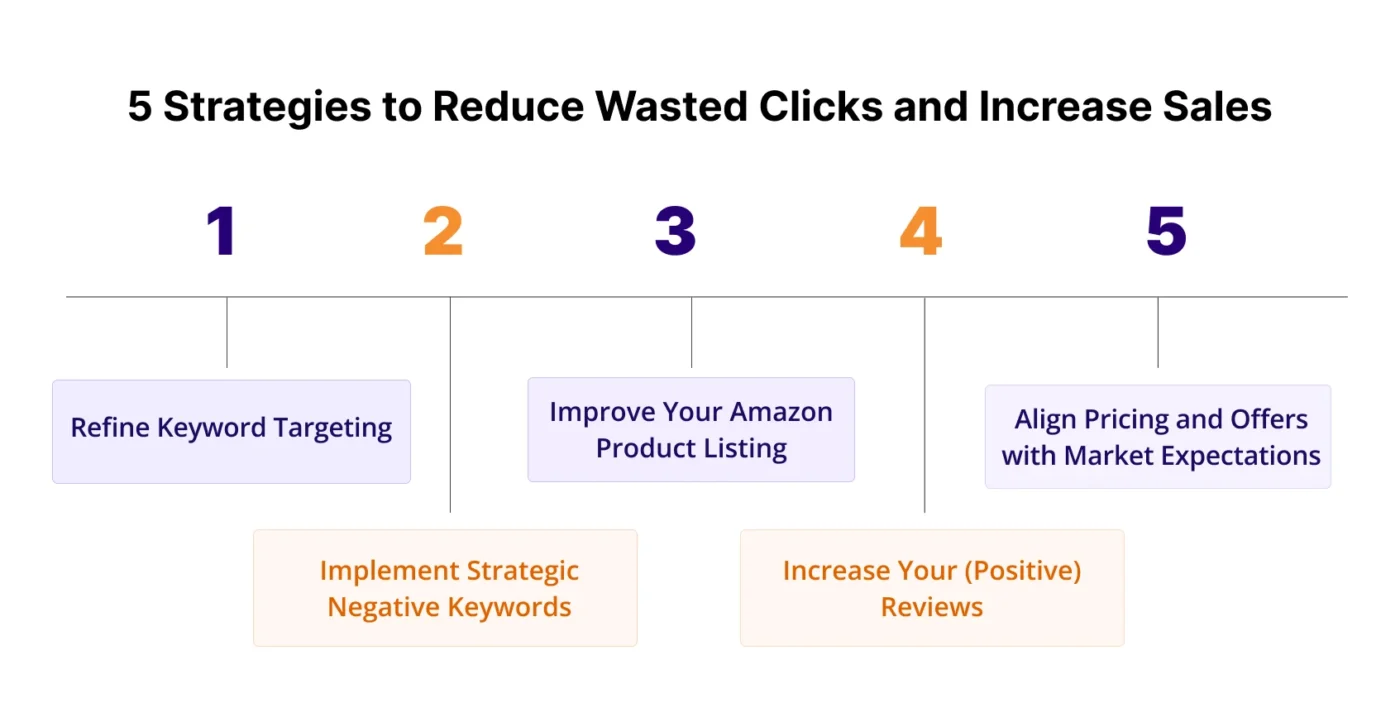
High clicks without sales require strategic optimization. These are proven strategies you can adopt to turn your clicks into profitable sales growth.
1. Refine Keyword Targeting
If your campaigns are getting clicks but not conversions, the first area to evaluate is keyword intent. Shift your focus from broad terms to long tail keywords as they are high-intent keywords that attract quality buyers. Long tail keywords are specific phrases that describe exactly what you sell. For example, instead of targeting a broad term like “water bottle,” which attracts general browsing traffic, target a more specific phrase such as “32 oz insulated stainless steel water bottle,” as the second search term indicates a high purchasing intent.
Specific product searches convert at 3x the rate of generic category terms. While these keywords have lower search volume, the shoppers using these terms are way further in their buying journey and are ready to purchase.
2. Implement Strategic Negative Keywords
Negative keywords are one of the most powerful tools for reducing wasted ad spend. If you sell a premium espresso machine, terms like “cheap” or “manual” are likely to eat your budget. Over time, this results in higher ACoS. Review your Search Term Reports to catch phrases that get clicks but never result in sales. Add these terms as negative exact or match phrases to prevent further waste. By doing this, you prevent your ad from appearing to the wrong audience. This ensures your ads get quality traffic that is likely to convert.
3. Improve Your Amazon Product Listing
If the conversion rate is low despite high clicks, this means something about your store is undesirable and needs to be changed. If shoppers click your product page but never buy, your product page may not be persuasive enough.
It is recommended to evaluate your page from the customer’s perspective. Ask yourself: Does the main image instantly communicate quality? Do the bullets clearly explain benefits instead of just features? Strengthen visuals, clarify messaging, and ensure your listing builds trust quickly. Small improvements in clarity and presentation can significantly increase conversions.
4. Increase Your (Positive) Reviews
Reviews on Amazon work as social proof. Shoppers often have faith in one another, and this plays a decisive role in their purchasing decisions. Shoppers hesitate to buy products with low or no ratings. If your product page has fewer or no reviews, you should take care of this initially. You can use Amazon’s “Request a Review” feature to gather reviews. When shoppers see others are satisfied with the product, they are far more likely to complete the purchase.
You can also focus on delivering a superior customer experience to naturally receive positive feedback. Aim for a 4.5 or above rating as product pages with one-star ratings are less likely to get sales.
5. Align Pricing and Offers with Market Expectations
Amazon is a highly competitive marketplace. Price remains one of the most critical factors shoppers evaluate before making a purchasing decision. Customers naturally compare similar products side by side, and even small price differences can influence where they choose to buy. If your offer appears expensive compared to similar products, shoppers will quickly move to competitors.
However, just competing for the lowest price is also not recommended, as it can impact your profitability. Instead, you can analyze competitor pricing and offer discounts and value-added bundles that make your offer more attractive. Rather than racing to the lowest possible, you can communicate your products’ unique value. When shoppers understand that your product is worth the price, even price-sensitive buyers are less likely to abandon your listing.
Conclusion
If you are experiencing a spike in clicks but struggling with a low conversion rate, you now understand why this is happening, and more importantly, what you can do about it. High traffic without sales is a performance signal that something needs to be changed or refined.
This guide has broken down the root causes behind the disconnect and outlined practical solutions to correct it. The goal is not to generate more clicks, but to improve what happens after the click. With our guidelines, you can direct quality traffic to your quality listing and turn that attention into consistent sales. When the right audience meets the right offer, conversions increase naturally.
And if you need expert support for this, AMZDUDES works as a performance-driven Amazon PPC Management agency focused on making the best of your investment on Amazon. Get a free consultation now.
Frequently Asked Questions
Why am I getting clicks but no sales on Amazon PPC?
This usually happens due to poor keyword intent targeting, weak listing conversion elements, uncompetitive pricing, or stronger competitor positioning.
How do I reduce wasted clicks on Amazon?
Refine keyword targeting, add negative keywords, analyze search term reports regularly, and focus budget on high-converting queries.
Can a low conversion rate increase ACoS?
Yes. Since Amazon PPC operates on a pay-per-click model, low conversions mean you are paying for traffic without generating enough sales, which directly increases ACoS.
How can I improve the conversion rate on Amazon?
Optimize your product images, strengthen your title and bullet points, improve reviews, align pricing with competitors, and clearly communicate your product value.
Should I lower my price to increase sales?
Not always. Instead of bringing your prices to the lowest, justify your value through branding, features, bundles, and promotions while maintaining healthy margins.