

Key Takeaways
- Follow the 10 effective strategies: Structuring campaigns needs effort. You can follow the strategies that are proven to drive results.
- Start with clear goals and the right metrics: Defining campaign goals and setting a realistic target ACoS helps guide bidding, budgeting, and optimization decisions from the start.
- Use the right keyword strategy to avoid wasted spend: Choose the correct keywords, apply proper match types, and add negative keywords so your ads reach high-intent shoppers only.
- Optimize beyond bids and tools: Adjust bids based on page rank, improve product reviews, and run A/B tests regularly to increase conversions and maintain long-term performance.
- Avoid common mistakes to protect performance: Regularly review reports, maintain healthy inventory, optimize listings, use ad groups correctly, and choose the right match types to prevent budget loss.
If you want to be successful on Amazon, you need to have an effective Amazon PPC management strategy. With 310 million active users on Amazon, the platform is the best to advertise your product. While holding the best opportunities, the platform has fierce competition and many sellers grapple with their ad spend. There are strategies that can be utilized to structure your Amazon PPC campaigns to drive better results. With our comprehensive guide you can make the maximum of your ad spend and run a successful Amazon PPC campaign.
How Your Campaign Structure Impacts Amazon PPC Success
Your Amazon PPC campaign structure describes how you organize and manage your campaign. It determines how your ads appear. A good Amazon PPC campaign structure is fundamental to providing your marketing efforts with control.
When Amazon PPC campaigns lack the structure, it becomes difficult to monitor performance. A strong structure creates clarity as goals are well defined and performance is monitored smoothly. Campaign structure also affects cost control. When keywords and Amazon PPC targeting methods are differentiated, underperforming areas can be spotted easily. This lets Amazon sellers locate winning segments and scale them with confidence.
Top 10 Amazon PPC Campaign Optimization Strategies
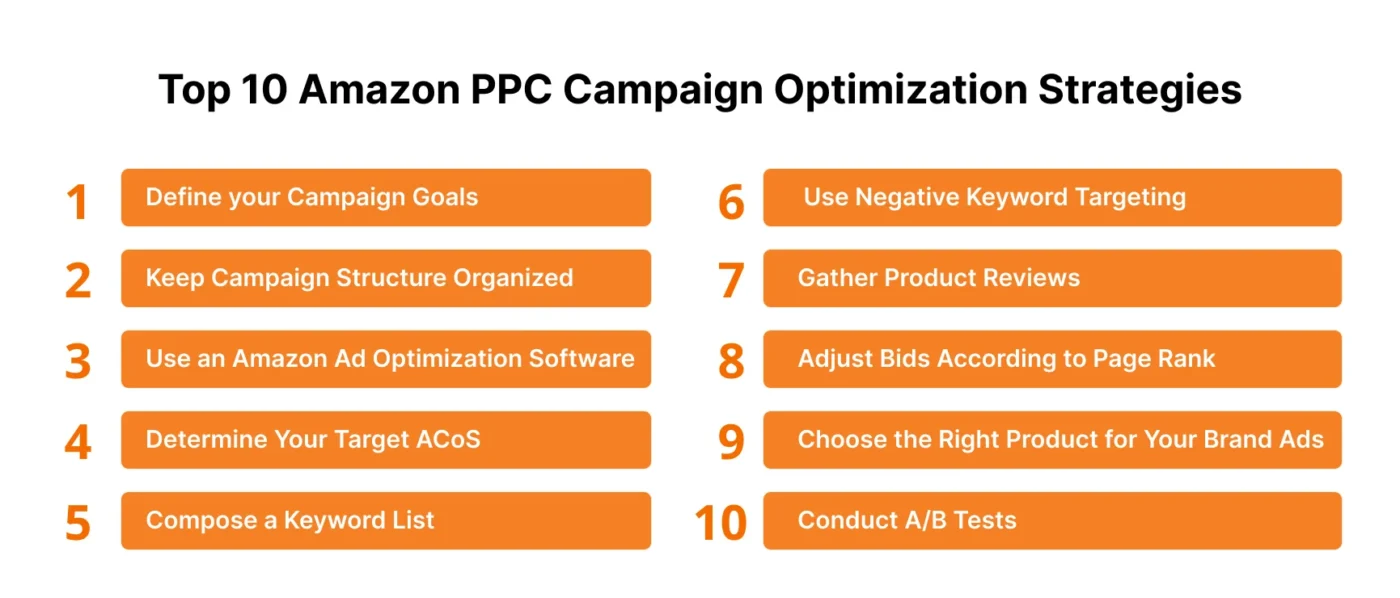
A strong Amazon campaign follows a clear process. Here is the breakdown of strategies that are essential for successful amazon ad campaigns.
1. Define your Campaign Goals
Before beginning your campaign, it is crucial to define its goals. While defining the goals, make sure they are clear and aligned with your business objectives. Campaign goals will further help you tailor your Amazon PPC campaigns. They also provide insights and clarity for future Amazon PPC campaign optimization.
While the ultimate goal of Amazon PPC campaigns is to generate sales, your campaign goals need to be more targeted. For example:
- Generate interest in a new product line.
- Reduce target advertising cost.
- Increase brand awareness.
If, for example, your goal is to increase brand awareness, your campaign structure should focus on gaining visibility which can be achieved by bidding on high volume search terms so your ads get seen by more people.
Once your goal is in place, you can make it more specific by creating SMART goals. This stands for:
- Specific
- Measurable
- Achievable
- Relevant
- Time-bound
Having SMART goals in place will give you more of a focus and is a proven strategy to achieve Amazon PPC campaign success.
2. Keep Campaign Structure Organized
Keep the structure of Amazon PPC campaigns organized as it’s easy to get lost in the sea of ad campaigns. This also helps you keep track and measure your metrics which is likely to enhance the performance of your campaign. You can create a campaign based on products as when ad groups are tightly themed, it becomes easier to see which search terms are driving results. This will also enhance the performance of your campaign.
Structuring your ad campaigns is flexible, but here are a few proven options you can consider:
- Create separate campaigns for closely related products.
- Structure campaigns by keyword intent.
- Use separate campaigns for exact, phrase, and broad match keywords.
3. Use an Amazon Ad Optimization Software
Amazon ad optimization software is useful to monitor performance at scale. With more campaigns and keywords, manual optimization can become hard to manage. Amazon optimization software can act as a support system and save you time.
These are some capabilities of Amazon ad optimization software:
- Tracks performance across multiple campaigns in one place.
- Identifies wasted spend and underperforming targets early.
- Applies controlled bid and budget rules at scale.
- Automates routine optimizations without constant manual work.
- Improves reporting clarity for faster decision-making.
- Supports scaling while maintaining cost control.
Ad optimization software can be quite costly but it can increase your ACoS. Therefore, such software is ideal for larger businesses with a higher profit margin. It is essential to calculate profit margin before committing to an Amazon advertising software.
4. Determine Your Target ACoS
Advertising cost can be a pretty important factor in your campaigns. ACoS (Advertising Cost of Sales) is a metric used to measure performance. It can be calculated as:
ACoS = (Ad Spend ÷ Ad Sales) × 100
Example:
If you spend $200 on Amazon ads and generate $1,000 in ad-driven sales:
ACoS = (200 ÷ 1,000) × 100 = 20%
This means you are spending 20% of your sales revenue on advertising. When you are just starting, aim to break even with your ACoS until you get enough data to refine your Amazon PPC campaigns. Once you have got around three months worth of data, you can fine tune your bids based on what’s actually converting.
A common starting point is to target an ACoS between 20% and 30%. This range works for many sellers, but it can vary. Your ideal ACoS depends on many factors including COGS, profit margin, and also your competition.
If your ACoS is too high, there are several steps you can take to bring it down:
- Review your keywords and search terms to ensure they match buyer intent.
- Use a balanced mix of keyword match types instead of relying on one.
- Lower bids on expensive or unstable targets.
- Pause keywords that consistently spend without converting.
Your reports will be the most effective tools to bring down ad costs. Take time to analyze reports and look for reasons behind successful and failed campaigns.
5. Compose a Keyword List
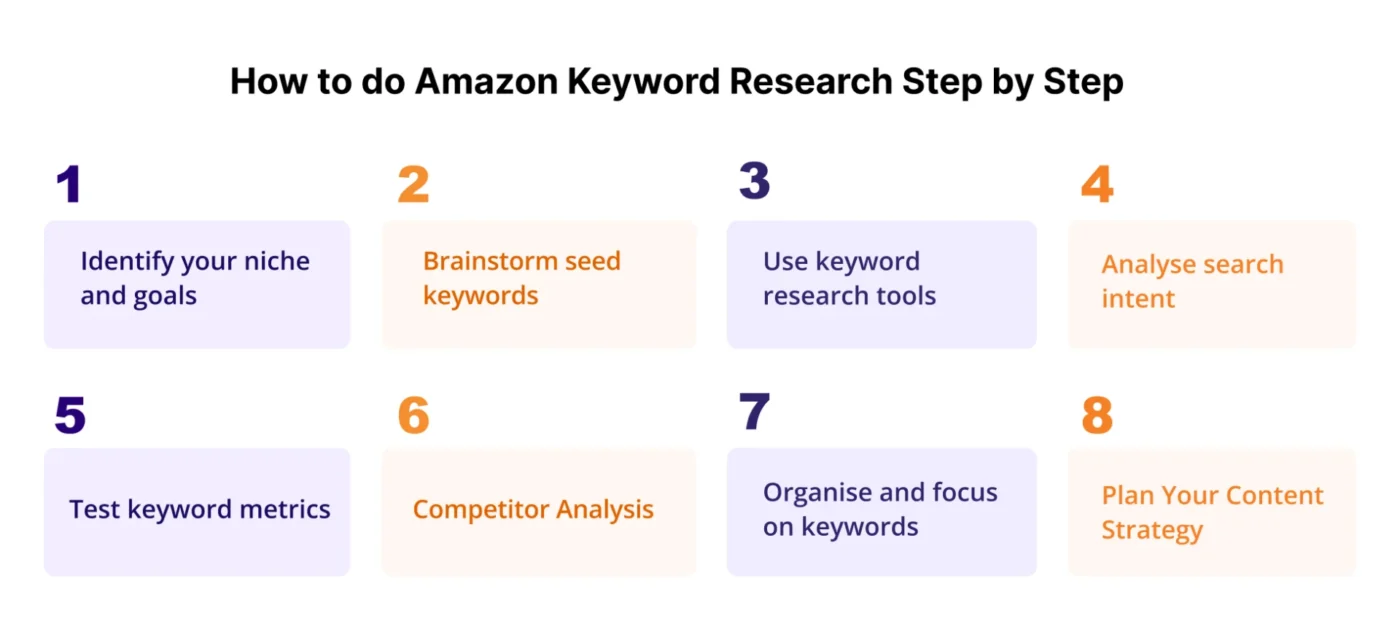
Keywords have the potential to make or break your Amazon PPC campaigns. You have to be strategic with your keyword research and selection as these needs to be thorough and accurate. Amazon keywords are search terms consumers type into Amazon search bar while looking for a product on Amazon.
Amazon keywords can be long tail keywords and short tail keywords. Long tail keywords are more targeted and normally have a higher CTR (Click-Through-Rate). Short tail keywords on the other hand are broader and tend to have high search volume. They are generally good for brand awareness campaigns.
Finding the right keywords is about balance. You want a mix of high volume keywords and more specific long-tail terms that may get fewer searches but often convert better.
To get started:
- Write down all relevant keywords, synonyms, and phrases related to your product.
- Use keyword tools to find additional keyword ideas and gaps.
- Review each keyword based on search volume and competition.
- Look at competitor listings and ads to discover keywords you may have missed.
Keep in mind that keyword optimization is not a one-time task. Shopper behavior and search trends change, so your keywords need regular adjustments to render desired results.
6. Use Negative Keyword Targeting
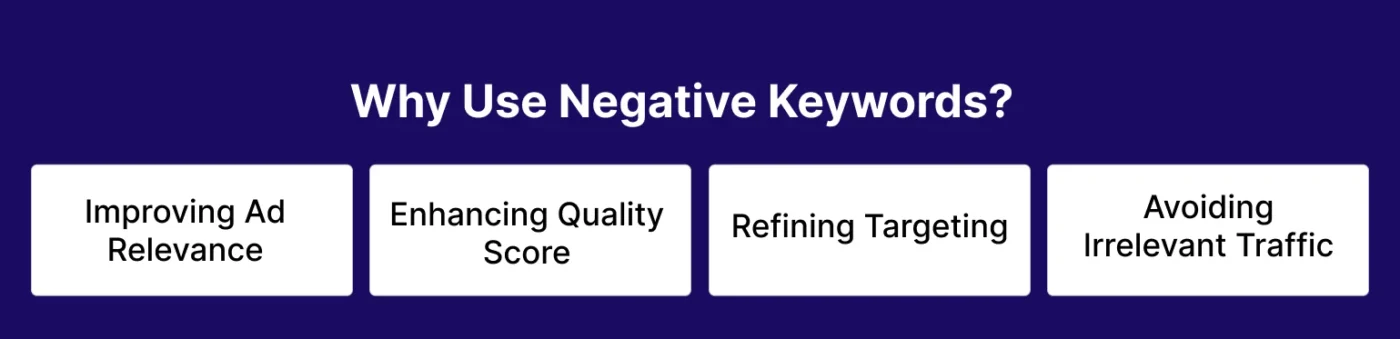
Negative keywords are specific keywords that are irrelevant to your campaign or unlikely to lead to conversion. As they are not relevant to your product, you might be wasting money on ads if they show up on searches who aren’t interested in your product. This can lead to wasting bids on irrelevant traffic.
For example, if you sell a premium leather office chair, your ad might show searches like “cheap office chair,” “used office chair,” or “office chair repair.”
These shoppers are unlikely to buy your product. By adding “cheap,” “used,” and “repair” as negative keywords, you prevent your ads from appearing for those searches. This helps reduce wasted spend and ensures your budget is focused on shoppers who are more likely to convert. It is essential to thoroughly analyze keywords to ensure that a term isn’t relevant before you dismiss it.
7. Gather Product Reviews
Customers often read reviews before making a purchase. Reviews help build trust by providing social proof and have a huge impact on purchasing decisions. Even well-structured campaigns struggle to convert if shoppers do not trust the product.
With all that in mind, one of the most helpful things you can do for your Amazon PPC campaign is to gather reviews from customers. You can encourage them to provide reviews using the ‘Request a Review’ feature. You can also send out automatic feedback requests using software. Also make sure to respond to any negative feedback to show that you take customer service seriously.
8. Adjust Bids According to Page Rank
Your product page rank has a direct impact on how efficiently your ads convert. To get most out of your Amazon PPC optimization efforts, adjust your bids according to what page they rank on. Start by analyzing the position of your Amazon ads along with their keywords. You can adopt the following following bid strategy for better optimization:
- Page 1 rankings: If your product ranks at the first page, it means your product already has strong visibility. You should structure your ad campaign to mainly support conversions and defend position.
- Page 2–4 rankings: These keywords often benefit the most from ads, as paid visibility can help push your product closer to page one.
- Beyond 4th page: It is not recommended to bid on keywords for product pages this far down. However you can test with controlled budgets to gather data, but avoid aggressive bids until you see consistent conversions.
This approach helps you spend where ads have the most impact.
9. Choose the Right Product for Your Brand Ads
Brand ads are effective for enhancing brand exposure and if you aim to optimize Amazon PPC campaigns that utilize brand ads, you need to be selective. You need to start with products that represent your brand well as not every product in your catalogue is a good fit for brand ads.
Here are best practices you can follow when selecting products for each placement:
- First Slot: Place your best-selling product first to capture your audience’s attention. Pick a product that has good reviews and has a strong sales history.
- Second Slot: Use the second slot for a product that has a good conversion rate with lower visibility. This helps you to show potential customers what else you have to offer.
- Third Slot: Reserve the final slot to showcase newly launched products. This placement increases exposure and drives traffic to those products.
With this approach, you present products in order that is proven to drive growth.
10. Conduct A/B Tests
A/B testing helps you understand what actually improves your Amazon advertising performance instead of relying on assumptions. It is done by running two ads simultaneously with one differentiating factor. After picking a product to for experimentation, you can choose any factor as
- Image
- Title
- Description
- Features
- Price
- Keywords/search terms
By keeping other factors the same you can clearly measure what exactly caused change in performance. Run your tests for a couple of weeks to gather sufficient data to determine the winner. Compare metrics and once you identify the winning factor, create another A/B experiment using that ad. This time, choose a different element to change and keep repeating the process for better optimization.
5 Common Amazon PPC Structure Mistakes
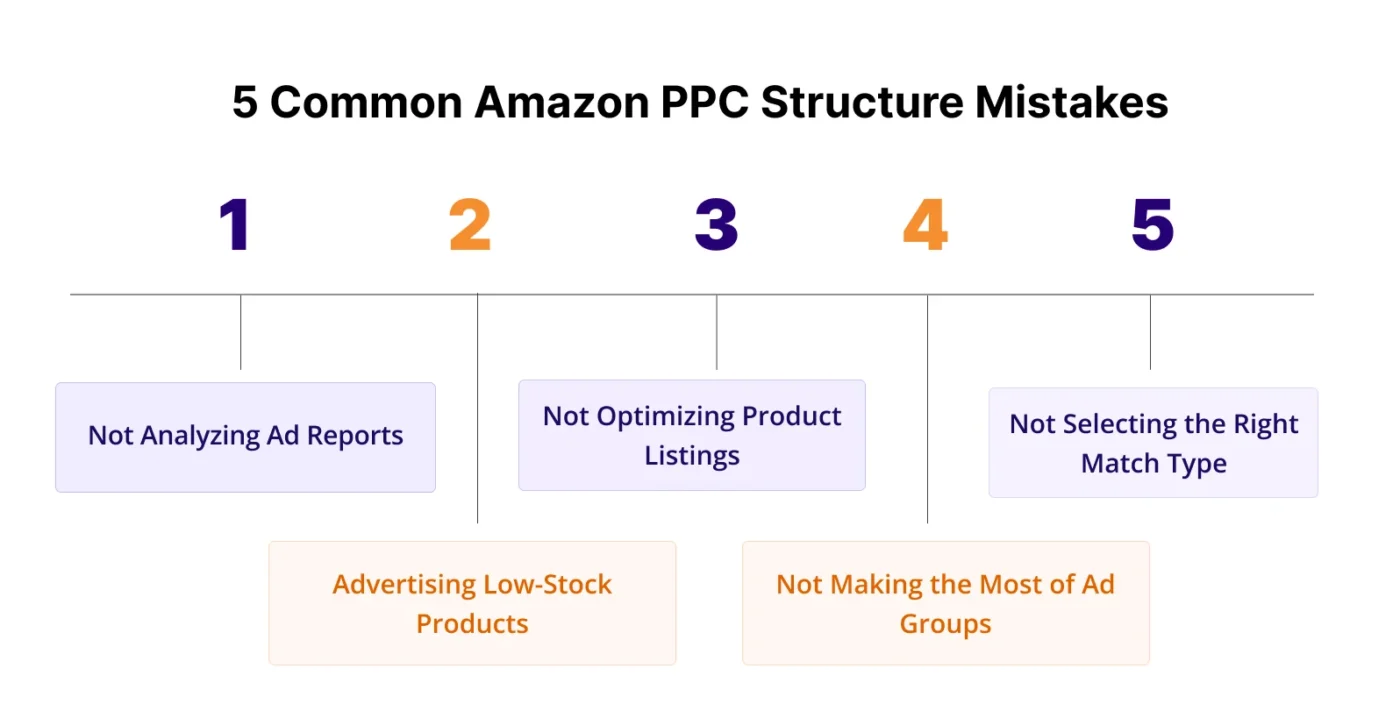
Many Amazon PPC accounts underperform because of structural mistakes made early on. Here are the most common mistakes sellers make:
1. Not Analyzing Ad Reports
Ad reports are the foundation of smart Amazon PPC decisions. They give you useful insights into campaign success. Not analyzing your reports means you won’t have the right information that is needed to improve Amazon PPC campaign performance. Your ad reports such as search term reports can tell you what keywords are working for you. These insights are essential for knowing where to cut back and where to scale.
2. Advertising Low-Stock Products
Advertising products with low inventory can be problematic. If you run ads and consequently run out of stock, your listing can be pushed down in Amazon’s ranks. Running ads on low stock products also wastes budget. It is important to have a good inventory management system in place before running ads.
3. Not Optimizing Product Listings
Product listing is what converts shoppers into buyers so if your ads are getting clicks but not sales, it’s time to look at the quality of your product listings. A number of Amazon sellers neglect this aspect thinking in terms of ad clicks. Clicks can be converted to sales with compelling listings. Use high quality images with clear descriptions and content that pushes customers for a sale.
4. Not Making the Most of Ad Groups
Ad groups on Amazon are created to make things easier for Amazon sellers. They keep you organized if used properly. Many sellers fail to make the most of these ad groups and end up with poorly structured ad groups that hide performance differences. Ad groups should be tightly themed around similar keywords as this makes it easy to evaluate Amazon PPC performance and make decisions accordingly.
5. Not Selecting the Right Match Type
Amazon has three keyword match types; broad match, phrase match and exact match. Each match type serves a different purpose and using them incorrectly will impact your ad performance. Many sellers focus on the wrong type and end up with wasted ad spend. For example, relying only on broad match keywords may cause your ads to appear for loosely related searches that do not match buyer intent, driving clicks without conversions.
Final Thoughts
There are some effective strategies to structure your Amazon PPC campaigns for success. A well organized campaign structure makes it easier to understand performance and scale with confidence. Regular analysis and optimization is crucial to ensure your campaign stays aligned with your business goals.
Amazon PPC success is about building a strong foundation and making informed adjustments. With the right structure in place your advertising becomes sustainable over time. If you need support at any stage, our Amazon optimization services help improve campaign structure and support long-term growth. Book a consultation to review your account and identify clear opportunities for improvement.
FAQs
What is a good ACOS for Amazon PPC?
It varies by product, category and business goals. Typically an ACoS lower than your profit margin percentage is good as it indicates you are earning more than you are spending on ads.
How to optimize product listings for Amazon PPC?
Conduct thorough keyword research and use relevant keywords into title and content. You should invest in high quality images and create content that persuades readers to take action.
Can I improve my Amazon ACoS by optimizing product listings?
Yes, improving your product listings can result in higher CTRs (Click-Through-Rates) ultimately leading to more efficient ACoS.
What is the importance of keyword research in Amazon PPC campaigns?
Keyword research helps identify relevant search terms that are likely to get your ads appearing in relevant searches resulting in driving more traffic. This can boost sales with a higher conversion rate.
What is the purpose of using negative keywords in Amazon PPC campaigns?
Negative keywords prevent your ads from being displayed to irrelevant searches reducing wasted ad spend. This can ultimately improve ROI and ensure your ads reach the right audience.