
Key Takeaways
- Keep up with Key 8 Trends: Align your strategies with the core trends to stay profitable in 2026.
- Use AI for ad management: AI integration is likely to become a requirement as it is effective and reduces manual labour.
- Fix your product pages first: Improve images, copy, and A+ content before increasing ad spend. Strong listings help ads convert and lower wasted clicks.
- Focus on visuals and video: Visual search is gaining popularity and is effective to attract attention.
- Effective inventory management will be the backbone for Amazon PPC success: Inefficient inventory management can cost you more than the potential profits.
Amazon’s advertising business has rapidly grown into a core pillar of the company, with annual ad revenues surpassing $50 billion in 2025 and is forecast to approach $70 billion in ad revenue by 2026. This explosive growth is no accident as Amazon with advanced ad technology, and wide customer reach delivers strong results. The company has built an unparalleled platform for brands to reach consumers through Prime Video, Fire TV, Twitch, Amazon Music, IMDb, Alexa, live sports, and more.
The leaders at Amazon are clear that 2026 will be all about using these strengths for even greater impact. Amazon advertising is expected to remain one of the most reliable tools for success in 2026. This article outlines Amazon advertising trends that will play a vital role to shape performance in 2026.
Why Keeping Up with Amazon Advertising Trends Matter in 2026
Amazon accounts for nearly 38% of all U.S. ecommerce sales, far more than any competitor. That dominance attracts brands of every size which results in higher competition. As more advertisers compete for the same customer attention, this results in higher keyword competition, and ad saturation. As Amazon prioritizes sales and conversions, sellers that fail to align their strategies are likely to lose visibility and ultimately sales.
In 2026, you have to keep up with these Amazon advertising trends that will likely position your brand for success.
8 Core Amazon Advertising Trends That Will Define 2026
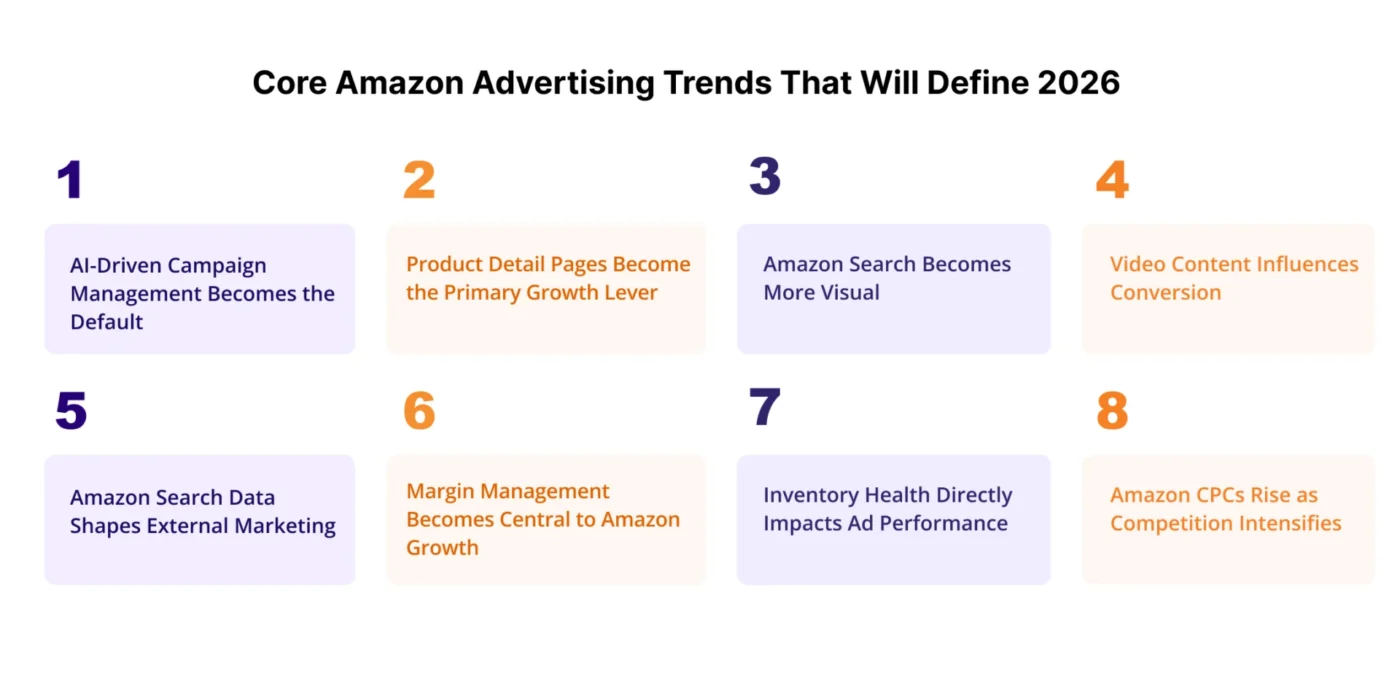
Let’s break down the most important Amazon advertising trends shaping 2026. These trends are backed by data and expert opinion that can help you stand out and make a real impact in the future.
Trend 1. AI Takes Over Campaign Management
One dominant Amazon advertising trend for 2026 is artificial intelligence that is rapidly transforming Amazon advertising. Amazon’s ad leaders emphasize that AI and machine learning will be ruling everything from Amazon PPC campaign optimization to creative generation.
“The future of programmatic, full-funnel media buying will be defined by the transformative power of AI,” says Kelly MacLean, VP of Amazon DSP. Advertisers will increasingly rely on advanced machine learning algorithms to find the right audiences, and drive real-time decisions across Amazon properties.
Furthermore, by using generative AI, Amazon can help brands produce video ad content in hours rather than weeks. This lowers the production cost and unlocks new possibilities. For the same purpose, Amazon has introduced its “Creative AI Agent” that can automatically generate campaign ready video ads from a product page or ASIN within hours. This means by 2026, even smaller sellers can quickly turn their product listings into polished video ads using Amazon’s AI, enabling high-quality creative at scale.
Trend 2: Product Pages Matter More Than Ever
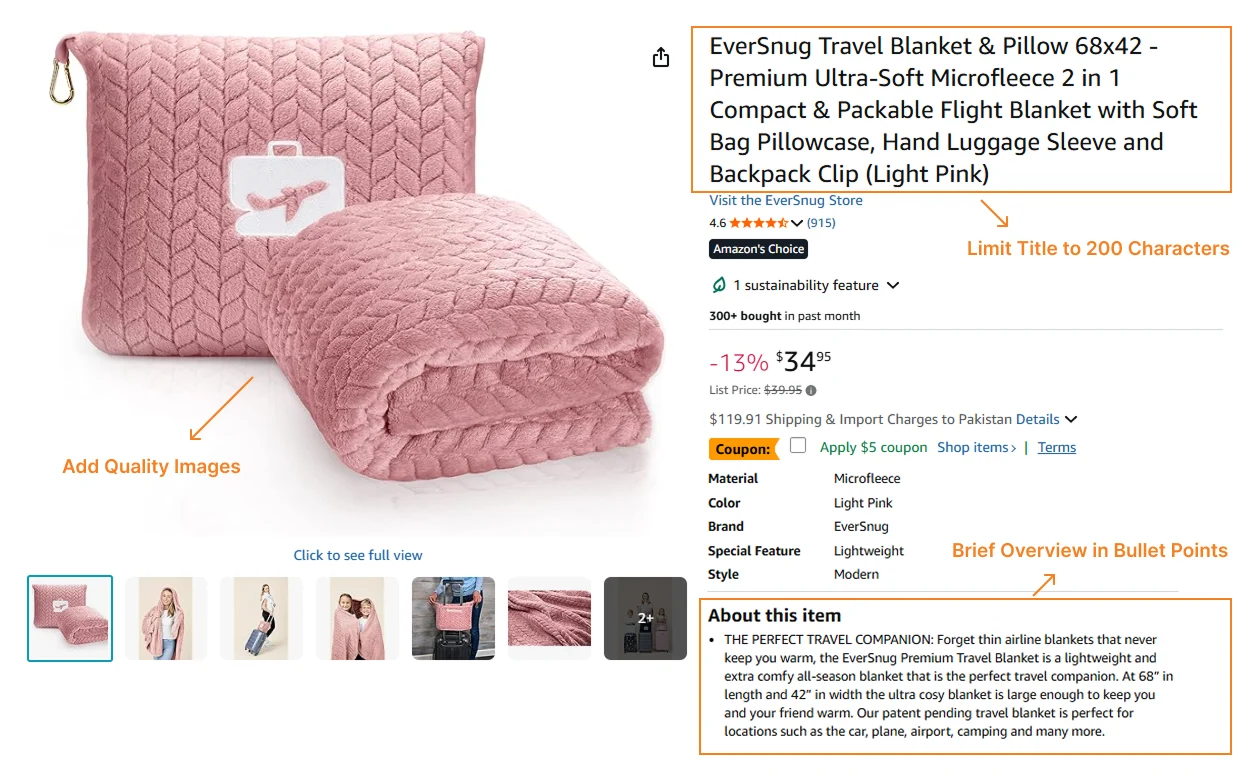
Amazon’s algorithm increasingly rewards listings that convert. According to Amazon Seller Central documentation, conversion rate directly influences organic ranking and ad delivery. Better listings win more impressions and contrary to it, ads underperform on weak listings.
With advancements in Amazon search algorithm, the computer program that decides which products to show, is getting smarter. It wants to show shoppers exactly what they are looking for. An optimized listing speaks the algorithm language. A great listing gives shoppers all the information they need to feel good about their purchase. That way the product detail pages are becoming performance tools.
Trend 3: Amazon Search Becomes More Visual
Amazon search results are becoming more visual as product images, video thumbnails and brand elements now dominate the result page. Amazon is increasingly designing search to support faster, more intuitive decision-making, where visual cues guide shoppers. This shift aligns with broader emphasis on brand presence and immersive discovery across Amazon.
As Claire Paull, Vice President of Marketing at Amazon Ads, has noted, “For larger enterprises, Prime Video ads is an effective solution for building brand awareness and deepening customer engagement.” That same brand-first mindset is now shaping Amazon search itself. In 2026, strong visual assets will be critical for awareness and earning attention. This is likely to earn clicks directly within search results. Brands that fail to adapt their listings and creatives to this visual-first environment risk losing visibility.
Trend 4: Video Content Influences Conversion
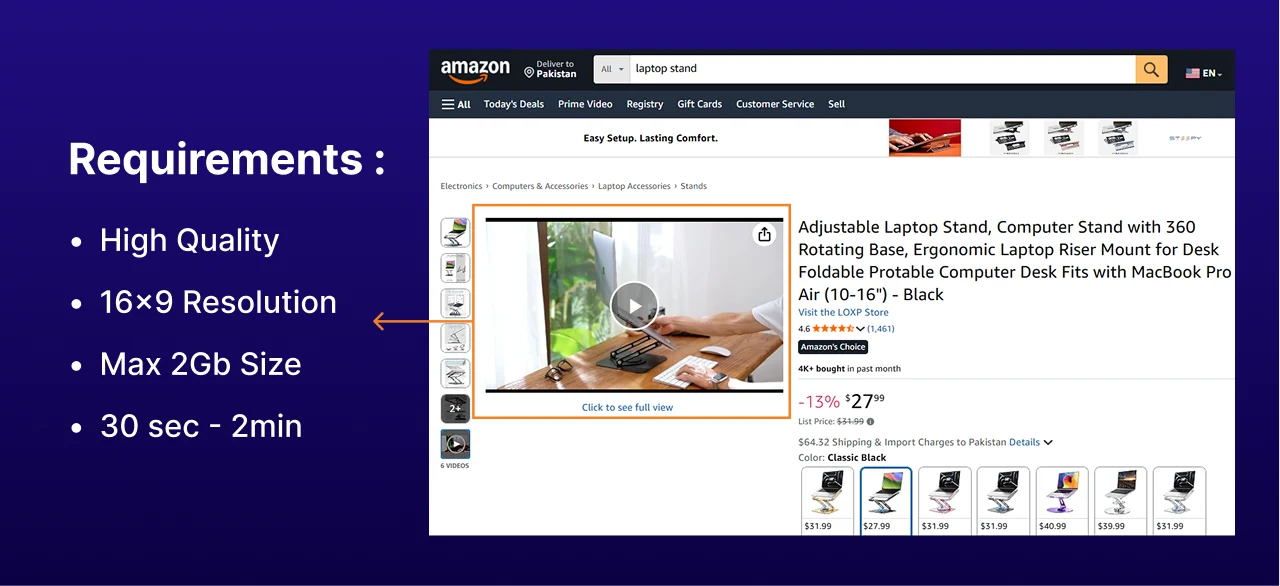
Videos can increase conversion rates by up to 80%. This is the reason it is becoming a standard expectation on product listings. Videos have a higher likelihood of capturing audience attention and provide a more immersive, persuasive way to showcase the product and its value. Seeing a product in action through videos can help build trust with potential customers, as it shows authenticity.
It has emerged as a competitive category so it can’t be treated as optional in 2026. Leading brands are adding short explainer videos to top SKUs and are using it as a sales tool. Brands that fail to adapt to this increasingly visual search environment risk losing competitive advantage and converting less traffic.
Trend 5: Amazon Search Data Plays a Role in External Marketing
Amazon is making it easier for brands to understand how their marketing outside Amazon impacts results on the platform. Using tools like Amazon Attribution, advertisers can see how traffic from external marketing efforts on different channels leads to product page visits and sales on Amazon. Amazon states that this data helps brands understand “how non-Amazon marketing channels perform on Amazon,” giving sellers clearer visibility into what actually drives customer action.
As Amazon explains, this approach helps advertisers “understand how different marketing channels work together to drive conversions.” In 2026, brands will increasingly use Amazon search and conversion data to guide decisions beyond the marketplace. Marketers can rely on first party data to shape external marketing strategies that support Amazon sales. This cross channel alignment can serve as a key competitive advantage for advertisers.
Trend 6: Profit Margins Are Responsible for Amazon Growth
In 2026, Amazon growth is no longer measured by sales volume alone. As CPCs rise, fulfillment costs increase and promotions become more frequent, brands without margin control become unsustainable. Amazon’s algorithms increasingly reward listings that convert efficiently and generate consistent sales. This puts pressure on sellers to manage costs more carefully. Advertising strategies that ignore margins may still drive revenue, but they often do so at the expense of long-term profitability, making growth harder to sustain.
This results in a shift from aggressive spend-driven growth to margin-aware advertising decisions. According to Marketplace Pulse, Amazon seller fees can now consume 50% of revenue for many brands once ads, FBA with operational costs included. In 2026, successful sellers will treat margin management as a core part of their Amazon advertising strategy using data to decide when to scale and when to pull back. Achieving consistent growth on Amazon is becoming less about high spending and more about spending smarter.
Trend 7: Inventory Drives Ad Results
Inventory health has become a key determinant of Amazon advertising performance, and is likely to maintain its importance in upcoming years. When products run out of stock, Amazon’s systems reduce visibility to protect the customer experience and avoid serving ads that lead to dead ends.
Research shows that when products are unavailable for long periods, average sales rankings can worsen by 14 %–67 %, reflecting a direct link between inventory availability and sales performance across categories. This means that advertisers can spend more on clicks, only to see conversion rates drop and ad efficiency decline if inventory fails to support demand.
Stockouts can also damage long-term momentum and result in wasted spend. About 50 % of Amazon FBA sellers experience stockouts at least once a year, which negatively impacts revenue and also weakens organic rank. Sellers have to invest more later to regain their position. Because Amazon ad systems reward consistent fulfillment and customer satisfaction, healthy inventory levels help ensure ad spend drives real conversions. In 2026, tying ad strategies tightly to inventory management is essential to maintain visibility and scale growth on the platform.
Trend 8: Amazon CPCs Rise as Competition Gets Tough
In 2026, Amazon cost-per-click (CPC) rates continue to rise as more brands compete for limited placements. As Amazon attracts advertisers of every size, competition on core keywords increases, pushing bids higher across most categories. What was once manageable CPC growth has become a consistent upward trend, making visibility more expensive year over year.
Recent performance data from 2025 highlights this shift. Average ACoS typically ranges between 15–25%, while top-performing advertisers are able to stay under 10% by using disciplined structures and smarter budget timing. At the same time, CPCs have increased by roughly 10% year over year, and Amazon’s algorithms are showing a stronger preference for ads with high engagement and strong creatives. Heading into 2026, this signals a clear change: winning advertisers will focus more on improving efficiency through better listings, and systems that convert traffic profitably.
Conclusion
In 2026, Amazon Ads will move beyond basic targeting toward more predictive experiences. It has evolved into a connected system where advertising performance is shaped by product detail pages, inventory health, pricing discipline, creative quality, and data-driven decision making. With competition getting tough, success depends on keeping up with the Amazon advertising trends and strategic planning. You can position yourself for Amazon ad success by keeping up with these Amazon Advertising trends. You can also rely on us for Amazon optimization services. To explore how this can work for your business, book a consultation and take the next step toward sustainable Amazon success.
FAQs
1. What is the biggest shift in Amazon Advertising trends for 2026?
The transition from manual campaign management to Agentic AI is the biggest shift. Amazon has introduced its AI agents which allow sellers to manage campaigns using natural language. This is replacing manual bids with efficiency across Sponsored Products and DSP.
2. Is off-Amazon traffic still important?
Yes, it is more important than ever. With advances, Amazon offers the ability to track off Amazon traffic. Many brands now spend substantial amounts on external traffic to boost ranking.
3. How can brands handle rising CPCs?
Brands can handle rising CPCs by improving conversion rates through better listings and visuals. Focusing on strong creatives helps control costs while staying competitive.
4. How does inventory affect Amazon ad results?
Unstable inventory reduces ad visibility because Amazon limits ads for products that may go out of stock. This leads to wasted ad spend and lost sales momentum when demand cannot be fulfilled.
5. Is Amazon advertising still profitable for small brands?
Yes, Amazon advertising can still be profitable for small brands when campaigns are strategically controlled. Success depends on several factors including but not limited to strong listing, budget management, efficiency etc.